


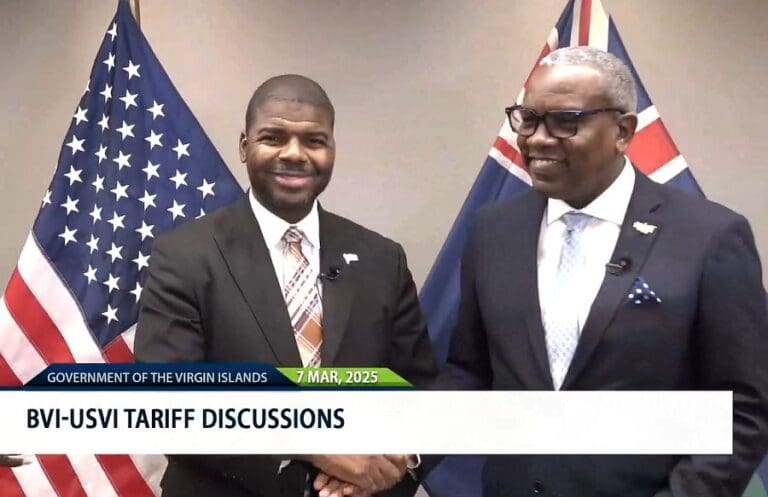
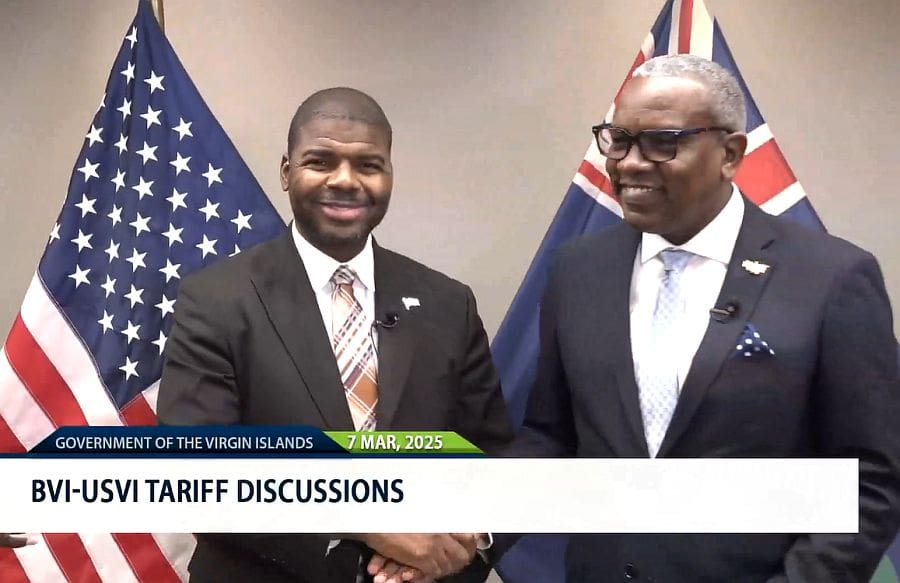
Gov. Albert Bryan Jr. met with British Virgin Islands Premier Natalio Wheatley to discuss the potential impact of proposed fee increases on non-BVI-based charter operations, a move that could significantly affect the shared maritime economy between the USVI and the BVI. Both leaders agreed to temporarily pause the implementation of the proposed changes while further data is reviewed and potential solutions are explored, Government House announced.
During the meeting, Bryan voiced concerns that the proposed fee increases and strict entry limits would hurt USVI-based charter operators who rely on access to BVI waters. He warned that the changes could force many businesses to close, jeopardizing the livelihoods of Virgin Islanders who depend on a thriving maritime industry, according to the press release.
Bryan emphasized the importance of maintaining fair policies that support the long-standing economic and cultural ties between the territories. Wheatley acknowledged these concerns and committed to reviewing the proposed fee structure while working toward a resolution that benefits both sides, the press release stated.
“Having these discussions is important. This is not just a Virgin Islands issue or a Greater Virgin Islands issue – it is a challenge being faced on an international scale,” Bryan said. “As we navigate these political hurdles, communication is key. Coming here to the BVI to discuss the issue, understanding the various moving parts, gives us a broader playing field to craft an agreement that makes sense for both our people and the industry. What we decided today is to examine the numbers and work together on a solution that benefits everyone.”
Wheatley echoed the commitment to collaboration, acknowledging that while no firm conclusions were reached, the discussions laid the groundwork for an equitable agreement, the release stated.
“Governor Bryan represented the interests of the U.S. Virgin Islands robustly, and of course, I did the same on our side,” Wheatley said. “But the important thing is that we were able to discuss common ground and areas of mutual cooperation. While we were not able to reach any firm conclusions today, we made a commitment to go back and crunch the numbers to ensure that we maintain equity, and we made a commitment to fairness in this relationship.”
Bryan expressed optimism about the path forward, calling the meeting a key step toward a sustainable and cooperative maritime policy, the release stated.
“The Virgin Islands – both U.S. and British – have long benefited from a shared maritime economy that fuels our prosperity,” Bryan said. “By continuing to work together, we can develop policies that foster growth on both sides of the water, ensuring that our people and businesses continue to thrive.”
Lt. Gov. Tregenza Roach also underscored the importance of collaboration and equity between the territories, reinforcing the need for a resolution that preserves the region’s economic and tourism interests, the release stated.
“I look forward to a resolution of these issues that will lead to an experience for our visitors and their visitors to truly enjoy the beautiful Virgin Islands without division between the U.S. and British territories,” Roach said. “These waters and pristine places that we inhabit should be accessible to all who visit the U.S. Virgin Islands or the British Virgin Islands. I look forward to us coming together again and resolving these issues.”
The Bryan-Roach administration remains committed to ongoing dialogue with the BVI government to ensure a strong and cooperative maritime industry that supports economic growth and strengthens tourism in the region.









Op-Ed: Historic Estate Adventure is for Agriculture, Not Solar Farms
At the recent Agrifest 2025 celebration, I got some unsettling news from a great Virgin Islander and friend about something dear to my heart of these beautiful Virgin Islands. That is the preservation of our natural, cultural, historical, and agricultural resources of these islands. My concern is Estate Adventure, an historic site with cultural, natural and agricultural resources.
It was brought to my attention that our government had wanted to establish a solar power plant on some 200 acres of prime agricultural farmland. If it would not have been for my friend, due to his position in government, Estate Adventure’s prime farmland would have turned into a solar power plant.
Estate Adventure is located in the fertile heartland of St. Croix’s prime agricultural farmland. The estate is south of the Department of Agriculture with a lush basin tropical moist forest along the stream bank and with an open grassland on the western part of the property.
Historically, the flat central plain of St. Croix had very highly productive soils that are still productive today. Believe me, I am not convinced that we as a people are serious when it comes to food security in the Virgin Islands. A few years ago, I had the opportunity to assist former Sen. Michael Thurland on an agricultural bill to protect prime agricultural farmland in the Virgin Islands. The legislators voted on the bill and the late Gov. Charles W. Turnbull signed the bill into law, protecting government prime agricultural lands in the Virgin Islands.
Section (b) of Act 6836 states, “The purpose of this chapter is to promote and protect the agricultural industry of the Virgin Islands, to include the protection of prime agricultural farmland necessary to promote and protect the public health, safety, and welfare of the people of the Virgin Islands.”
My experiences through the years with some government agencies, particularly those agencies that I try to get information from, demonstrates that they don’t have sufficient personnel to enforce laws or carry out other mandates by the department. Today, some government departments are skeleton in service to the people of these islands compared to the way it used to be.
However, this doesn’t mean government agencies are not helpful. They are very helpful. It is frustrating at times when “Peter don’t know what Paul is doing.” The reason I say this is that if the contractor or contractors knew that Estate Adventure is protected prime farmland, then the area wouldn’t have been considered in the first place for establishing a solar power plant on highly fertile farmland.
In many cases, our legislators have rezoned prime government farmland knowing willfully in their hearts that they are breaking the law to achieve their political goals. Don’t get me wrong! This is not all our senators who voted to rezone farmland. In our democratic system of government, they say “majority rule.” Yet, some of them will tell lies to our faces speaking from both sides of their mouths, telling the community how important agriculture is to our local economy. And as a people, we are failing ourselves because we don’t speak out about the preservation of agricultural land in these islands. What we do best is complaining how high food prices are.
The largest aquifer in the Virgin Islands is Kingshill on St. Croix. It is 25 square miles larger than the island of St. John. It is the most productive water resource providing some 67% of total groundwater withdrawal in the Virgin Islands. Estate Adventure is within this large underground aquifer. In fact, the 200 acres where they wanted to establish a solar power plant has about 19 or 20 wells.
The area is very historic with two sugar mills, water mill ruins, a great house, historic Danish bridge, and other ruins. Former Lt. Gov. Julio A. Brady once lived in the Estate Adventure great house, I was told. Sadly, our government allows the great house to grow up in bush. On the east side of Estate Adventure stream, there is a hiking trail. Recently, the trail has been restored with benches, tables, a pavilion, interpretive signage, and the botanical history of the site by V.I. Trail Alliance and the St. Croix Hiking Association.
Here is a brief human history of the Estate Adventure site. From 1736 to 1742, Johannes Carstensen and Adrian von Beverhoudt of St. Thomas owned the estate. From 1750 to 1765, Thomas Lake Sr. owned the estate with several enslaved Africans. In 1765, Thomas Lake Sr. leased the property to Manning Lake Sr. In 1772, there were three owners and three settlements on Estate Adventure. All three owners had enslaved laborers.
From 1780 to 1792, Manning Lake Sr. and heirs leased Pleasant Hill and Pleasant Prospect from the heir of Thomas Lake Sr., with enslaved laborers. In 1795, Peter Coppinger acquired the property from Manning Lake Sr. His heirs renamed the property “Adventure” or Estate Adventure. In 1796, he added a windmill with two free and 93 enslaved laborers cultivating 140 acres of sugarcane. From 1803 to 1830, Robert Lang and William McCormick acquired Estate Adventure from the heirs of Coppinger, who had died.
They had 78 enslaved Africans, 48 free males, 47 Christians, 72 field workers, four tradesmen, and two domestics living in a village consisting of six stone and 14 wattle and daub houses. In 1847, the Lang and McCormick heirs had 136 enslaved Africans. In 1850, they had 57 laborers and added a 14 horse-power steam engine to the estate sugar factory. They owned Estate Adventure until 1890 when Andrew Jackson Blackwood acquired the property. In 1901, the Blackwood family had 152 residents, including Estate Paradise, of whom 76 were from the Eastern Caribbean islands.
In 1911, the Bartram Brothers of New York bought the estate from the Blackwood family with 100 residents, including Paradise with 200 acres of sugarcane. From 1913 to 1924, the West India Sugar Factory owned the estate. In 1935, the U.S. government acquired the land from the bankruptcy of the West India Sugar Factory (VICORP) and later (VICO) had 10 resident families growing sugarcane. In 1966, the Virgin Islands Company harvested the last sugarcane crops. And in 1967, the U.S. government turned Estate Adventure over to the Virgin Islands government.
I beg our government, please, Estate Adventure is for agriculture only, not a site for a solar power plant.