

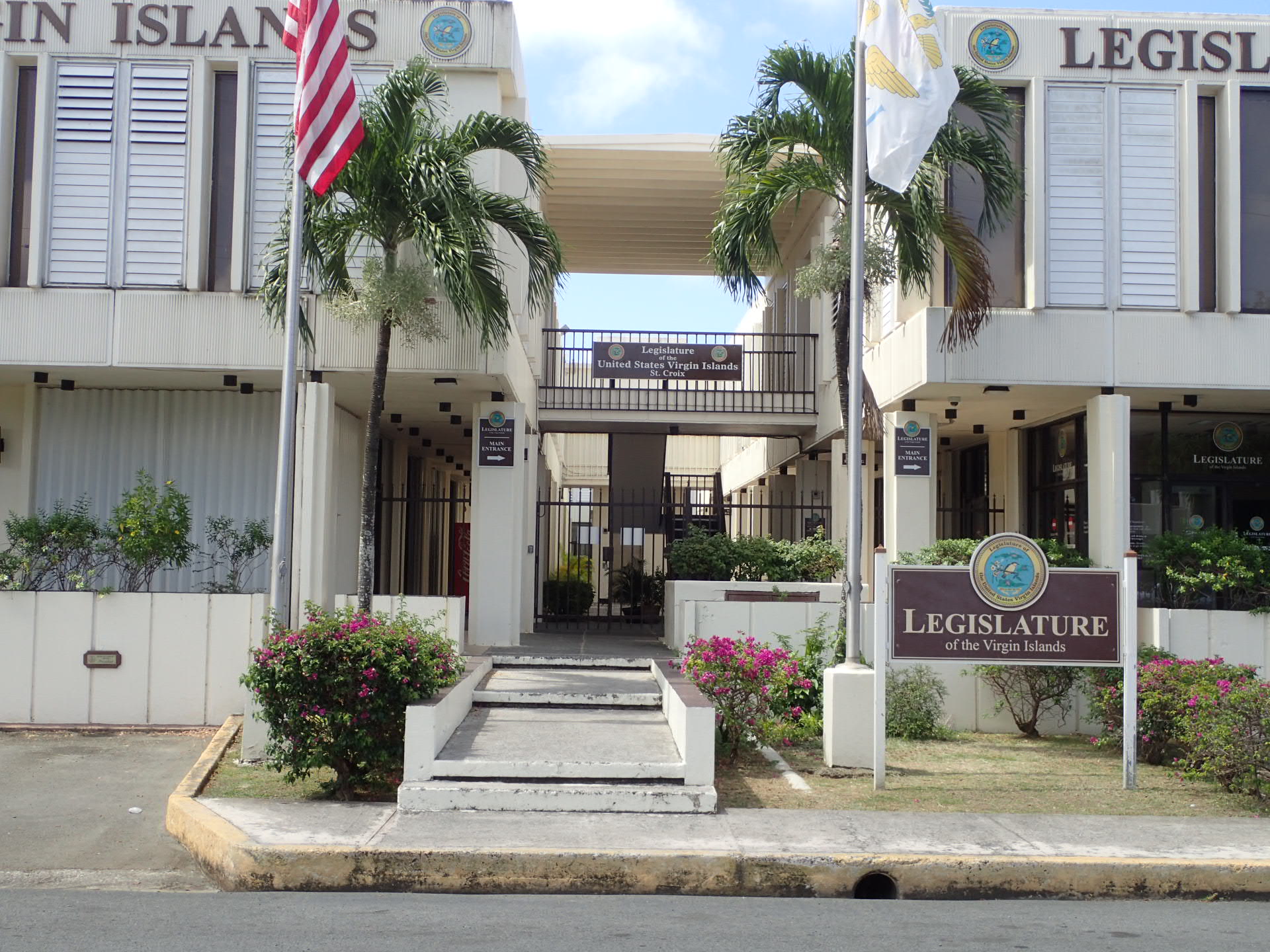
Is there room to cut bloat in the V.I. government to help fill its crippling structural deficit?
Most large government agencies are starved for funds, not overfunded. But if we look closer, there may be room for surgical cuts that can move the deficit in the right direction and set an example by leading from the top. It is possible to have bloat and waste while struggling to meet urgent needs. While rank and file employees are not very well paid, those at the top; commissioners, contracted consultants, authority heads, the governor and senators; all do very well. The Office of the Governor appears to be much better funded than most similar entities. (See: “The V.I. Budget Crisis: Part 8, Gubernatorial Bloat.”)
The V.I. Legislature is better funded and far more active than most state legislatures. It may be too active, churning out new legislation that does little; approving all leases, approving zoning changes, approving the school system budget and periodically getting embroiled in the internal management of different agencies.

The V.I. Legislature is also among the highest paid, with senators making more than legislators in every state but California, Pennsylvania and New York. V.I. senators’ pay starts at $85,000 and is tied to commissioner salaries. Most states pay between $20,000 and $50,000 per year, according to government watchdog Ballotpedia. If cuts must be made, cutting the Legislature will not close classrooms or turn away those seeking medical care.
A decade of in-depth reporting on the activities of five different legislatures provided ample evidence that most senators work hard and genuinely want to use their office to make life better for all Virgin Islanders. But the results are not completely in line with their best hopes.
The V.I. Legislature is hyperactive, creating much more legislation and requiring its approval for much more activity than most state legislatures. All government leases and zoning approvals must come before it for debate and votes.
It approves all Coastal Zone Management permits after they are approved by the Coastal Zone Management Commission. It also frequently enacts legislation that does little, or cannot be carried out due to lack of funds, so that senators can point to bills they sponsored as they run for reelection. (See: “Senate Unanimously Approves Six New Unfunded Mandates” in Related Links below)
It periodically weighs in on matters far outside of its bailiwick, as in 2014, when Sens. Alicia “Chucky” Hansen, Kenneth Gittens and others got involved in the internal operations and governing board staffing of the Gov. Juan F. Luis Hospital. Helping the CEO drive out members of the hospital’s governing board and fire his financial team, they brought the hospital to the brink of disaster. (See: “Hansen, Griffith to Blame for the JFL Decertification,” in Related Links below.)
At the same time, it is so busy overseeing budgets for every agency from Veterans Affairs, with $350,000 to Licensing and Consumer Affairs’ $3.8 million appropriation that it can only give a day of committee hearings to the massive, $205 million Education Department budget.
This is not a unique problem and most U.S. jurisdictions make oversight of school budgets and administration the full-time job of their elected board of education, with legislatures and county boards only voting on total budget numbers. But V.I. senators are loathe to give up that power, though they do not have the time to effectively oversee the government’s biggest department.
The Legislature could do less and spend less time and money doing it. It meets year-round, while most legislatures do not. The state of Virginia’s General Assembly, for example, convenes for about 45 days per year – plus a couple more days to consider the governor’s amendments and vetoes.
The senators also have larger personal staffs than most state legislators. State legislators have a median of 3.8 staffers, according to the National Conference of State Legislatures, while, as of 2014, V.I. senators had around 4.7 staffers, on average, based on the 70 named staffers with telephone numbers listed in the Legislature phone directory as part of individual senators’ offices. The actual number of staffers might be higher as another 21 staffers were listed in the directory without names, but as “staff,” with their own phone lines. The Legislature directory no longer lists staff members and phone numbers.
The Legislature passed a statute some years back allocating two percent of the Legislature’s operating budget to each senator to run their offices, which, multiplied by 15 senators is 30 percent of its total operating budget. It appropriated $21 million for itself for FY 2016 and again for 2017 for operations and capital expenses. During the 2016 budget cycle senators said $1 million was for capital expenses and $20 million for operating expenses. Thirty percent of that is $6 million, with $400,000 per senator per year for office allowances. Top Senate officers get additional allotments.
Because senators also have access to the central staff and legal counsel’s office, which help with drafting and vetting bills, answer the main phone lines, provide janitorial services and so forth, it is not obvious why each senator needs several full-time employees.
And some senators clearly regard legislature employment as a source of personal patronage power, jealously guarding their ability to affect who is hired and whether that person keeps the job. Then-Sen. Craig Barshinger proposed legislation in 2011 and again in 2013 to reduce the probationary period for central Legislature employees from four years to six months. Senators roundly killed the bill both times.
During the 2013 hearing, Hansen took umbrage at the very idea and spoke at length about how she was personally responsible for the hiring of many Legislature employees, who she suggested owed their jobs to her.
While the comparatively excessive V.I. spending levels on legislative staffing make these jobs a tempting place to look for saving, cutting those funds would mean a loss of employment to real people, Virgin Islanders who just want to have a decent job and feed their families.
Sometimes senators abuse their authority over Legislature employees beyond what is allowed in the law. When St. Thomas Sen. Alvin Williams pleaded guilty to racketeering and corruption charges in 2013, he confessed to forcing his employees to pay a portion of their salaries to him – bleeding his employees for cash.
At the time of Alvin Williams arrest, several individuals who refused to go on record told the Source that this sort of shakedown by senators was not an isolated event. In the absence of proof or a named source willing to go on record, it was deemed too gossipy and too lacking in confirmation to print in the Source.
But just recently, in April, a V.I. resident sent the Source a complaint – also anonymously – naming a senator they claimed was doing the same type of shakedown of employees for part of their salaries. Without a criminal complaint, a name attached to the claim or a second source, it cannot be treated as credible enough to name the allegedly corrupt senator. But coming soon after Williams confessed in court to the same thing, it raises an eyebrow.
Aside from shakedowns, Williams also used his employees as personal servants – and beyond even that – used them to do online classwork to try to fraudulently attain a college degree. Williams and, more recently, Legislature Executive Director Louis “Lolo” Willis also wasted taxpayer money by corruptly steering contracts to certain construction companies in exchange for bribes. Willis pleaded guilty in 2015.
Former Sen. Wayne James is awaiting trial for misuse of funds too. He allegedly pocketed hundreds of thousands of dollars in bogus expenses.
Hansen too was charged with corruption, related to directing government contracts to firms tied to her husband. Ultimately, while others went to prison, most of the charges against her were dropped and she pleaded guilty only to several counts of intentionally failing to file income tax returns. Those crimes got her declared ineligible to run and she is only able to run for office thanks to a pardon from Gov. John deJongh Jr. She was reelected in 2016.
Taxpayer money misused in these ways could be better spent on actual government work.
But solving the riddle of how to prevent that waste is not easy or obvious.
The Legislature passes a lot of legislation that ends up having no real effect. In years past, senators have often added small appropriations for many purposes, from road repairs to community centers, disconnected from any actual cost estimates, seeking to fill a need. Sometimes a governor vetoes the appropriations, saying the amount is not enough to get the job done, or that the money cannot legally be used that way. (See: “DeJongh Vetoes Items Before Signing Bond-Authorization Bill.”) Other times, the appropriation is signed but simply languishes until the funds are re-appropriated to other uses or evaporates when revenues fail to meet projections.
For example, several years back, Sen. Wayne James championed a $1.5 million appropriation of bond funds to rebuild Durant Tower in Frederiksted. The original “tower” was an attractive Victorian-era house with a tower-like structure built into it. It burned down in 1989. After much fanfare and talk of a museum, the funds have at least partially been re-appropriated and no tower appears to be in the works. Dozens, if not hundreds of small road and school repair appropriations have similarly languished and come to naught, over the years, while the sponsors get credit in the news and on the radio anyway.
The Senate has created many boards and commissions that sound noble but never really functioned.
In 2016, the Legislature created an all-volunteer “Virgin Islands Compensation Commission,” tasked with reviewing top government officials’ salaries and recommending pay levels. It was to convene in January of this year but does not exist. In 2014, the Legislature created a 13-member “Virgin Islands Sports Commission.” There is no sign that this body has been manned or convened. The Legislature created a special Centennial Commission just to plan centennial activities- a task the Department of Tourism could have done. Now the Legislature is considering abolishing it, disagreeing with how its volunteer members have chosen to spend some of the money allotted to it.
In 2001, the Legislature voted unanimously to establish the Military Museum Board and Veterans Memorial Board to design and run a non-existent museum that was never funded. The V.I. Civil Rights Commission, created in 1984, certainly has a noble purpose, but it has been defunct for at least a decade. The Legislature created the V.I. Wage Board and gave it authority to prescribe minimum wages in the territory. Since its authority would overlap with the Legislature, which would still have power to do the same things, it is not clear what it would do, on a practical level, if it existed, which it doesn’t.
Along with the active Magens Bay Authority on St. Thomas, there appear to be at least two non-functioning park boards: The St. Croix Park Authority Board of Directors and the Territorial Park Trust Board.
The Legislature created the Office of Status Education in 1996 to “educate the public on the issue of status.” No record of this body meeting, having any members, or having any budgetary funding could be found.
There is also a “Tax Study Commission,” but V.I. code is lacking in detail of when it was created or what it is meant to do and no record of any membership or meetings could be found. The Legislature established the “Hospitality Training School” by legislative fiat in 1995, yet there is no hospitality training school. The Legislature established the V.I. Maritime Academy Board in 1990, yet there is neither a board nor an academy.
Some Senators have acknowledged the proliferation of boards and commissions has caused problems. Then-Sen. Kenneth Gittens said in March 2016 that he was working on legislation to comprehensively address the issue and to consolidate and reduce the number of V.I. boards and commissions. He did not, although he did introduce legislation, since enacted, to consolidate the territory’s two elections boards starting in 2018.
Creating boards that never come into existence even as many other boards languish without quorums is a reflection of the hyperactivity of the Legislature. Senators strive to find new things to do, to create a legacy for themselves and a record upon which to run. Wanting a legacy is natural. Being a legislator is an inherently noble and necessary job. The oversight they provide to government agencies is critical for the common welfare. Laws often need to be changed. In recent years, senators have raised minimum wages, decriminalized marijuana, outlawed plastic grocery bags and many more good things. But too much of what they have done in the past is unnecessary, counterproductive, redundant or pointless: hyperactive legislating.
Still, all these concerns notwithstanding, the Legislature accounts for less than 3 percent of the V.I. government’s annual spending and even cutting its budget to zero would not come close to eliminating the deficit.
And the Legislature controls the purse strings and senators have been loathe to give up control over granting CZM permits and leases, much less things that directly impact themselves. Senators hold officials of other agencies to account during budget hearings, posing tough questions and poring over a post audit report on the numbers. But the Legislature’s own budget is approved every year without details, testimony or debate.
A few senators, including Sen. Janette Millin Young, have consistently questioned whether there even is a budget crisis.
“You can’t come here every two weeks and tell me we have $6 million in cash on hand … because we don’t know … . We hear we are running out of money every day. The sky is falling every day,” Young said during a Feb. 15 hearing on tax increases. She and others senators said much the same back in 2011 when Gov. John deJongh Jr. urged tax increases and budget cuts during that year’s budget crisis.
Some senators have expressed a willingness to take a cut to set the example. At a recent town hall on tax increases, Sen. Neville James said he would be willing to take a cut of $10,000 to $20,000 “as long as it was across the board.” Sen. Myron Jackson also said he would be willing to take a cut. Not all senators are on board though.
Sen. Jean Forde said he would not want to be a senator if it paid less.
“If the job was $20,000 less, I would not run for it. It was a lateral move. I’m worth what I’m being paid,” Forde said. (See: “Majority Senators Justify Tax Increases at Town Hall” in Related Links.)
If the territory’s economy was booming, unemployment low and the budget in surplus, few would begrudge even a very generous taxpayer-funded salary. But every agency is struggling, the public hospitals are teetering and the budget is badly, permanently unbalanced. There is something to be said for leading by example. Public service is different from working for a corporation. Prestige and honor are often important considerations aside from monetary compensation. Does anyone think it would be impossible to get anyone to run for senator if the pay were $65,000 instead of $85,000 or more a per year? If they had $150,000 each for office expenses instead of $400,000?
Still, cuts to the Legislature, while symbolic, would not be enough by themselves to make much difference. Is there fat to trim anywhere else without cutting services or personnel?
Next: Part 10, Rampant Overtime Costs
Read the whole series:
How Did We Get Here, How Do We Get Out?
The V.I. Budget Crisis: Part 2, The Hovensa Effect
The V.I. Budget Crisis, Part 3: The GERS Time Bomb
The V.I. Budget Crisis Part 4: Debt or Spending? What To Worry About
V.I. Budget Crisis Part 5: Weren’t Rum Funds Supposed To Save Us?
The V.I. Budget Crisis: Part 6, Technology Park Tax Breaks
The V.I. Budget Crisis: Part 7, What About Horse Racing and Casino Gambling?
The V.I. Budget Crisis: Part 8, Gubernatorial BloaThe V.I. Budget Crisis: Part 9, Hyperactive Legislating
The V.I. Budget Crisis: Part 9, Hyperactive Legislating
The V.I. Budget Crisis, Part 10: Chronic Overtime
The V.I. Budget Crisis, Part 11: Education, Where The Big Spending Is
The V.I. Budget Crisis, Part 12: What Else Can the USVI Do To Help? Rationalizing Government Agencies
The V.I. Budget Crisis: Part 13: Finding New Revenues – AirBnB and Marijuana
The V.I. Budget Crisis, Part 14: Medicaid and Medicare
The V.I. Budget Crisis: Part 15, Rum and Congress
The V.I. Budget Crisis, Part 16: Irma and Maria Make A Bad Situation Worse
V.I. Budget Crisis Part 17: Federal Help Is Coming, But Not Enough
V.I. Budget Crisis, Part 18: Honesty Makes the Best Policy
V.I. Budget Crisis, Part 19: Congress Can Still Do a Lot – But If It Doesn’t, Brace For Impact




The author neglected to mention that the Legislature Building on St.Croix is a rented facility–another example of financial waste.
So the Senators are sitting on each other, scratching their heads to come up with a plethora of unnecessary legislation, in order to give the appearance of frenzied activity.
Truly satirical.
Excellent article, Bill.