

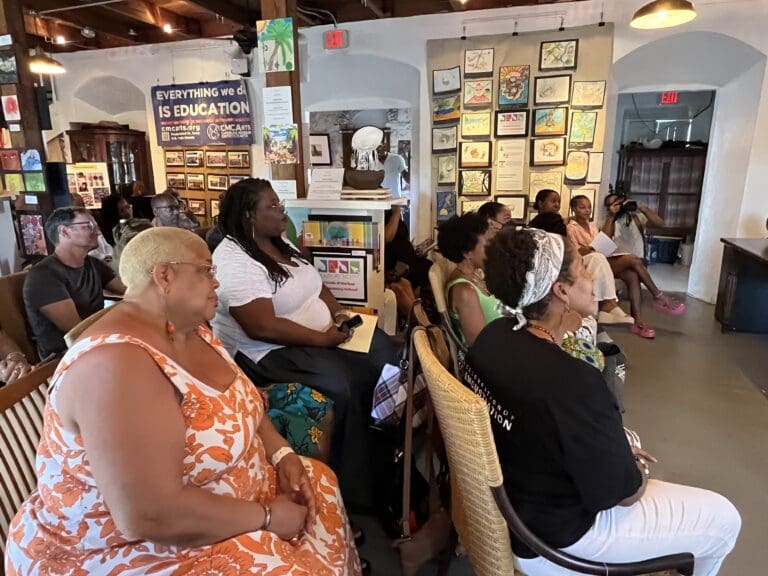

The final series of “dECOlonial Feelin’” opened this weekend with a current that pulled attendees into deep and necessary conversations on art, ancestry, intellect, education and activism at Crucian Heritage and Nature Tourism, Inc. in Frederiksted. Against the backdrop of St. Croix, where the sea is both history and horizon, the Virgin Islands Studies Collective invited participants to consider decolonial thought not just as theory but as lived practice.
Hadiya Sewer, VISCO member and an Africana philosopher hailing from St. John, set the tone early, honoring those who paved the way. “I’m grateful for generations of Black feminists,” she shared, a sentiment echoed in the audience’s nods and affirmations. They spoke of the privilege of continuing the work — of answering the call of the ancestors and their experiences, of letting spirit shape scholarship. “Our political status is in a possessionless state,” they noted, confronting the historical violences that have shaped the Virgin Islands and other colonized lands.
In a moment that felt sacred, Sewer read from her first short story, “Interment,” publicly shared for the first time. Set to be included in VI Noire, the piece centered Mary Magdalene – not the biblical figure, but a reimagined Crucian ancestor inspired by her great-grandmother, Mary Joseph. “That sounded like love or obeah or both,” Sewer shared, offering a meditation on how spirituality disrupts and reclaims power from the narrative that demonizes ancient practices.
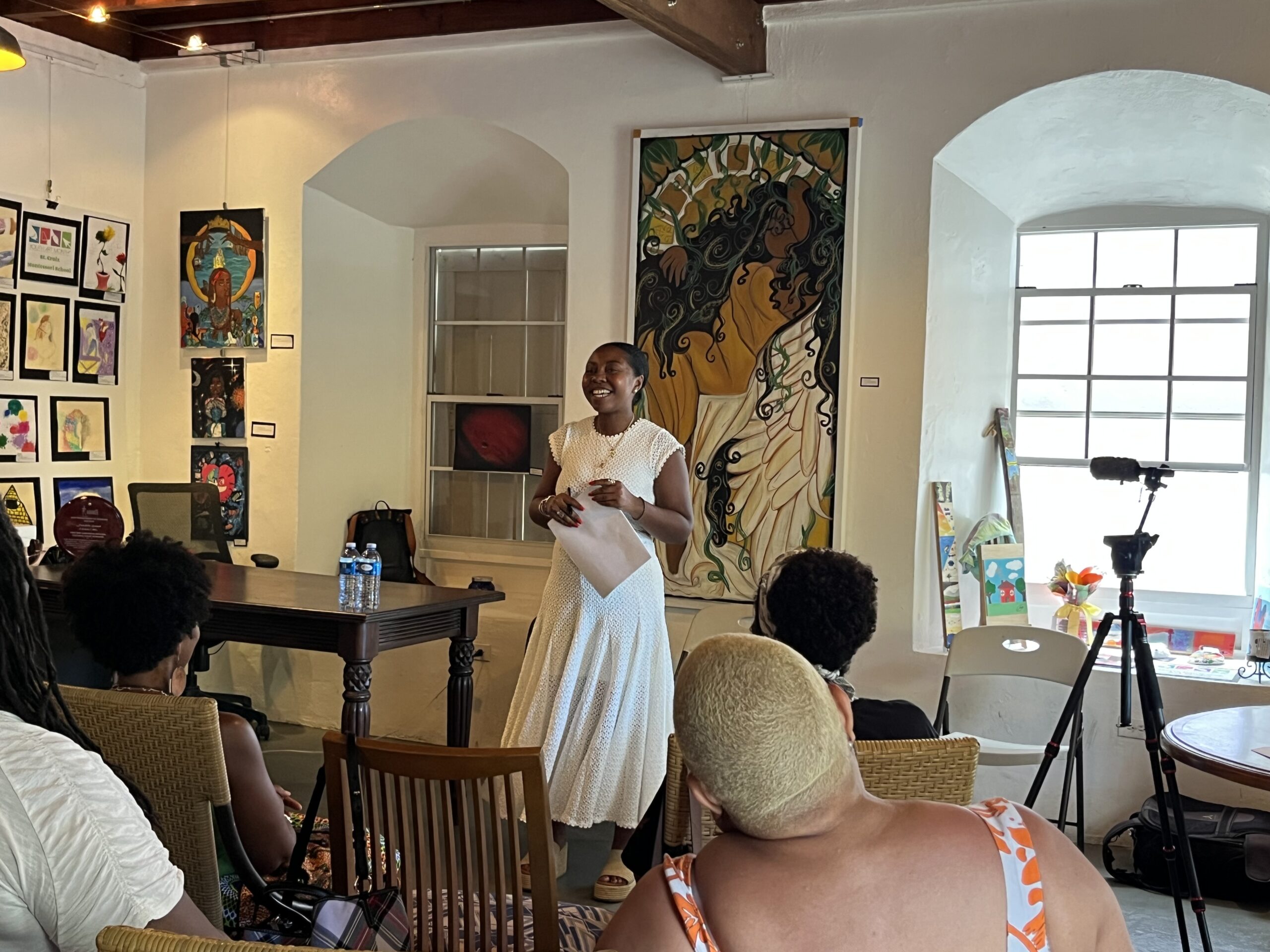
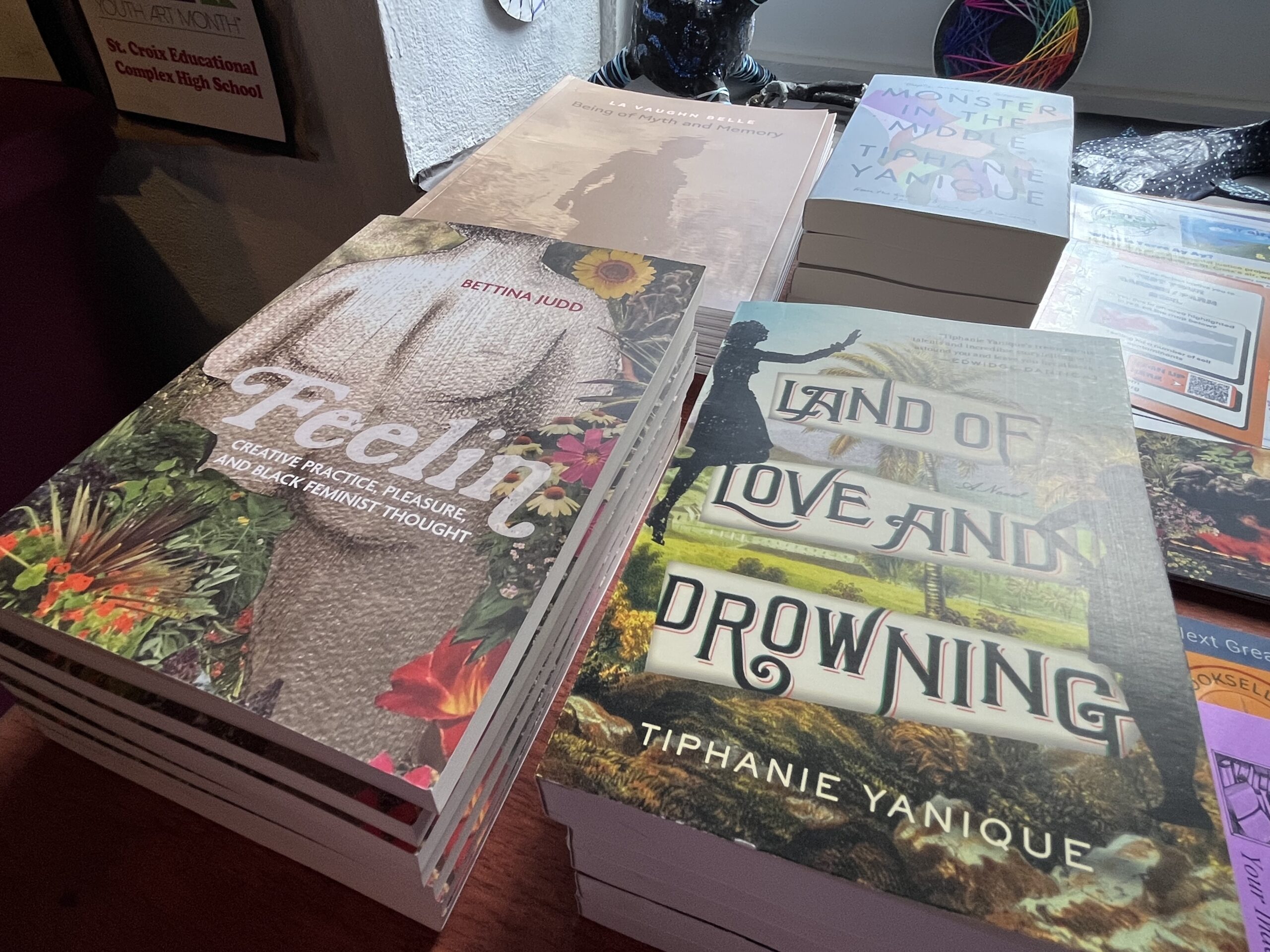
Tiphanie Yanique, a VISCO member, ancestral Virgin Islander, and award-winning author and poet, led a session filled with wordplay and vivid imagery of vertigo. During the session, she read from her new short story, “Looking House,” set on the island of St. John. She shared a passage where, at five years old, the main character feels “steady on the sand” and connects with sixth cousins across the Atlantic, collapsing the vastness of the ocean into something familiar — a “small puddle in comparison to the entire earth.” The main character also experiences vertigo, “feelin'” the coming of a tsunami, the first of its kind on St. John, which intensely builds to the internal struggle of following his father, a fisherman, out to sea or listening to the ocean urging him to run home to his mother high in the hills.
Magical Knowing: The Power of Being Multiple
Bettina Judd, author of “Feelin,” guided a conversation with Sewer and Yanique that dug into what it means to be both grounded and fluid, bound yet boundless. “I am always multiple. That is our state of being. That moving-being thing is natural to us,” Yanique reflected, challenging static definitions of identity as a Virgin Islander.
“Our selfhood is magical,” she continued, “That knowing is a magical knowing.”
The discussion turned to the intersections of land, spirit, and resistance. Sewer spoke of the U.S. Virgin Islands as a site of ongoing struggle — two-thirds of St. John remains occupied by federal entities, a stark reminder of environmental colonialism. “Our Black bodies, our relationship to the land,” they emphasized, “the environment itself is a coconspirator in our liberation project.”
Yanique frequently wove water into the conversation, quoting the late Teresia Teaiwa, who coined the term “Big Ocean People.” “We know the sea. We are connected to the sea,” she reminded the audience, urging a reclamation of that relationship.
Attendees reflected on the inherited fear of water — the epigenetic trauma of ancestors thrown from ships, the trail of sharks that marked the trans-Atlantic slave trade routes. “It wasn’t the sea’s fault,” Yanique noted. “It took us in. It was our cemetery.” A new vision emerged: one of swimming as resistance, as spiritual practice, as a decolonial act. “The Caribbean is a continent,” an attendee observed. “We just have more water than land.”
Decolonizing Everyday Life
The conversation shifted toward tangible ways to integrate decolonial thought into daily life. Yanique offered a simple but profound directive: “Making art is decolonial work.” She also rejected institutional allegiance, stating, “Institutions are only there to serve the individual. Operate on a human level.” The collective provided free lesson plans for educators at all levels, from elementary to collegiate, interested in decolonizing the minds of young Virgin Islanders.

For Sewer, the foundation of decolonial practice is love. “Love is central,” they asserted, referencing a young St. Johnian’s film on colonial violence. “There is so much violence we have with each other. In order to organize, you need solidarity.” Love, Sewer explained, must be practiced with integrity and care, and a wanting of healing, transformation, survival and liberation.
An audience member, who moved to St. Croix — a witness of racial injustice — asked how to engage in difficult conversations. “What is the role of anger?” she asked. Sewer’s response was decisive: “I made a political stance to not respond.” She added that showing up to sovereign spaces is enough. And proposed to not ask for the answer to that question, but instead to “do the work for yourself … with love.” Because “we [Black women] tired” rippled through the audience resoundingly.
As the afternoon session closed, there was a collective sense of gratitude — not just for the speakers but for the space created by host Frandelle Gerard, executive director at CHANT.
The symposium offers opportunities to deepen conversations and consider how the land, the sea, and storytelling lead toward liberation. La Vaughn Belle, groundbreaking artist and a member of VISCO, will close this final series in downtown Christiansted with a performance art walk.
For more information to support VISCO, contact vistudiescollective@gmail.com or visit https://www.vistudiescollective.org.
















Op-Ed: The Lounge | A Column for Men: Are You Keeping or Caging?
“Am I my brother’s keeper?”. This was asked by Cain after he slayed Abel. In that moment, he didn’t [want to] feel as though he needed to be responsible for his brother. In fact, he was, and he knew it. We are here to serve others and to help them (along with ourselves) face all the trials of life. To be human is to exist in community with others. Hearkening back to scripture, the Word says that “it is not good for man to be alone”. Even though the immediate support or “helpmate” was the creation of a woman. The implications of us not meant to be alone were far-reaching and still contribute fundamentally to a blossoming and healthy society. It is our interconnectivity that shapes our beliefs, ethics, morals, behaviors, etc. Even though we are what we think, what we think is a direct reflection of our environment, inside and outside of our homes.
If you look at your sphere of influence and you aren’t inspired, if they are not encouraging your growth, development, and maturity, you don’t have a circle, you have a cage. I did not come up with the phrase, but once I read it on social media, it was seared into my mind. It also became one of the pillars of the rubric that I gauge my interactions against. This also applies to myself: am I uplifting and supporting or holding people back? We don’t like to admit this, but sometimes we are the problem. We cannot expect to be vaulted into our next season of success if we are also being inhibitors to others. There is a difference between standing on the shoulders of great people and stepping on people in an attempt to become great.
To be a keeper is to introduce a level of responsibility and, our favorite word in The Lounge, accountability for the well-being of others. I recall that my parents told me that I can’t save the world, however, everyone has their own “world” in which they live. When I came to this conclusion, I realized that I could save their world, one person at a time. And so can you. When we keep people, we aren’t declaring them property but a privilege. We get to protect, empower, influence, encourage, and assist them in their life journey. I believe that, aside from parenthood, this is the noblest and most gratifying task assigned to us. Unfortunately, we live in a time where we are only concerned with our own lives and well-being.
Caging people is the exact antithesis of keeping. It as far as you can swing the pendulum when it comes to our interactions with people (specifically we are meant to care for). If we are honest with ourselves, we are all [something] for being a roadblock in someone’s life. Now this might have been inadvertent, but it happened, nonetheless. We still need to take ownership of where we have been in previous impediments and ensure we make the necessary adjustments to be enablers going forward. However, there is a sinister set of individuals who purposely manipulate those for their own gain. These people see the goodness, blessings, success all over you and choose to create barriers to those ends. Whether they feel threatened, insecure, afraid to be disconnected, or some other motivator is something we will reserve for another discussion. These are individuals that can be friends, neighbors, and even family members, whose secret disdain for who you are and what you are trying to accomplish will have them doing everything they can to sabotage your life.
Are you willing to look at yourself and your people and determine if you all are keeping or caging each other? The intro and retrospective looks are always the most difficult because it is easy to see fault in others, but not us. If you have made some decisions and initiated separation from external actors who are not meant for your well-being or future, yet you still see an inability to progress, it is time to look in the mirror. Some of what keeps us from becoming the best version of ourselves is not just who we are connected to but how we are treating them. We cannot be entrusted with greatness because our morals are already corrupted. Not that this can’t be changed, but it requires an acknowledgement that the change must occur, followed by vigilant activity.
We all have the ability to transition from gatekeepers to key makers. I am living proof of this phenomenon. I lived a double life of pseudo-service and selfish gain for years, having one foot in and one foot out of doing the right thing. I vividly remember looking at myself in the mirror and saying, “Man, you are not a genuinely good person. You only pretend to be when it’s convenient”. That startling realization was a wake-up call and a call to action; what kind of person and man did I really want to be and what did I need to do get there? I made a tough choice and lost some people along the way, but those were people who were trying to cage me and not keep me. Likewise, I gained new friends and improved strained relationships when I decided to start keeping them and not caging them. We must learn to support and not suppress, celebrate and not silence. Let us stop being our brothers (and sisters) stumbling blocks and start being their staircases.
Langley “Casual-Word” Shazor is a poet, author, publisher, entrepreneur, public speaking coach, podcast host, and pastor who is an advocate for youth and men. His goal is to enlighten, empower, and liberate those who are silenced, marginalized, and enslaved to self-destructive thoughts and behaviors.
Visit thecasualword.com.
Editor’s Note: Opinion articles do not represent the views of the Virgin Islands Source newsroom and are the sole expressed opinion of the writer. Submissions can be made to visource@gmail.com.