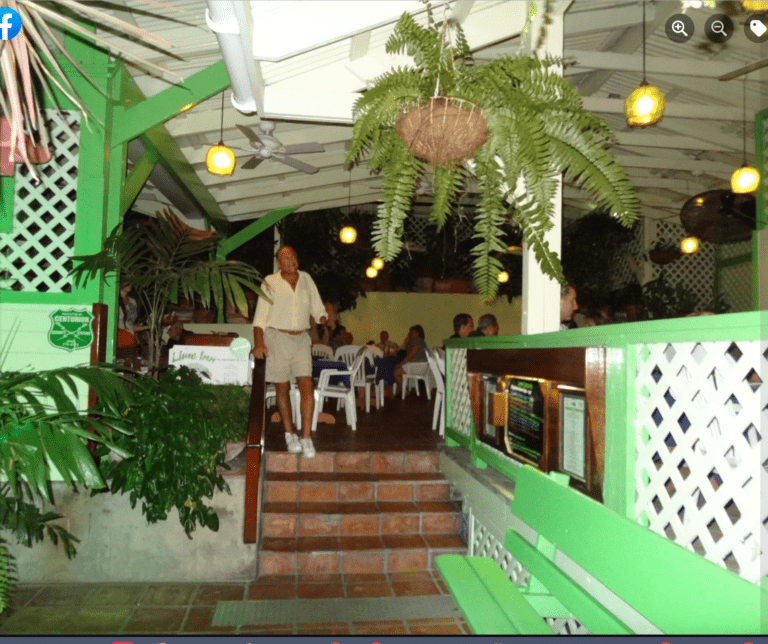
Restaurants in St. John ranked eighth in the world for boater-friendly restaurants in a new survey from a charter yacht booking company.
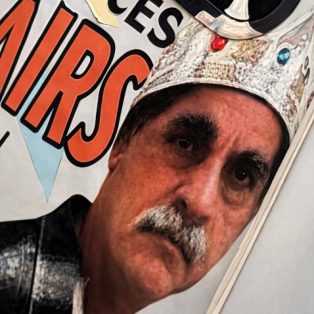
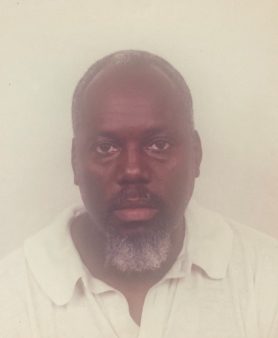
Rich Meyer at his customary position as host at the Lime Inn. (Photo courtesy of the Meyers family)
BoatBooker, a platform connecting boat captains with charter customers, reviewed thousands of Google reviews to compile their Dock & Dine listing.
Greece ranked first, followed by Croatia, Italy, Indonesia, the Maldives, the Philippines, and the United States. The USVI came in eighth, ahead of Chile and Malta in the top 10.
The Lime Inn took the survey’s top spot, followed by Skinny Legs, the Longboard, The Beach Bar, and Morgan’s Mango in Rock City top five.
The Roti King, 1864 The Restaurant, Extra Virgin Bistro, Johnny Lime, Woody’s Seafood Saloon, Miss Lucy’s, Lime Out St. John, Sun Dog Cafe and St. John Brewers Tap Room Brewpub and The Banana Deck also received mentions. Surf Club Cantina, Heidi’s Honeymoon Grill, Zozo’s at Caneel Bay, Ekaete Pink Corner, Pizza Pi VI, Heading East Bar & Grill, and The Refinery rounded out the St. John rankings.
The Virgin Islands Waste Management Authority invites the community to take part in a territory-wide collection drive for residential white goods and bulk waste on Saturday, March 28, and Sunday, March 29. The event will be held from 8 a.m. to 3 p.m. each day.
Residents are encouraged to bring bulk waste items—including furniture, mattresses, carpets, grills, and other bulky household items—as well as white goods such as stoves, dryers, washing machines, refrigerators, water heaters, and similar appliances to the following designated drop-off locations:
In St. Thomas at Mandahl Convenience Center, Cancryb Bin Site, Bovoni Landfill, and the Nazareth Bin Site
In St. Croix at the Anguilla Landfill, Cotton Valley Bin Site and the Peter’s Rest Convenience Center
In St. John and Water Island at the Coral Bay Bin Site, Pine Peace Bin Site, Susannaberg Transfer Station, and the Water Island Bin Site
VIWMA would like to remind residents that Commercial Waste, Construction Debris, Electronic Devices, Fats, Green Waste, and Used Motor/ Cooking Oil are not permitted at the bin sites. These items must be disposed of at the landfills and transfer station, noting that temporary suspensions may be in effect.
VIWMA appreciates the community’s ongoing support in keeping our islands clean. Your involvement strengthens neighborhoods, protects the environment, and helps preserve our paradise.
For more information, contact Ms. Stevens at 340-473-0246 (St. Thomas/ Water Island), Mr. Lake at 340-244-9242 (Peter’s Rest Convenience Center), Ms. Tyson at 340-642-9517, or Mr. Jacobs at 340-626-7768 (Anguilla Landfill), Ms. Powel (Susannaberg Transfer Station) at 340-473-9845, or email customer_care@viwma.org.
Susan Virginia Ellis, a longtime resident of St. Croix, U.S. Virgin Islands, completed her earthly journey and returned home to spirit, surrounded by love, Saturday, March 7, 2026 at Juan F. Luis Hospital on St. Croix.
Susan Ellis
Susan was born in Tulsa Oklahoma on June 2, 1946 to her parents, Joan and Jack Ellis. Susan spent her formative years in Casper, Wyoming. She attended the University of Wyoming and received a bachelor’s degree in journalism at Mesa State University. She lived in Colorado raising her two daughters until moving to her beloved island of St. Croix in 1993.
She was inspired by the love of family and charity to others. She became the Special Projects Coordinator at Lutheran Social Services, supporting the orphanage (Queen Louise Home) caring for St. Croix ‘s disadvantaged children. Susan was always a champion for the environment, animal rescues, and many other non-profits. She was a lifelong social rights activist who stood up for those who were often overlooked or unheard.
She also had a successful career in journalism as a reporter for The St. Croix Avis and more recently at the St. Croix Source. A gifted journalist whose mastery of language was matched only by her lifelong love of books.
Susan loved St. Croix because of the beauty, the people and the culture- she was highly revered and loved by many in the community.
In Susan’s spare time, she could always be found snorkeling or playing with dogs at the St Croix Animal Welfare Center, where she volunteered. She has always been known as vibrant, young at heart, witty and loved good conversation with friends and family.
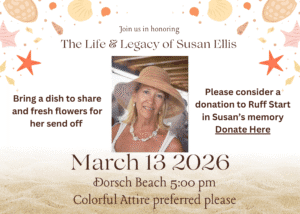
Because of Susan’s deep love of the ocean, St. Croix, and the natural world, she chose to return to the waters she cherished. She will be laid to rest at sea.
Susan is survived by her two daughters; Sandra and Ashley. Grandchildren; Connor , Cole and Maeve. Great Grandchildren; Ivee and Milo. Her siblings, Deborah, Celeste and John. Loving Aunt Helen K., niece Katherine, nephews Jason and Christopher and many, many loving cousins and friends.
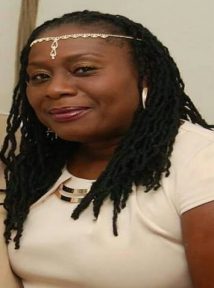
Brenda Young-White lovingly known as Donna, was born on May 4, 1959, in St. Kitts, West Indies. On Feb. 28, 2026, Brenda Young-White peacefully passed away in St. Croix at the age of 66. She was a loving mother, grandmother, sister, aunt, and friend whose kindness, strength, and devotion to family will forever be remembered by all who knew her.
Brenda Young-White
Donna leaves to cherish her precious memories her devoted husband John White and loving daughters KaDonna Lowe-Haynes, KaDawn Lowe-Rhynes, and KaZinga Lowe. Her legacy continues through her beloved grandchildren: Michael Givens, Jordon Johnson, Kaori Haynes, Cameron Rhynes, Kaylee Akuoko Lowe, who brought her immense joy.
She is also survived by her siblings; Gene Syder, Desmond Young, Joseph Young, Mervin Young, Wayne Dover, Shawn Dover, Natasha Dover-Miranda. She also leaves behind her dear aunts, Judith Charles, Christine Young. Donna will be fondly remembered by her nieces, Sheba Young, Amira Dover and nephews, Carl Young, Abdul Young, Jason Young, Matthew Young, Elijah Dover, Ahijah Dover, Sean Dover, Anthony Dover, and Amir Miranda.
She shares specials bonds with her dear friends & family Greta Salisbury, Ruth(Sweeny)O’Garro, Linda Rouse-Doyle, Mona(Shelly) Sackey, along with many other relatives and friends whose lives she touched with her humor, generosity, and warmth.
Viewing will be held at 10 a.m. on Friday, March 27, at Divine Chapel, 129 Peter’s Rest.
The Celebration of Donna’s life will be held 12 p.m. Friday March 27 at Vincent F. Mason Sr, Coral Resort/F’sted Pool
Donna’s love, faith, and gentle spirit will forever live on in the hearts of her family and friends.
Manuel Nieves was born on Jan. 1, 1951, and peacefully passed away on March 2, 2026. He lived a life marked by quiet strength, kindness, and a deep appreciation for family and friends. Manuel was known for his warm spirit and the many meaningful relationships he built throughout his life. Those who knew him will remember his generous heart, his friendly nature, and the lasting impression he left on everyone he encountered.
Manuel Nieves
Manuel was preceded in death by his beloved mother, Eugenia Nieves, and his father, Enrique A. Nieves. Though they have gone before him, their love and guidance remained a strong foundation throughout his life.
He leaves to cherish his memory, his loving brother, Enrique A. Nieves Jr., and his sisters, Ida N. Brown and Migdalia Nieves. Manuel was also a cherished uncle to many nieces and nephews who will continue to honor his memory. His nieces include Lorraine Dowling, Graciela Sanabria, Lisandra Garcia, Tamara Allen, Risa Adams, Lisa Nieves Christian, Nancy Nieves Wright, Ana L. Nieves, Maria Hernandez, Lydia Ryner, Vanessa Dowling, Kaisha Ortiz, Jasmin Nieves, Karisa Danielson, Renisa Brewster, Currisa Frederick, Brenee Soldier, Lisandra Luna, and Alisa Washington. His nephews include Ronald Elliot, Kareem Danielson, Lauriel Dowling, Sammy Sanabria, Orlando Nieves, Ricardo Nieves, Ricardo Daniel Nieves, Melbourne Adams, Roberto Russell, Lamar Dent, Marcus Mitchell, Mark Bough Jr., Makai Bough, Austin Tutein, Lenny Valdez, and Ricky Dowling. He is also survived by his niece-in-law Alma V. Nieves and his nephew-in-law Richard D. Wright.
Manuel also shared special bonds with many close friends who became like family, including Daisy Carino and family, Alvin Milligan, Janice McFarlane, Jacqueline R. Richards, Leon Martinez, and the entire St. Croix Senior Center community, who will all deeply miss his presence.
A viewing for Manuel Nieves will be held on Thursday, March 12, at Friedensberg Moravian Church in Frederiksted (across from the Frederiksted Cemetery) beginning at 9 a.m., followed by the funeral service at 10 a.m. Interment will take place at Kingshill Cemetery.
Though Manuel has departed from this life, the love, memories, and legacy he leaves behind will forever remain in the hearts of his family, friends, and all who had the privilege of knowing him. May he rest in eternal peace.
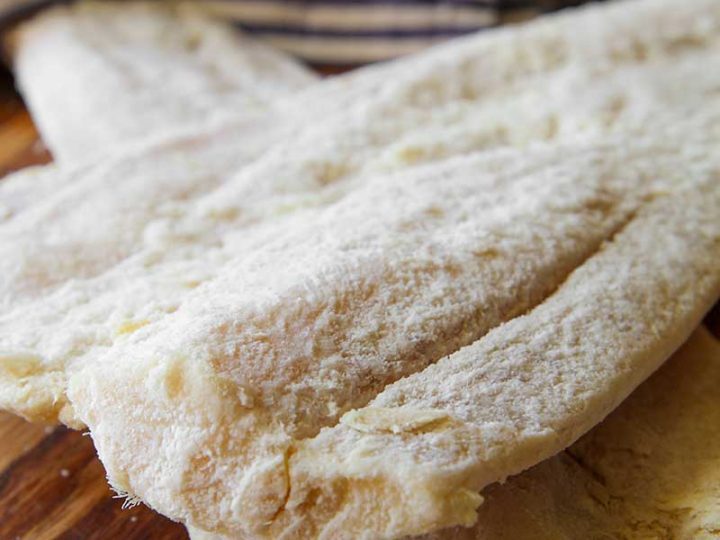
Dried salted cod is now common in the West Indies. (Photo courtesy Wikipedia)
My colleague Saudi Jones asked me if I have any historical information on the use of saltfish in the Virgin Islands. I must say this, she got me thinking. I grew up eating saltfish. However, I never really thought about the history of saltfish until she inquired of the history to me. She wanted to know if there were any historical documents, records, etc., or just something that connects saltfish to Virgin Islands culture for her exhibit at the 2026 AgriFest.
Olasee Davis, Ph.D. (Submitted photo)
The origins of saltfish can be traced to ancient civilizations, such as the Greeks and Romans, where they recognized the value of preserving fish to ensure a stable supply. Saltfish, a staple in the North Atlantic region, has been produced for over 500 years in Iceland, Newfoundland, and in other European countries. Thus, saltfish was a major export of the North Atlantic region and can be found in many of the ingredients in the Atlantic, but it also spread and became a tradition in West African, Mediterranean, Caribbean, and Brazilian cuisines. The bottom line was that saltfish was a staple food in Europe.
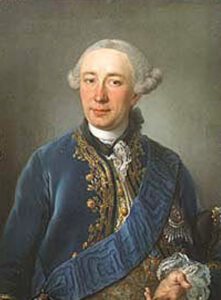
Heinrich Carl von Schimmelmann (1724-1782), a prominent German-born Danish merchant, banker, politician, and slave trader who owned four large plantations on St. Croix. His slaves were fed with saltfish from Newfoundland. (Image courtesy Wikipedia)
It was also a vital link in the international commerce between the so-called New and Old World. Nonetheless, the history of saltfish in the Danish West Indies is linked to the 17th century colonial plantation economy, the transatlantic slave trade, and how saltfish preserved well in a tropical climate for the enslaved population of the Caribbean region. In 1792, when the French Revolution took a radical turn, Charles Boudens, vicomte de Vanderbourg, from a noble family in France, was forced to flee his country. He fled to Germany and then to Denmark and later ended up in the Danish West Indies where he became a supervisor for Heinrich Carl von Schimmelmann, a prominent German-born Danish merchant, banker, politician, and slave trader who owned four large plantations on St. Croix.
In his note of the state of the enslaved Africans on Schimmelmann plantation, he mentioned saltfish, also called cod fish, as part of the food enslaved laborers consumed. “The neighboring Negroes of the towns purchase bread, butter, meats, and salted fish there, all of which are foreign provisions,” noted Venderbourg. In the late 1820s, Lt. Brady, a British navy officer, visited St. Croix. His brother was the manager of Mannings Bay on the south shore of St. Croix, a plantation where the Randall “Doc” James Racetrack is located today.
Brady had the opportunity to view the conditions of slavery in Mannings Bay and several other Crucian sugar plantations. In his findings, he published a book titled Observations on the State of Negro Slavery in the Island of St. Croix. In his book, he mentioned, “The legal weekly allowance of provisions there, and in the neighboring island of St. John, for each full-grown negro is six quarts of Indian corn-meal, or twenty-four pounds of yams, or other edible roots, and six herrings, or a proportion of other salted fish …”
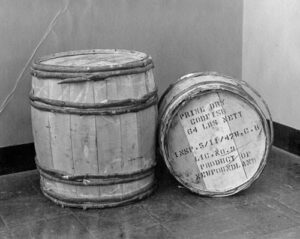
Wooden barrels containing dried salted cod. (Image courtesy Maritime History Archive, Memorial University of Newfoundland)
In the transatlantic slave trade, saltfish was a key commodity in the triangular trade of kidnapping Africans from Africa. Often saltfish was imported from Newfoundland or Europe alongside the transported supplies of sugars from the West Indies. King Frederik V (1746-1766) of Denmark was not known primarily for his dietary regulations. However, his administration in the Danish West Indies introduced dietary regulations affecting the treatment of the enslaved population in the mid-18th century.
This was primarily due to the 1733 slave insurrection, which highlighted how severe malnourishment and abuse was for the enslaved population in the Danish West Indies. The rights of medical care, family integrity, and other issues facing the enslaved population must be addressed, King Frederik V stated. Part of the dietary regulations was to allow each enslaved individual 10 years or older a weekly ration of three pounds of saltfish, beef, pork, etc.
The intention of this regulation was to standardize treatment for the enslaved population in the Danish West Indies and it was to be carried out by the colonial government. However, planters argued that such regulations were more disadvantageous than advantageous to their plantation operations. In other words, planters believed this new rule would cut into their operations expanding. The Danish West Indies was not the only market to import saltfish from Europe.
Brazil, which is known as “small Africa” due to the largest population of imported enslaved Africans in the Americas, had a major imported saltfish market from Europe, particularly from Newfoundland. In 1808, saltfish was first imported to Brazil when the country was still a Portuguese colony. Saltfish was also imported to the French and Spanish West Indies and to Dutch Caribbean island colonies.
The British West Indies, which included Barbados, Jamaica, British Guiana, Grenda, Trinidad, Dominica, St. Lucia, St Vincent, Tortola, and others, were also part of the saltfish market from Europe. In return, these islands’ products were sugar cane, including molasses and rum, at least until the abolition of slavery in 1833, because their economy depended upon enslaved Africans. Plantation owners in these regions needed a cheap source of protein for their slaves and later “free slaves,” and Newfoundland provided saltfish for that market
Fish and Fungi is now the Virgin Islands National dish. However, due to rations of saltfish and cornmeal by our ancestors, enslaved African women developed “fish and fungi or fungie.” Thus, saltfish has become one of the cornerstones of Virgin Islands native dishes. This product appears in stews, saltfish cakes, saltfish Gundy, fish pudding, fish loaf, saltfish pates, and the list goes on. Back in the day, eating saltfish on Good Friday was a tradition extending from slavery in the Danish West Indies.
According to the Bible, Jesus ate fish after his resurrection to prove to his disciples that he was physically alive and not a spirit. This scripture ties into a Virgin Islands traditional dish where saltfish, ground provisions like boiled sweet potatoes, yams, dumplings, green banana, boiled ripe plantains, and a boiled egg on the side was eaten on Good Friday. Traditionally, maubi was drunk on Good Friday as part of the lunch after the church service, although it can be drunk any time of the year. How can I forget Docouna, which was part of our Easter tradition in the Virgin Islands and throughout the Caribbean region?
After the 1848 emancipation of the enslaved population of the Danish West Indies, saltfish remained a staple diet for our ancestors due to its accessibility and affordability. In addition to the preservation of saltfish, local rock salt from our salt ponds provided salt for corning fresh local caught fish. As a result, saltfish became a tradition, bringing Africans, Europeans, and Caribbean folks together, connecting us with food, slavery, and freedom.
— Olasee Davis is a bush professor who lectures and writes about the culture, history, ecology and environment of the Virgin Islands when he is not leading hiking tours of the wild places and spaces of St. Croix and beyond.
Editor’s Note: Opinion articles do not represent the views of the Virgin Islands Source newsroom and are the sole expressed opinion of the writer. Submissions can be made to visource@gmail.com.
Morris Anselmi made his initial appearance in federal court Monday, two years after he was charged with misusing half a million dollars in Paycheck Protection Program funds. (Shutterstock image)
Appearing virtually before a federal magistrate judge Monday morning, Morris Anselmi pleaded not guilty to two-year-old federal wire fraud charges stemming from the alleged theft of half a million dollars in COVID-19 relief funds.
Anselmi and co-defendant Kimberly McCollum were first indicted two years ago, but proceedings have moved at a snail’s pace because of health issues that prevented Anselmi’s return to the territory. His initial appearance before Magistrate Judge Emile Henderson III came days after U.S. Marshals formally processed Anselmi’s arrest in Texas, where Anselmi’s attorney said he is living at a medical center and awaiting a heart transplant.
The delays in Anselmi’s case also complicated proceedings in the separate federal fraud case against Davidson and Sasha Charlemagne, in which Anselmi is a key figure and likely witness. The husband and wife were indicted in June 2024 alongside former V.I. Housing Finance Authority executive Darin Richardson over an allegedly inflated disaster recovery contract awarded to Anselmi and McCollum’s company, Island Services Group, and subcontracted to the Charlemagnes.
Anselmi did not testify in Richardson’s trial last year, and the former VIHFA chief operating officer was found guilty of making material false statements to a federal agent, having a criminal conflict of interest, bank fraud, money laundering and making false statements on a loan application last year. Richardson’s sentencing is scheduled for late March.
At the same time, the case against the Charlemagnes stalled while attorneys sparred over the admissibility of Anselmi’s testimony. During the first part of a court-ordered deposition in April, Anselmi reportedly acknowledged that he was testifying in hopes of receiving immunity, leading to confusion over whether his immunity agreement pertained to the PPP case, his involvement in the Charlemagnes’ alleged scheme, or both. Senior District Judge Wilma Lewis later concluded that the agreement only covered the woodpile case and that “in the absence of a change in Anselmi’s potential criminal exposure which would permit him to fully answer Defendant’s cross-examination questions … without a legitimate fear of self-incrimination,” his testimony would be excluded from trial.
Since then, attorneys have repeatedly told the court that they’re close to reaching a plea deal in the PPP case. During a status conference in the Charlemagnes’ case two weeks ago, Assistant U.S. Attorney Denise George said a new immunity agreement “should be completed shortly,” allowing them to resume Anselmi’s deposition. Following a separate status conference, Anselmi and McCollum’s attorneys told the court that they had reached a resolution with the government and were in the process of having the documents signed by all parties.
“This matter does not need to be scheduled for trial,” they wrote in a Feb. 27 filing.
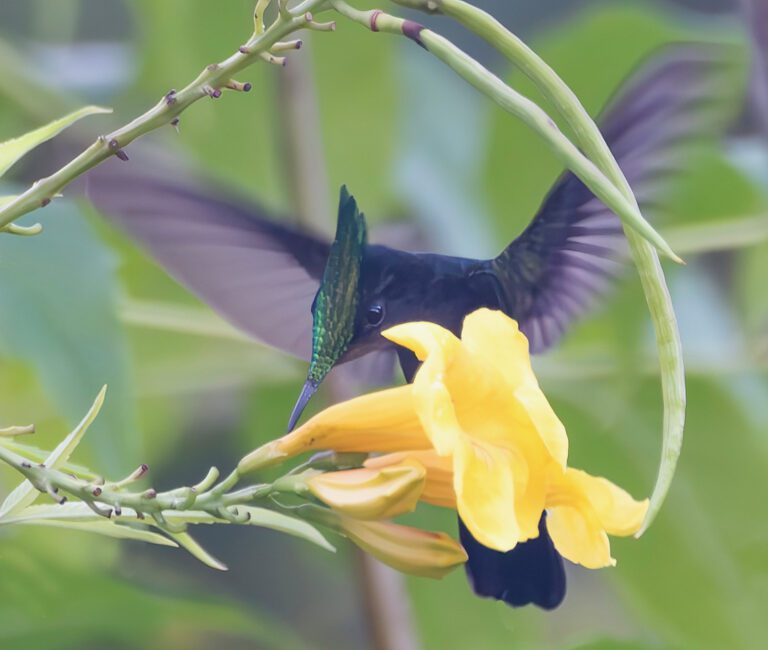
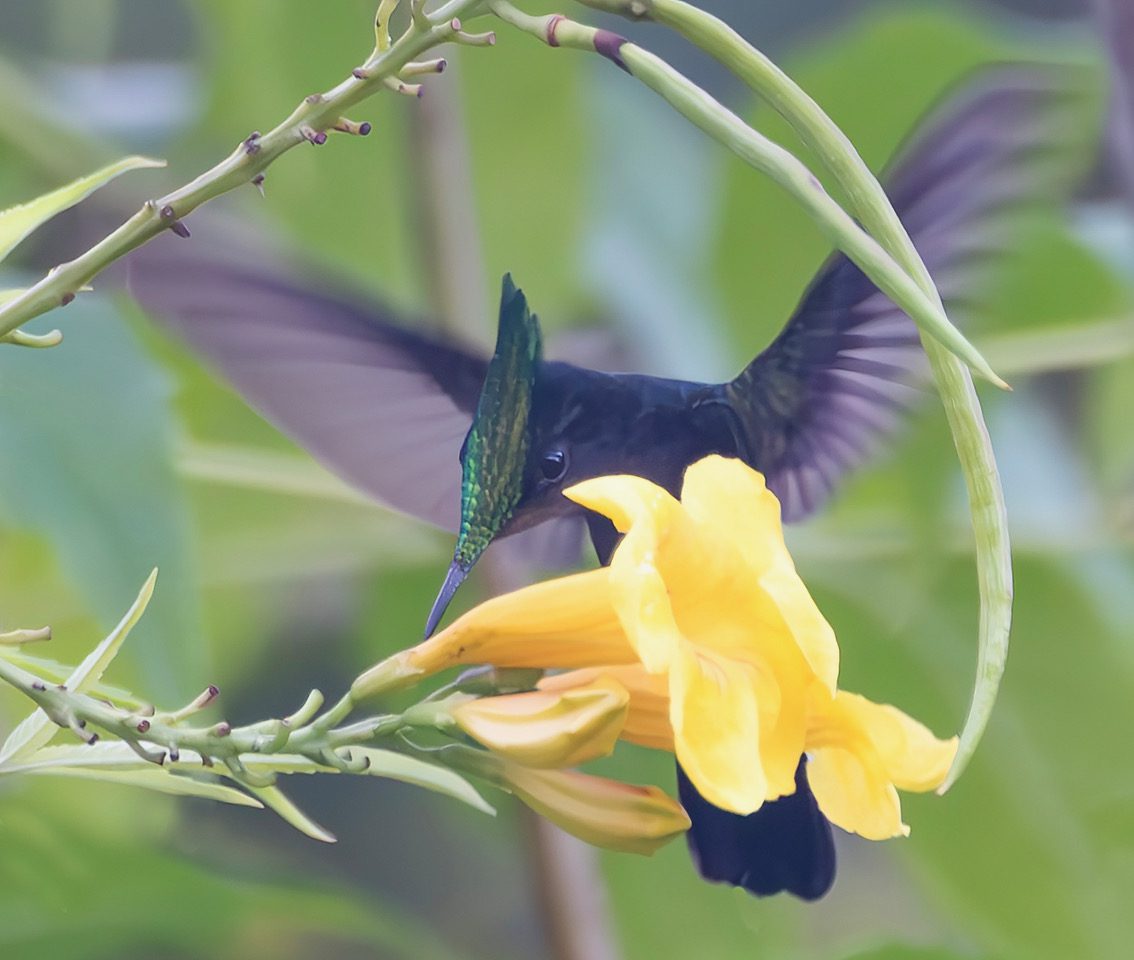
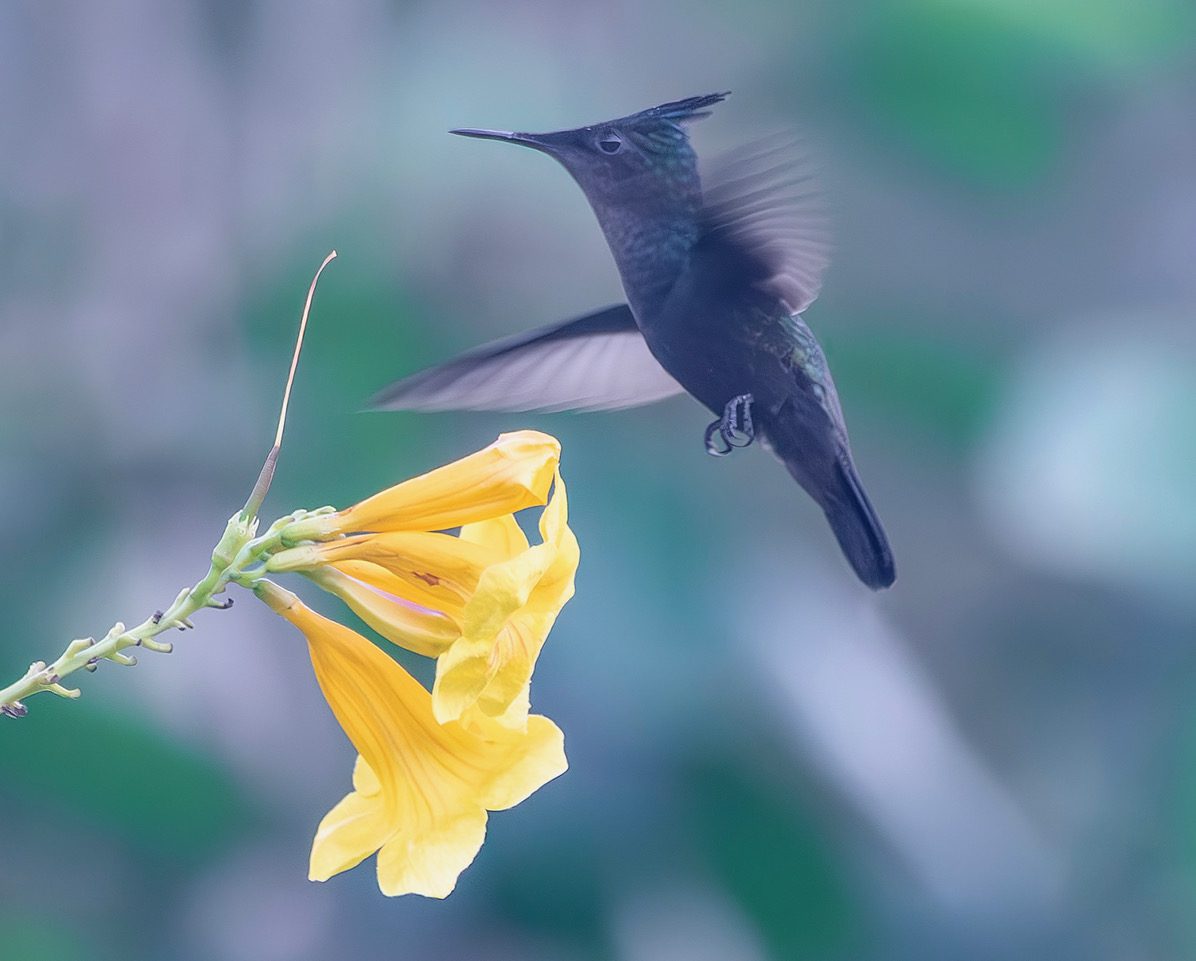
A male Antillean Crested Hummingbird pierces the base of a Ginger Thomas flower. (Photo Gail Karlsson)
When I noticed several Antillean Crested Hummingbirds flitting around the Ginger Thomas flowers I thought, how sweet, they are busy pollinating the flowers. But no!
I went to get my camera, and took some shots with my telephoto lens. At a distance I hadn’t been able to see exactly what the birds were doing, but when I looked at the photos in my computer I was shocked.
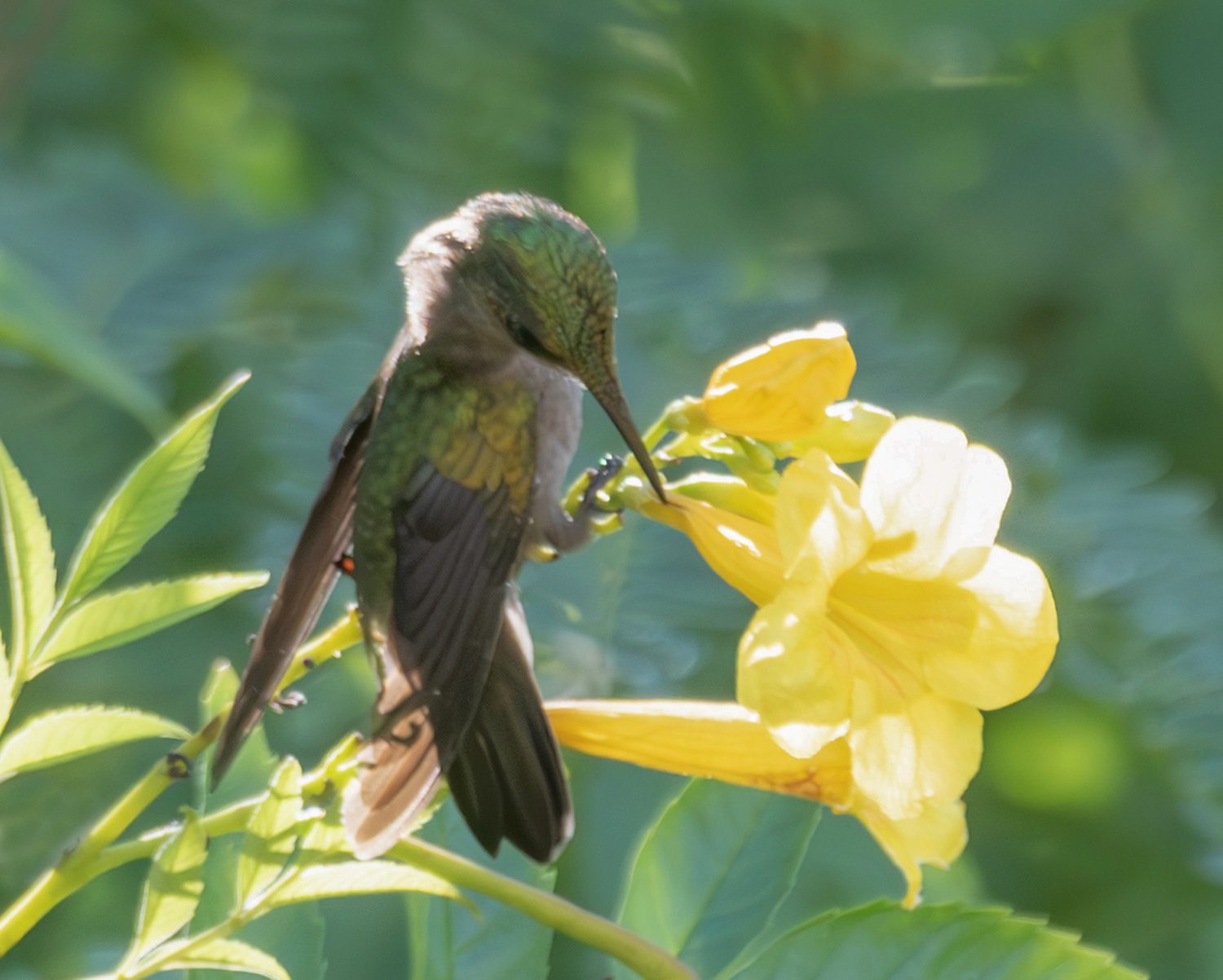
They weren’t even thinking about pollinating the flowers! These birds were entirely bypassing the insides of the trumpet-shaped flowers, where the female stigmas were waiting patiently to receive male pollen grains that would fertilize them.
Instead the hummingbirds were staying outside and sticking their sharp beaks into the flower bottoms, sucking out the sweet liquid directly from the nectar sac.
Flowers produce nectar to provide an enticement and reward for visitors that then pick up pollen (often inadvertently) and transport it from one flower to another. Food in exchange for cross-pollination services. Not a free lunch.
Female Antillean Crested Hummingbirds are lighter in color and lack the crest. (Photo Gail Karlsson)
Self-pollination by a flower leads to lack of genetic diversity, with diminished strength and adaptability of the resulting seeds and seedlings. Like many other trees, a Ginger Thomas (Tecoma stans), also known as Yellow Trumpetbush, makes an effort to avoid self-pollination. One measure, for example, is to set different times of day for pollen dispersion and stigma receptivity within a flower, so self-pollination can’t happen by mistake.
The Ginger Thomas really wants the birds and bees to come and bring outside pollen into contact with the flower’s inner reproductive parts. The flower uses its bright yellow color and an enticing scent to attract potential pollinators. How frustrating then for the flowers to instead be poked, probed, and robbed of their laboriously made sweet fluids with nothing to show for it.
In defense of the Antillean Crested Hummingbirds, the issue might be that their bills are too short — maybe only half an inch — so they can’t reach the nectar sac by going through the natural flower opening, which is narrow, and can be two inches deep. Then again, hummingbirds also have long tongues that are designed to extend way out past their bills to allow them to reach deep inside tubular flowers.
Maybe it’s just easier to break in.
Antillean Crested Hummingbirds hover with up to 80 wing beats per second. (Photo Gail Karlsson)
Interestingly, although Ginger Thomas has been designated as the official flower of the U.S. Virgin Islands, there is some question about whether it is actually native in these islands. So perhaps it is unfair of me to accuse the crested hummingbirds of violating some ancient coevolution pact in this relationship.
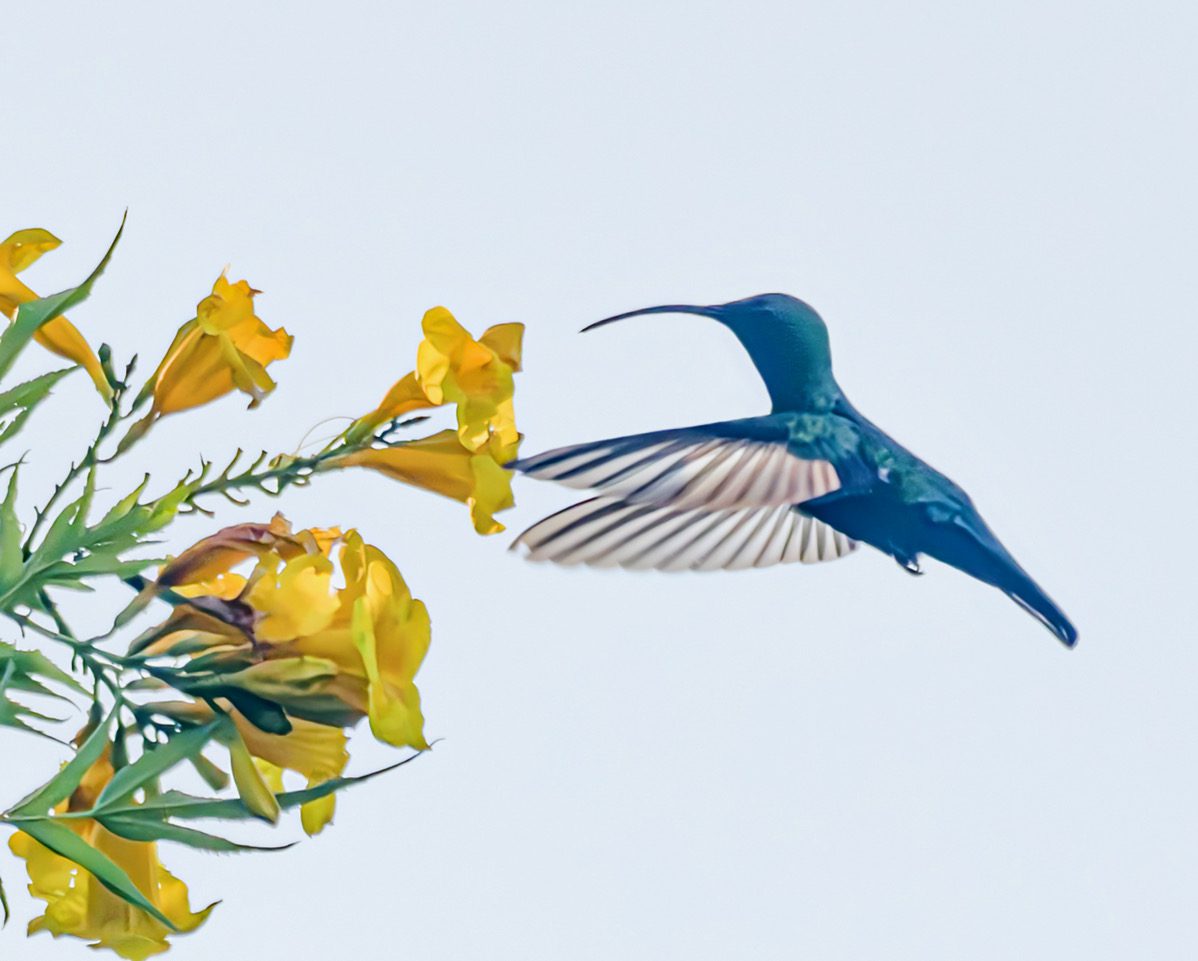
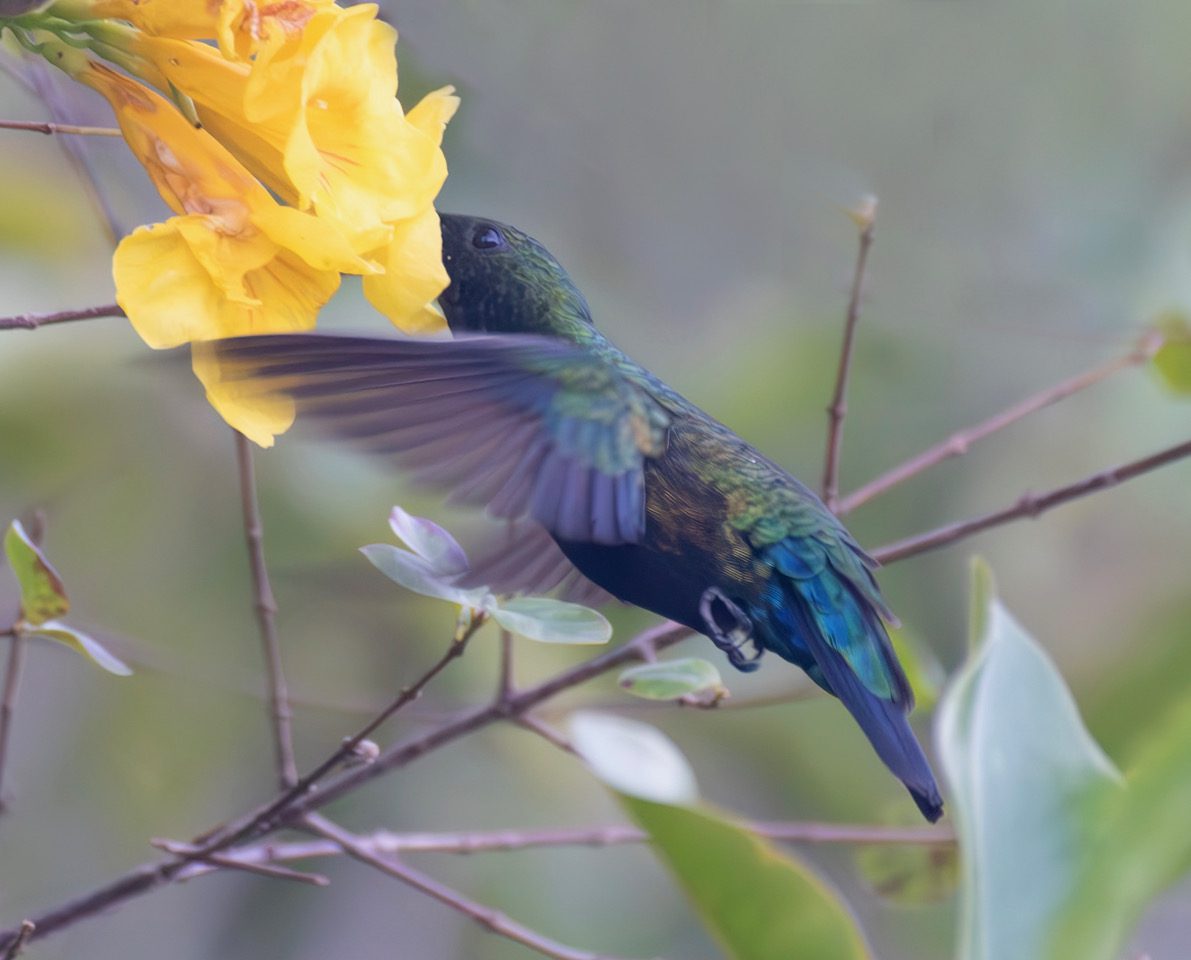
Other common local hummingbirds, the Green-throated Caribs, don’t seem to have any trouble reaching inside the Ginger Thomas flowers and performing pollinator duties. They are larger and have longer, curved bills. Probably also longer tongues.
A Green-throated Carib hummingbird approaches a Ginger Thomas flower from the front, not the back. (Photo Gail Karlsson)
However, they are happy to go to feeders, bypassing the flowers and their pollination needs altogether. (Something to think about when you put out sugar water for them.)
A Green-throated Carib hummingbird hovers in place while it drinks nectar. (Photo Gail Karlsson)
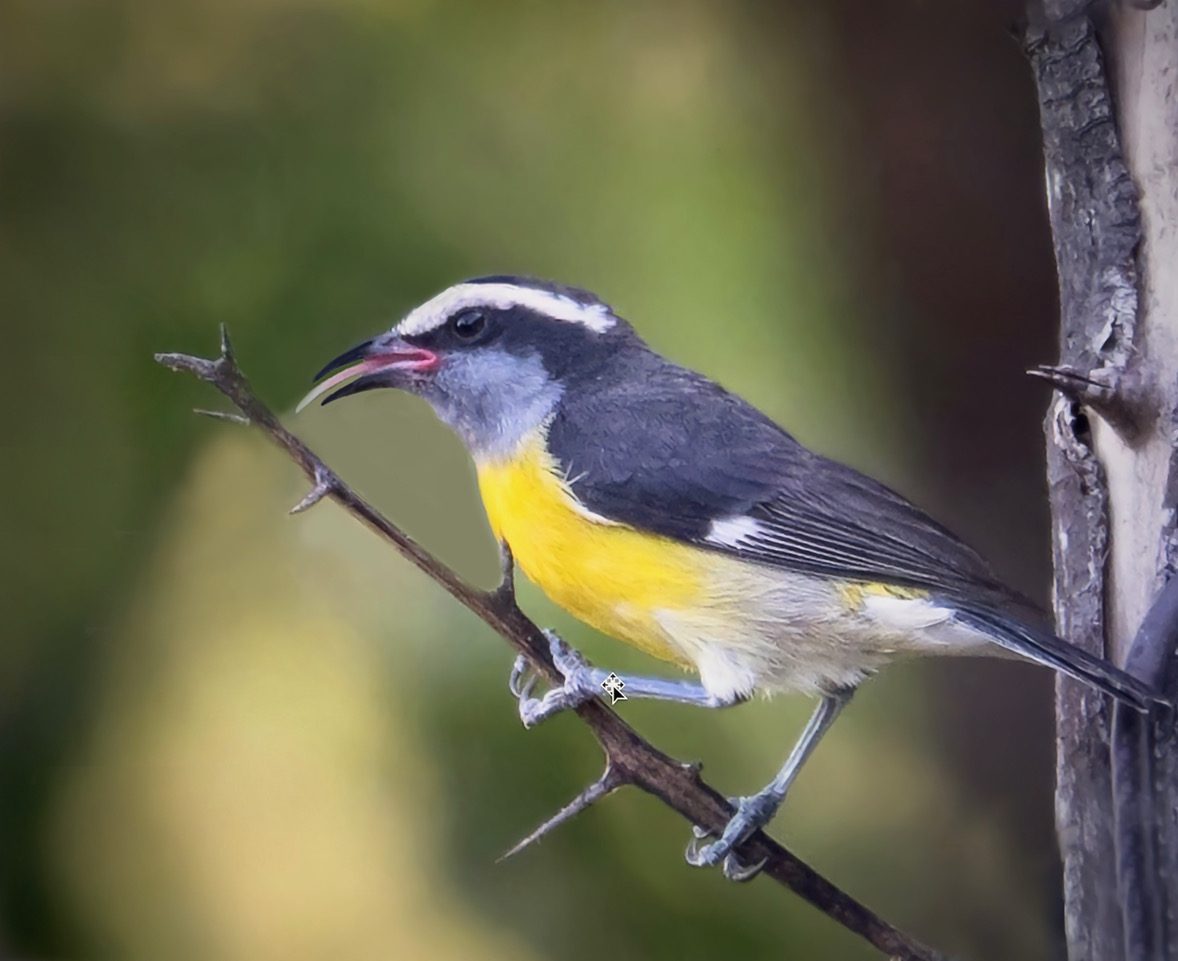
I also saw Bananaquits exploring the Ginger Thomas flowers. They are known as ‘Sugar Birds’, so of course they would be attracted to the sweet nectar. But they certainly don’t have the right type of bill to slip inside the elongated Ginger Thomas flowers.
From watching the Bananaquits, though, I know that they too have long tongues, which they sometimes use to drink from hummingbird feeders.
Like hummingbirds, Bananaquits have tongues designed to drink nectar. (Photo Gail Karlsson)
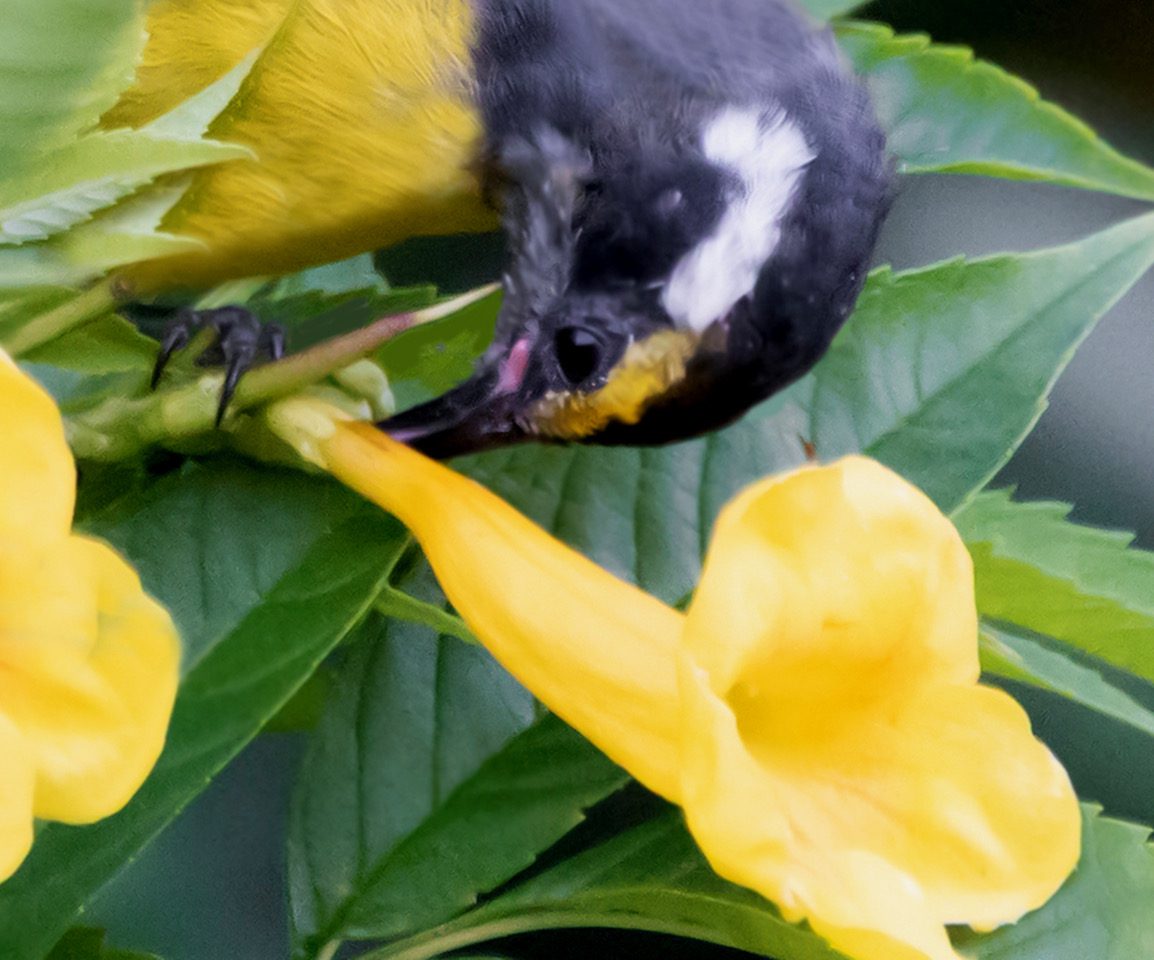
Nevertheless, the Bananaquits followed the example of the Antillean Crested Hummingbirds and just poked holes in the flowers.
Ginger Thomas flowers are soft, and easy to pierce. (Photo Gail Karlsson)
Meanwhile, it’s not only birds that are nectar robbers. Bees do it too!
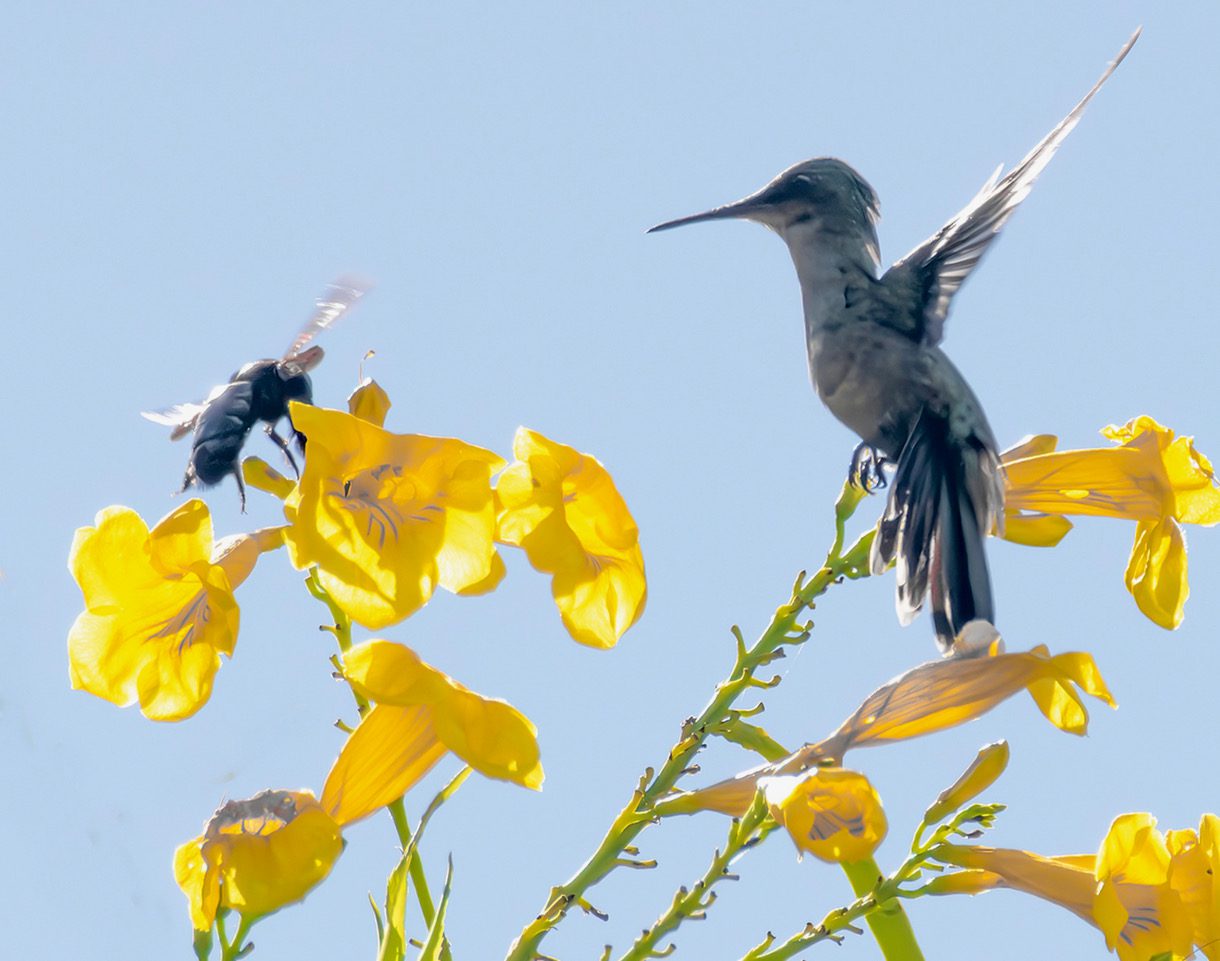
A few big, shiny black Carpenter Bees came to the Ginger Thomas flowers and went straight for the flower ends. These are native solitary bees — they don’t live in hives with other bees. They are called ‘carpenters’ because they bore holes in tree branches and other wood to make nests. Then they place ‘bee bread’ made out of pollen and nectar in the nests with their eggs to provide food for the emerging larvae.
A Carpenter Bee follows the lead of an Antillean Crested Hummingbird. (Photo Gail Karlsson)
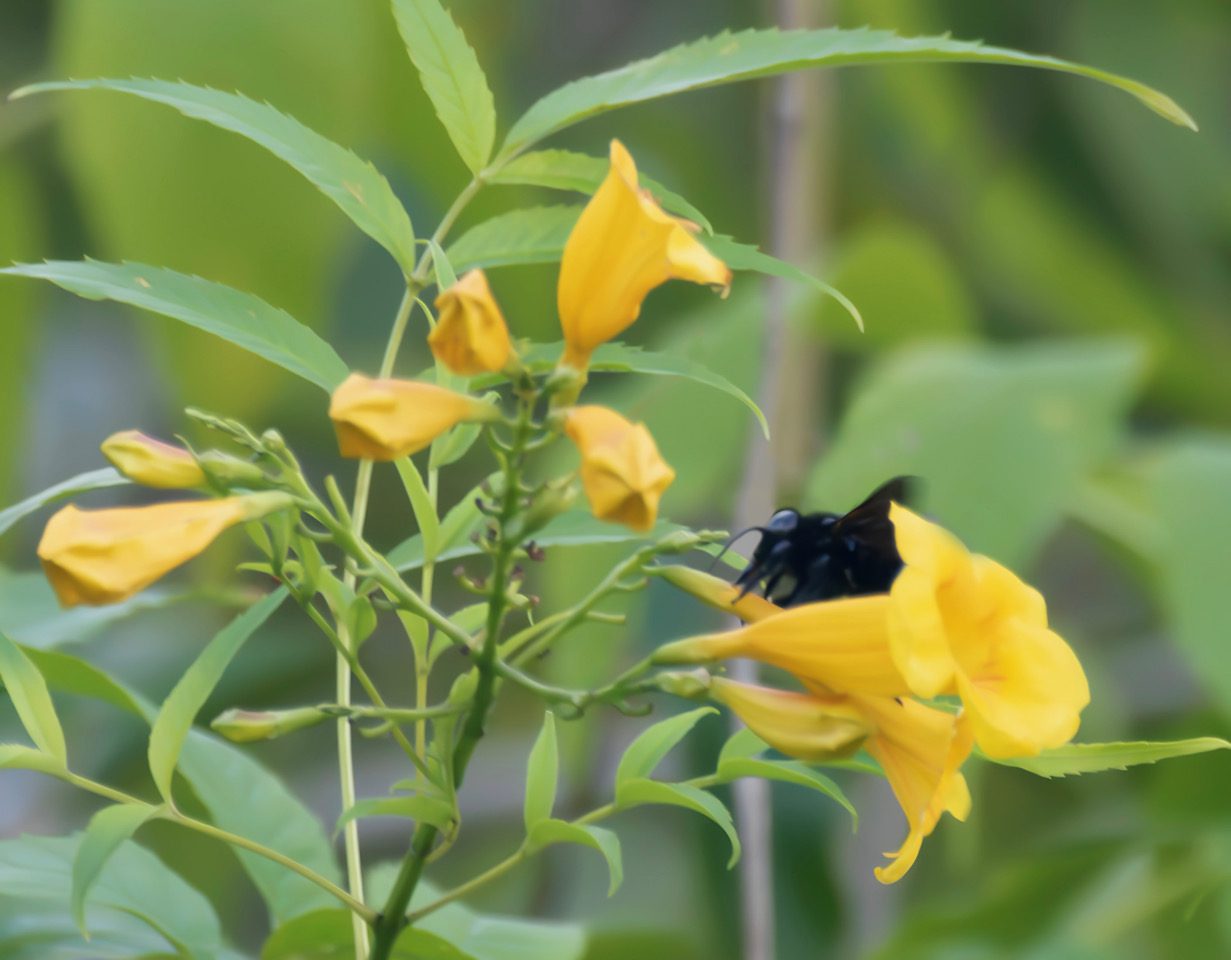
Too bulky to crawl inside Ginger Thomas flower, a Carpenter Bee can use its sharp, wood-cutting mandibles to make an incision at the base of the flower. Then it can suck up nectar from the hole through its straw-like tongue or proboscis, which clearly isn’t long enough to reach down inside the Ginger Thomas flower. Or it might go to a hole already made by a bird to mop up any leftover nectar seeping out.
Carpenter Bees collect nectar and pollen to put in nest holes for their larvae to eat. (Photo Gail Karlsson)
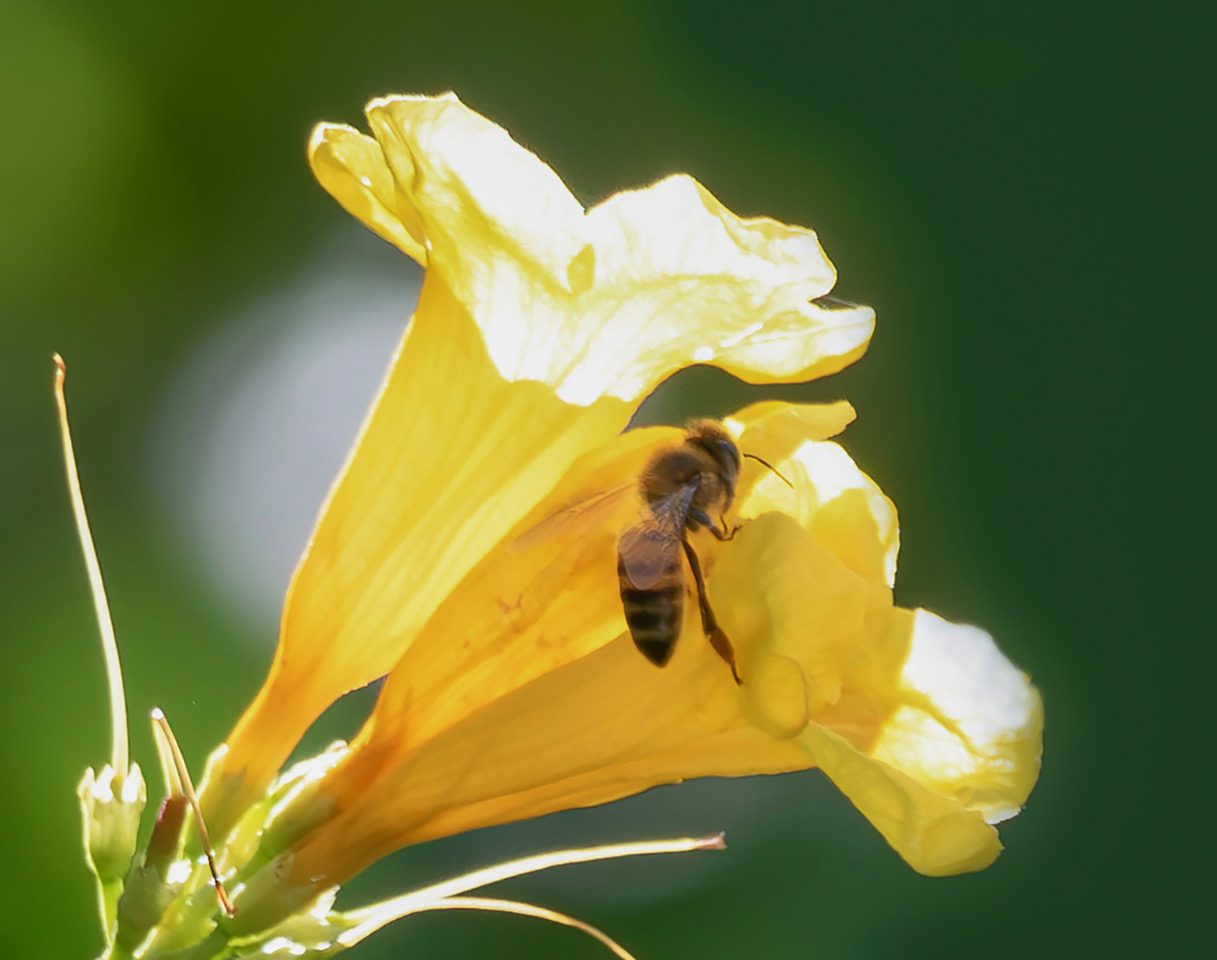
European Honeybees come to the Ginger Thomas flowers too. They were brought here to pollinate crops, but they will go to wild trees as well (sometimes reducing nectar availability for native bees). A honeybee will crawl in and out of different flowers, drinking nectar through its proboscis. Meanwhile, it is also collecting pollen in sacs on its legs and transferring some of it to other flowers, thereby facilitating pollination.
But a honeybee might instead use an already-made hole to suck up nectar, as will other possibly pollinating insects, like ants and wasps.
Though honeybees are generally good pollinators, they sometimes take nectar from holes in the flowers. (Photo Gail Karlsson)
It turns out that nectar robbing is actually pretty common behavior. Too much thieving from flowers could significantly reduce the ability of trees to get pollinated. Or cause hardship to other would-be pollinators that lose out on going to those flowers and getting nectar as a food source.
Yet the Ginger Thomas trees seem to be thriving, despite all the nectar robbing. On the other hand, the Antillean Crested Hummingbirds became pretty scarce after the 2017 hurricanes, and still might need some extra resources.
Perhaps the Ginger Thomas trees have adapted their nectar production to take the skimming into account. Or are actually being generous in feeding the neighborhood birds and bees, and would characterize these interactions as interspecies generosity rather than robbery.
— Gail Karlsson is the author of a photo book Looking for Birds on St. John, as well as two other books about nature in the Virgin Islands –The Wild Life in an Island House, and Learning About Trees and Plants – A Project of the Unitarian Universalist Fellowship of St. John. Follow her on Instagram @gailkarlsson and gvkarlsson.blogspot.com. More info at gailkarlsson.com
Joseph Alton Estick a.k.a. “Joe” or “Estick” of Lorraine Village, transitioned into eternal life on Feb. 9. He was 74 years old.
Joseph Alton Estick
He was preceded in death by his mother Clarice Estick; father, James Estick.
He is survived by his daughter, Iris Estick, Emily Estick; sons, James Estick, Clint Estick and Joseph Estick Jr.; grandchildren, Jahmayah Hospedales, RaNleka, Ras Seloh, Ras Enoch, Ras Ali, Rakebwi Caesar, Na’Carra, Na’Cayah, Na’Coi Estick, Zyeim, Zyra Estick, Maleyah Estick, Joseph Estick, Melasia Estick, Zaire Estick, Zmare Estick; sisters, Miriam Estick, Iris N. Lewis; nieces, Shani Estick, Carol Francis, Natalie LaVerne Leveille, Audrey Eugennie Lewis; nephew, Aubrey Eugene Lewis, Jr.; great-nieces, Jia-li Lewis, Cartia Leveille, Shomyra Francis, Cheryl Ravariere; great-nephews, Carlaurent Leveille, JaMichael Lewis, D’Andre Lane, Javiel-Antonio Rodriguez, Shomari & Shandell Beharry, Isiah Williams; brothers-in-law, Aubrey Eugene Lewis Sr., Olson Wallace; cousin and other relatives, The Rawlins Family & Clarke Family; other relatives and friends too numerous to mention.
Funeral service will be held on March 12 at Bethel Seventh Day Adventist Church. Viewing will begin at 9:30 a.m. with service at 10:30 a.m. Interment will follow at Kingshill Cemetery.
Professional arrangements are entrusted to James Memorial Funeral Home, Inc.
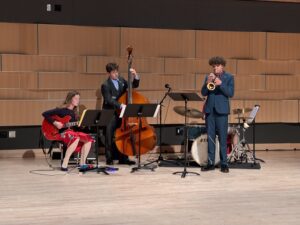
Virgin Islands 10th Grader DJ Parson, tours with world-renowned cellist Yo-Yo Ma and the Interlochen Arts Academy this week.
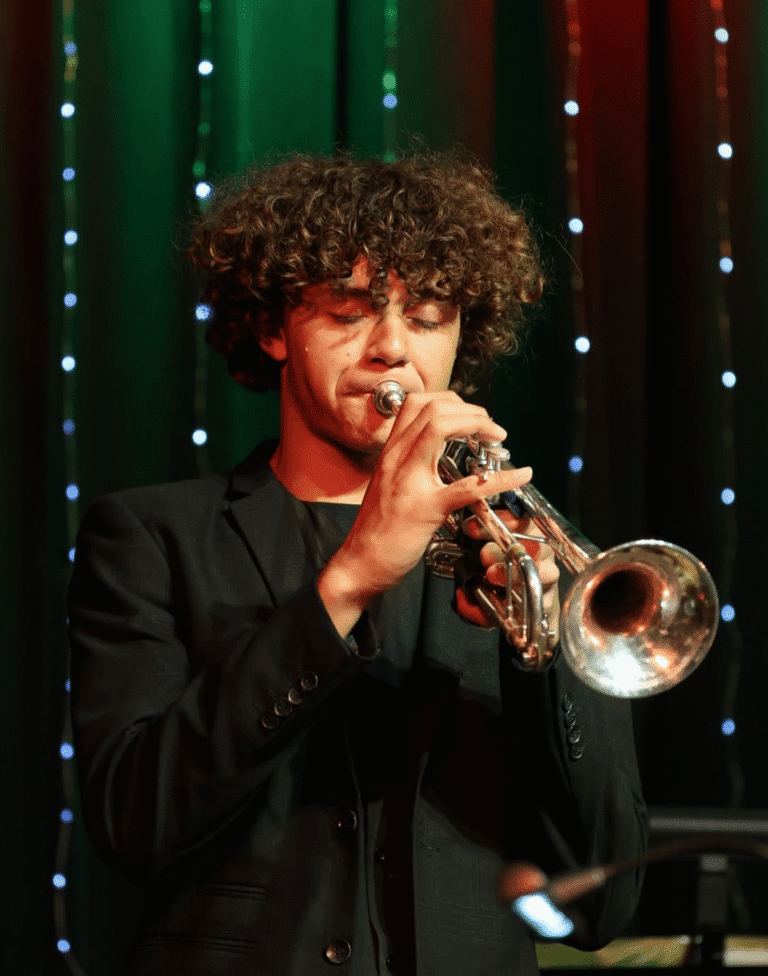
Trumpeter DJ Parson jr., 16, is from St. Thomas. (Submitted photo)
The March 7-15 tour is a collaborative project with the Boston Symphony Orchestra, The Philadelphia Orchestra, and the Detroit Symphony Orchestra and features side-by-side performances with members of each orchestra, many of whom are Interlochen alumni. Cristian Măcelaru, Artistic Director and Principal Conductor of Interlochen’s World Youth Symphony Orchestra and Music Director Designate of the Cincinnati Symphony Orchestra, and Interlochen Arts Camp and Academy alumnus, will conduct.
During the tour—which will kick off at Interlochen and include stops in Detroit, Philadelphia, and Boston — students will present a program featuring a new cello concerto by Wynton Marsalis commissioned by Interlochen; Reena Esmail’s “RE|member”; and, a reimagined performance of Charles Ives’ Symphony No. 4 including multidisciplinary elements by students from all seven of the Academy’s artistic disciplines.
Cellist Yo-Yo Ma has been working with Arts Academy students and will serve as the soloist for the Marsalis concerto for the performances in Interlochen, Philadelphia, and Boston. Isidore String Quartet cellist, Arts Academy alumnus, and Detroit native Joshua McClendon will appear as the guest soloist for the Detroit performance. Performance dates and locations for the spring 2026 tour are:
● Saturday, March 7 – Corson Auditorium | Interlochen, Michigan
● Tuesday, March 10 – Orchestra Hall, Max M. and Marjorie S. Fisher Music Center | Detroit, Michigan
● Friday, March 13 – Marian Anderson Hall, Kimmel Center for the Performing Arts | Philadelphia, Pennsylvania
● Sunday, March 15 – Symphony Hall Boston, Massachusetts
St. Thomas Dion Johan (DJ) Parson jr., 16, is from St. Thomas.
DJ Parson, an alumnus of Antilles School, Inc., on St. Thomas, U.S. Virgin Islands, where, fully supported by the school and its music program, he was allowed to follow his passion since kindergarten.
Currently, a trumpet jazz major student at the Interlochen Arts Academy, he has been selected to join the Imagine US: Celebrating America at 250 tour as the only jazz horn player.
In this unique role, he contributed to scoring music for film presentation, performs on stage the music of the film production live and presents words of gratitude alongside Trey Devey (the president of Interlochen Center for the Arts), and had the honor to work directly with legendary jazz artist Wynton Marsalis preparing for his performance with the Interlochen jazz quartet for the tour’s sponsor and donors post reception.
DJ’s journey, from a young musician growing up in the Virgin Islands, supported by his community, to performing in a national artistic celebration, reflects the power of mentorship, dedication, and access to worldclass arts education. His participation stands as a powerful reminder that when young Virgin Islanders are allowed to grow through the arts, their voices can reach the world’s largest stages.
The Tour
“Interlochen Arts Academy students from 45 U.S. states and territories, 27 countries, and other young artists from the tour areas will come together, exemplifying the power of the arts to foster understanding and connection, and to help advance the ideals of a democratic society,” explained Trey Devey, President of Interlochen Center for the Arts. “This tour gives an important youth voice to programming in honor of the nation’s semi-quincentennial, creating mini-festivals in each community, reinforcing the essential role of youth arts education, and providing our incredibly talented students with the chance to be mentored by some of the world’s finest musicians as they explore what it means to be a citizen artist. Interlochen is proud to bring current students and the many alumni who hold positions in these orchestras together as we begin celebrations leading to our centennial in 2028.”
“We are delighted to collaborate with partners who share our commitment to citizen artistry and to inspiring the next generation of artists,” said The Philadelphia Orchestra President and CEO Ryan Fleur. “As we celebrate America’s 250th birthday, we look to the future and to the young people who will help to shape it. This impactful partnership will provide unique opportunities for the next generation of creatives to hone the skills that will enable them to positively impact society through their artistry.”
“The Boston Symphony Orchestra is honored to host Interlochen Arts Academy as part of their extraordinary tour celebrating the 250th anniversary of our nation’s founding. Artistic explorations like these remind us of the vital role the arts have played in shaping America’s story—expressing our shared history, inspiring new perspectives, and bringing people together across generations. By uniting young artists with world-class musicians, this collaboration embodies the spirit of creativity and mentorship that continues to define our nation’s cultural legacy. We look forward to welcoming these exceptional young musicians to Symphony Hall and celebrating the power of music to connect us to our past and guide us toward the future,” said Chad Smith, the Boston Symphony Orchestra’s President and CEO.
Currently, 15 alumni and two alumni parents are musicians with the Boston Symphony Orchestra, nine alumni and one alumni staff member are musicians with The Philadelphia Orchestra, and 16 alumni and five alumni staff members are musicians with the Detroit Symphony Orchestra.
The March 2026 Detroit performance marks the 100th anniversary of the collaboration between Interlochen and the Detroit Symphony Orchestra, which began in 1926 with the inaugural performance of the National High School Orchestra—the precursor to Interlochen Arts Camp—at the DSO’s Orchestra Hall. Over the decades, DSO musicians and conductors have regularly served as faculty members and guest artists at Interlochen Arts Camp and Arts Academy. Since 2019, the orchestra has conducted annual residencies at Interlochen Arts Camp which include a public concert by the DSO, master classes, and a side-by-side performance featuring the World Youth Symphony Orchestra and musicians from the DSO.
“The Detroit Symphony Orchestra celebrates its shared history with Interlochen as national leaders in arts education, particularly in bringing the joy of music to young people in the state of Michigan for a century,” said Erik Rönmark, President and CEO of the DSO. “We can think of no more fitting tribute to the 100th anniversary of our collaboration than this concert by the Interlochen Arts Academy Orchestra at Orchestra Hall in Detroit with DSO musicians who are Interlochen alumni and cellist Joshua McClendon.”
Interlochen Arts Academy’s 2026 tour will build on many recent student touring opportunities, including a performance as part of the New York Philharmonic’s 2022-23 season and a critically acclaimed 2016 performance by the Arts Academy Orchestra at the NY Phil Biennial. Other recent Arts Academy tours include a multidisciplinary performance at Miami’s New World Center in early March 2020 and premieres of new works at National Sawdust and Carnegie Hall in February 2019.
This tour is one of several major initiatives leading up to Interlochen’s Centennial celebrations in 2028.
For complete biographical information for Interlochen’s 2026 tour partners, please visit:
Yo-Yo Ma at https://www.yo-yoma.com
Wynton Marsalis at https://wyntonmarsalis.org/
Cristian Măcelaru at https://macelaru.com/
Reena Esmail at https://www.reenaesmail.com/
Boston Symphony Orchestra at https://www.bso.org/
Detroit Symphony Orchestra at https://www.dso.org/
The Philadelphia Orchestra at www.philorch.org
About Interlochen Center for the Arts
The nonprofit Interlochen Center for the Arts is a recipient of the National Medal of Arts and the only organization in the world that brings together a 3,400-student summer camp program; a 580-plus-student fine arts boarding high school; a year-round source of expert online arts education for children, teens, and adults; opportunities for adults to engage in fulfilling artistic and creative programs; two 24-hour, listener-supported public radio services (classical music and news); more than 600 arts presentations annually by students, faculty, and world-renowned guest artists; a robust hospitality division that curates on-campus lodging, dining, and transportation services; and a global alumni base spanning nine decades, including leaders in the arts and all other endeavors. For information, visit Interlochen online at www.interlochen.org



 VIWMA appreciates the community’s ongoing support in keeping our islands clean. Your involvement strengthens neighborhoods, protects the environment, and helps preserve our paradise.

 Because of Susan’s deep love of the ocean, St. Croix, and the natural world, she chose to return to the waters she cherished. She will be laid to rest at sea.