

 In her biweekly column, “State of the Territory,” former Sen. Janelle K. Sarauw delves deeper into issues of concern for V.I. residents.
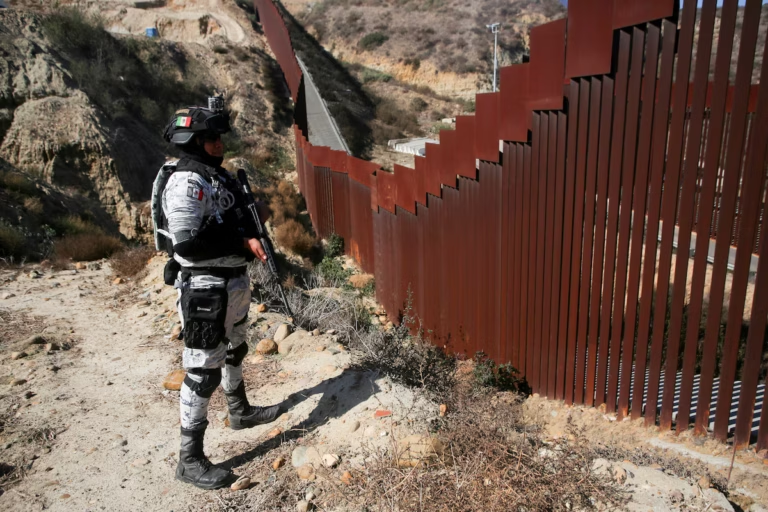
The phrase, “Mexicans didn’t cross the border, the border crossed them,” encapsulates a profound historical truth about the United States’ territorial expansion and its enduring impact on immigration and Latin American stability. Too often, discussions about immigration policy in the U.S. are framed as if migrants from Mexico and Central America arrive in search of opportunity with no historical context. In reality, the cycles of migration and mass deportation today are deeply tied to America’s own history of conquest, intervention, and economic policies that have shaped the fates of millions.
How the U.S. Acquired Mexican Lands
The U.S. acquisition of nearly half of Mexico’s territory was not a peaceful process – it was one rooted in war, expansionist ideology, and coercion. In the early 19th century, American settlers flooded into Texas, encouraged by the Mexican government to populate the northern frontier. However, tensions soon arose as these settlers, mostly from the South, resisted Mexican laws, particularly those banning slavery. The Texas Revolution (1836) resulted in Texas declaring independence from Mexico, and in 1845, the U.S. annexed Texas, setting the stage for war.
The Mexican American War (1846-1848) – a conflict deliberately provoked by the U. S. – resulted in the Treaty of Guadalupe Hidalgo, where Mexico was forced to cede vast territories in exchange for a paltry $15 million. This land grab included what are now California, Nevada, Utah, Arizona, New Mexico, and parts of Colorado, Wyoming, Kansas, and Oklahoma. Five years later, in 1853, the Gadsden Purchase added southern Arizona and southwestern New Mexico, finalizing the U.S.-Mexico border.
For the Mexican communities living in these territories, the border had moved, not them. They went from being Mexican citizens to living under a U.S. government that often treated them as foreigners on their own land.
How U.S. Foreign Policy Destabilized Latin America
Beyond the loss of land, U.S. policies in Latin America have directly fueled the migration crises we see today. From military interventions to economic exploitation, American actions have contributed to the very conditions that push millions to flee their homes.
- Military Interventions and Economic Exploitation
Under the Monroe Doctrine (1823), the U.S. asserted dominance over the Western Hemisphere, often intervening militarily to protect its own interests. The Banana Wars (1898-1934) saw U.S. forces invade multiple Latin American nations to ensure control over resources and trade routes. In Guatemala (1954), the U.S. orchestrated a coup to overthrow democratically elected leader Jacobo Árbenz because his land reforms threatened American corporations like United Fruit Company.
During the Cold War, the U.S. propped up brutal dictatorships across the region under the guise of fighting communism. In Chile (1973), the CIA supported a coup against President Salvador Allende, replacing him with the ruthless Augusto Pinochet. In Nicaragua (1980s), the U.S. funded the Contras, fueling a deadly civil war. In El Salvador, U.S. military aid supported a government accused of massacres and human rights abuses.
- The War on Drugs and Increased Violence
The U.S. War on Drugs militarized Latin America, strengthening corrupt regimes and deepening cycles of violence. In Mexico and Colombia, American funding turned local conflicts into full-scale wars, leading to mass displacement and economic devastation. Entire communities were left without opportunities, fueling waves of migration.
- NAFTA and Economic Displacement
The North American Free Trade Agreement (NAFTA) (1994) further destabilized Mexico. While the deal was touted as a means to boost trade, it flooded Mexico with cheap U.S. agricultural products, decimating small farms and leaving millions unemployed. As a result, many sought work in the U.S., fueling migration.
From Expansion to Deportation
Despite its deep role in creating the conditions that drive Latin American migration, the U.S. has historically responded with mass deportations and harsh immigration policies. From Operation Wetback (1954), which deported over a million Mexican workers, to modern policies separating families at the border, the U.S. has treated Latino migrants as a problem rather than recognizing its own complicity in their displacement.
The history of U.S. expansion and intervention is directly linked to today’s immigration crises. The people crossing the border today are, in many cases, fleeing conditions that the U.S. helped create. A real conversation on immigration reform must acknowledge this history and move beyond punitive measures to address the root causes of migration. Until then, we will continue to repeat the cycle – one where the border crossed people long before they ever crossed it.
The Current State of U.S. Immigration Policy
Today’s immigration policies remain largely focused on deterrence rather than addressing the underlying causes of migration. The construction of border walls, increased militarization of border patrols, and mass deportations do little to curb migration because they fail to address why people leave their homelands in the first place. Instead of criminalizing asylum-seekers and refugees, the U.S. should take responsibility for its historical role in destabilizing the region and work toward policies that promote economic development, political stability, and humanitarian protections.
Policies like the Remain in Mexico program, Title 42 expulsions, and family separations ignore the reality that many migrants are fleeing violence and economic collapse, conditions often exacerbated by American intervention. A humane and effective immigration policy must go beyond border enforcement and include investment in Latin American economies, fair trade agreements that do not exploit local workers, and asylum processes that recognize the U.S.’s moral obligation to those it has displaced.
The border may be a political boundary, but history shows that its effects extend far beyond geography. Until the U.S. reckons with its past, its immigration policies will remain reactionary, failing to address the root causes that drive people to seek a better life elsewhere.
Editor’s Note: Opinion articles do not represent the views of the Virgin Islands Source newsroom and are the sole expressed opinion of the writer. Submissions can be made to visource@gmail.com.






















Op-Ed: The Lounge | A Column for Men: Dad Diaries: Daughters
One of my personal goals and public crusades is to become part of a collective of men who have taken up the mantle of impactful fatherhood. I will be the first to admit that I did not always make the best choices as a father and role model; I was sometimes absent, disengaged, uninterested, and subpar overall. I speak on this in my book “Baby Daddy: Changing the Narrative.” This book was just as much an introspective journey into my own deficiencies as it was a vulnerable dive into many of the things men do and don’t do. I will plug myself here, if you have not picked up a copy of this book, I recommend it (available on Amazon).
Parenthood is a challenging but worthwhile privilege. I must stress that point because there are many people and couples who want to have a child and cannot. Of course, we understand that there are adoption and fostering opportunities which are equally impactful for young people deprived of love and support. However, there is something special about birthing and raising your own children that can’t be completely quantified or understood. With this in mind, I reemphasize the opportunity to bring a life into this world and raise it.
As men, we often want to have a son to carry on our lineage. We can be rough and tough with them and do all the cool “boy” stuff. It is often said that it takes a man to raise a man. However, it depends on the kind of man you are that will determine how that youngster will develop. This, of course, means you must first be involved. This is a privilege and a responsibility. We should retrain our minds from “I have to raise this child” to “I get to raise this child.” You have a chance to create and effect change through your lineage, as well as your legacy.
Today, I want to highlight the importance of our role in the lives of our daughters. I was having a conversation recently with a young lady who talked about the behavior that was first modeled, then emulated. She spoke about her mother accepting abuse, neglect, and infidelity. Witnessing these regular occurrences framed what she would believe to be a relationship should be. She excused the same types of behaviors in her own dating life due to that foundation. All she knew was men having other families and children outside of the relationship and the neglect because attention was elsewhere. In extreme cases, we see unwanted advances by older men (typically in the home) on younger women.
This is not the forum to dissect those issues from a psychological viewpoint. Suffice it to say that many women grow up with a skewed sense of love and relationships can be directly tied to the type of men they had been exposed to. Bringing us to a question that is often asked, but seldom contemplated on deeply; would you want your daughter to date a man like you? Do you represent the type of person you would want her to build a life with? Do you teach her to respect herself and to have boundaries?
A daughter’s first love is her father, or that male role model that has stepped in to provide stability. What she sees and how she begins to process the dynamics between men and women stem from her observations as well as interactions. Like the young lady I mentioned earlier, what you normalize is what will ultimately be her reality, at least until she liberates herself from those types of attachments. You play the most pivotal role in who she will become and how she will discover her place in the world. You have a duty to be a good example.
WE should be ashamed of ourselves. We often talk about the behaviors and predispositions of some women, who are direct reflections of either poor fathers or absentee fathers. We mock the term “daddy issues” as if we aren’t responsible (as a gender) for the issues existing in the first place. We berate women for being products of environments we created. Pot calling the kettle black, don’t you think? Of course, this doesn’t apply to every person and does not excuse irreverent behavior on either side of the fence. We do need to take some accountability, though.
But there is always hope. Many of us, me included, started out being the absolute worst version of not only ourselves, but of men. I, like many in my circle and those I have worked with and been connected to, took a stance to become something better and to impart that with our children. My daughter and I, through time, hard work, tough conversations, and overcoming outside struggles, have built a blossoming, healthy relationship. We talk daily about everything from boyfriends (talk about uncomfortable) to future plans, travel, and fashion. She is comfortable talking to me about anything, and I had to create that space for her.
The journey of fatherhood is one of continuous growth and self-improvement. It’s about recognizing our past mistakes, learning from them, and striving to be the best role models we can be for our children. We must cherish the opportunity to influence our daughters’ lives positively, teaching them self-respect and healthy relationship dynamics. Let us be the fathers who break the cycle of neglect and disengagement, replacing it with love, attention, and unwavering support. By doing so, we not only transform our daughters’ futures but also create a legacy of strong, compassionate, and responsible men who understand the profound impact of their role in their children’s lives.
Langley “Casual-Word” Shazor is a poet, author, publisher, entrepreneur, public speaking coach, podcast host, and pastor who is an advocate for youth and men. His goal is to enlighten, empower, and liberate those who are silenced, marginalized, and enslaved to self-destructive thoughts and behaviors.
Visit thecasualword.com.
Editor’s Note: Opinion articles do not represent the views of the Virgin Islands Source newsroom and are the sole expressed opinion of the writer. Submissions can be made to visource@gmail.com.