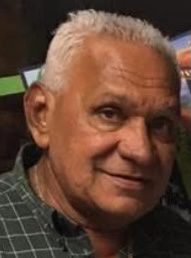
It is with great sadness we announce the passing of Jose “Frank” Trinidad, a father, grandfather and great-grandfather, on July 14, 2025 on the island of Puerto Rico at the age of 79.
He was a known business owner for 10 years in Frederiksted, St. Croix, by the name of La Fonda de “Frank”. He was laid to rest in Ciales, Puerto Rico, on July 17.
To better understand the challenges and opportunities facing the U.S. Virgin Islands’ private sector, the Virgin Islands Economic Development Authority (VIEDA) has launched BizPulse VI: Business Climate Survey. The survey will give the business community a direct voice in shaping policy, with results shared with a Business Climate Commission (“Commission”), soon to be established by the Office of the Governor, to develop strategies for improving the Territory’s business environment.
Virgin Islands Economic Development Authority
The BizPulse VI survey will remain open for participation until 11:59 p.m. on Monday, September 15, 2025. Business owners who are interested in taking this survey to share their feedback about the business climate can visit www.usvieda.org.
“Our business community has a voice that is invaluable for our economic future in the U.S. Virgin Islands. And Vision 2040 is not just a plan on paper—it’s a living strategy that requires direct feedback from the people it’s designed to serve,” said the Honorable Albert Bryan Jr., Governor of the U.S. Virgin Islands. “Information from the BizPulseVI: Business Climate Survey results can help us make informed decisions that can help create a more vibrant and business-friendly environment for all Virgin Islanders and the individuals who choose to relocate here and make the USVI their place to live and work. I urge every business owner to participate and help us build a more prosperous future together,” added Governor Bryan, Jr.
Input from the business community will guide informed decision-making and drive meaningful change. All survey responses will remain anonymous. The results will be shared with a new Business Climate Commission, which will be established by the Governor of the U.S. Virgin Islands. These results will also be shared with the public.
The Commission will be a group of private and public sector stakeholders tasked with identifying actionable policies and solutions to foster a more business-friendly environment in the USVI. Resources would be appropriated to the Commission by the Government of the Virgin Islands to evaluate public sector initiatives, assess tax and regulatory measures, and recommend supportive public/private initiatives to strengthen the climate for conducting business.
“It is indeed our pleasure to launch this critical initiative as a key part of our Vision 2040 strategy. The information we collect from the responses from our USVI business community will be instrumental in helping the Business Climate Commission craft policy recommendations that will reduce barriers and create a more supportive ecosystem for businesses,” said Wayne L. Biggs, Jr., chief executive officer, VIEDA. “I also encourage all USVI business owners to take a few minutes to complete this survey as we join together to drive meaningful economic growth in our Territory,” added VIEDA CEO Biggs, Jr.
The establishment of a Commission is a key recommendation of Vision 2040, a 20-year economic development strategy designed to create a more prosperous, sustainable, and resilient U.S. Virgin Islands. This survey will play a key role in providing insights to the Commission into how businesses perceive the current business climate in the USVI.
For questions about the BizPulseVI: Business Climate Survey, please send an email to info@usvieda.org .
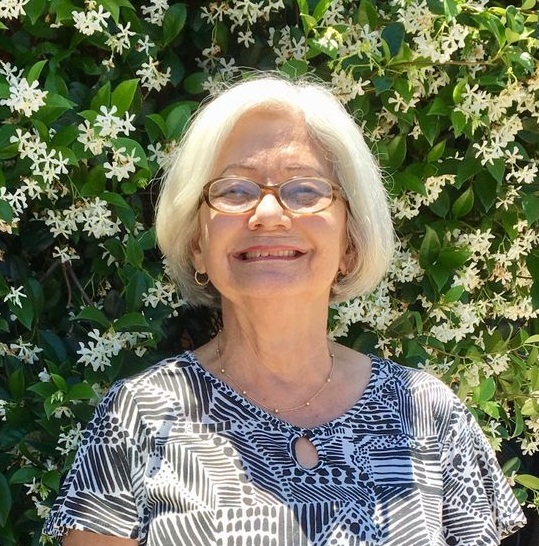
Luz (Lucy) Minerva Morales, 82, of St. Augustine, Florida passed away peacefully into the glorious presence of our Lord and Savior on Aug. 18, 2025 in DeLand, Florida.
Luz Minerva Morales
She was a devoted and faithful servant of Christ who spent countless years spreading the message to the children of Southgate Baptist Church and Moultrie Baptist Church. She also led a Women’s Bible Study group and was a true apostle that never hesitated to spread her love of Christ.
Lucy is predeceased by her loving husband, Luis Morales.
She is survived by her three children, Michele Morales Davis and her spouse, Craig Davis; Christina (Tina) Morales Araman and her spouse, Jacques Araman; son, David Morales and his spouse, Alanna Hayden Morales; and five wonderful grandchildren: Chloe Sorrelle Phillips-Hayden, Sophie Marie Araman, Aaron Luis Morales, Maya Anne Araman and Xander Thomas Morales.
Lucy is also survived by her siblings: Louis Roman and Ivonne Roman Colon and her spouse, Humberto “Tito” Colon, as well her many relatives too numerous to mention.
The family announces two memorial services to honor and celebrate Lucy’s life in St. Augustine, her home for the last 10 years; and one in St. Croix, her beloved island home, where she will be reunited and laid to rest alongside her forever love, Luis Morales.
St. Augustine Service:
Moultrie Baptist Church
3699 US 1
Saturday, September 20, at 3 pm
Reception to follow
St. Croix Service:
Southgate Baptist Church
Southgate Farm, St. Croix
Thursday, December 18, at 11:00 am
Reception to follow
Private arrangements are being made by the family for interment at Kingshill Cemetery, St. Croix.
In lieu of flowers, the family requests donations be made in Lucy’s name to either: The Lighthouse Mission, PO Box 24248, Christiansted, St. Croix 00820 or the Coral and Sea Turtle programs at The Nature Conservancy of St. Croix, 3052 Estate Little Princess, Christiansted, St. Croix 00820
Due to a ruptured water pipe affecting water flow and usage on campus, Joseph Gomez Elementary School on St. Thomas dismissed early at 2 p.m. on Monday.
All students have received lunch, and bus transportation will be provided for those who utilize school bus services, the Education Department said in an emailed alert.
Eulalie Rivera K-8 School on St. Croix. (V.I. Education Department photo)
Police are investigating after a decomposed body was found Sunday morning in the bushes behind the Eulalie Rivera PreK-8 School.
According to a V.I. Police Department release sent close to noon Monday, a concerned citizen contacted the 911 Emergency Call Center around 8:57 a.m. Detectives with the Criminal Investigation Bureau responded and confirmed the remains south of the school grounds. Because of the advanced stage of decomposition, investigators said the person’s identity and cause of death are not yet known. An autopsy and DNA testing are pending.
Rivera, along with all St. Croix public schools, was closed to students Monday morning as Police investigated a bomb threat that circulated by text Sunday night before being posted publicly online by concerned citizens.
The discovery comes weeks after a body was found in a remote area of Fortuna on St. Thomas, a case that also remains under investigation. Police have urged anyone with information that may assist detectives to call 911, the CIB at 340-778-2211, or Crime Stoppers VI at 1-800-222-8477.
This story will be updated as more details are released.
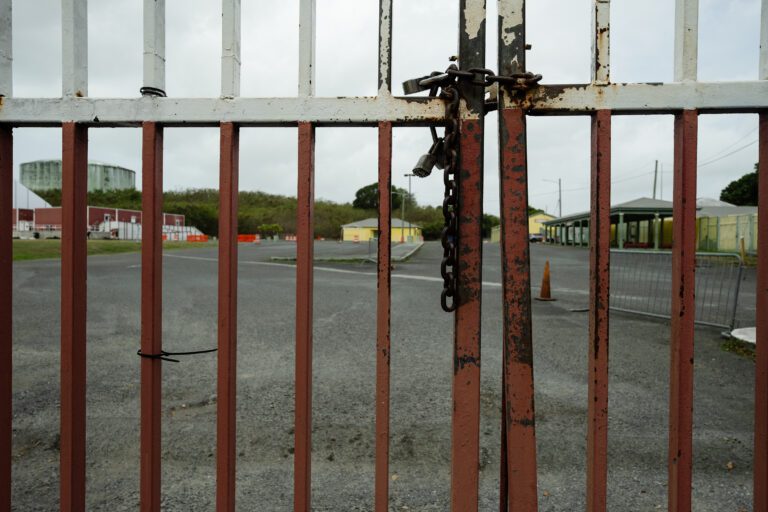
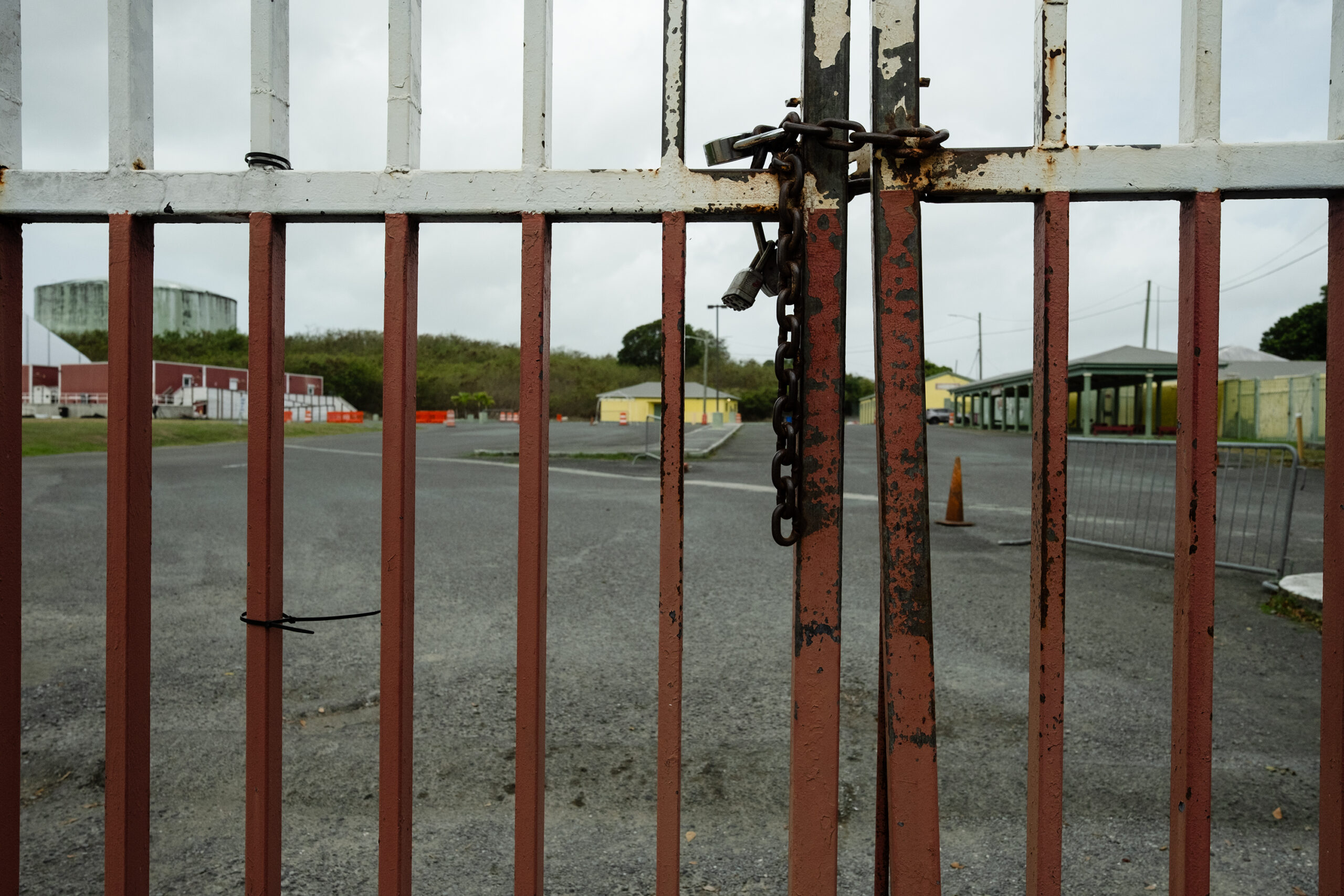
A lock keeps the entrance lane to St. Croix Central High School closed Monday morning. All public schools in the district closed after a bomb threat circulated widely on social media and a number of school monitors called in sick. (Source photo by Kit MacAvoy)
Updated 9:50 a.m.
The Virgin Islands Department of Education has closed all St. Croix public schools as police launched district-wide searches Monday morning in response to safety concerns and a wave of school monitors calling out sick.
Officials said the Virgin Islands Police Department, joined by other law enforcement partners, began conducting security sweeps across every St. Croix campus “out of an abundance of caution” after the circulation of a potential threat on multiple platforms. Buses were immediately dispatched to return students home while officers moved through schools to secure grounds before classes resume Tuesday .
The situation placed additional strain on the district, with VIDE citing the high number of absent school monitors as a serious gap in campus oversight. At the same time, VIPD activated heightened safety protocols across both districts, including precautionary searches on St. Thomas and St. John campuses. Those schools remained open, and officials stressed there were no active threats there.
In a statement, VIDE said the safety of students and staff remains its highest priority and vowed to provide updates as law enforcement continues its work. Police officials reminded the public that making threats of any kind is a crime under Virgin Islands law.
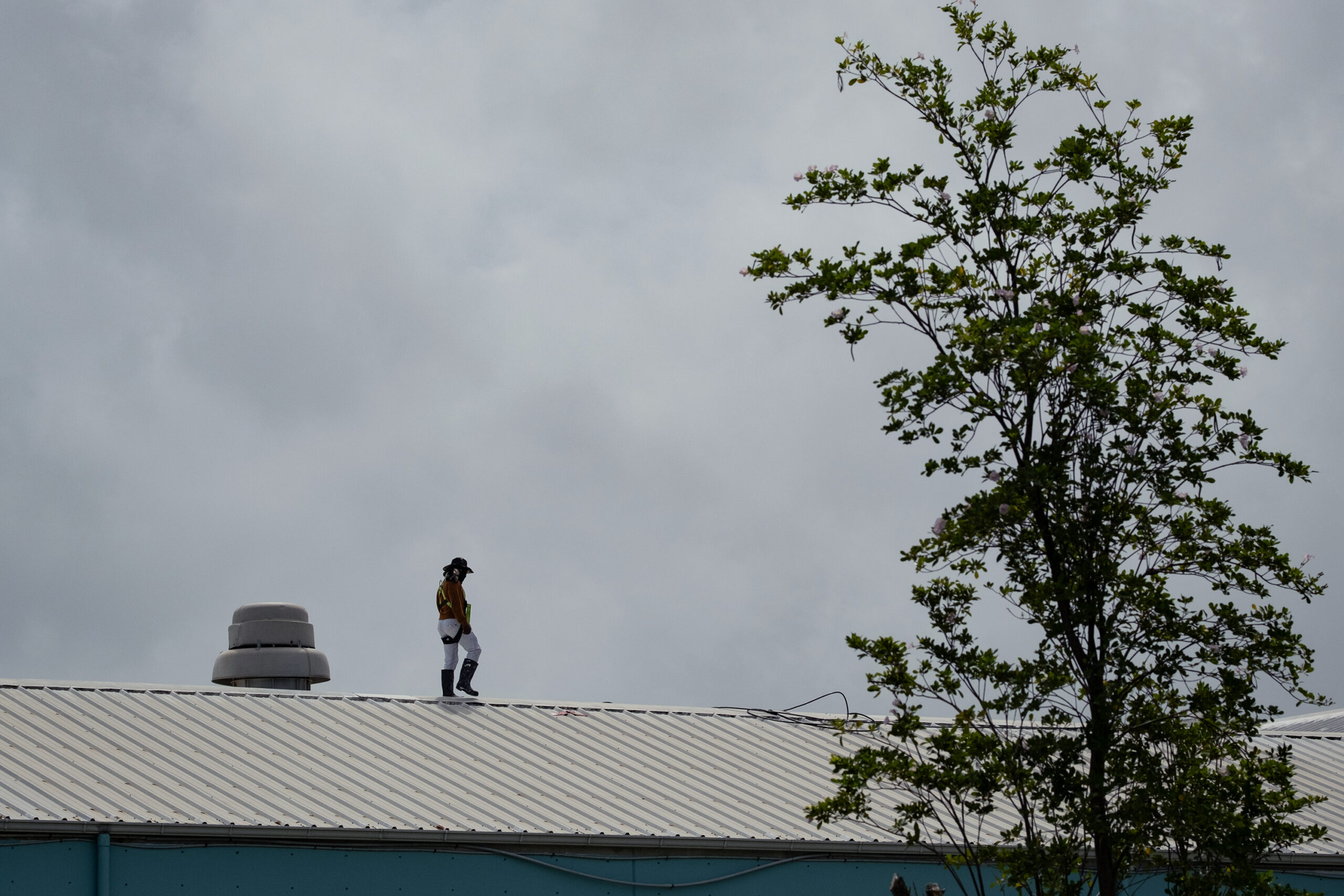
Maintenance workers continue repairs at John H. Woodson Junior High School Monday after all public schools in the district closed amid a bomb threat and shortage of school monitors. In-person classes at Woodson were delayed in order to let workers complete roof repairs, mold remediation and air quality testing. (Source photo by Kit MacAvoy)
Posted 8 a.m.
St. Croix public high schools are closed Monday due to “concerning threats” to harm students and blow up campuses, according to an urgent alert the V.I. Education Department issued around 7:30 a.m. on social media. It said the decision also comes as “a significant number” of school monitors have called in sick.
The department said the threats and messages have been circulated across multiple platforms “indicating intent to cause harm to students and to blow up school campuses,” and immediate precautionary measures are being taken to protect the safety of the students, faculty, and staff.
“In adherence to established safety protocols, the St. Croix Central High School, St. Croix Educational Complex High School, and St. Croix Career and Technical Education Center will be closed on Monday. This decision also follows notice that a significant number of school monitors at these campuses have called in sick and confirmed that they will not report to work. Their absence gravely impacts the Department’s ability to adequately monitor and manage school operations,” the alert stated.
The VIDE has requested that students, faculty and staff do not report to these campuses Monday. “This closure will allow law enforcement to continue its investigation into the threats that have been made and ensure that campuses are fully secured before resuming normal operations,” it said.
“The VIDE emphasizes that threats of any kind will never be taken lightly. Individuals should be reminded that making such threats is a serious crime and carries legal consequences. The VIDE will continue to fully support law enforcement in holding any responsible parties accountable,” it said.
The department asked for the cooperation and support of parents, guardians and the broader community as it works alongside law enforcement agencies to safeguard the schools.
“The safety and well-being of our students and staff remain our highest priority. The VIDE will not tolerate threats to our schools and stand firmly with law enforcement in pursuing anyone who seeks to disrupt learning or endanger lives. We urge our community to remain vigilant and to continue supporting our students as we work through this matter together,” the alert stated.
Further updates will be provided through official VIDE communication platforms as more information becomes available, it said.
Public schools in the St. Croix district closed early after a potential bomb threat circulated on social media and a number of school monitors called in sick. Law enforcement and the V.I. Education Department stated that there was no active threat made against schools in the St. Thomas-St. John district. (Source photo by Kit MacAvoy)
Award-winning VI author Cadwell Turnbull sits down with our in-studio team to talk about the release of the final part of his Convergence saga, while host Adisha Penn recaps the biggest headlines of the past week, from breaking court coverage to the filing of a draft bill the expands the deadline for complaints put before the Senate’s Ethics Committee. There’s always something new on Consider the Source!
In his biweekly column, Langley Shazor speaks to issues important to men within the territory.
One of the biggest lies we tell ourselves is that what we do is our business and does not affect anybody else. That lie feels safe. It feels protective. It gives us space to justify our behavior, escape consequences, and avoid reflection. But it is not true. The way we move through the world, how we speak, how we show up, how we lead, how we handle conflict, always impacts the people connected to us. We are not islands. We are deeply interwoven, and emotional intelligence forces us to confront that reality.
Emotional Intelligence 2.0 introduced me to the concept of relationship management as one of the core EQ skills. It is the part of emotional intelligence that deals directly with how we navigate relationships, especially under pressure. After self-awareness and self-management, relationship management is the space where those internal skills get tested externally. It is one thing to know yourself. It is another to regulate yourself. But can you still lead with clarity, respect, and accountability when emotions are high, stakes are personal, and egos are in the room? That is the grown folks’ work.
We throw the word accountability around like it is a buzzword, but few people understand the depth it requires in the context of relationships. Accountability is not just saying “my bad” when you mess up. It is not the surface-level apology or the public performance of regret. Real accountability in relationships means owning the ripple effects of your actions. It means choosing growth over ego and responsibility over deflection. It means listening to someone when they tell you how your actions impacted them and resisting the urge to become defensive. That takes emotional intelligence. That takes strength. That takes the maturity to recognize that relationships are not built on perfection, they are built on honesty, ownership, and the willingness to course-correct.
A lot of us grew up in environments where emotional discipline was misunderstood. Some of us were taught to stay quiet and mind our business. Others were raised in households where emotional explosions were normal, and apologies rarely followed. We learned survival, not accountability. We learned how to react, not how to reflect. And when those lessons go unchallenged, we carry them into our adult relationships, unaware of the damage they cause. We blame others for our triggers, call correction “hate,” and cut people off the moment we feel uncomfortable. That is not empowerment. That is avoidance. That is fear wearing the mask of independence.
I am thankful that I have people in my life who hold me accountable—not just for what I say, but for how I say it, when I say it, and who I say it to. These are not “yes” people. These are not fans or followers. These are friends, mentors, and partners who are more committed to my growth than to my comfort. They challenge me when I step out of alignment. They check in when I withdraw. They remind me that leadership is not just about vision, it is about how you treat people on the way there. And I do my best to do the same for them. That is what a real relationship looks like.
Relationship management is about consistency, not convenience. It is about how you communicate when things are not going your way. It is about how you respond when someone disappoints you. It is about how you navigate disagreement without turning it into disrespect. Strong relationships are not built in moments of peace; they are tested and strengthened in moments of tension. If every relationship in your life collapses when someone holds you accountable, it might be time to examine whether you are really committed to connection or just addicted to control.
One of the most important lessons I have learned in this season is that correction is not rejection. When someone points out a blind spot or asks you to change a harmful behavior, they are not attacking you, hey are inviting you to grow. They are making space for the relationship to deepen. But if you cannot hear that without feeling personally attacked, you will sabotage every meaningful connection in your life. Emotional intelligence gives you the tools to receive feedback, process it, and respond with intention instead of insecurity.
So here is what I am practicing: I am asking for feedback. I am listening more than I am speaking. I am pausing before I respond, especially when I feel triggered. I am checking my tone, even when I believe I am right. I am apologizing without needing to be asked. I am extending grace, but I am also telling the truth. Because accountability is not one-sided. It is a shared responsibility. It is what makes relationships resilient. It is what keeps communities from crumbling under the weight of pride and ego.
We were never meant to do life alone. And we definitely were not meant to do it unexamined. Accountability does not diminish who you are, it reveals who you are becoming. It requires people, process, and presence. So, the next time you are tempted to shut down or lash out, remember this: we are not islands. And the people in your life are not disposable. They are mirrors, partners, and co-laborers in your growth. None of us are an island; and we are better for it.
Choose accountability. Choose maturity. Choose connection. That is the real work.
Langley “Casual-Word” Shazor is a poet, author, publisher, entrepreneur, public speaking coach, podcast host, and pastor who is an advocate for youth and men. His goal is to enlighten, empower, and liberate those who are silenced, marginalized, and enslaved to self-destructive thoughts and behaviors. Visit thecasualword.com.
Editor’s Note: Opinion articles do not represent the views of the Virgin Islands Source newsroom and are the sole expressed opinion of the writer. Submissions can be made to visource@gmail.com.
The U.S. Virgin Islands delivered its most successful Pan American Games performance in history at the 2025 Junior Pan American Games, claiming three medals — including the territory’s first-ever Pan American gold — across two weeks of competition from Aug. 9 to Aug. 23 in Asunción, Paraguay.
Fencer Kruz Schembri captured gold in the men’s individual épée, while track athlete Michelle Smith won silver in the 400-meter hurdles (56.61 seconds) and swimmer Maximillian Wilson added a silver medal with a national record-breaking time of 54.31 seconds in the men’s 100-meter backstroke. The three-medal haul represents a breakthrough for the Caribbean territory of just over 100,000 residents, whose delegation of nine athletes competed across five sports.
Schembri Delivers Historic Gold
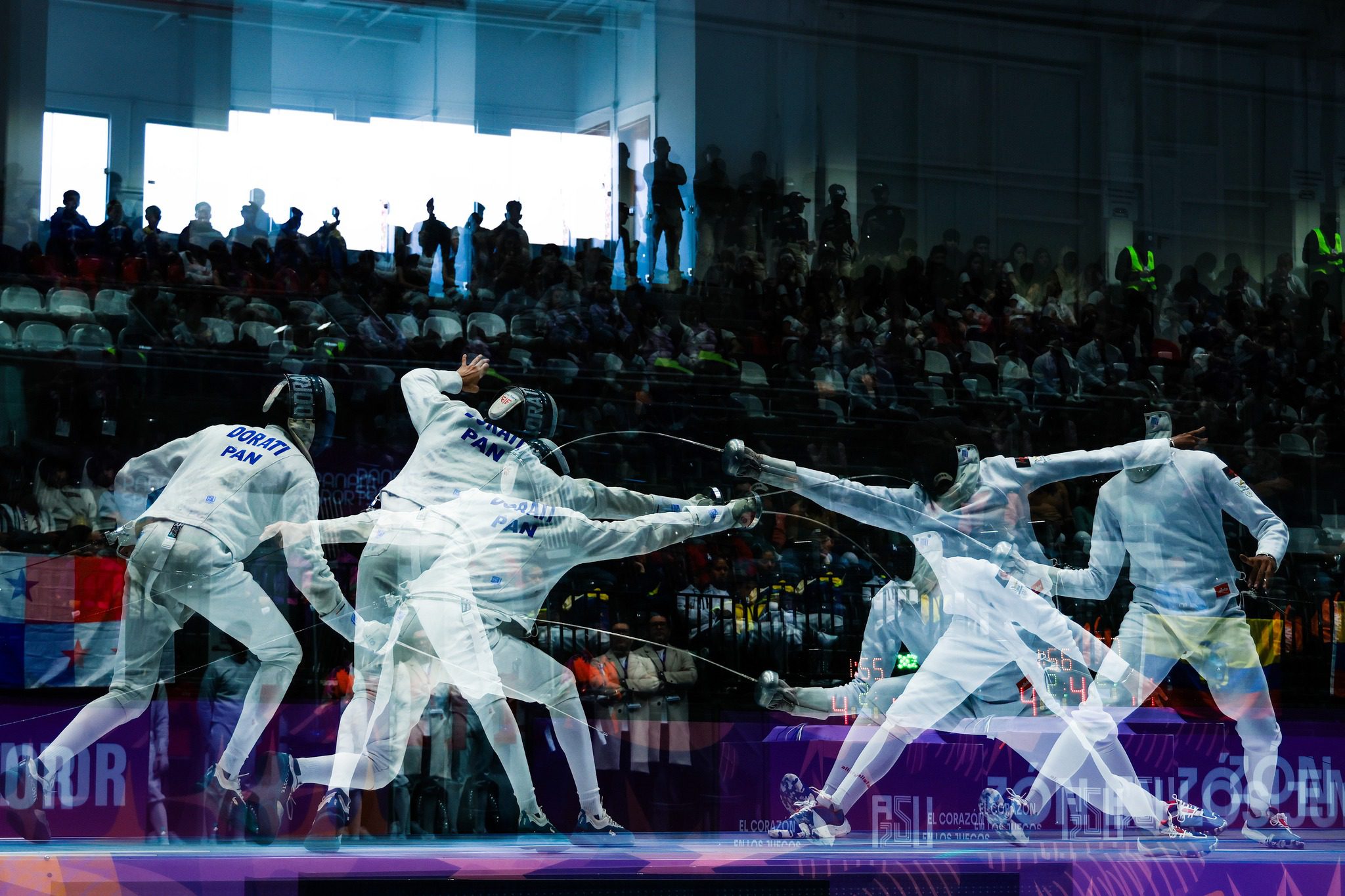
Fencer Kruz Schembri captured gold in the men’s individual épée, marking the Virgin Islands’ first gold medal in any Pan American Games competition. (Photo by Marcos Dominguez / Panam Sports)
Schembri’s victory in the men’s individual épée marked the Virgin Islands’ first gold medal in any Pan American Games competition. The 18-year-old incoming Notre Dame freshman had prepared for the moment through focused training and competition experience.
“Honestly, I was just locked in. I tried not to overthink and just trust all the training I’ve put in. I kept telling myself to stay calm, take it one touch at a time, and fight for every point,” Schembri said of his gold medal match.
The fencer, who competed for the USVI at the 2024 Paris Olympics, entered the Junior Pan-Am Games after winning double gold at the 2025 Central American and Caribbean Fencing Championships in both individual épée and foil events.
“Representing the Virgin Islands and showing that athletes from a small place can achieve big things means everything to me. I hope it inspires more kids back home to chase their dreams in sports or whatever they’re passionate about,” Schembri added.
He began fencing at age 8 after participating in other sports and chess. “People told me fencing was like ‘physical chess,’ so I decided to give it a try — and they were right. I loved the mix of mental strategy and athletic intensity, and I’ve been hooked ever since.”
Looking ahead, Schembri plans to balance collegiate and international competition. “Right now, I’m training hard and preparing for upcoming international competitions, but I’m also starting a new chapter by fencing at Notre Dame. Mixing it up on the NCAA collegiate level is exciting — I get to represent both my school and the USVI while pushing myself to keep improving.”
Smith Claims Silver in 400 m Hurdles
Michelle Smith claimed second place in the women’s 400-meter hurdles with a time of 56.61 seconds. (Photo courtesy VI Olympic Committee Facebook)
Smith’s silver medal came in the women’s 400-meter hurdles, where she finished second in 56.61 seconds. The 19-year-old University of Georgia student entered the games as one of the world’s top under-20 hurdlers, holding the world’s fastest time in the event for her age group with a USVI record of 54.56 seconds.
The competition’s atmosphere suited Smith’s approach. “There was a lot less pressure than other competitions: not too many eyes, just the teams in the stands,” she said of the Junior Pan-Am environment. “I feel like I do better when I don’t really care about how I’m going to perform. I just run to execute the plan.”
When asked what she was thinking during her silver medal race, Smith recalled, “I started off just thinking ‘Push, push, push. Push off all the hurdles.’ Then at hurdle three, it hit me, like ‘Oh shoot, I’m actually running,’” she laughed.
Smith relished the opportunity to observe other Virgin Islands athletes compete during the games, noting the supportive atmosphere among the delegation.
Following the games, Smith returns to her training routine at Georgia before competing at the World Athletics Championships in Tokyo in September.
Wilson Sets Record, Earns Silver
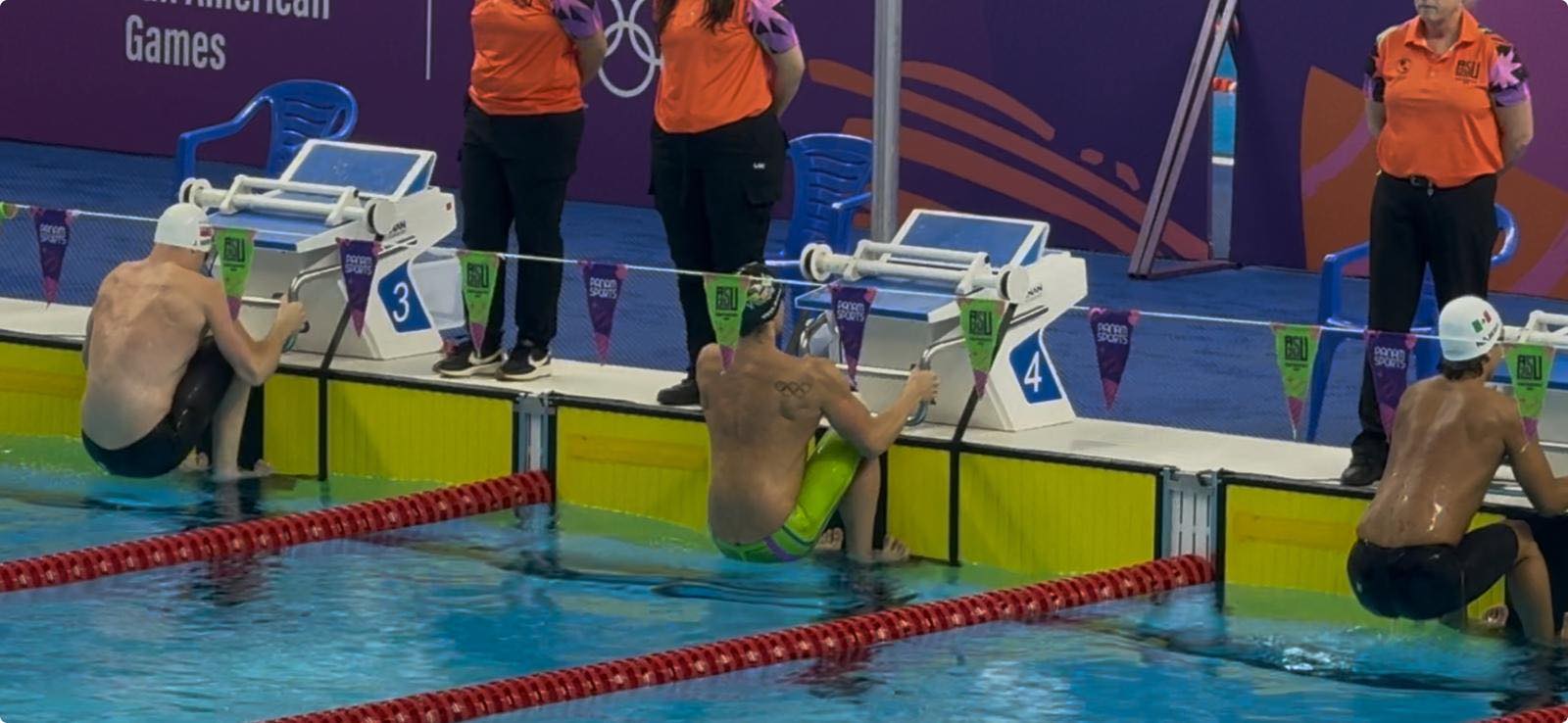
Maximillian Wilson’s silver medal-winning performance in the men’s 100-meter freestyle set a new USVI national record. (Photo courtesy VI Olympic Committee Facebook)
Wilson’s silver medal in the men’s 100-meter backstroke came with a new USVI national record of 54.31 seconds, improving on his own previous best set at the 2024 Paris Olympics. The 22-year-old Florida State senior also competed in the 50-meter backstroke, where he came within hundredths of a second of breaking another national record that has stood for over 15 years.
Wilson attributed his success to focused preparation. “This summer I did a lot of training in the weight room, which helped my power and strength in the water,” he said.
The experience of competing for the Virgin Islands at the Junior Pan-Am Games held special meaning for Wilson. “It was an incredible feeling and great opportunity to represent my country. I’m proud to be able to compete at this level, being from such a small place.”
Wilson, who holds USVI national records in seven events, used the games to compete across multiple freestyle distances while maintaining his focus on backstroke events as his specialty.
Wilson, like the other medalists, shares the challenge of juggling collegiate and international competition as he looks forward to a senior year of peak performance.
Territory’s Largest Delegation
The nine-athlete delegation represented the Virgin Islands’ largest team at a Junior Pan American Games. Beyond the three medalists, the team included swimmers Kaeden Gleason, Allison “Lu” Joseph, and Riley Miller; sprinter Brandon Pemberton; tennis player Yared Alfred; and triathlete Michael Dizon-Bumann.
“Three medal winners is unreal! My favorite part of it all is looking at the scoreboard and comparing the populations of the other competing nations to ours. It’s one of the reasons I continue saying the VI is full of talent,” said Brigitte Berry, treasurer of the VI Olympic Committee.
Schembri noted the team dynamic during competition. ” Seeing fellow VI athletes out there gave me so much pride and motivation. We’re all part of something bigger, and cheering each other on makes it feel like family.”
Looking Toward 2027
The Junior Pan American Games serve as a development pathway for athletes ages 17-22, with many participants expected to compete at the 2027 Pan American Games in Lima, Peru.
For the Virgin Islands, the three medals represent not only historic achievement but a foundation for continued success in international competition as the territory’s athletic programs continue to develop talent on the world stage.
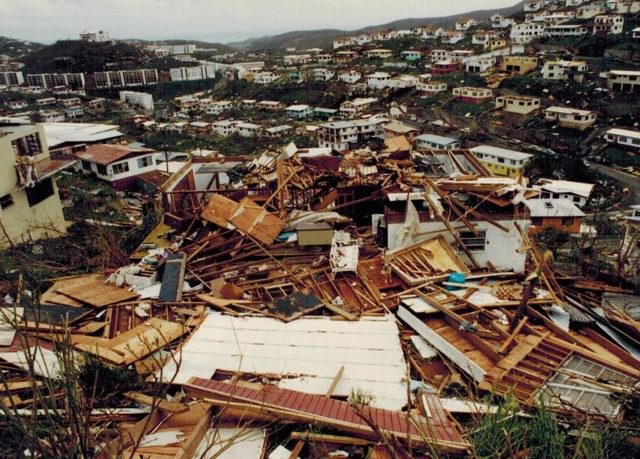
Damage from Hurricane Marilyn across St. Thomas in September 1995. (Photo courtesy NHC and NOAA)
This September, as the U.S. Virgin Islands approaches the 30th anniversary of Hurricane Marilyn and marks eight years since Irma and Maria devastated the territory, emergency officials and meteorologists say major strides have been made in hurricane forecasting, storm monitoring, and disaster preparedness.
According to official records from the National Hurricane Center, Hurricane Marilyn struck the U.S. Virgin Islands between Sept. 15 and 16, 1995. The agency reported that the cyclone was a high-end Category 2 hurricane, nearly a Category 3 storm, at the time the hurricane hit the territory.
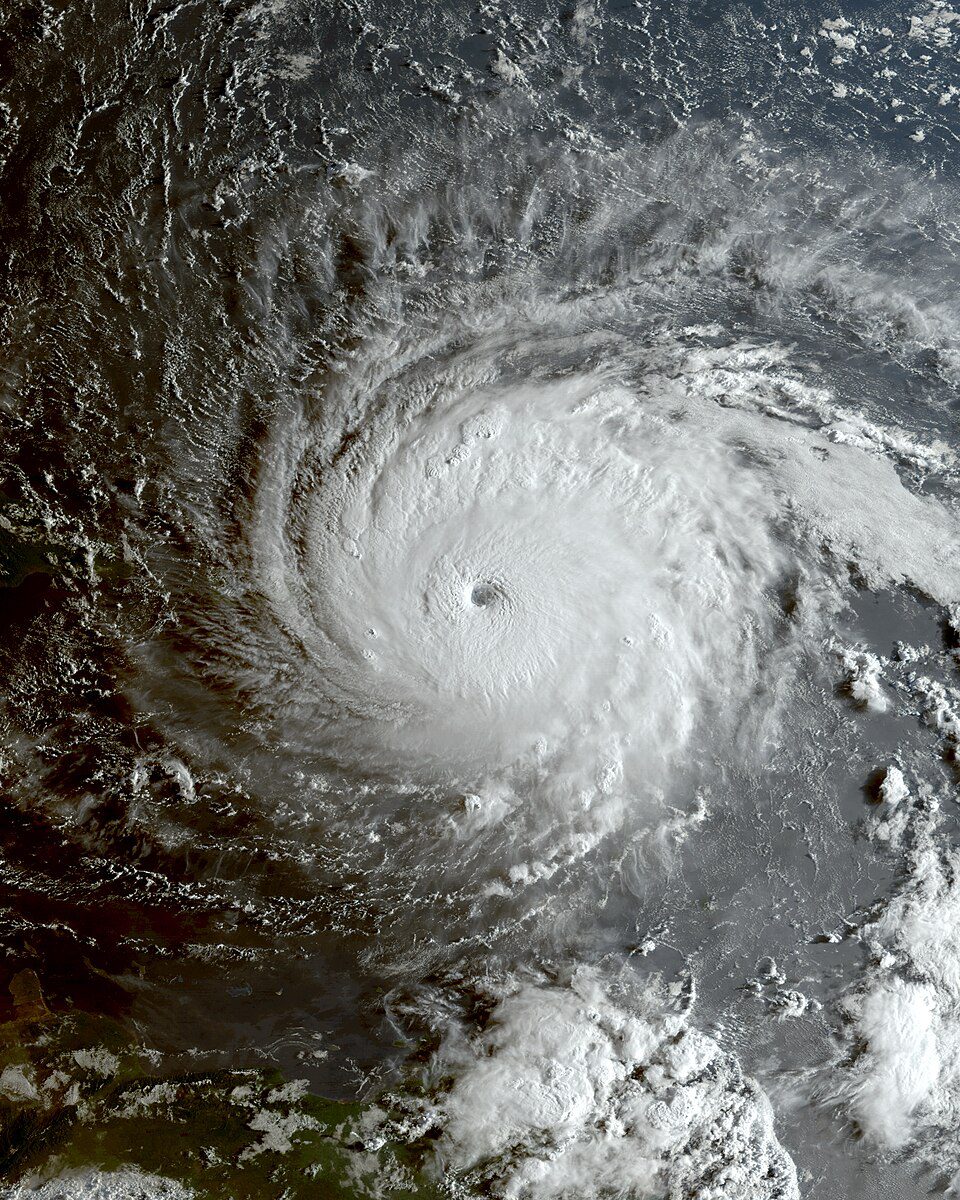
Satellite imagery of Hurricane Marilyn, Sept. 15, 1995. (Photo courtesy NHC and NOAA)
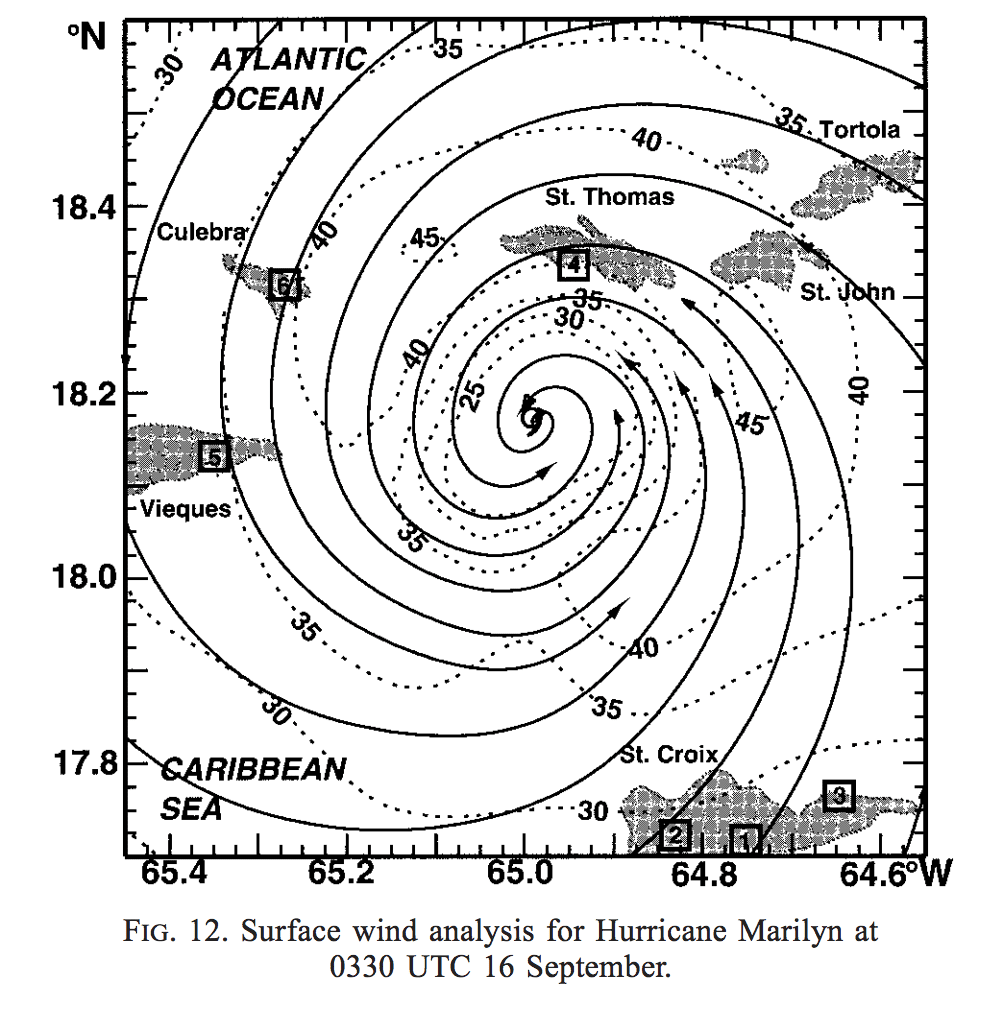
“Marilyn’s eye passed across the east end of St. Croix, where an amateur radio operator reported an unconfirmed wind gust of 127 mph around 5 p.m. AST Friday, Sept. 15, 1995,” according to a report from the NHC. “The eye then passed between St. Thomas and Culebra with the most devastating portion of the eyewall moving across the west part of St. Thomas. Here, both storm surge and wind caused widespread destruction. The Automated Surface Observing System, located at the St. Thomas airport, recorded sustained winds of 104 mph with a maximum gust to 129 mph around midnight, Sept. 15-16. These are the strongest recorded winds associated with Marilyn,” the NHC report explained.
Wind field analysis of Hurricane Marilyn in 1995. (Photo courtesy NHC and NOAA)
“Wind gusts approaching 140 mph were estimated from an aerial damage survey conducted soon after the hurricane’s passage. Heavy rains, mudslides, and strong winds pounded Culebra and Vieques, where damage was also considerable. Marilyn did not severely impact the main island of Puerto Rico, although some strong winds and heavy rains did affect the island,” according to the report.
“In the 1990s, NHC’s three-day track forecasts had an average error of about 265 miles. Our three-day track errors for the current decade have been cut to an average of about 90 miles, a reduction of about 65%. Even our five-day track forecasts currently have an average error of about 200 miles, which is also less than the three-day forecasts from 1995,” Berg explained.
“NHC’s three-day intensity forecasts were off by an average of 20 mph in 1995, and those errors have been cut to 10–15 mph in the current decade,” he added.
Berg went on to note that forecasting the rapid intensification of hurricanes – when a storm’s winds increase sharply in a short period – remains challenging, though the center has made gains.
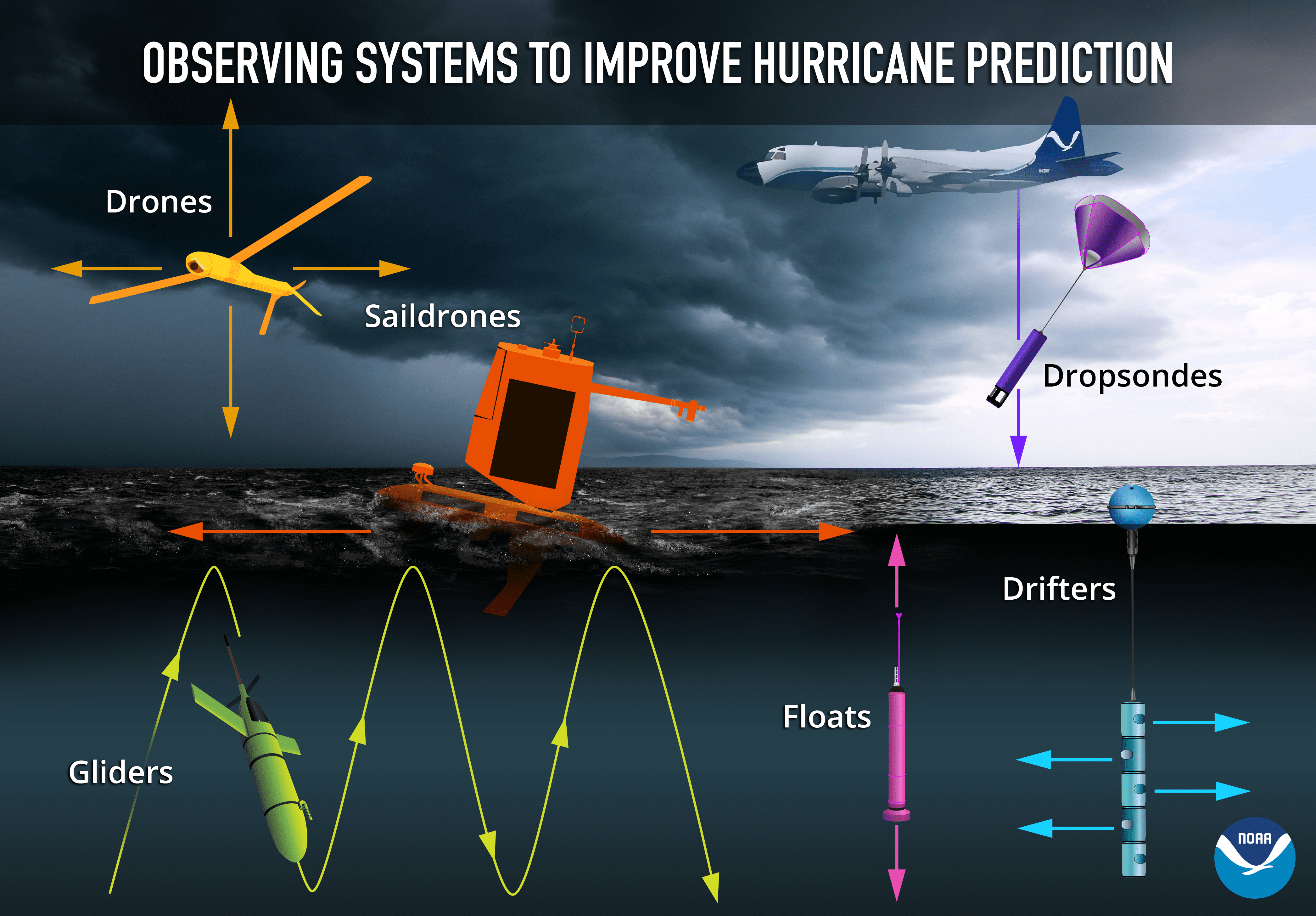
Instruments and technology utilized by Hurricane Hunters have vastly improved in recent years. (Photo courtesy NHC)
“Through a mixture of better tools, more accurate modeling, and forecaster experience, there are promising signs that NHC is getting better at detecting and predicting rapid intensification. In the years from 2010 to 2014, NHC’s 24-hour forecasts for rapidly intensifying storms were on average about 30 mph too low, and the storms strengthened 30 mph more than we were forecasting,” said Berg. “However, from 2020 to 2024, NHC’s 24-hour rapid intensification forecasts were 18 mph too low, so there is overall improvement. That said, there are still cases of unexpected rapid intensification, such as the case of Hurricane Otis, which hit Acapulco, Mexico, in 2023 as a Category 5 hurricane.”
Better Technology Improves Forecasts
“Satellite technologies have improved over the past two decades, with the data now being available more frequently and at a higher resolution that helps us monitor storm trends,” he said. “New tools have been installed on Hurricane Hunter aircraft, including Tail Doppler Radar on the NOAA P-3 aircraft. This radar data helps give a more accurate three-dimensional view of the structure of the hurricane, which is also plugged into the computer models to help provide a more accurate simulation. Computing power has also increased exponentially over the past two decades, which has led to higher-resolution modeling of storms,” Berg explained.
Communication methods have also tremendously evolved over the years.
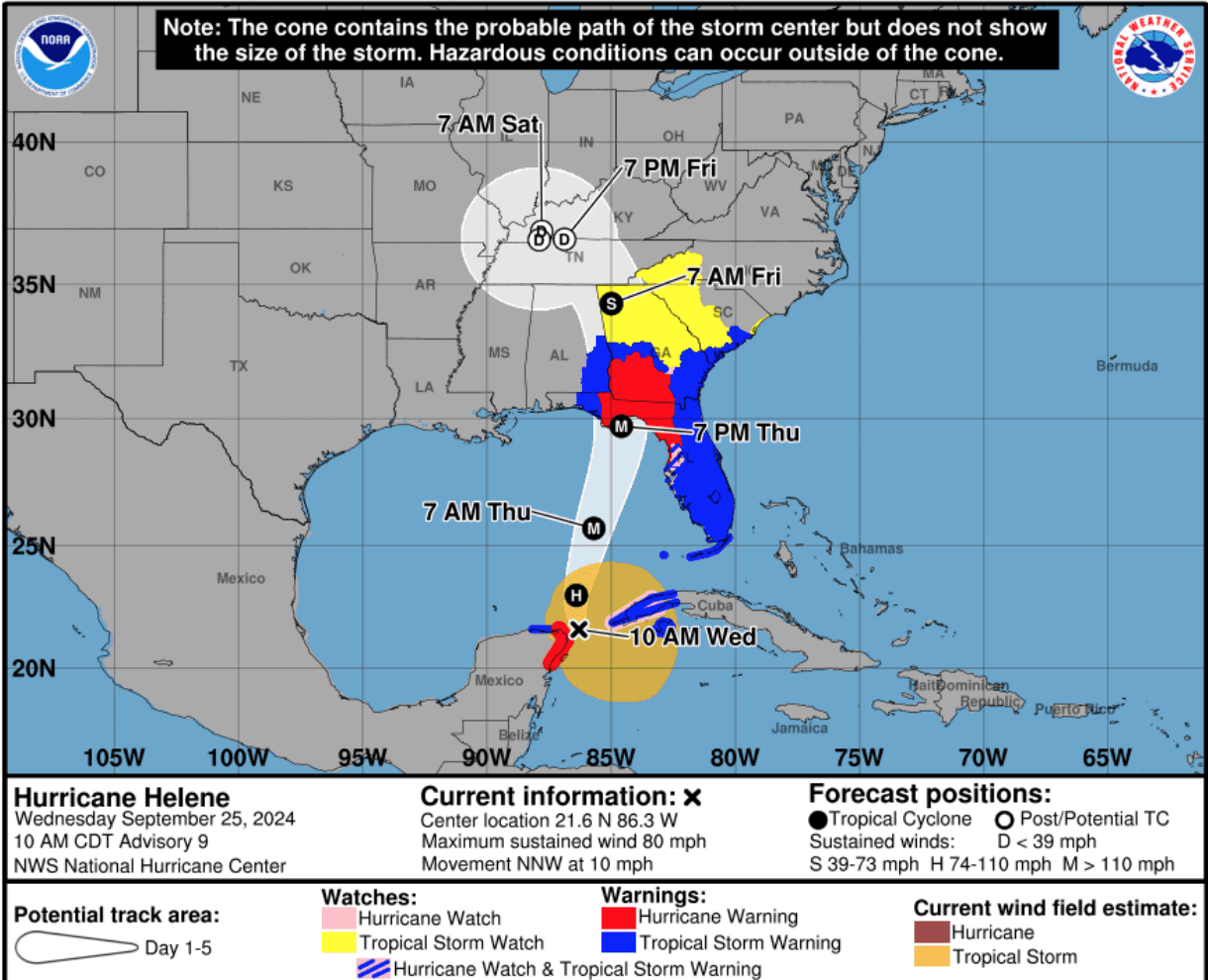
The NHC continues to update forecasting products, including an experimental “cone of uncertainty” depicting inland weather threats, an upgrade announced before the 2025 Atlantic hurricane season. (Photo courtesy NHC)
“Some of the biggest changes since the mid-1990s are the ways that we communicate the forecasts of hurricanes. We incorporate the uncertainty in our forecasts in the forecast graphics we produce, Berg stated. “For example, the cone of uncertainty began in 2002 to show that the center of a storm may not follow the exact forecast track. We’ve also unveiled several products that communicate the hazards that a storm could bring, including wind speed probabilities, time of wind arrival, when conditions could deteriorate, and potential storm surge flooding graphics.”
Hurricane Anxiety
When asked about advice for residents in the USVI and Puerto Rico who lived through hurricanes like Marilyn, Irma, or Maria – and who may feel anxious as each new season approaches – Berg offered the following insight.
“Anxiety and stress about hurricanes are perfectly normal – a lot has to be done to get ready for these storms, and life can be impacted significantly by the storm’s hazards,” Berg acknowledged. “However, preparation and having a plan definitely help to reduce that stress and anxiety. Making some preparations early, like putting your emergency supply kit together and not waiting until you’re under an actual threat, means that’s one less thing that’s on your plate. Do what you can now so that you’re not overwhelmed when a storm threatens.”
NOAA Hurricane Hunters: Sim Aberson
Sim Aberson, a NOAA meteorologist and Hurricane Hunter, told the Source that major strides have been made in hurricane forecasting since Hurricane Marilyn, especially in the assimilation of data gathered during aircraft reconnaissance.
“A huge amount has changed since 1995,” Aberson affirmed. “NOAA uses the same large aircraft now as in 1995 – the two P-3s – but with vastly improved technology. The Gulfstream-IV became available the next year and was used for tropical cyclones for the first time in 1997. The Air Force C130H planes, which were in use then, were retired about 2004 and replaced with C130Js,” he said.
Technology Improvements
One of the most important advances has been the use of instruments called dropwindsondes, which help Hurricane Hunters collect data while flying into a cyclone to investigate the storm.
“We now have dropwindsondes, which came online in 1997 and can reliably measure wind, temperature, and humidity in hurricanes,” Aberson said. “In 1995, by contrast, Doppler radars aboard the P-3s only had one antenna that scanned vertically. To get an analysis of the winds, you had to fly two aircraft perpendicular to each other through the storm at the same time, then manually quality control and combine the data. Combining this data took six months to a year for each pass through the hurricane, so we didn’t do it for many cases,” he explained.
“Now those radars have two antennas that scan fore and aft, providing the two looks needed for a complete wind analysis from one radar system,” Aberson said. “More importantly, we now quality-control the data and make the analyses in real time on the aircraft. We transmit the data to the NHC so they can see the system’s structure, and around the world to be assimilated into forecast models in real time. There has been amazing progress,” Aberson declared.
Data Collection Efficiency
Operational efficiency has also improved. “Because data collection and storage were so different back then, we used to have much larger crews. Now we can do a lot of the work on the ground, which saves a lot of time, effort, and money for the government while providing much better data,” he said.
“I’ve been in the territory, living on St. Croix, for a little over 20 years now,” he said. After retiring from the Virgin Islands National Guard in 2016, Jaschen was invited by Governor Bryan to serve as VITEMA director in 2019. “So that’s my seventh year as a director for VITEMA, and we’ve seen a lot of positive changes,” Jaschen said.
Jaschen highlighted the most important areas of progress, particularly since the passing of Hurricanes Irma and Maria in 2017, storms that many Virgin Islanders recall in vivid detail.
“In September 2017, Hurricanes Irma and Maria, two back-to-back Category 5 hurricanes, significantly impacted the U.S. Virgin Islands,” according to a report from the Federal Emergency Management Agency. “Hurricane Irma was the ninth named storm of the 2017 hurricane season when it impacted the USVI on September 6, and it devastated much of St. Thomas and St. John,” FEMA said.
“Two weeks later, on September 20, Hurricane Maria passed directly by St. Croix and devastated the previously damaged USVI. Homes, schools, hospitals, infrastructure, and public services, particularly in St. Croix, were significantly impacted by this second storm. Hurricane Maria also caused further complications to the Hurricane Irma response, as emergency workers and residents dealt with multiple events and interruptions to the effort. The storms placed additional pressure on an already strained economy, which relies heavily on tourism and a thriving hospitality industry,” the FEMA report explained.
“Hurricanes Irma and Maria were the strongest hurricanes to strike the USVI since Hurricane Marilyn in 1995,” FEMA noted.
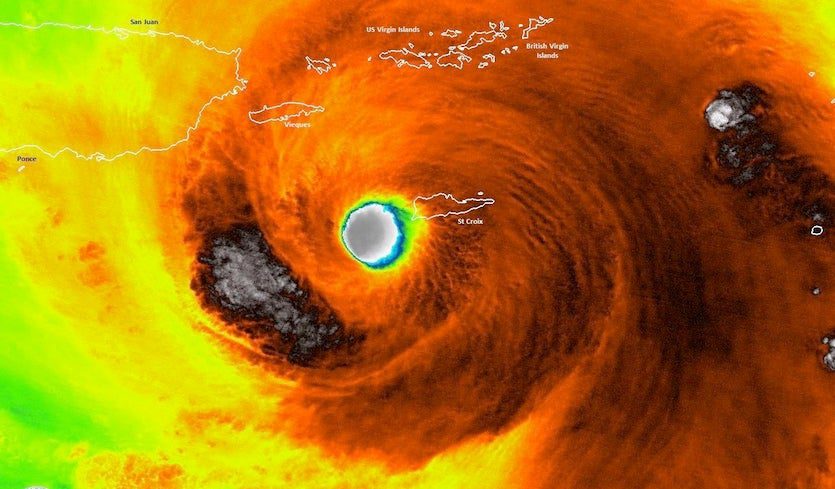
Satellite imagery of the eye of Hurricane Maria passing just south and west of St. Croix on Sept. 20, 2017. (Photo courtesy NOAA)
Speaking to the advancements made since the devastating hurricanes of the past, Jaschen noted that several areas stand out, and he shared details in a comprehensive interview with the Source.
Communications
“We’ve become much more reliant upon our smartphones to do everything for us. And, of course, that ties us into having connectivity to cell towers as well as the internet for doing many things. We’ve seen technology improve tremendously for us as individuals, for businesses, as well as for first responders and emergency responders,” Jaschen said.
Jaschen explained that a major part of this connectivity advancement has been a new 911 system across the territory.
“We’ve put in a new 911 system that gives us the ability to see on a map where they’re calling from and have much better information provided to us,” Jaschen explained. He pointed out that this system can significantly improve the capability to dispatch fire, police, and emergency medical services to the community.
Jaschen also highlighted new options for staying connected during storms, noting that communication lines are increasingly being placed underground for greater reliability, while satellite systems provide backup when traditional infrastructure fails. He added that newer technology now allows text messages to be sent via satellite if mobile towers are down, ensuring people still have a way to communicate even without standard service.
Power Grid
Power resilience is another key area. While acknowledging that improvements need to continue with the power grid across the territory, he pointed to newer energy solutions such as solar power increasing across households and businesses in the USVI. “We’ve seen the electrical technology improve tremendously to provide solar power for homes, for businesses, and battery backup systems for added support,” he said.
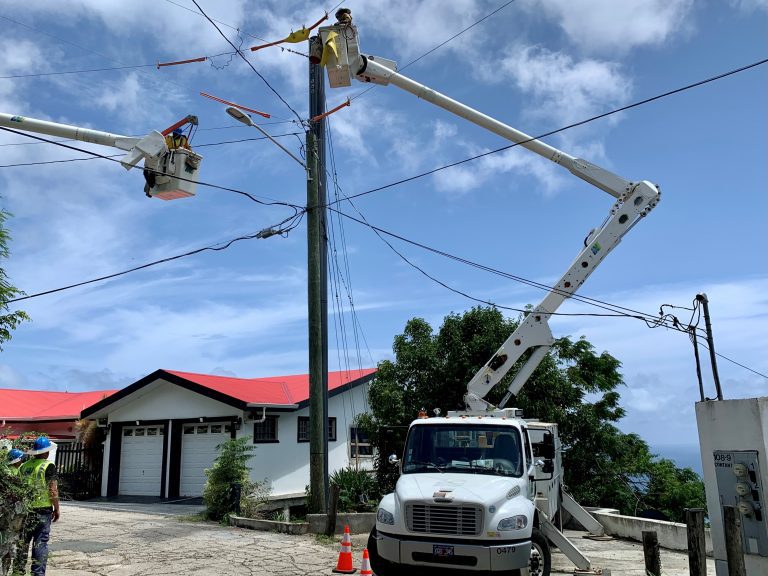
“We now are pursuing underground power, which is great for us to keep that reliance up. We have several thousand composite poles within St. Thomas, St. Croix, St. John and Water Island,” Jaschen said. “They’re hollow poles, but from a wind perspective, they can definitely stand up to the wind.”
Still, vulnerabilities remain, Jaschen admitted, especially when falling trees damage power lines. He emphasized that keeping trees and brush trimmed during hurricane season can help reduce the risk.
Evacuations
Jaschen recalled that evacuating patients during the 2017 storms was difficult, when people moved from the territory to Puerto Rico and then relocated again after Maria, often without proper tracking. Since then, he said, there have been major improvements.
The territory now has a strong patient movement evacuation plan coordinated by the Department of Health and local hospitals, Jaschen noted. A key part of that plan is J-PATS, the Joint Patient Assessment and Tracking System, which electronically monitors individuals from the time they leave the territory under a disaster declaration until they reach their destination.
On FEMA readiness, Jaschen said there are now warehouses on St. Croix and St. Thomas, along with containers on St. John, stocked with supplies. These include boxed water with a 10-year shelf life that can be distributed quickly after a storm, as well as shelf-stable meals. He emphasized that having about a 10-day supply on-island marks a major improvement compared to 2017.
“We have about 10 days of supply of that water and shelf-stable meals. The fact we have that 10-day supply is such a great improvement from what we had in 2017.”
Continued Progress Needed
Despite the progress, Jaschen was clear-eyed about challenges, including the continued need to ensure that the hospitals across the territory are able to withstand future disasters.
“Our biggest vulnerabilities right now are our two hospitals,” Jaschen noted.
Even with limitations, Jaschen believes the territory is in a stronger position than before. When asked if he feels the USVI is safer and better prepared today, he said, “I would say yes. Having gone through past storms, people take the forecasts more seriously now. And with five to six days’ advance notice, that time is very, very important.”
He added that individual preparedness has also improved. Stronger communications and power systems put residents, families, and businesses in a better position, and building code changes have resulted in sturdier structures.
Finally, he urged self-reliance. “We now understand what it means when I say be self-sufficient for five to 10 days. You need to be on your own.”
A Local Perspective
Additionally, the Source connected with Rafe Boulon, a weather observer on St. John, who meticulously records rainfall data from his home at Trunk Bay. Boulon, who has spent his life living in the USVI, shared thoughts on what he believes has significantly improved across the territory regarding hurricane readiness. Notably, Boulon affirmed many of the improvements that have been shared in this story, and he feels more confident that the islands are in a better position to withstand a disaster than in previous years.
Boulon noted he was not in the territory when Hurricane Luis or Hurricane Marilyn struck the USVI. However, he’s been on island for every other storm in recent history.
“Hurricanes Luis and Marilyn were the only two cyclones where I was not in the Caribbean – in either the Virgin Islands or on Puerto Rico – in the last 70+ years,” Boulon said. “There have been a number of changes that have made a difference in storms, including since Hurricane Hugo in 1989.”
“For example, WAPA has made upgrades that have reduced time without electricity,” Boulon explained. “We were without power for four months after Hugo, three months after Marilyn, two months after Irma and only 10 hours after the recent brush with Hurricane Erin, admittedly a much lower impact storm,” Boulon noted.
New composite electrical poles have been installed across the USVI since Hurricanes Irma and Maria wreaked havoc across the territory in 2017. (Photo courtesy FEMA/Eric Adams and USVI Office of Disaster Recovery)
“Upgrades include the installation of new, stronger electric poles and more frequent vegetation clearing along power line easements. Changes to the building codes have also reduced much of the damage to structures that we saw with some of the earlier storms,” he noted.
“Additionally, VITEMA has become more proactive with notifications and suggestions for preparations for storm events,” Boulon stated.
“In general, I think the Virgin Islands population is more aware and better prepared as a result of past storms. People take them more seriously and work together to help each other, both before and after storms,” Boulon concluded.







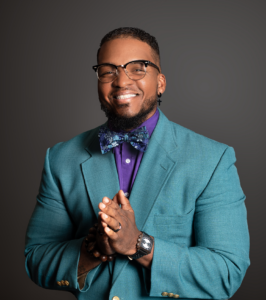 In his biweekly column, Langley Shazor speaks to issues important to men within the territory.