

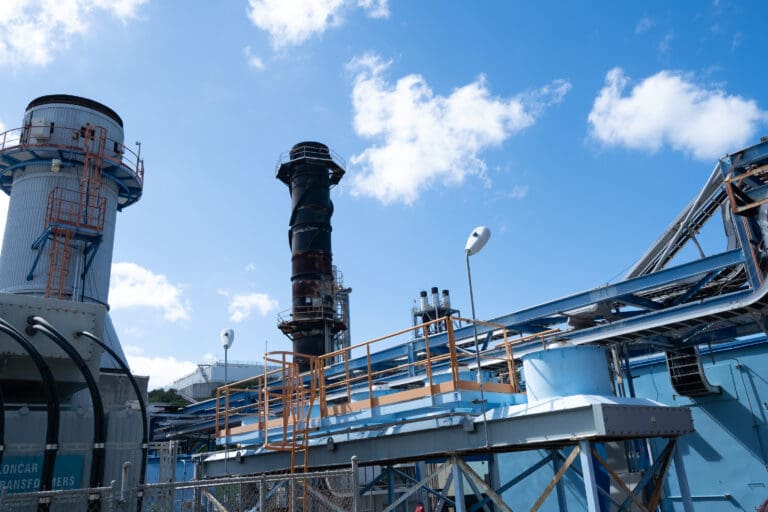
For the Virgin Islands Water and Power Authority, financial recovery is only part of the equation. True stability, CEO Karl Knight said in a recent interview with the Source, depends on rebuilding the system itself — hardening the grid, expanding renewable generation, and preparing for a future where outages are the exception, not the norm.
“The reality is, we’ve neglected maintenance for too long,” Knight said. “We’re fixing one system and another fails. It’s been a constant game of catch-up. But what we’re doing now — with these major infrastructure and renewable projects — is building for resilience.”
Across the territory, that resilience is taking shape in visible ways. WAPA’s composite pole program is nearly complete, replacing thousands of aging wooden poles with more flexible, storm-resistant ones designed to withstand hurricane-force winds. Funded largely through FEMA, the program covers areas where undergrounding isn’t possible. “The composite poles have been a real success,” Knight said. “They’re stronger, safer, and we’ve amended contracts to keep adding more wherever we can.”
Where possible, the utility is also burying lines. Projects like Feeder 13’s bypass on St. Thomas — a long-troubled underground cable route responsible for frequent outages — are about 80% complete. Once finished, Knight said, it will allow crews to take aging cables offline and replace them without affecting service. “That project will make a noticeable difference for customers,” he noted.
The utility’s most ambitious work, however, centers on generation. On St. Croix, WAPA is moving forward with a complete rebuild of the Richmond Power Plant — a project funded through FEMA that includes new generation units, upgraded substations, digital control systems, and another battery energy-storage system. Construction will take several years, but temporary generation and battery components are expected within the next 12 to 18 months to stabilize supply. “It’s a once-in-a-generation project,” Knight said. “We’re not just replacing what we had — we’re modernizing it.”
The St. Thomas–St. John district is seeing similar investment. WAPA plans to add about 40 megawatts of new generation to the Harley Power Plant, along with additional battery backup systems and temporary generation to bridge the transition. Knight said the project, now in design, will take roughly three years to complete.
At the same time, WAPA is expanding renewable capacity through two large solar farms on St. Thomas — one at Estate Fortuna and another at Estate Bovoni — both developed through private partnerships. Each site will include battery storage, enabling WAPA to shift daytime solar power into the evening hours. “The solar at Fortuna should start generating by mid-2026,” Knight said, “with Bovoni coming online shortly after.” Together, they are expected to provide enough daytime generation to power St. Thomas and St. John while allowing the utility to idle older, inefficient gas turbines.
Renewable efforts extend beyond the main islands. On St. John, WAPA is developing a battery-energy-storage project in Coral Bay — the foundation of a planned microgrid that could allow portions of the island to operate independently from St. Thomas during outages. “It’s about energy independence and reliability,” Knight said. “If we can isolate portions of St. John, we can keep the lights on even when the main grid is down.”
The investments are massive. WAPA estimates that federal funding across all water and power projects totals several billion dollars, including roughly a billion each for St. Thomas and St. Croix waterline and underground work. But those funds are restricted — they can only be used for capital improvements, not operating costs. Knight acknowledged that supply-chain delays, labor shortages, and rising costs for equipment such as transformers continue to test schedules and budgets. “It’s not easy,” he said. “We’re building at a time when everything — materials, freight, labor — costs more. But the alternative is to keep patching the old system, and that’s not sustainable.”
Despite those obstacles, many of the authority’s short-term projects are nearing completion. Underground upgrades at Blackbeard’s Hill, Mahogany Estate, and other neighborhoods are wrapping up by year’s end, and WAPA expects the Feeder 13 bypass to be energized before December.
What these efforts represent, Knight said, is a philosophical shift. “We’re not just reacting to problems anymore — we’re designing the grid we should have had twenty years ago,” he explained. “Every project we complete, from a single composite pole to an entire solar field, brings us closer to that goal.”
Still, Knight remains realistic about public expectations. Power interruptions will continue in the near term, especially as older units fail and new systems come online. “We’re not out of the woods yet,” he said. “But every investment we’re making now — in generation, storage, and infrastructure — is a step toward a stronger, more reliable, and more affordable WAPA.”
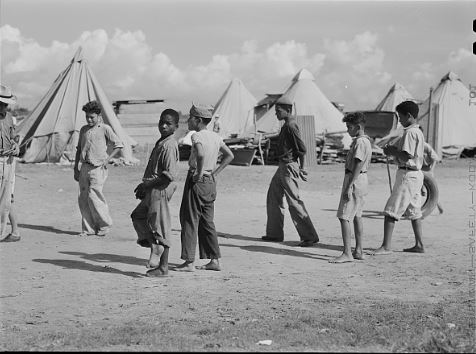




 Each year the competition awards $12,500 in scholarships to participating high school students and provides a significant opportunity to develop and advance public speaking and advocacy skills and promote the study of law. Those wishing to learn more about the competition can visit:



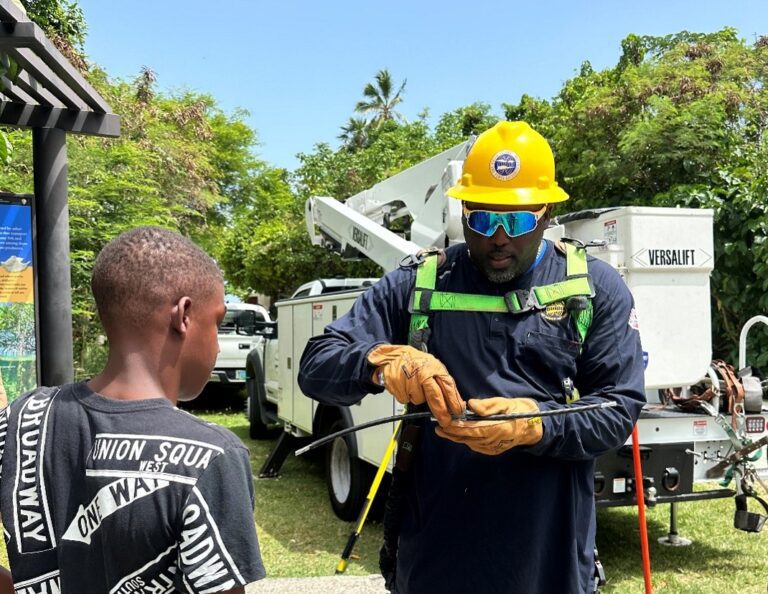


Op-Ed: Bowing to the Spirit of the Law: Stop Signs and Lights
I had been thinking for years about a column that would clarify for those who might not know or be clear about what the laws of the U.S. Virgin Islands say. And to be fair, most lawyers in the V.I. would agree some of the code is ambiguous and even “outdated.” But that is not my job to fix, though perhaps a gentle nudge through this effort might encourage some clarity and updating.
A decade or so ago when I first thought about it and discussed it with the then-executive editor, Bill Kossler, I wanted to call the effort: “It’s the Law!”
I have mellowed since then and thus, when I stumbled upon the poem that follows by 19th century poet and transcendentalist Margaret Fuller,* the notion came alive again under this gentler rubric: Bowing to the Spirit of the Law
Freedom and Truth
by Margaret Fuller
The shrine is vowed to freedom, but, my friend,
Freedom is but a means to gain an end.
Freedom should build the temple, but the shrine
Be consecrate to thought still more divine.
The human bliss which angel hopes foresaw
Is liberty to comprehend the law.
Give, then, thy book a larger scope and frame,
Comprising means and end in Truth’s great name.
As a lifelong lover and reader of poetry, Fuller’s eight-line verse spoke directly to me of freedom and respect, saying, “True Freedom is to comprehend and obey the law, especially where the law gives rise to consideration for others as an act of kindness and dedication to the safety and well-being of all living things.”
It is in the spirit of the law that I have come to this column, which has also sprung from years of frustration and fear while observing the carelessness that has arisen over my lifetime with regard to caring for and about someone or something other than ourselves.
We live in a violence-ridden world. Much of the savagery highlighted, fed and nurtured by commerce-driven, mainstream and anti-social media springs from buried, and thus unresolved, trauma and pain.
If only those who wantonly flout the law understood the congestion of harm they were contributing to, perhaps they would reconsider the behavior that daily and even hourly threatens our peace.
It is with that intention of understanding, and thus reconsideration, that I consecrate our “codes” of conduct — as we refer to our laws in the Virgin Islands and elsewhere — as I hope and pray it is not too late for us to change.
I will start with stopping; the simplest of universal laws signified by the hexagonal red sign found in the same shape in local verbiage at intersections across the globe.
I was fortunate to be taught to drive by my mother who, among her other jobs with Bell Telephone Corp., taught driver education to employees. Remember, she taught driver ed in the early ’50s when there were only about 2 billion people on the planet, and automobiles were relatively new, relatively slow moving and much rarer contraptions. Needless to say, no one was texting while driving.
All laws across the nation, including New York State where I was born, basically say the same thing about what the stop sign requires: “Come to a full stop, yield the right-of-way to vehicles and pedestrians in or heading toward the intersection. Go [only] when it is safe.”
The consequences of not respecting the directives above are dire. After going down the Google Gopher hole, I feel safe in saying that more than half of all traffic injuries and one quarter of all traffic fatalities occur at intersections.
This, of course, includes the more frightening and egregious act of total disregard for the sacredness of life — running red lights. In January 2025, that specific act resulted in two tourists being thrown “up into the air” by a vehicle driven, as far as we know, by another human being who was running a red light in disregard of the qualified “left on red after stopping.” Allow me to add: “much less looking, for God’s sake.”
To add personal, unresolved (though I have tried and tried) trauma and harming thoughts to injury: When I was 25 years old I was struck by a vehicle while crossing (not in a crosswalk and late at night, to acknowledge my part of the responsibility) a long city stretch in Rochester, New York, called Lake Avenue. The driver of the vehicle that struck me was going 40 miles an hour, according to the police report, which was presumably the speed limit at the time. I too was thrown into the air as were the tourists and landed on the hood, my barely-adult skull cracking the windshield.
When I read the story of the hapless pedestrians who trusted the traffic lights when crossing the intersection by the Lucinda A. Millin Home senior center on St. Thomas, I was transported back 50 years to an occurrence I do not consciously remember, no doubt due to the resulting concussion. Yet, the trauma lives on in my body somewhere, also triggering thoughts of violence when I observe the insanity of drivers running stop signs and red lights.
Addendum: We must not disregard the trauma of the perpetrators, who will carry their own psychic injury, if left unresolved, of being a first-hand witness to the pain — even death — they have caused. That is what is known as Post Traumatic Stress Disorder (PTSD) and widely acknowledged as a mental health disorder and recognized as such in the DSM-III and DSM-5. If there was only one victim and one driver, we now have two people with mental health disorders when stopping would have cost nothing but a movement or two of consideration.
So, the ask here is best articulated by The Supremes: Stop in the Name of Love
*Poet, essayist, journalist, and transcendentalist activist Sarah Margaret Fuller was born on May 23, 1810, in Cambridgeport, Massachusetts. She is best known for her controversial treatise, Woman in the Nineteenth Century (Greeley & McElrath, 1845). Fuller died on July 19, 1850, in a shipwreck off Fire Island, New York.