
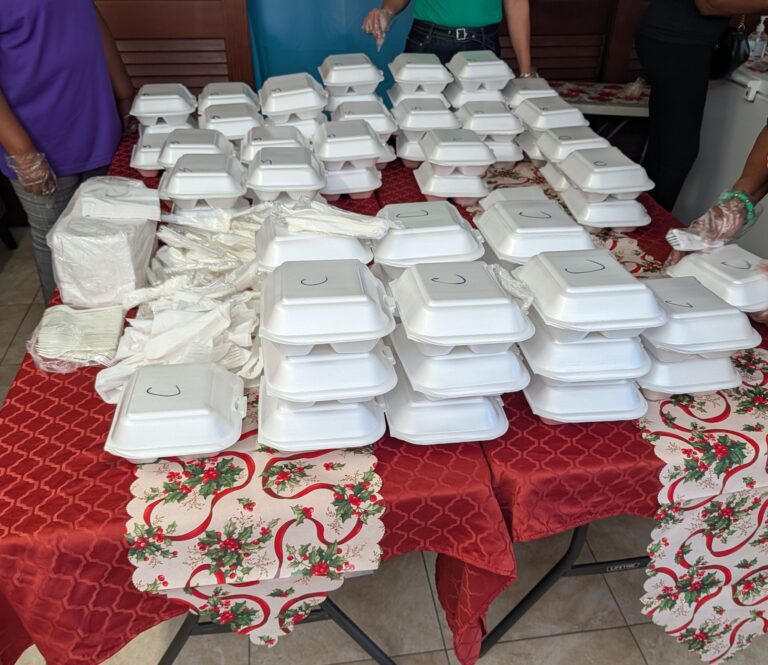
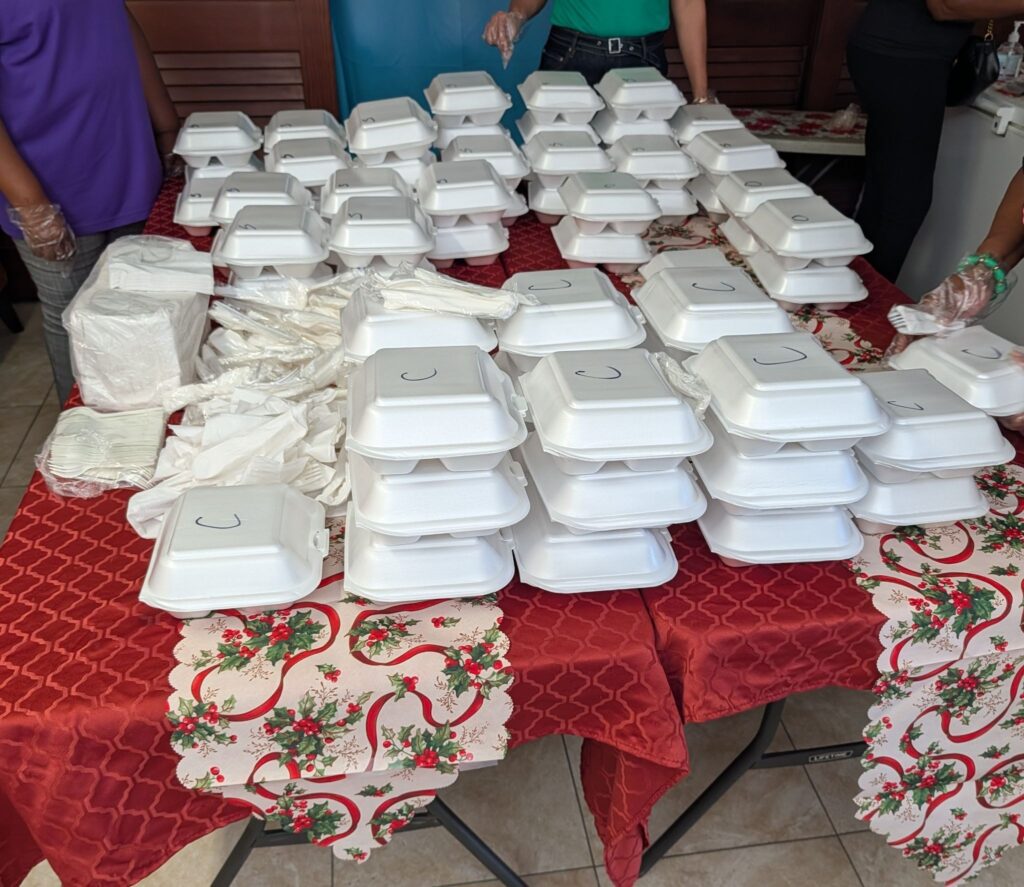
On Monday, Members of Catholic Charities of the Virgin Islands, Alpha Kappa Alpha Sorority Inc, Suffolk-CBNA, the Community Foundation of the Virgin Islands, and the Vivo Group partnered to host a meal distribution at the St. Martin de Porres Outreach Center in Charlotte Amalie.
The event served more than 100 meals at the outreach center and across St. Thomas, with volunteers driving to the eastern and western ends of the island to deliver food. A similar distribution is scheduled for Tuesday on St. Croix at the St. Teresa of Calcutta House of Hope in downtown Christiansted starting at 11:45 a.m.
Lorraine Benjamin-Matthew, a member of the Mu Gamma Omega chapter of Alpha Kappa Alpha Sorority Inc. on St. Croix, emphasized the importance of community partnerships.
“We are here along with our sister chapter on St. Thomas, which is Sigma Theta Omega,” she said, noting the collaboration between the various organizations. She pointed to previous successes as the foundation for the current outreach, adding, “Last month, we had an event in St. Croix for Thanksgiving at Catholic Charities over there at St. Teresa’s House, and that was successful.”
Benjamin-Matthew said the community’s appreciation for the large meal sizes during the Thanksgiving distribution influenced the planning for the Christmas events. “We were known as giving the big plate because, of course, we did a bigger size plate,” she said.
She noted the larger portions meant “they were able to get a little bit more for the holidays.” The initiative aims to both nourish and uplift the local population. “It’s very impactful, and those are the things that we do as an organization. We want to impact the community, especially our community,” she stated. “That’s why we’re here.”
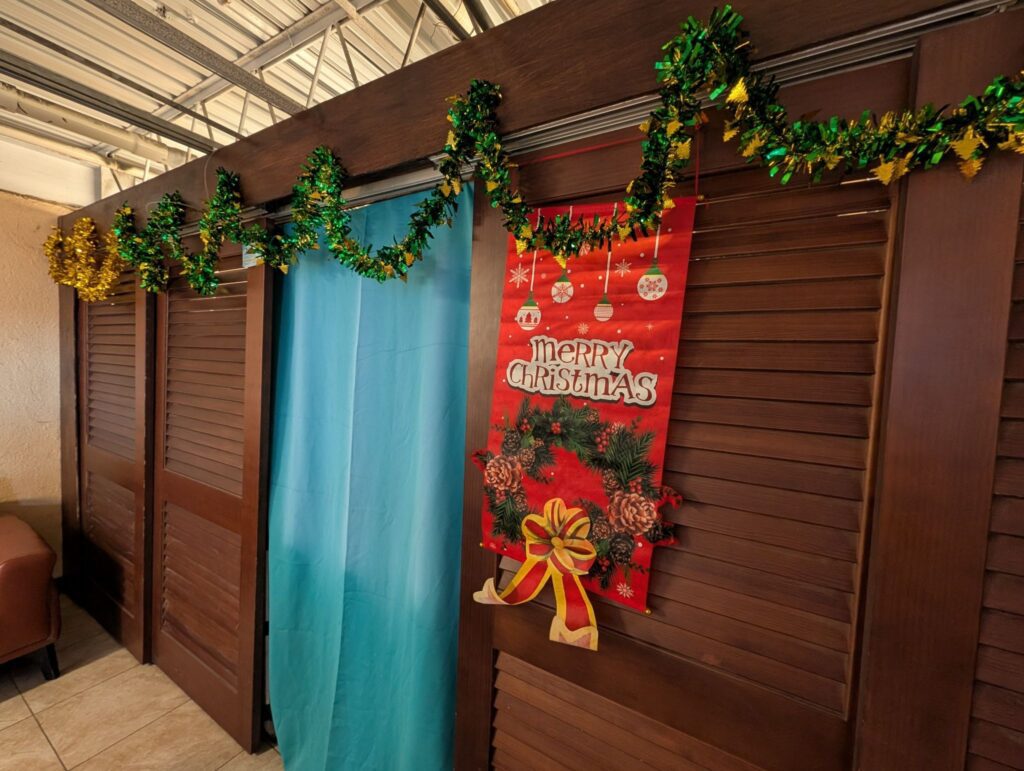
Pointing to the festive garlands and the music playing in the background, she noted the impact of the event’s “Christmas spirit.”
“It’s not all about giving the food, but also when they come, they feel a sense of awareness that they’re part of the Christmas season,” Benjamin-Matthew said. Whether through providing extra food or additional decorations, she said the sorority always strives to go “that extra mile” to help the community.
Alicia Barnes, a member of the Mu Gamma Omega chapter and community outreach coordinator for the Suffolk-CBNA joint venture, highlighted the significance of the event and partnership.
“Suffolk-CBNA has been contracted by the government of the Virgin Islands to rebuild schools on St. Thomas and St. Croix,” she noted. “They were able to provide the funding for us to purchase 100 meals for distribution in St. Thomas/St. John, and another 100 meals for St. Croix.”
Barnes described the event as a tapestry of organizations working toward a common goal. “This is community engagement and outreach. It’s a collaboration between the Suffolk-CBNA joint venture, the Mu Gamma Omega and Sigma Theta Omega chapters of Alpha Kappa Alpha Sorority, and the Community Foundation of the Virgin Islands, which acted as the fiduciary for the food distribution,” she explained.
Catholic Charities hosted the event while the Vivo Group provided transportation and logistics support. “It’s a true community partnership and collaboration,” Barnes added.
The holiday menu was designed to be filling and delicious. “We have chicken, oxtail, which is a treat for many, and salmon. We also have drinks and dessert,” Barnes shared. “We wanted to make it a bit more special for the holiday season.”
Barnes said the mission of the sororities and the other foundations is to reach the community’s most vulnerable members. “We really believe the sororities are of service to all mankind,”
She continued “During this holiday season, we know it could be challenging… we just want to have an opportunity to spread some goodwill, give them a warm holiday meal and let them know that we see them, we hear them, and we care.”
Linique Williams, president of the Sigma Theta Omega chapter, reiterated the sorority’s mission of service. “We are a group of college educated women focused on service and sisterhood… Our sorority focuses on uplifting our local community. We just want to give back to those who have supported us in the past and cater to those in need.”
Catholic Charities of the Virgin Islands Executive Director Andrea Shillingford expressed gratitude for the collective effort, noting that such partnerships bolster the organization’s daily work. On a typical day, the nonprofit serves between 65 and 100 clients at this outreach center, while also reaching out to the homebound and elderly with their delivery service.
Shillingford emphasized that this outreach is a direct extension of the organization’s faith-based mission. “Christ has called us to serve the less fortunate. We are here to feed them, clothe them, and house them,” she said.
Peter Gasparini, executive vice president for project controls at the Suffolk-CBNA joint venture, said the company views community outreach as inseparable from its rebuilding work in the territory.
“Suffolk and CBNA came here to the Virgin Islands as part of the rebuild USVI program. So we’re here to rebuild the schools that have been damaged since the back-to-back hurricanes in 2017, so our entire mission here is to help rebuild the community,” he said. “We know that rebuilding the community isn’t isolated to just the construction side of it. It’s helping wherever we can… it’s important for us to let the Virgin Islanders know that we’re here to serve them, and not just to come in and build a few buildings, but to serve the community in any way that we can.”





Op-Ed: Virgin Islands at a Crossroads, Part VI: Project Meridian Gateway: Building America’s Digital Harbor in the United States Virgin Islands
America is in a race for leadership in artificial intelligence (AI), advanced connectivity, and resilient energy. The jurisdictions that deliver hardened infrastructure, reliable power, and trusted digital services will shape security and prosperity.
McKinsey & Company projects that up to $7 trillion will be invested in AI-ready infrastructure by 2030, flowing into data centers, submarine cables, grids, and secure compute.
The United States Virgin Islands stands at an inflection point. Federal rebuilding funds and our mid-Atlantic location create a convergence of opportunity. The question is no longer whether we rebuild after Irma and Maria. The question is what we choose to become.
I propose Project Meridian Gateway: a unified vision to transform the USVI into America’s digital harbor, a secure hub for AI infrastructure, advanced energy, and resilient transatlantic connectivity. In operational terms, the product is straightforward: AI-grade power, secure cable landings and cross-connect, and continuity-grade compute delivered under U.S. law. Done right, it becomes an investable platform with clear standards and measurable performance.
Why the USVI Is Uniquely Positioned to Win
Our advantages are twofold: U.S. jurisdiction and mid-Atlantic geography. The U.S. rule of law provides enforceable contracts and a trust profile aligned with national security. Our geography places us between North America, South America, and West Africa, creating route diversity that reduces concentration risk.
Just as importantly, our location is outside mainland congestion yet inside U.S. governance. That gives agencies and investors geographic redundancy without sacrificing enforceability or trust standards. In an era of rising concentration risk, the value is not “no disruption.” The value is engineered continuity and geographic diversification.
Pillar One: From Fragile Grid to Energy Fortress
AI infrastructure cannot tolerate interruption. Today’s grid cannot support tomorrow’s loads. We must build AI-grade power that is redundant, stable, and able to sustain operations through extreme weather.
Phase One (2026 to 2028) delivers an initial 50 to 150 MW tranche by deploying integrated solar, onshore wind, and battery storage, using liquefied natural gas (LNG) as a firm, dispatchable bridge fuel. This must be anchored by a Tier IV-certified data center campus built for Category 5 or greater storms.
Phase Two (2028 to 2035) scales firm capacity and hardens fuel logistics. The grid should be designed as SMR-ready, meaning the Territory prepares sites, interconnection pathways, and regulatory groundwork so it retains optionality for small modular reactors (SMRs) as a future firm-power resource. In parallel, we should initiate a Department of Energy feasibility study for potential nuclear deployment after 2035.
The government must set resilience standards, modernize interconnection rules, and streamline permitting. The private sector finances, builds, and operates under long-term offtake agreements. Virgin Islanders gain construction jobs now and operations careers for decades to come.
Pillar Two: Turning Submarine Cables into a Strategic Industry
Our existing cable landings are the digital equivalent of the Panama Canal: vital connectors that pass through our Territory with limited onshore value capture. Project Meridian Gateway changes this by establishing a Digital Free Trade Zone (DFTZ): a governed campus for secure data interchange, trusted hosting, business continuity, and disaster recovery, with published requirements and independent certification.
The DFTZ should be designed to earn trust, with cybersecurity and audit standards aligned to National Institute of Standards and Technology (NIST) guidance and audited annually by independent assessors. To be credible, a dedicated governing authority with published standards, third-party audits, and clear enforcement mechanisms should oversee the DFTZ. Compliance must come first if we want serious operators rather than speculative ventures.
We must also shape future Atlantic routing in partnership with carriers and consortiums. The USVI can become the secure southern anchor of a U.S.-anchored Atlantic data spine linking northern Virginia’s compute corridor to emerging digital economies in South America and Africa. New cables would originate in Loudoun County, land at Virginia Beach, then extend south to St. Croix as the U.S. midpoint in the mid-Atlantic.
From our shores, one branch routes to Fortaleza, Brazil; a second extends east to Lagos, Accra, and Dakar. Over time, this spine can support a Caribbean AI corridor through additional regional links and edge computing.
Today, there is no widely recognized, U.S.-anchored, high-capacity route purpose-built to link the mainland directly to West Africa without routing through multiple non-U.S. landing points. A U.S.-anchored pathway through the USVI would create secure, low-latency routes for trade, education, health, fintech, and AI collaboration, while generating landing fees, local bandwidth sales, and jobs.
Pillar Three: Sovereign AI Compute and Innovation Hub
With resilient power and transatlantic connectivity secured, the USVI becomes attractive for hyperscale data centers, federal continuity and mission-support facilities, and private AI training and inference campuses. Our location outside the mainland, yet within U.S. jurisdiction, offers diversification without sacrificing enforceability.
A governed innovation sandbox within the DFTZ would allow compliant fintech and AI firms to test and scale under U.S. law, as in Singapore and Bermuda, but with stronger security and redundancy.
This pillar delivers the highest multipliers: direct jobs in data center operations, network engineering, cybersecurity, and AI development, and spillovers across construction, logistics, and professional services. Partnerships with UVI, technical certifications, and apprenticeship pipelines ensure Virgin Islanders fill these roles, including power operations and network operations roles essential to continuity. A UVI-anchored Data Center and Grid Operations Academy can align certifications and apprenticeships to employer demand and ensure our people are first in line for these careers.
A Generational Choice
Project Meridian Gateway is not about chasing subsidies or hoping for handouts. It is about converting federal rebuilding capital, private investment, and our advantages into lasting strategic value. It aligns local aspiration with national priority: America needs secure, resilient digital infrastructure beyond the mainland, and the USVI can deliver it.
We stand at a true crossroads. One path leads to gradual recovery and continued vulnerability. The other leads to transformation into America’s digital harbor in the Atlantic, where Virgin Islanders design, operate, and own the infrastructure of the future.
By 2028, success should be visible: the first energy tranche online, a governed and certified DFTZ in operation, and a flagship campus demonstrating AI-grade continuity.
The technology wave is coming. The capital is mobilizing. Let us choose to build the harbor.
This piece is part of the “Virgin Islands at a Crossroads” series, which invites Virgin Islanders at home and abroad to join the conversation on building a resilient, diversified future. Read the first five parts of the series here:
Op-ed: Virgin Islands at a Crossroads: Act Now or Miss the Next Global Economic Wave
Op-ed: Virgin Islands at a Crossroads, Part II: Anchoring the AI Economy at the Digital Gateway of the Americas
Op-ed: Virgin Islands at a Crossroads, Part III: Building the Workforce of the AI and Diversified Clean Energy Economy
Op-Ed: Virgin Islands at a Crossroads, Part IV: Powering the Future — Transforming the Virgin Islands’ Energy Landscape
Op-Ed: Virgin Islands at a Crossroads, Part V: The Superpower of the U.S. Virgin Islands and Why Our Strategic Location Matters Today
— Bernard Dyer is a Virgin Islander in the diaspora and a technologist with more than 25 years of public-sector experience, including 17 years with Booz Allen Hamilton supporting digital modernization initiatives. He is a longtime co-host of WSTX AM 970’s Community Digest.
Editor’s Note: Opinion articles do not represent the views of the Virgin Islands Source newsroom and are the sole expressed opinion of the writer. Submissions can be made to visource@gmail.com.