

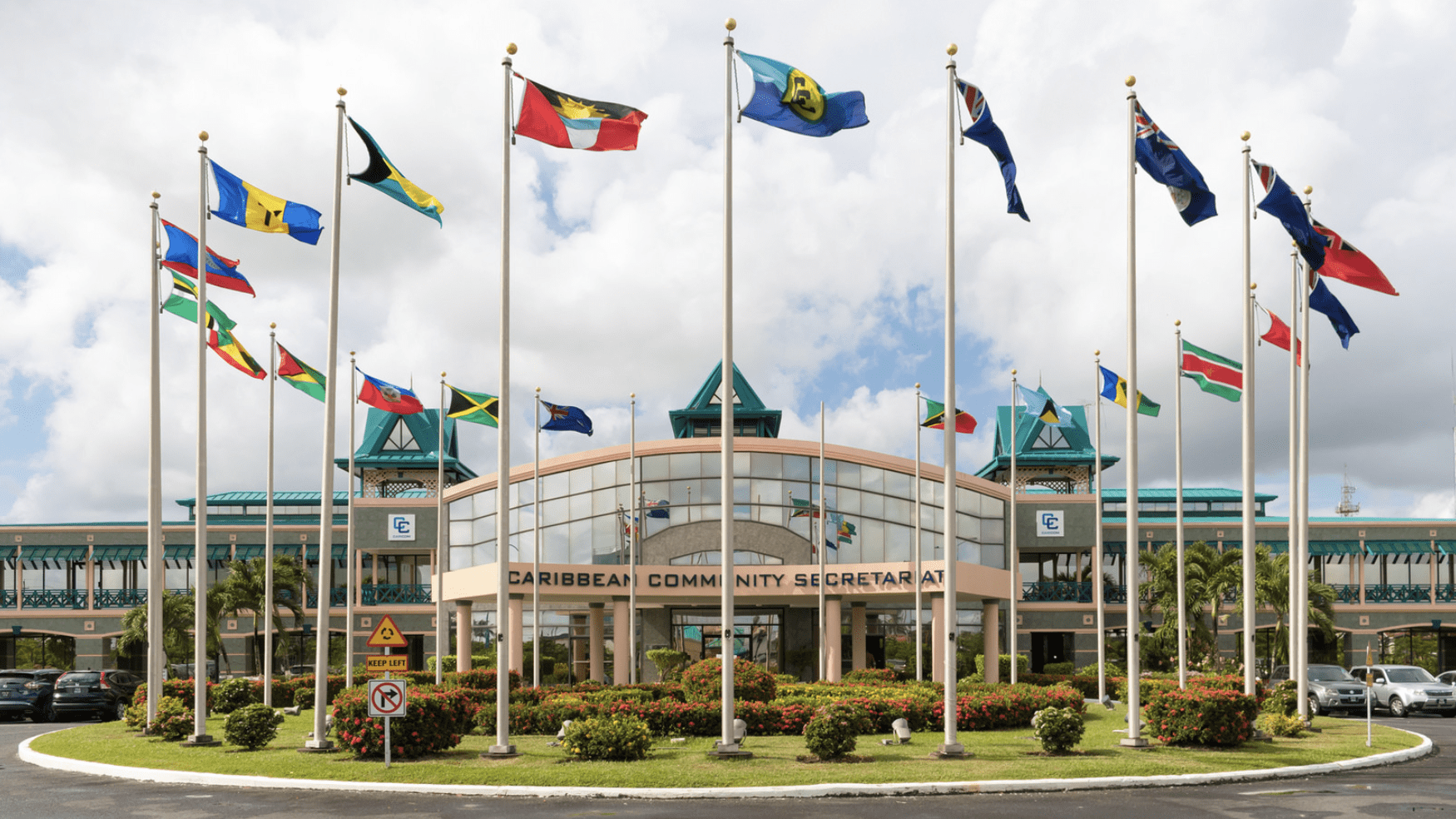
The recent eruption of tensions between Venezuela and Guyana, marked by territorial claims, border incursions, and a chilling trail of criminal violence possibly tied to Venezuelan military elements, has brought the Caribbean to a moment of reckoning. When Guyana’s soldiers come under fire and its capital suffers a bombing traced to regional criminal networks, the crisis cannot be confined to a border dispute. It exposes something far deeper: the fragility of the Caribbean’s self-conception as a coherent political and moral community.
The disunity within CARICOM over how to respond to this crisis reveals that fragility in real time. While Barbados’ Prime Minister Mia Mottley has asserted that the Caribbean Sea is a zone of peace — and that the U.S. military’s expanding presence is unwelcome — Trinidad and Tobago’s Prime Minister has dissented, refusing to join the regional call for withdrawal and even questioning whether CARICOM retains any strategic purpose. This disagreement is not merely tactical or diplomatic; it dramatizes the historical condition Franklin W. Knight once described — or, perhaps more accurately, produced — in his influential text “The Caribbean: The Genesis of a Fragmented Nationalism.”
Knight’s book title is, in itself, a conceptual drama. It proposes two claims that cannot coexist without contradiction. The first, “The Caribbean”, posits a coherent, nameable entity, a singular geography or civilization capable of being narrated as a whole. The second, “The Genesis of a Fragmented Nationalism”, immediately withdraws that coherence by describing the very nationalism of this entity as fractured at its birth. Knight’s title therefore stages what Derrida might call a dangerous supplement: it adds to the claim of regional unity precisely by undoing it. The subtitle does not elaborate the title; it undermines it, revealing that the “Caribbean” may be a discursive fiction: a word searching for a referent.
In this sense, Knight was not writing the history of a region; he was writing the region into history. “The Caribbean”emerges less as a geographical reality than as an academic and political construct, a name retroactively imposed on a field of islands, languages, and colonial trajectories that never coalesced into a single consciousness. His work performs what it describes: it institutionalizes the very thing whose fragmentation it laments. That paradox is now mirrored in the present CARICOM moment, where states speak of unity while acting in self-differentiation, invoking regional solidarity even as they retreat into national calculation.
The tragedy is that this intellectual fiction has long governed our political imagination. We have mistaken linguistic convenience for historical community, treating “the Caribbean” as an organic collective rather than as the inherited residue of European mapping and imperial administration. Our so-called regionalism is, at best, administrative solidarity, cooperation by necessity, not conviction. Thus, when crises arise, whether over Guyana’s territorial integrity, Haiti’s implosion, or U.S. military encirclement, we discover not a house divided, but a house never built. The “fragmented nationalism” is not a wound upon Caribbean unity; it is the evidence that such unity never existed.
And yet, Knight’s ghost lingers. The persistence of the Caribbean idea, invoked in every summit, communiqué, and diplomatic ritual, shows the power of intellectual constructs to outlive their contradictions. The Caribbean continues to be spoken into being because it serves a function: it provides the language of moral legitimacy to an otherwise uncoordinated ensemble of postcolonial states. To say “the Caribbean” is to perform belonging; to say “CARICOM” is to enact coherence. But neither name guarantees the substance it implies.
What today’s geopolitical crisis reveals is that the Caribbean remains a space of rhetorical unity and material disaggregation. The United States speaks of the region as a sphere; Venezuela treats it as extension; CARICOM members experience it as aspiration. And beneath all this, Guyana stands as both the frontier and the test, the point where the Caribbean’s imagined geography collides with the hard facts of land, oil, and sovereignty.
If there is to be renewal, it must begin with intellectual courage. We must confront the fact that “the Caribbean” is not a natural community but a historical proposition, and that its fragmentation is not accidental but structural. The future of regionalism depends not on reviving the myth of unity, but on reimagining solidarity as a conscious, ethical choice, one that accepts diversity, asymmetry, and contradiction as the very conditions of political belonging.
Until that reckoning occurs, Knight’s title will remain prophetic: not the history of a region, but the epitaph of one that never was.
— Walter H. Persaud, Ph.D., is a retired Guyanese-Canadian professor of political and cultural studies. He has worked in national broadcasting media in Canada and taught in Thailand for a quarter century. He currently resides in Guyana where he publishs regularly on a variety of national and regional issues. Dr. Persaud holds a Bachelor’s in History and a Ph.D. in Social and Political Thought from York University, Toronto.
Editor’s Note: Opinion articles do not represent the views of the Virgin Islands Source newsroom and are the sole expressed opinion of the writer. Submissions can be made to visource@gmail.com.