

As the United States prepares to host the Summit of the Americas next month in Los Angeles, the preeminent nation of the hemisphere has an opportunity to demonstrate forward leaning leadership by inaugurating a new relationship with its Caribbean neighbors. With 14 votes in the United Nations and active courtship by China, the Caribbean nations cannot be ignored and a holistic engagement on the part of the U.S. with the region is critical. Presently, the United States’ piecemeal policy approach to the Caribbean belies the region’s importance to U.S. national and economic security. Despite the Caribbean’s valuable resources and strategic location, U.S. policymakers have failed to adequately address its economic and political development. This continued marginalization has negatively impacted economic growth and crisis preparedness in the region, threatening to derail U.S. security and economic interests in the Western hemisphere.
U.S. and Caribbean Basin security interests have been linked since the American Revolutionary War. Gunpowder and weapons procured from the island of St. Eustatius enabled colonists to keep fighting during the early days of rebellion. During both World Wars and the Cold War, U.S. security concerns shifted to assessing threats of foreign subversion in the Caribbean. Today, the U.S. acknowledges that instability, not subversion, is the greatest threat to the U.S. and the region emanating from the Basin.
During a recent congressional delegation visit to Barbados, the urgency of the region’s economic crisis and its exacerbation of poverty and exclusion was clear. The numerous heads of state of the island nations spoke in specific detail about the Caribbean’s economic stagnation and provided compelling data—supporting the need for increased U.S. engagement, particularly in Haiti, where the national state itself continues to deteriorate. While the Haitian Hemispheric Opportunity through Partnership Encouragement Act (HOPE Act) and Haitian Economic Lift Program (HELP Act) have helped create support for the Haitian economy, more comprehensive and diverse trade engagement is necessary to thwart the political and economic instability of the Haitian nation and support economic development of others in the region.
Haiti and its Caribbean neighbors hold great potential for economic growth. Outdated trade agreements like the Caribbean Basin Initiative (CBI), however, leave much of this potential untapped. Indeed, CBI’s modest successes have been distributed unevenly across the region. Comprehensive trade legislation can remedy this imbalance and improve the economic outlook for present and future generations.
To this end, I introduced the Caribbean Trade Resolution (H.Res.1047) in the House of Representatives earlier this month. The resolution, if passed, is an important first step toward prioritizing trade and achieving meaningful economic integration with the Caribbean, including Haiti. Separately, the Caribbean Basin Security Initiative Authorization Act introduced by Representative Adriano Espaillat of New York authorizes new funding for the Caribbean Basin Security Initiative, a regional assistance program that includes support for disaster preparedness and resilience.
Strengthening the economic partnership between the U.S. and the Caribbean will also require us to confront the economic challenges that financial laws, triggered by the harmful trend of de-risking, have placed on small island nations. Nearly two decades from the 2008 financial crisis, de-risking efforts continue to create costly compliance hurdles for Caribbean affiliate banks. The challenges ensuing from financial exclusion have caused significant economic disruption to countries and businesses across the region. The worst effects are more readily felt, perhaps, by low- and middle-income families on the islands who rely on remittances as a lifeline.
Advances in financial technology (fintech) present opportunities for the U.S. to engage more effectively with stakeholders in the region. Given the dearth of correspondent banking relationships, Caribbean leaders are turning to fintech to fill the void left by U.S. banks. Fintech is particularly attractive to poorer and smaller volume Caribbean countries due to the technology’s ability to reduce the costs of transactions and services, leading to lower remittance costs. By working closely with stakeholders to facilitate fintech exchange, the U.S. can expand banking access in Caribbean countries with limited financial markets. Increasing fintech transfer can also help bridge the gap in resources, thereby strengthening financial inclusion and supporting economic growth.
As the United States’ “third border,” the Caribbean’s economic stagnation directly impacts U.S. security and stability. Our fates are inexorably linked. Yet many of the region’s problems are rooted in systemic neglect by U.S. policymakers as well as former colonial powers in the region.
As co-chair of the Congressional Caribbean Caucus, I am acutely aware that the economic and political challenges facing our neighbors are complex and, as such, require collaborative and sustained efforts from policymakers, industry experts, financial institutions, and civil society groups, among other stakeholders. As the leading power in the region, the U.S. must lead and tackle, head-on, issues such as financial exclusion, economic growth, and crisis preparedness in order to promote mutually beneficial economic prosperity. Without that U.S. leadership, the neighboring nations will continue to look elsewhere (China and Venezuela in particular) for support. With growing instability in the region threatening to undo the economic and social gains achieved over the last decade, the consequences of inaction are simply too great to ignore.
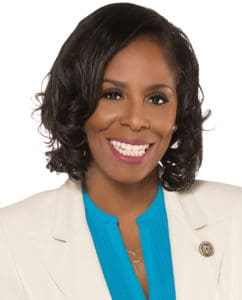
Congresswoman Stacey E. Plaskett
Editor’s note: Congresswoman Stacey E. Plaskett represents the United States Virgin Islands’ at-large Congressional District in the United States House of Representatives. She is currently serving her fourth term in Congress and is a member of the Ways and Means Committee, the Budget Committee, and the Agriculture Committee.