

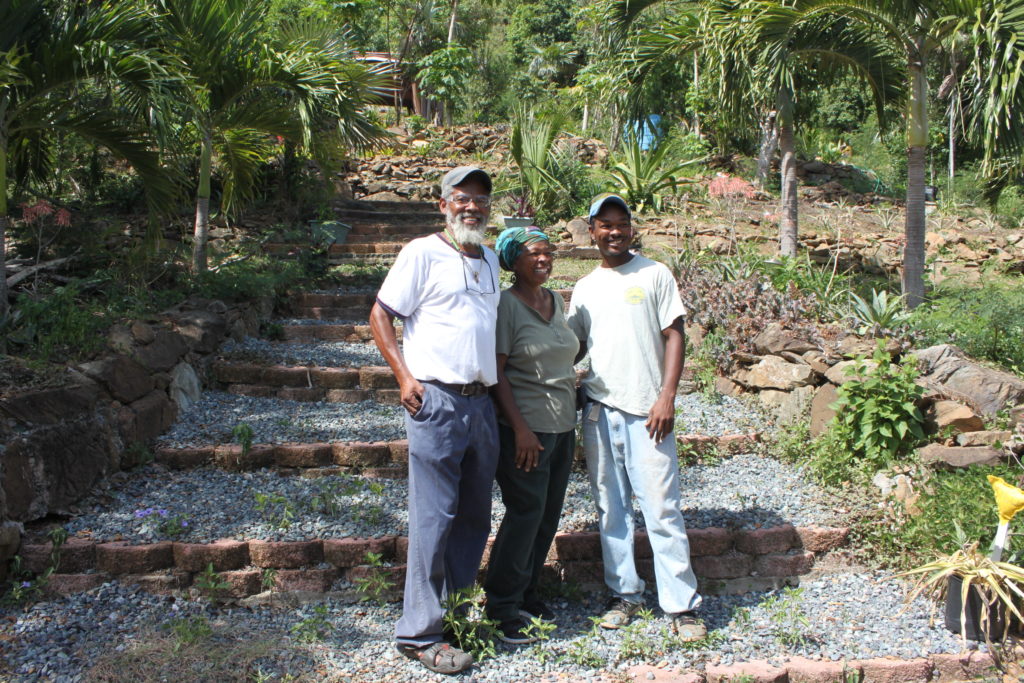
Tucked away in the coastline just minutes from Mandahl Bay beach and lagoon is a farm like no other on the island of St. Thomas. While it boasts pineapple groves and fruit trees of all varieties, this farm was conceptualized and has come to fruition as a campground with a two-fold mission, to protect natural ecosystems and educate youth about fragile marine and land environments.
Since 2003, Camp Umoja, which translates to camp unity, has been a labor of love that Founding Director Anna Francis started with her husband and co-founder Alcedo Francis, along with their son Jawanza Hilaire.
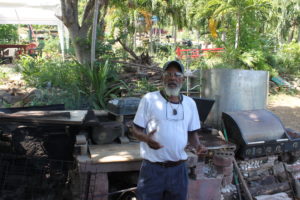
“This is a dream of my wife’s,” Alcedo Francis said.
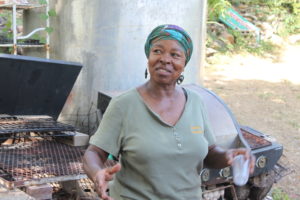
But Anna insisted it was a dream the couple nurtured together. “We wanted to have a place to entertain and educate children, and we agreed on doing that here. When the property came up on the market, we looked at it and knew it was perfect for us.”
When walking the spacious grounds guests can find tamarind, genips, papaya and bananas along the trails which Anna said were fashioned by campers. The entire grounds, which has composting areas, benches for resting, a structure used as an open-air classroom, and even grand staircases, were built in part by campers who came to learn construction skills.
“In some cases, the girls will create and lay out the designs then the boys will move the wood and rock and heavy materials. They work together to create something. All the children help to clear the land by hand and get their hands dirty,” Anna said referring to Camp Umoja’s Environmental Rangers which are ages 12 to 18. She added, “And all the camper’s plant something, whether a crop or fruit tree.”
Because not everyone can afford camp rates, which are still kept fairly low, Anna said they also offer the Environmental Heritage S.E.E.R Program (science, education, exploration, research) which allows enrollment once a year for 15 campers who meet one day a week for 40 weeks and is entirely free.

Anna said in this program campers meet the “movers and shakers” of the environmental and agricultural world. The pamphlet for the program reads that is a program that educates about how to survive both the wild and urban jungle, allowing campers to “create their own real-world research projects with public reporting to government, science agencies and civic organizations.”
“We have had those campers whose main project was learning to scuba dive and going around and video-taping, mapping and diagramming what we have on the property,” Anna said. “They were able to put all of this in a public service announcement and acted as anchor people. They were excited about it and what we are doing here with the youth is really good and exciting.”
Campers don’t come just for farming and construction, but an array of other activities the camp offers. Small and large group activities can be done within the camp where guests can do arts and crafts like traditional broom making, explore wetlands, take hiking identification tours, kayak and snorkel. All these single day-long camp undertakings are done while studying endangered ecosystems Anna said.
“After a day of exploring natural habitats they play games while we cook on an open fire using natural wood harvested from the area,” Anna said. The camp’s website showcases an array of dishes campers can choose from with several vegetarian options.
Each group of campers that Anna and her husband take in are part of groups generally no larger than 15 with a five-to-one ratio of students to adults.
“I do this because when you have just ten children you can really make a difference. Sure, you can make a difference with 30 but you don’t get to have that individual attention and that’s what they need,” Anna said.
To learn more about what the farm has to offer, its many community outreach projects, or research projects, visit the camp’s website at https://climatechangevi.org/.
“This is a family friendly place, open to the public, and we love seeing new faces,” Anna said.