

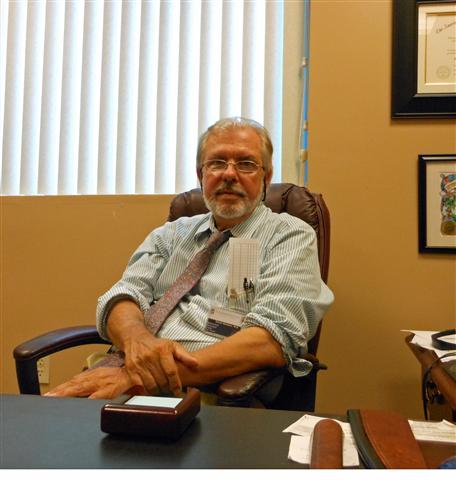
 When Dr. David Weisher was a youngster, he used to squint a light into his own eyes. "Who are you?" he would ask himself.
"I was fascinated with the concept of the brain as machine," he says. "I wondered who was behind those eyes."
It’s a question the neurologist still pursues—an abiding curiosity and passion for the mysteries of the brain and what happens when the brain has died.
Weisher moved to the island in 2003, leaving behind a highly successful neurology practice in the Washington, D.C. area, where he was on staff of six hospitals, as well as a member of the teaching staff at the University of Maryland Residency Program at the Prince Georges General Hospital in Maryland.
The engaging doctor has discarded only a couple of those hats on St. Thomas. Along with his private practice, St. Thomas Neurology, he is staff neurologist and Chief of Hyperbaric Medicine at the Roy L. Schneider Hospital; and medical director of both the St. Thomas Sleep Center and the hospice Continuum Care.
Weisher’s practice includes specialization in the diagnosis and treatment of strokes, Parkinson’s disease, migraines, seizures and other neurological disorders.
While publishing a wide swath of medical papers, he has written two books: "Different but Equal" and "Mysteries of Consciousness," both dealing with neurology and the nature of human consciousness.
The first book—dedicated to his mentor and high school principal, who encouraged the dyslectic student to pursue an engineering career—is an analysis of cerebral lateralization (the process by which the two hemispheres of the brain increasingly specialize in particular functions) and its application to everyday life, including romantic relationships, and near death experiences.
More later about the second book.
After graduating from Walla Walla College in Washington State with a bachelor of science degree in electrical engineering, Weisher embarked on a career as a mixed gas deep sea diver.
After a few too many life-threatening experiences, he left for a career above sea level as an aerospace engineer, an exciting and lucrative profession, but not a road he chose to tread.
So, off to explore the vastly more intriguing mysteries of the brain.
Weisher completed his neurology training at Georgetown University in Washington, D.C. in 1988. He was board certified in Neurology in November of 1989.
While at Georgetown, he was also chief resident and upon completion of his neurology residency in May 1991, he was appointed as clinical instructor to the Department of Neurology.
With a visionary’s instincts, he recognized early on the importance of sleep disorders, studying on a fellowship at the National Institutes of Health in 1988 before there was even a certifying board for sleep medicine.
Now, about that second book.
"As a neurologist," Weisher says, "I firmly believed human consciousness was machine in nature and ceased to exist with the death of the brain machine. I entered my field at the right time. Shortly after, came [breakthrough diagnostic technologies like] the CAT scan (Computerized Axial Tomograph), MRI (Magnetic Response Imaging), and the PET (Positron Emission Tomography), which allows us to visualize the brain’s metabolically active areas that may affect behavior."
He says, "I’d studied the near-death phenomenon, and I believed the experiences were the random firing of neurons. I remember telling a colleague that anyone who makes religion out of these experiences is an idiot."
That was until Weisher listened to Walter Funk, an ICU [intensive care unit] patient who had been clinically dead for several minutes after a cardiopulmonary arrest. It was a conversation that changed Weisher’s life.
He says, "I called Mr. Funk and his family into my office to tell them an MRI had revealed a small tumor in the temporal lobe, which he would be unlikely to survive.
"Mr. Funk interrupted me," Weisher says. "He told me, ‘I was dead and I came back.’
"I told him I knew that," Weisher said. "I was there."
‘You don’t understand, doctor,’ Funk said to Weisher. ‘I was out of body. I went to another place and returned.’"
Feeling very smug, Weisher said he explained the phenomena of hallucinations, until Funk said something [Weisher’s] "never forgotten."
Funk told Weisher, "I’m much older than you, and I’ve had many more dreams than you. This was no dream. It was as real as you in front of me now."
Funk went on to tell Weisher of how he met Jesus, and how he admitted to Jesus that he wasn’t a religious man, at which Jesus laughed. Funk told Weisher, "Jesus said I was a good man. He said it is the content of your character that counts.’"
According to Funk, during his out-of-body experience he had visited with his dead father and brother. He told them he wanted to stay with them, but they told him he must return, that he would be back soon.
"Mr. Funk already knew of the tumor," Weisher says. "He asked me if he could visit my hospice patients, to console them. Mind you, he was a highly successful businessman. His wife didn’t understand his change of heart."
Weisher relates other documented tales of near-death experiences in his book, which he says he has kept small, "so people will read it."
The stories from his patients and others have shaken his firm belief was that there was no soul—to its very core. The book is the result of this change of view. It presents the argument for Dualism (coexistence of spirit and brain) in personal, scientific and intellectual terms.
"It challenges the reader to open his or her eyes," Weisher says, "to think outside the Western religious box, and perhaps move a little closer to God."
There is a new book in the works, "The Golden Thread," Weisher’s most ambitious yet. "It’s about the mystery of why humans are the way we are," he says. "How the brain evolved. We are very, very, very different from the bonobo [i.e. chimpanzees], whose DNA is about 98 percent similar to ours."
Speaking recently on St. Thomas, Weisher is relaxed, generous with his time. As the hospital’s neurologist, he is always on—sometimes more than once a night. He even answered a reporter’s inquiry while in the ER Sunday morning. However, he says he still finds time to enjoy the lure that drew him to the territory — the water, sailing and diving.
The joy and satisfaction he takes in helping others are evident as he talks about his patients, "You become a member of the family when you help someone," he says. "The older folks in the community are those I enjoy most."
On Friday Weisher visits hospice patients in their homes. "A lazy doctor," he sagely observes, "is an oxymoron."