

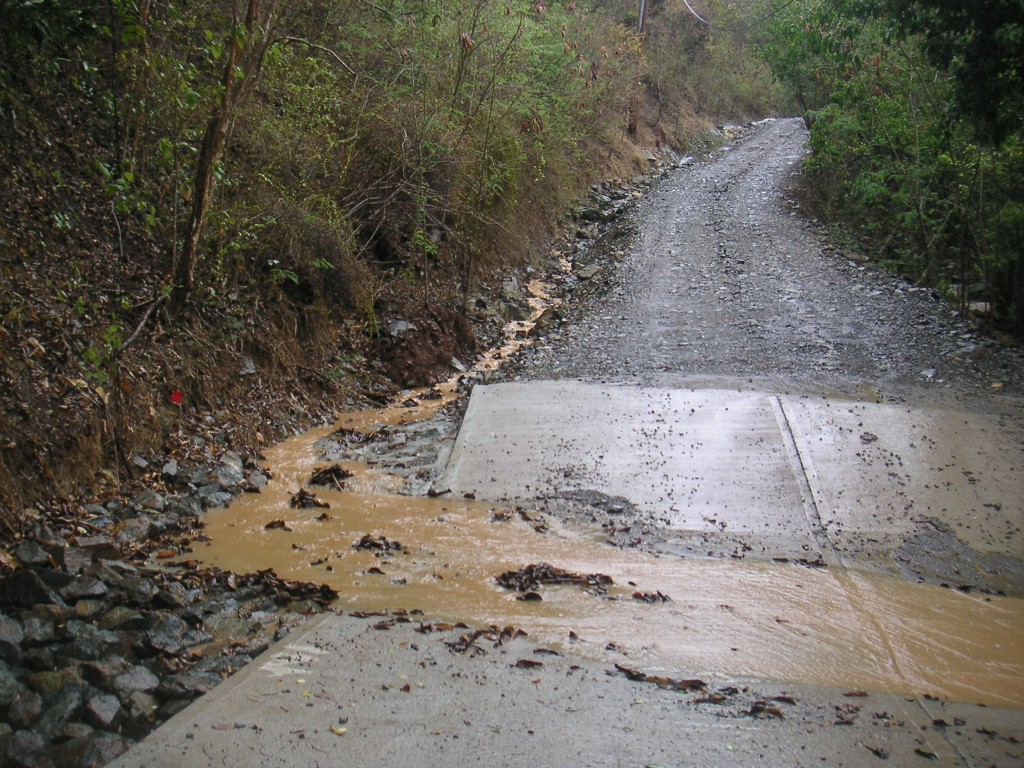
 Last week’s rain brought good news for the Coral Bay Community Council. The swales and sediment ponds installed by the organization under a National Oceanic and Atmospheric Administration Stimulus Fund grant did the job.
“They worked amazingly well,” said Chris Laude, the storm water engineer at the Coral Bay Community Council.
For example, the unpaved road called the Johnny Horn Trail, which runs alongside Emmaus Moravian Church into a developing residential area, previously funneled large amounts of sediment along with rainwater down the hill and into Coral Bay.
During the rain, two concrete swales on the road fed the water into existing guts so efficiently that no water appeared near the bottom of the gut that reaches the main road through Coral Bay near the Donkey Diner.
“All of the water flowed back into the ground,” Laude said.
The organization also installed two more swales further up Johnny Horn Trail road, which are further helping to alleviate the problem, Community Council President Sharon Coldren said.
The swales on Johnny Horn Trail are deep, so Coldren asked that anyone having problems driving through them let the organization know.
“They’re intended to drive through slowly,” she said.
Coral Bay Community Council also installed a sediment pond on King Hill Road. Laude said it captured all of the water that normally would flow down Gerda Marsh Road. It wasn’t until halfway down the road that sediment flowing in from both sides of the road turned the water brown.
The success of the Coral Bay Community Council’s projects demonstrates that simple things like swales and sediment ponds can make a big difference in keeping Coral Bay from turning brown when it rains.
“I drove up to picture point and there were no muddy plumes going out into the bay,” Laude said, referring to Bordeaux mountain overlook.
Subdividing the Coral Bay area started in the 1960s, Coldren said, but it wasn’t until the mid-1990s that a building boom began. With the increased building, the area began to experience serious sedimentation problems when it rained.
Coldren said that the developers subdivided so they could get the maximum amount of lots out of their land without considering the placement of natural guts. This resulted in an ever-increasing amount of roads and driveways, which Coldren said got little oversight by the authorities. Some of those roads are still unpaved, which means that the sediment from those roads flows downhill into the harbor.
Without all the houses and roads, Laude said the guts worked efficiently to keep sediment out of the bay. He said the sand in the guts absorbs water to prevent it from flowing downhill.
“Getting the water back into the guts where it belongs can have a profound effect,” Laude said.
The Community Council has $1.5 million to spend on 18 projects like these. The NOAA money, which includes administrative costs, was funded through the V.I. Resource Conservation and Development Council. Coldren said that a little over $1 million will go directly to the road projects.
According to the terms of the grant, work on all the projects must start by June 30. Getting permission from landowners and the government has been an arduous process, Coldren said. She said that many landowners want the water off their land rather than letting the water takes its natural course across their property.
However, she said that the Community Council will make the June 30 deadline.
Call the Community Council at 776-2099 or visit www.coralbaycommunitycouncil.org.