

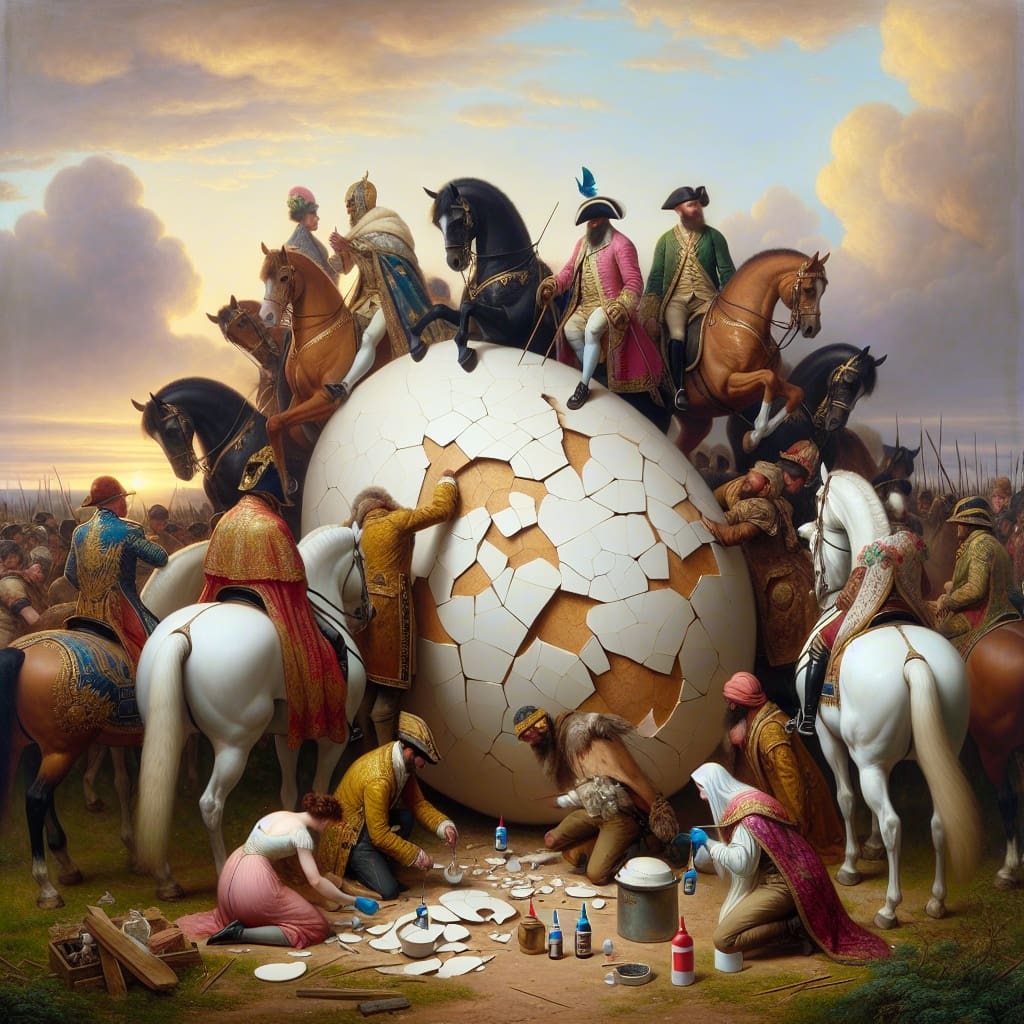
The famous nursery rhyme “Humpty Dumpty” from grade school tells the story of a character of fragility who took the risk of sitting on a wall but ultimately took a significant fall, a fall of great consequence. He breaks into pieces, and neither the king’s horses nor all the king’s men can put Humpty Dumpty back together again.
This rhyme conveys the importance of understanding consequences and recognizing the signs when warned of danger. It serves as a cautionary tale that can be applied to historical events, such as the decline of empires due to their poor behavior and failure to heed warnings.
What were the signs? Could their decline have been avoided?
Signs that an empire is on the verge of collapse are often unmistakable. Chief among these signs are profound national fear and a widespread lack of confidence in leadership, which leads to political instability and deep divisions within those in power. This political instability, a key sign of an empire’s collapse, usually coincides with a breakdown in governance, where the ruling authority fails to manage state affairs effectively. However, the economic decline amplifies public dissatisfaction and triggers widespread protests on college and university campuses, highlighting the situation’s urgency.
During such turbulent times, cultural values are often intentionally dismantled and compromised. Furthermore, as neighboring countries and allies withdraw their support, diplomatic relationships weaken and alliances crumble, making it clear that the empire’s status on the world stage is rapidly diminishing — these signs, when observed, point to the historical inevitability of an empire’s collapse.
Throughout history, many empires have ended, including the Roman Empire that fell in 476 AD, primarily due to internal strife, economic troubles and invasions by barbarian tribes. The Mongol Empire fell in the 13th century due to internal divisions and difficulties in managing its extensive lands, overextension, cultural differences among conquered peoples, and succession crises, weakening the centralized power. The Spanish Empire during the 16th century collapsed because of economic issues and rebellion in its colonies in Latin America. The Ottoman Empire began declining in the late 17th century and officially ended after World War I in 1922 because of military defeats, economic struggles, and rising nationalism among its diverse subjects. The Austro-Hungarian Empire collapsed after World War I in 1918, primarily governed by oligarchs, which contributed to its instability as nationalist movements and ethnic tensions resulted in the dissolution of the empire into several independent nations. Of course, the British Empire declined after World War I and lost many of its territories during the decolonization process following World War II, significantly reducing its global influence and power. The Soviet Union had problems in 1991 and disintegrated because of economic stagnation and growing independence movements from its constituent republics.
These historical examples serve as a relevant guide to understanding the collapse of empires.
Yes, the selfishness of leadership can be a significant factor in the collapse of empires. The leaders prioritize their interests over the needs of the state and its people, which can lead to widespread discontent and distrust. This self-serving behavior often results in poor governance, corruption, and a failure to address society’s critical issues, such as economic decline and social unrest. Moreover, selfish leadership can contribute to political instability as factions within the ruling class vie for power and resources, further deepening divisions where public confidence erodes, and the legitimacy of the leadership can weaken, making it challenging to maintain control and effectively govern.
The weight of leadership decisions, when not in the best interest of their citizens, can often accelerate the decline of the empire, as seen in various historical examples. Ultimately, combining selfish leadership with other factors like economic troubles, social unrest, and weakened alliances can create a perfect storm that leads to an empire’s collapse.
It is precisely what happened in part during the decline of the Roman Empire; many emperors prioritized their personal ambitions, pleasures, and the consolidation of power over the needs of the state and its citizens. This selfish behavior led to corruption, mismanagement, and inefficiency in governance, and they shifted toward oligarchic structures, particularly in the later years, with the elite individuals or families wielding power. For instance, Emperor Nero’s lavish spending on his own entertainment while the empire faced economic troubles is a clear example of selfish leadership.
With the Ottoman Empire, oligarchs were often military leaders, bureaucrats, and wealthy merchants who took advantage of instability. The British Empire was very similar and frequently exhibited a range of motivations, including greed, ambition and a desire for power and prestige; particularly in the mid-20th century, the concept of oligarchy played a significant role, and it lost its colonies and faced increasing challenges both domestically and internationally. However, the rich continued to have considerable power.
In the Soviet Union in 1991, Mikhail Gorbachev’s policies of perestroika (restructuring) and glasnost (openness) were intended to revitalize the economy and allow more freedom of expression. However, this led to worsening economic conditions and social unrest. These reforms also created opportunities for corruption and the rise of oligarchs.
While saving an empire from collapsing may be complex, it is redeeming. The first stage is to be ethical, followed by transparency and accountability, thus working for the common good, rebuilding trust from the constituents and balanced representation among different political factions, addressing grievances to mitigate divisions, seeking diverse industries, enhancing trade relations, strengthening national identity and promoting inclusivity among various ethnic and social groups. Put anti-corruption clauses in place and stick to them; no one should be above the law. Listen to the constituents and address their concerns. And invest in education and innovation to empower the populace by preserving the cultural heritage of all.
Sources:
Brendon, Piers. 2010. The Decline and Fall of the British Empire, 1781-1997. New York: Vintage.
Charles River Editors. 2019. The Decline of the Soviet Union: The History of the Communist Empire in the Last 30 Years of Its Existence. Ann Arbor, MI: Charles River Editors.
Gibbon, Edward. 1993. The Decline and Fall of the Roman Empire: Volumes 1-3. London: Everyman’s Library.
Palmer, Alan. 2011. The Decline and Fall of the Ottoman Empire. New York: Fall River Press.
— Otis D. Alexander, PhD, a retired music teacher at St. Croix Central High School, has taught at the Sprauve and Guy Benjamin schools on St. John. He is an alum of the Harvard Graduate School of Education Leadership for Academic Librarians.
Editor’s Note: Opinion articles do not represent the views of the Virgin Islands Source newsroom and are the sole expressed opinion of the writer. Submissions can be made to visource@gmail.com.