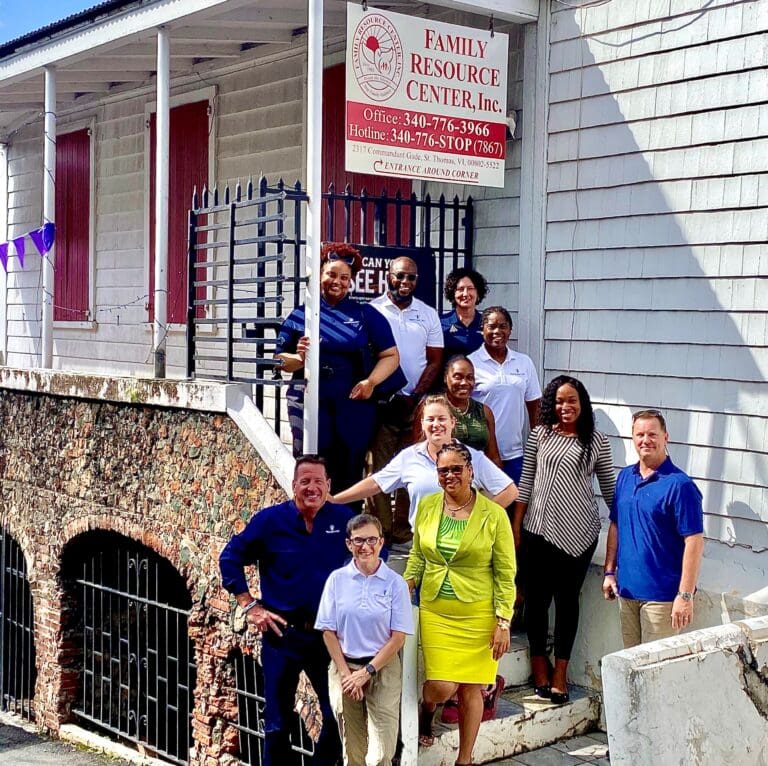
My Brother’s Workshop is proud to announce a community brunch fundraiser in support of the Family Resource Center, an organization that has served as a vital lifeline for survivors of domestic violence, sexual assault, and child abuse in the U.S. Virgin Islands for more than 45 years.
Family Resource Center
FRC provides essential services, including emergency shelter, crisis counseling, and advocacy for individuals and families in crisis. However, the organization is currently facing a severe financial shortfall, having not yet received over $220,000 in approved government funding. This delay has left staff unpaid and critical services at risk.
Despite these challenges, FRC Executive Director Anya Stuart remains resolute: “We cannot close our doors.”
In response, MBW is partnering with FRC to host a Brunch Benefit Fundraiser, inviting the community to come together in support of this essential mission.
Event Details:
Date: Saturday, April 25 Time: 8 a.m. – 12 p.m. Location:MBW Main Campus, 1-6 Estate Donoe, St. Thomas
All proceeds from the brunch ticket sales will directly benefit FRC, helping to sustain its critical programs and services during this urgent time.
Community members are encouraged to attend, bring family and friends, and stand in solidarity with those in need. Together, we can ensure that FRC continues to provide safety, support, and hope to those who need it most.
About My Brother’s Workshop My Brother’s Workshop is a nonprofit organization dedicated to empowering at-risk youth in the U.S. Virgin Islands through education, job training, counseling, and job placement.
About Family Resource Center Family Resource Center provides comprehensive services to victims of domestic violence, sexual assault, and child abuse, working to promote safety, healing, and justice across the territory.
Congresswoman Stacey E. Plaskett released the statement below following the U.S. House of Representatives’ vote requiring the Secretary of Homeland Security to designate Haiti for Temporary Protected Status until April 20, 2029.
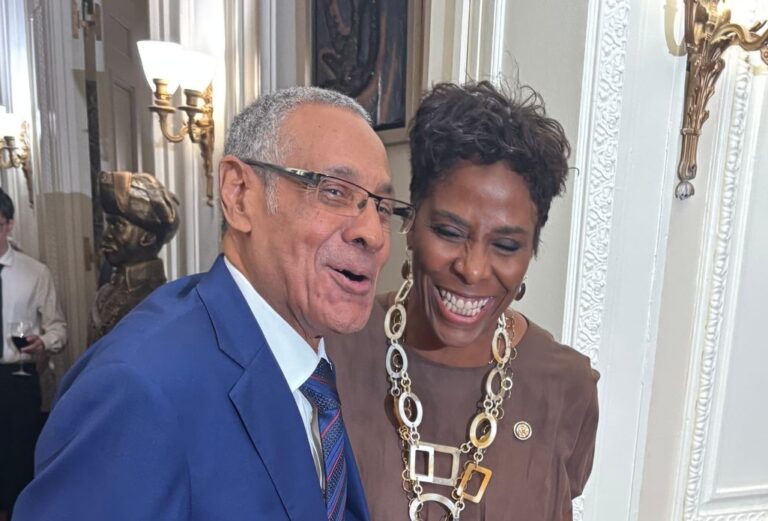
Congresswoman Plaskett and Haitian Ambassador Lionel Delatour. (Submitted photo)
The vote to require the Secretary of Homeland Security to designate Haiti for Temporary Protected Status (TPS) until April 20, 2029 follows the successful adoption of H. Res. 965, the Discharge Petition led by Congresswoman Ayanna Pressley (D-MA) to consider H.R. 1689. This marks a significant milestone in Congresswoman Plaskett’s longstanding efforts to protect Haitian TPS holders. Congresswoman Plaskett assisted this week in whipping votes for passage of the legislation. The bipartisan vote comes after the Administration moved to revoke TPS from more than 350,000 Haitian nationals; protections that a federal court order has been keeping in place.
Congresswoman Plaskett has been instrumental in Congress to defend these protections. In 2025, she led a congressional letter with 48 of her colleagues to Secretary of Homeland Security Kristi Noem urging the immediate extension of TPS for Haitian nationals, detailing the catastrophic humanitarian conditions on the island, including gang violence that has killed thousands of civilians and displaced over 1.4 million Haitians. Congresswoman Plaskett has continued to advocate for Haitian TPS holders through legislation, coalition building, and direct engagement with the Administration.
“Our immigrant neighbors and their children are not our enemies, and today this body affirmed that reality,” said Congresswoman Plaskett. “Haitian TPS holders contribute nearly $6 billion to the U.S. economy each year and annually pay $1.56 billion in taxes, as they are required to do, even though they are not eligible for the benefits that they directly help fund, like Social Security. For over 15 years, Haitian TPS holders have started families, built businesses, and contributed to communities throughout this country as teachers, caregivers, and more. Today’s vote is a critical step toward restoring their protections.”
Haiti’s TPS designation was first granted after the deadliest earthquake in the history of the Western Hemisphere killed hundreds of thousands and displaced more than a million Haitians. Despite these deep roots in American communities, President Trump stripped legal status from otherwise law-abiding Haitian nationals.
Congresswoman Plaskett continued, “It is notable that even members of the Trump Cabinet understand this reality and the profound negative consequences of this decision. According to HHS Secretary Kennedy, there is already a shortage of health care workers. A mass deportation of Haitians will worsen the caregiving crisis. More than 20 percent of Haitians in the United States work in healthcare and help comprise the 1 in 4 long-term care workers who are immigrants. This decision is counterproductive, and even one of the most questionable members of this Cabinet understands that reality.”
Congresswoman Plaskett continued, “Arbitrarily stripping Temporary Protected Status from Haitians is cruel and unconscionable. It forces Haitian people to return to a nation in abject chaos. Congress took a stand against pulling the rug out from under our law-abiding neighbors. We must now see this bill through the Senate and to the President’s desk.”
BACKGROUND: Discharge Petitions are a procedural tool that allow Members of Congress to bring to the House floor for consideration a public bill or resolution that has been referred to committee but not reported, once 218 Members have signed the petition. This allows the consideration of legislation outside of regular order, which is controlled by the Speaker of the House.
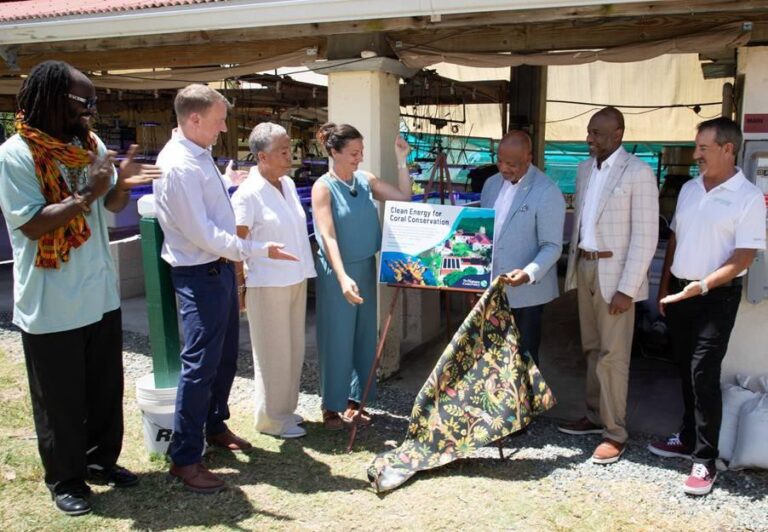
The Unplugging Ceremony hosted by The Nature Conservancy Virgin Islands Program on Sunday April 12, at TNC’s Coral Innovation Hub at Estate Little Princess on St Croix, signals a new model for powering coral restoration facilities, not just in the Caribbean, but globally.
Unveiling a sign marking the transition to solar-energy with Kemit Sweeney, Rob Brumbaugh, Frandelle Gerard, Jessica Ward, Lt. Gov. Tregenza Roach, Darren Vanterpool, Rob Fairchild. (Photo by Marjo Aho)
This is the view expressed by Jessica Ward, TNC Virgin Islands Program Director as she delivered remarks at Sunday’s Unplugging Ceremony which unveiled a sign to celebrate the installation of a 164-panel solar system that is now providing more than 50% of the energy needed to power the Coral Innovation Hub. “Traditionally, restoring reefs has relied on fossil-fuel-based power, contributing to the very problem we are trying to solve,” Ward, an experienced coral scientist said. “By transitioning to solar energy, we are intentionally breaking that cycle, aligning our operations with our mission.”
Ward explained that while coral restoration is essential, it is also a very energy intensive activity, requiring reliable power for life-support systems, research, and monitoring. She said the transition to solar power “demonstrates how we can adapt to climate realities while continuing the urgent work of reef restoration, using clean energy, and nature-based solutions that work together to protect reefs for future generations.”
Darren Vanterpool, Virgin Islands Regional Manager for Banco Popular, one of the funders of the solar installation, said Popular views the solar-powered coral restoration initiative as key to TNC’s efforts to achieve its goal of reducing its carbon emission footprint by 2030. The Anegada-born banker explained that that solar initiative sets up TNC as a model, and also “aligns with the plans of the Government of the US Virgin Islands and allows us [Popular] to support the clean energy goals of TNC.”
Vanterpool shared that Popular’s commitment to sustainability and protecting the environment is not a trend, but rather “it has been a long-term responsibility…deeply rooted in our history and our vision for the future.” He praised Popular’s partnership with TNC and said TNC’s leadership and expertise in conservation stewardship has turned Popular’s commitment into measurable impact.
On the theme of stewardship, Lt. Gov. Tregenza A. Roach expressed that it is wonderful that TNC and other organizations are considering their responsibility and stewardship of the land and resources and coming up with ways to do things better and more in harmony with nature. “I really think the recognition of severing the power generation from the problem of carbon emissions and other impacts on our climate is a significant and important one to celebrate,” the Lt. Governor shared with Virgin Islanders gathered for the Unplugging Ceremony.
Pointing to the historic windmill located at Estate Little Princess and others like it that dot St Croix’s landscape, Lt. Governor Roach says these windmills are evidence that renewable and alternative sources of energy were once part of Caribbean society and generated power for sugar production.
“It is an advancement and at the same time a reflection on what we once did to utilize the forces of nature,” he concluded.
“Places like Estate Little Princess hold deep meaning, not only for their ecological value, but for the cultural and spiritual connections they carry for our Crucian history,” explained Frandelle Gerard Executive Director of the Crucian Heritage and Nature Tourism and also the Vice-Chair of TNC Caribbean Board of Trustees. “By integrating renewable energy into the coral restoration work at the Coral Innovation Hub, we are honoring that legacy while building a future that is sustainable, just, and rooted in respect for both people and nature.”
The ceremony, which concluded with the unveiling of a sign to mark the significant milestone, took place during Sunday’s Coral Conservation Festival that also signaled the start of Coral Reef Week in the US Virgin Islands. The unveiling party included Kemit Sweeney, Aquaculture Associate; Rob Brumbaugh, Executive Director, TNC Caribbean Division; Frandelle Gerard, Vice-Chair, TNC Caribbean Board of Trustees; Jessica Ward, TNC Virgin Islands Program Director; Honorable Tregenza A. Roach, – Lieutenant Governor of the United States Virgin Islands; Darren Vanterpool, Virgin Islands Regional Manager, Banco Popular; and Rob Fairchild, Representative of ProSolar.
The Nature Conservancy Caribbean Division acknowledges the contribution of the following partners of the VI Coral Program and funders of the solar installation project: TNC Road Island Chapter, Popular, Honda, NOAA, the Virgin Islands’ Governor’s Office, the Department of Planning and Natural Resources, the Energy Office, and the National Park Service.
The Virgin Islands Water and Power Authority wrapped up its Week of the Young Child outreach with an educational visit to Ulla F. Muller Elementary School on Thursday, April 16, in partnership with the Virgin Islands Department of Education.
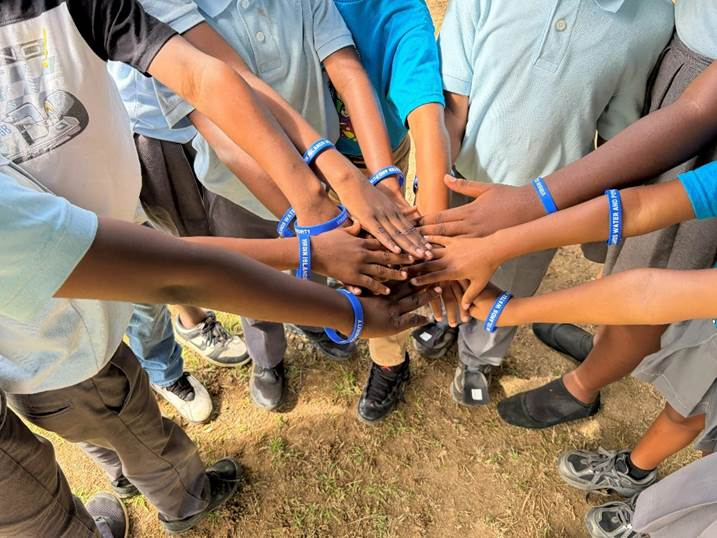
Students at Ulla F. Muller Elementary School gear up with their “energy band” wristbands as they prepare to race in an activity simulating how quickly electricity moves on April 16. (Submitted photo)
More than 100 students in Grades 1 through 3 learned how electricity moves from power lines into their homes and schools. Through guided discussion, they explored how electricity travels across a connected system and how electrons carry energy through a continuous flow. The energy-filled activity that followed brought the concept to life, with students acting out the movement of electrons and ending with a fast-paced race that demonstrated how quickly electricity moves.
“It was such a delight to see young students’ curiosity about the energy field come to life,” said Shanell Spencer, WAPA Communications Director. “We are glad to participate in Week of the Young Child and support STEM learning through kinetic experiences that make learning more exciting and engaging for students.”
During Week of the Young Child, WAPA supported youth education through meaningful outreach that inspired curiosity, encouraged exploration, and helped students see themselves as future STEM leaders in the energy field and beyond.
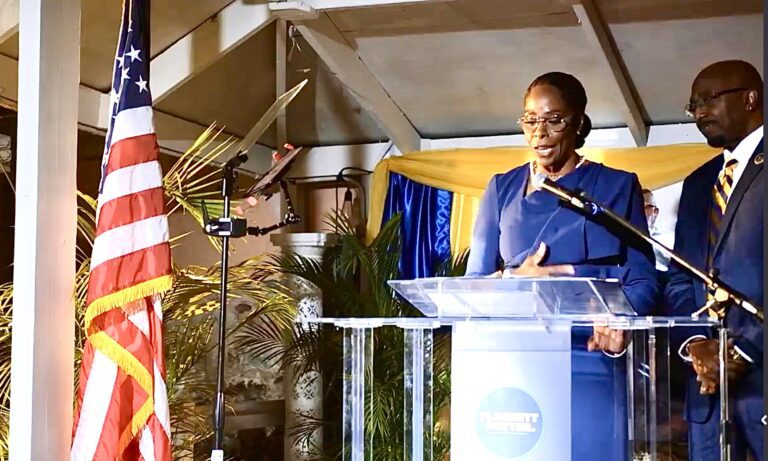
On a warm Saturday night in Frederiksted, St. Croix, Stacey Plaskett formally entered the race for governor, tapping Senate President Milton Potter as her running mate in a joint announcement that leaned heavily on experience, federal access, and a promise to turn long-discussed funding into tangible results on the ground.
The rollout — equal parts personal narrative and policy pitch — centered on a shared theme repeated throughout both speeches: a “people-powered” campaign that is “ready to deliver,” with the candidates positioning themselves as a blend of federal influence and local execution at a moment they described as critical for the territory.
Potter, who will seek the lieutenant governor’s seat, grounded his remarks in a personal story about growing up in the Virgin Islands and watching his mother struggle to access specialized health care — a moment he said shaped both his career and decision to run.
“That kitchen table is still out there,” he said, describing families forced to navigate gaps in local medical services. “Far too many of our families are still sitting by it.”
From there, Potter pivoted to a broader critique of long-standing systemic challenges — particularly the territory’s energy grid and health care system — tying both to everyday impacts on residents.
On the Virgin Islands Water and Power Authority, Potter framed outages not as technical issues but as daily disruptions to health and economic stability, citing residents unable to refrigerate medication and businesses losing revenue during blackouts. He argued that despite abundant solar potential, Virgin Islanders continue to pay some of the highest electricity rates in the United States — a point supported by federal energy data showing the territory’s costs consistently rank among the highest nationally due to fuel dependency and aging infrastructure.
He also pointed to the territory’s reliance on off-island care, a long-standing issue documented in federal and local health assessments, where limited specialty services often require costly travel. Potter credited Plaskett with securing federal funding to rebuild hospitals, but emphasized that “resources” must translate into accessible care locally — a gap that has been repeatedly flagged in post-hurricane recovery reporting.
Throughout his remarks, Potter cast the ticket as a functional partnership: Plaskett opening doors in Washington, and himself ensuring those resources are implemented effectively at home.
Plaskett’s speech afterward built on that framework, tracing her candidacy through both personal history and her nearly 12 years as the territory’s delegate to Congress. She highlighted her upbringing in a family shaped by migration for economic opportunity — a common experience among Virgin Islanders — and positioned that background as central to her approach to governance.
Her case for governor leaned heavily on federal dollars secured during her tenure, including disaster recovery funding following the 2017 hurricanes, Medicaid expansions, and tax credit provisions that deliver tens of millions annually to residents.
That funding — totaling billions — aligns with congressional appropriations tied to hurricane recovery and infrastructure rebuilding across the territory. But Plaskett acknowledged a key criticism that has surfaced in public discourse and reporting: that large federal allocations have not always translated into visible improvements in daily life.
“Securing billions of dollars is not enough,” she said. “Resources … are not worth anything if people are not seeing it on the ground.”
Her policy outline focused on converting those funds into outcomes, including two accredited hospitals within six years, expanded health care workforce development, improvements in education outcomes, and modernization of government services — including proposals for public-facing dashboards and a centralized 311 system.
On energy, Plaskett referenced billions already allocated for grid improvements, pledging a more transparent and accountable approach to reforming WAPA, which has faced years of scrutiny over outages, procurement practices, and debt obligations.
Plaskett also moved preemptively to address one of the most persistent political flashpoints tied to her tenure: campaign donations linked to convicted sex offender Jeffrey Epstein.
The issue has resurfaced periodically in Virgin Islands politics, particularly given Epstein’s financial and social ties to the territory prior to his 2019 death. Public records show that Plaskett’s campaign received contributions connected to Epstein, which she later redirected to organizations supporting women and families.
In her remarks, Plaskett characterized the issue as a political distraction, stating she had been “cleared by the victims themselves” and emphasizing that her campaign contribution — approximately $8,000 — had been donated.
She also suggested opponents would attempt to leverage the issue to divert attention from broader governance concerns, urging voters to focus instead on policy outcomes and accountability.
Both candidates repeatedly framed their campaign as a break from what they described as cycles of delay, political favoritism, and unfulfilled promises — language that echoes broader voter frustrations reflected in recent polling and public commentary around infrastructure, health care access, and governance transparency in the territory.
Plaskett, in particular, emphasized urgency, calling the current moment a “once-in-a-generation opportunity” to transform the Virgin Islands, while warning against continued delays in deploying already-secured funding.
Potter reinforced that message by positioning the ticket as a practical governing team rather than a symbolic one — a pairing, he said, designed to move from policy to implementation.
The Plaskett-Potter ticket now enters what is expected to be a competitive gubernatorial race, where issues like energy reliability, health care access, and government accountability are likely to dominate.
Both candidates signaled they will begin an island-wide campaign tour in the coming weeks, with a focus on direct engagement — a strategy consistent with their “people-powered” messaging.
From left, USVI Festival Committee Member, Sen. Novelle Francis, Director of Festivals Ian Turnbull, and contestants D’Quana Lewis, Safiah Wharton, Ajenue Willet-Tyson, Jahniya Williams, 2025 St. Thomas Ambassadorial Queen Arliesha Paul, and Alvin Burke Jr. (Source photo by Rick S. S. Grant)
As the sun began to set and anticipation filled the air, supporters, family members, and pageant enthusiasts gathered on Saturday evening at the Eldridge Wilburn Blake Sports and Fitness Center at the University of the Virgin Islands for an evening of pageantry culminating in the crowning of a new St. Thomas Ambassadorial Queen.
At the conclusion of a highly competitive evening, contestant number one, Safiah Wharton, emerged as the new titleholder. A senior at Charlotte Amalie High School, Wharton also earned the titles of Miss Intellect and Best Ambassadorial Presentation, solidifying her standout performance in two key segments of the competition.
Contestant number four, Jahniya Williams, a student at the University of the Virgin Islands, presented and performed consistently throughout the night and was named first runner-up. Williams secured several awards, including Best Swimwear, Best Cultural Historical Dress, Miss Photogenic, and the People’s Choice Award, the latter reflecting strong community support through text-based voting.
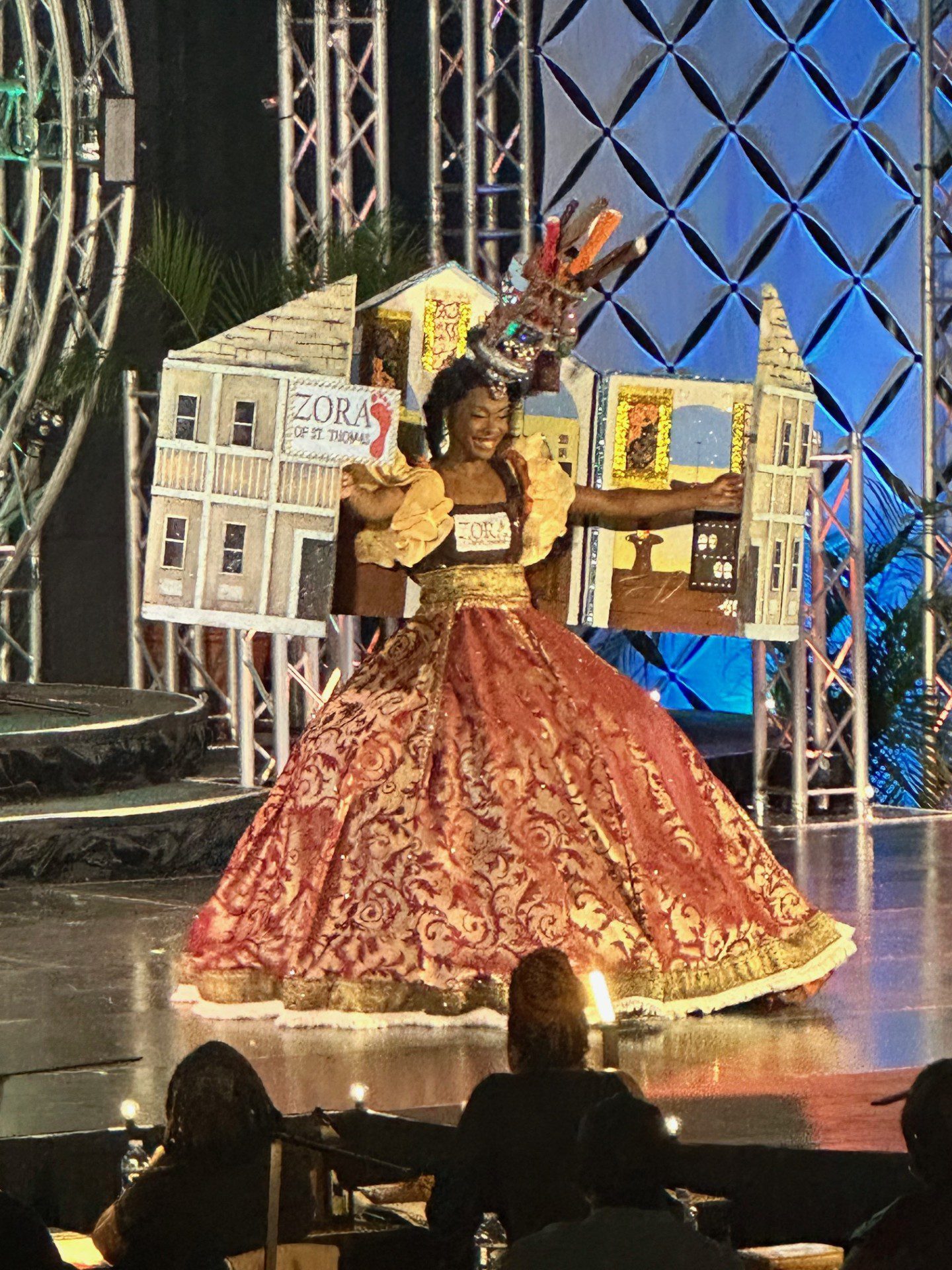
Cultural Historical Dress- Jahniya Williams
Contestant number three, Ajenue Willet-Tyson, captured both Best Talent and Best Evening Wear, demonstrating excellence in performance and stage presence.
Completing the slate of contestants was D’Quana Lewis, who also contributed to the evening’s dynamic and competitive showcase.
The show began promptly at 6 p.m. with the traditional formalities that set the stage for the evening’s proceedings. The opening number followed, which began with a cultural tribute that paid homage to the territory’s women cultural bearers of yesteryear, as contestants appeared adorned in traditional Bamboula dancer garments. This was followed by a high-energy routine that ushered in the vibrant spirit of Carnival.
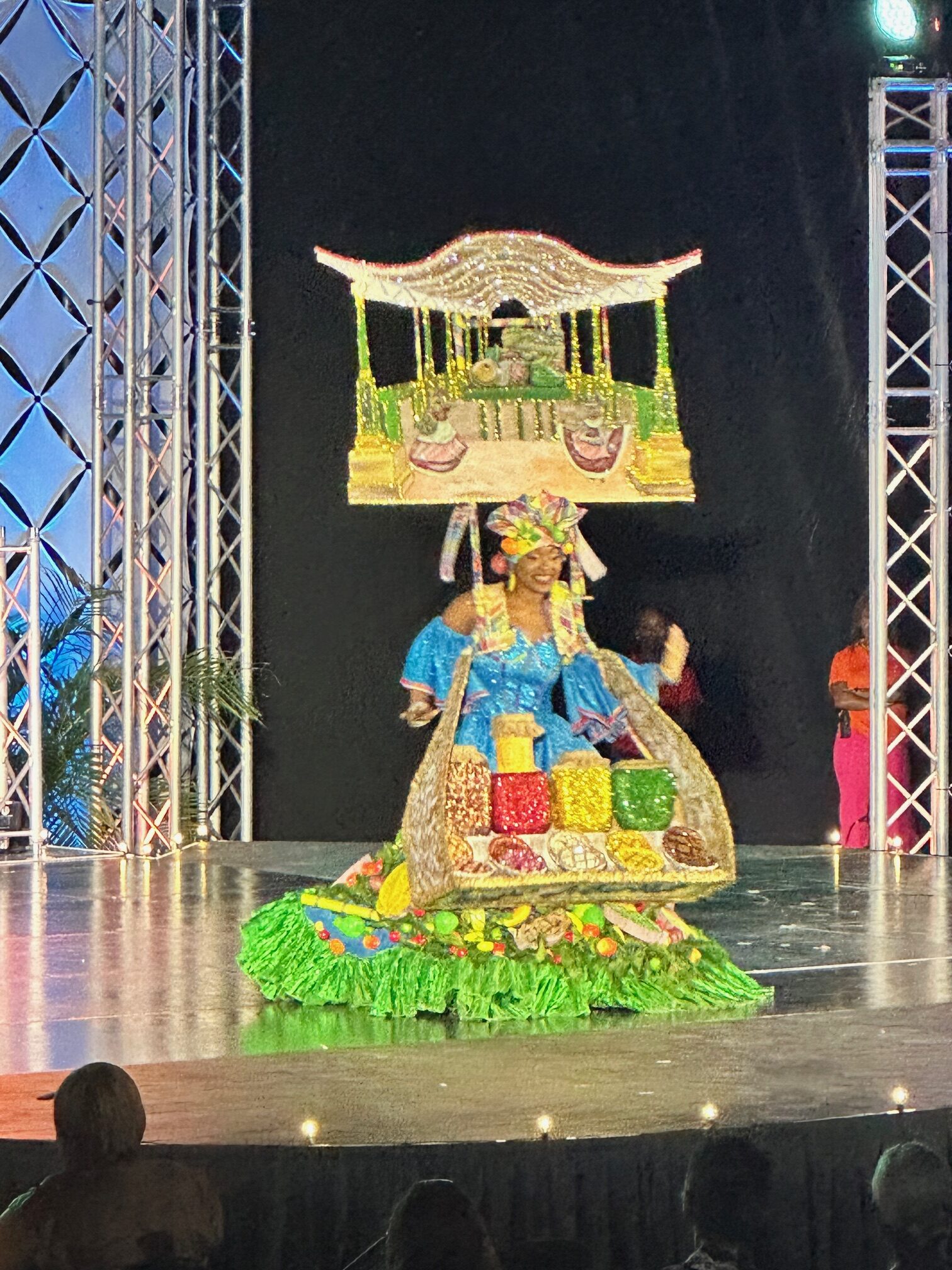
Cultural Historical Dress- D’Quana Lewis (Source photo by Rick S. S. Grant)
In pursuit of the coveted crown, each contestant displayed her individual style, poise, talent, cultural awareness, and intellect across seven judged segments: Introductory Speech, Swimwear, Ambassadorial Presentation, Onstage Interview, Cultural/Historical Dress, Talent, and Evening Wear, with a total possible score of 1,950 points.
The Introductory Speech marked the first formal opportunity for the audience to learn about each contestant and the platforms they represent. This segment was well executed by all contestants and effectively set the tone for the evening.
Building on this momentum, the Swimwear segment followed, highlighting fashion, fitness, and flair as each contestant took to the stage with confidence and poise. Each appearance was crafted to reflect the unique personality and style of the contestants. Williams distinguished herself in this segment, commanding the stage in a blue-themed swimwear design accented with yellow, complemented by touches of Madras fabric and a polished, confident routine.
The competition deepened during the Ambassadorial Presentation. Each contestant spoke to their interests and sense of civic responsibility. Wharton delivered a passionate and eloquent speech on the topic, “Unmasked: Breaking the Stigma of Mental Health Among USVI Youth.” Lewis used her platform to emphasize the importance of civic engagement, encouraging greater awareness and active participation. She reminded listeners that the future of the Virgin Islands can be shaped using their voices and exercising their right to vote. Willet-Tyson thoughtfully blended her aspiration of becoming a judge with a cultural perspective, incorporating her involvement with the Rising Stars Steel Orchestra to underscore the role of the arts in community development. Williams drew on her passion for sports to bring awareness to the economic and social benefits of sports tourism, presenting it as a viable avenue for growth within the territory.
Cultural Historical Dress- Safiah Wharton (Source photo by Rick S. S. Grant)
The Onstage Interview immediately followed the Ambassadorial Presentation. During this segment, each contestant was asked three questions. The first served as an icebreaker, while the remaining two assessed the contestants’ ability to thoughtfully respond to current issues. The featured topics for the evening focused on the education of young women in the community and tourism. Wharton distinguished herself as one of the most composed and fluent speakers.
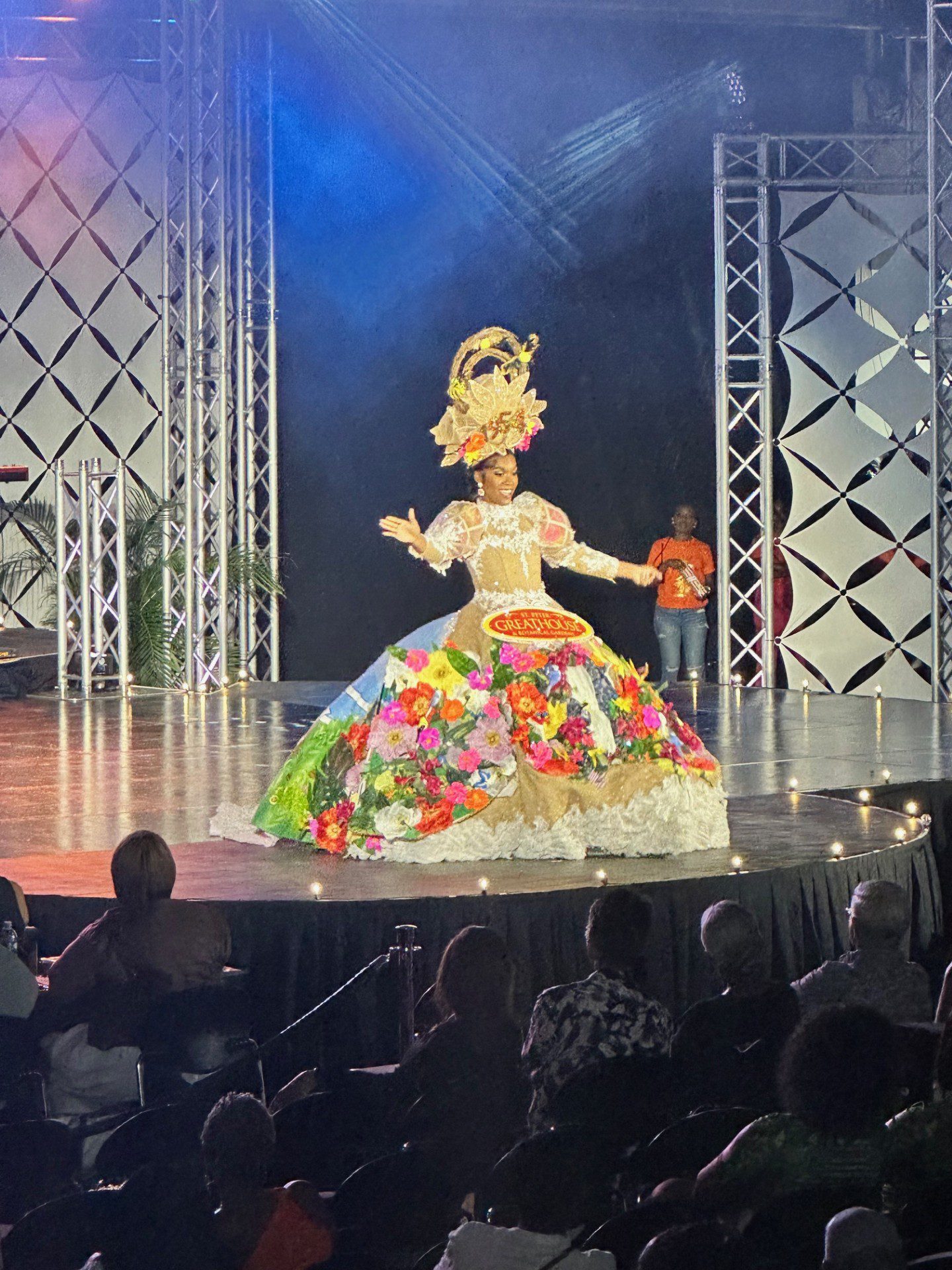
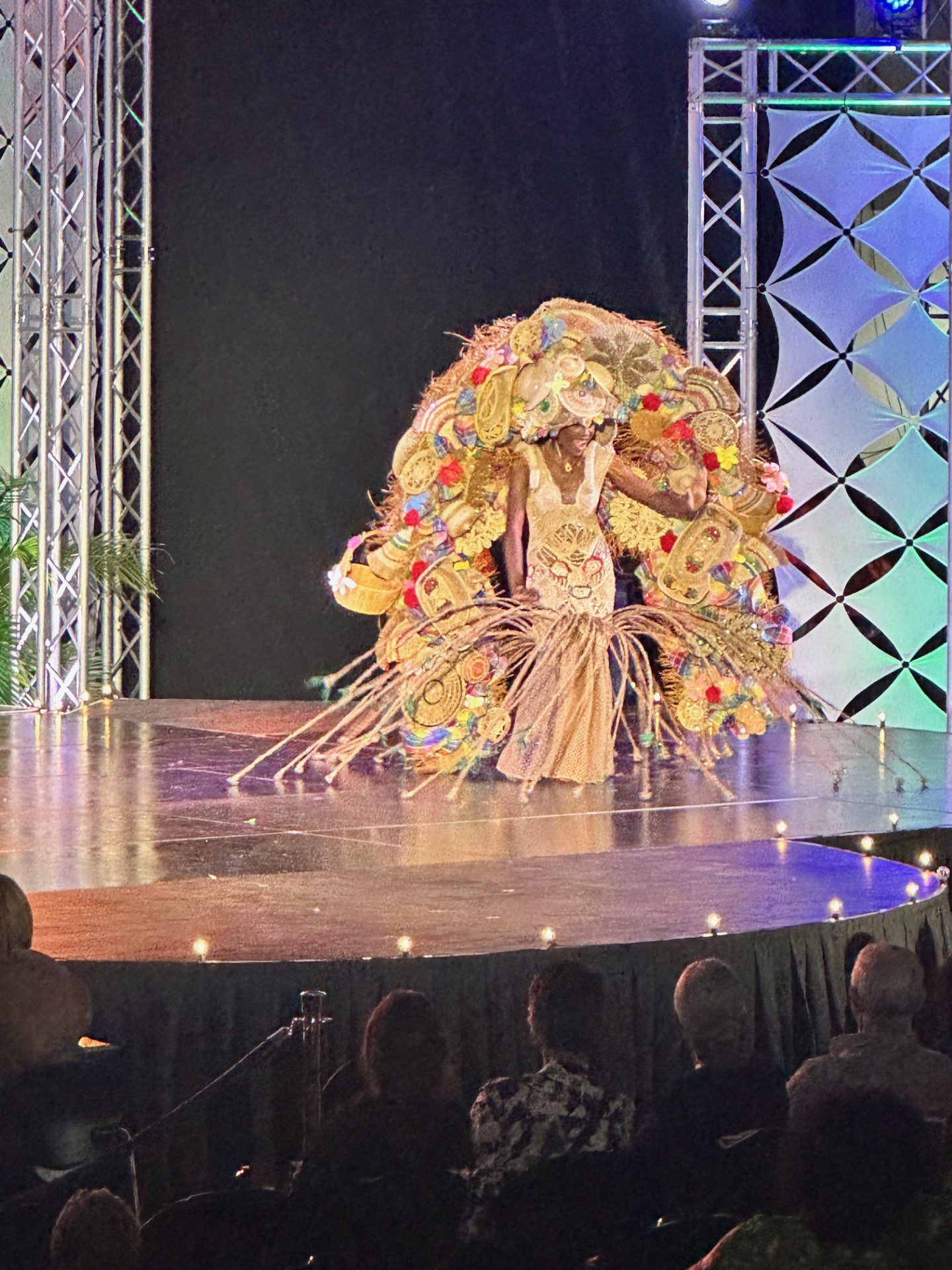
The energy shifted as the evening moved into the staging of the Cultural/Historical Dress segment, one of the most anticipated appearances of the pageant. This segment was a kaleidoscope of creativity and culture, as each contestant thoughtfully and masterfully curated designs that depicted elements of St. Thomas’ rich heritage. Wharton brought to life the beauty and splendor of the St. Peter Greathouse and Botanical Gardens through an elegant and visually captivating portrayal. Lewis embodied the vibrancy of a traditional local market, capturing its history, energy, and cultural flavor. Willet-Tyson paid tribute to what she described as one of the Virgin Islands’ greatest treasures, the art of palm weaving and Virgin Islands basketry, skillfully highlighting its cultural significance. Williams distinguished herself in this segment through her intricate depiction of the historic Zora’s of St. Thomas. Her presentation paid homage to the craft of leatherwork and featured custom leather pieces that evoked a sense of nostalgia and cultural pride among audience members.
The stage came alive during the Talent segment through heartfelt and culturally reflective performances that emphasized the rich talents of the four contestants. This included vocal performances, instrumental displays, and acrobatic pieces, each sharing the contestants’ creativity and versatility. Willet-Tyson’s performance paid tribute to the work and contributions of musical legends who once graced the stage. She delivered a dynamic performance of familiar tunes on the keyboard, steelpan, and drums. Wharton captivated the audience with her vocal ability, delivering a medley of four melodies. Lewis offered a musical tribute through a flute performance, while Williams presented a heartfelt homage to former Carnival queens who have passed, blending vocals with acrobatic elements in a moving and expressive piece.
Cultural Historical Dress- Ajenue Willet-Tyson (Source photo by Rick S. S. Grant)
As the evening drew to a close, the pageant transitioned into the Evening Wear segment. Each contestant embodied elegance and style, gracing the stage with poise, confidence, and sophistication. Wharton stunned in an emerald green gown accented with lime tones. Lewis captivated in a sunset-inspired orange hue, while Williams commanded attention in a striking crimson red evening gown. However, it was Willet-Tyson who earned top honors in this segment, dazzling in a radiant yellow gown that set her apart.
As is customary, the reigning queen, Arliesha Paul, took her final walk, a moment marked by reflection and gratitude as she bid farewell to her reign.
Throughout the evening, the audience was entertained by the Euphoric Band and also enjoyed a dynamic performance from the Energique Dance Group. Hosts Dionne Donadelle and JeRonn Simmonds kept the show running smoothly, guiding the audience through each segment with energy, poise, and engaging commentary. Beyond the pageantry, the event reaffirmed the role of the Ambassadorial Queen as a platform for youth advocacy, cultural preservation, and civic engagement within the Virgin Islands.
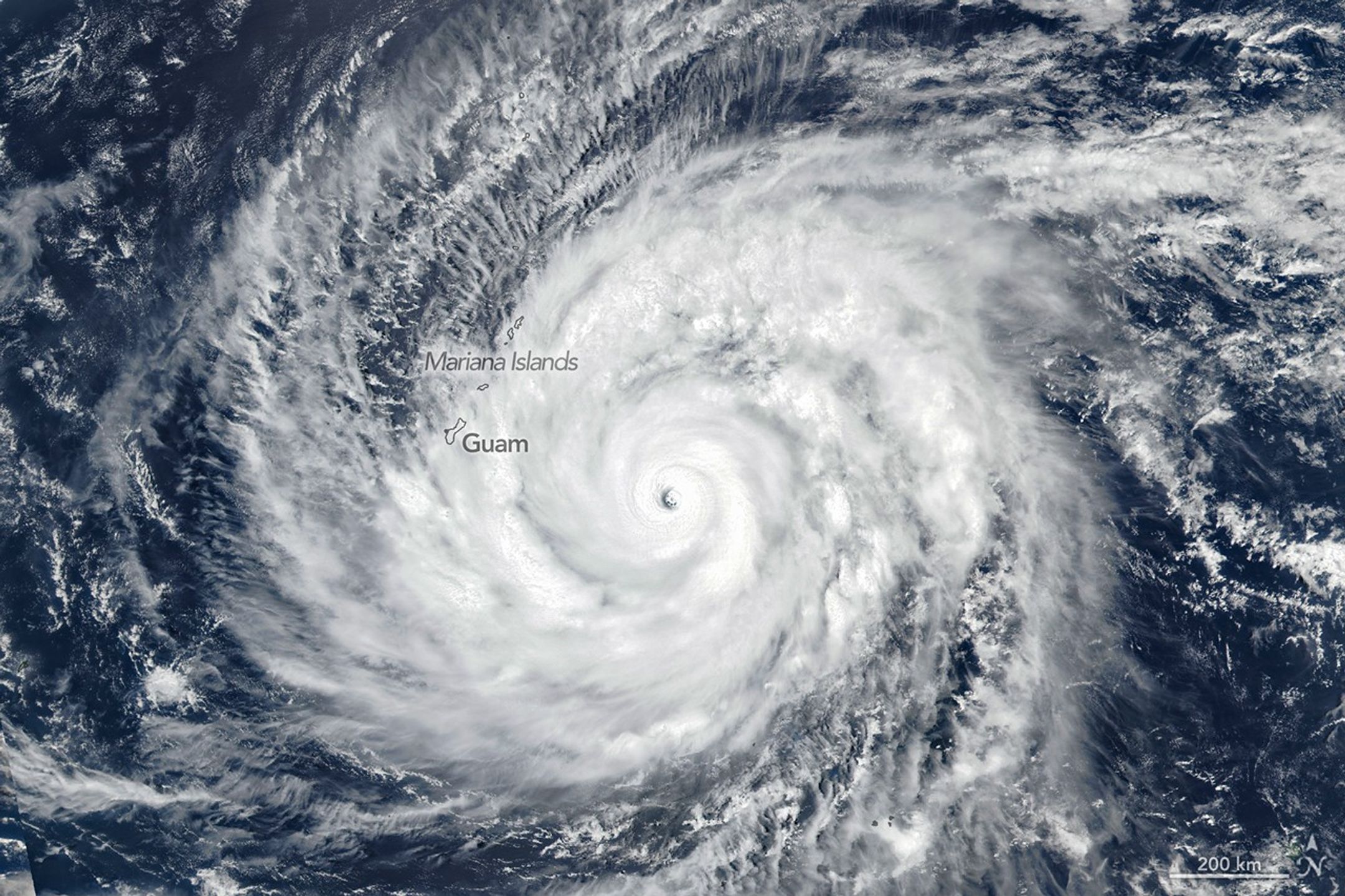
Super Typhoon Sinlaku approaches the Mariana Islands on April 13, 2026. (Photo courtesy NASA Earth Observatory/Michala Garrison)
Super Typhoon Sinlaku has left areas of Guam and the Commonwealth of the Northern Mariana Islands in the Pacific with major damage and a long recovery. The CNMI’s main islands of Saipan and Tinian took a direct hit from Sinlaku, underscoring the unique disaster-response challenges facing U.S. territories.
Like the U.S. Virgin Islands and Puerto Rico, Guam and the CNMI are U.S. territories where geography can complicate disaster response and recovery, putting Sinlaku’s aftermath into a familiar island context for readers here in the Virgin Islands.
Storm Was Slow, Powerful, and Destructive
A typhoon and a hurricane are the same type of weather phenomenon, and the difference in the names is due to the location on the planet where the cyclone occurs.
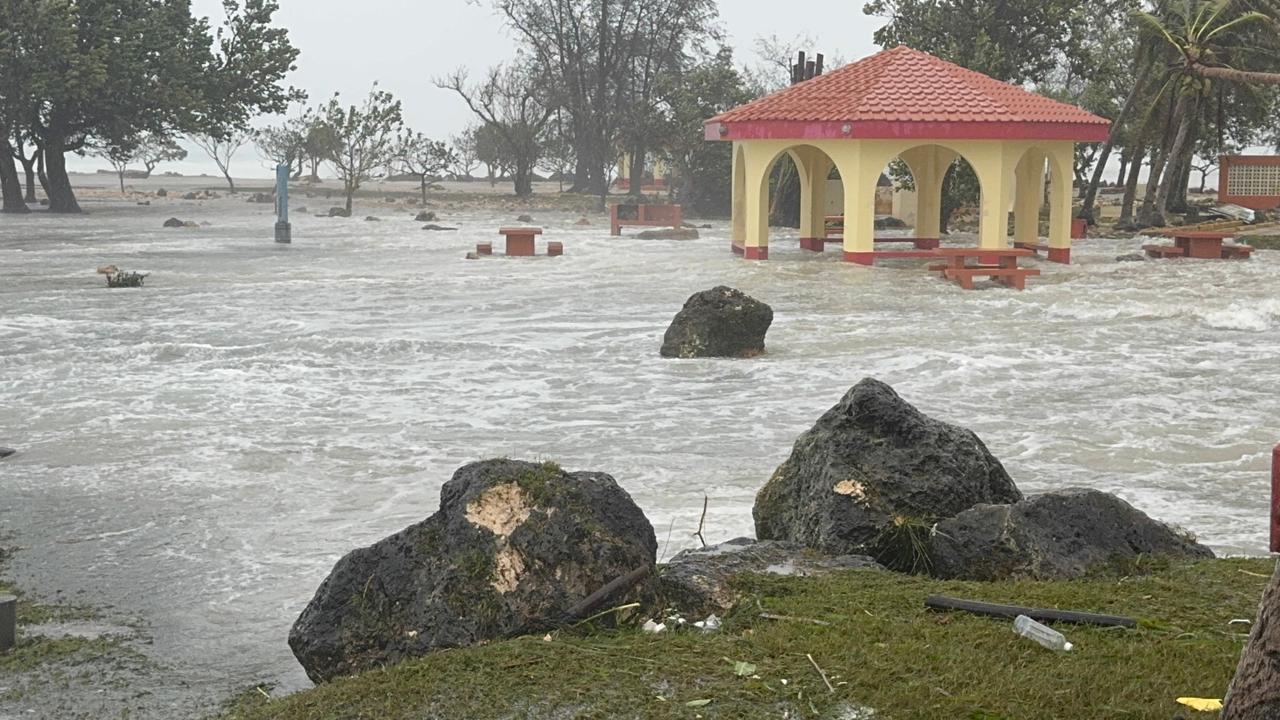
Coastal flooding and storm surge inundate a shoreline area in Guam as Super Typhoon Sinlaku impacts the island. (Photo courtesy Marcus Landon Aydlett, NWS, Guam)
“Hurricanes and typhoons are the same weather phenomenon: tropical cyclones. A tropical cyclone is a generic term used by meteorologists to describe a rotating, organized system of clouds and thunderstorms that originates over tropical or subtropical waters and has closed, low-level circulation,” according to the National Oceanic and Atmospheric Administration. A “super typhoon” is equivalent in strength to a Category 4 or 5 hurricane on the Saffir-Simpson Hurricane Wind Scale.
The Source spoke with Marcus Landon Aydlett, warning coordination meteorologist at the National Weather Service office in Guam, who said the storm’s aftermath reflects the logistical realities island territories often face after major disasters. The Guam office covers Guam and the Northern Mariana Islands, including Saipan and Tinian.
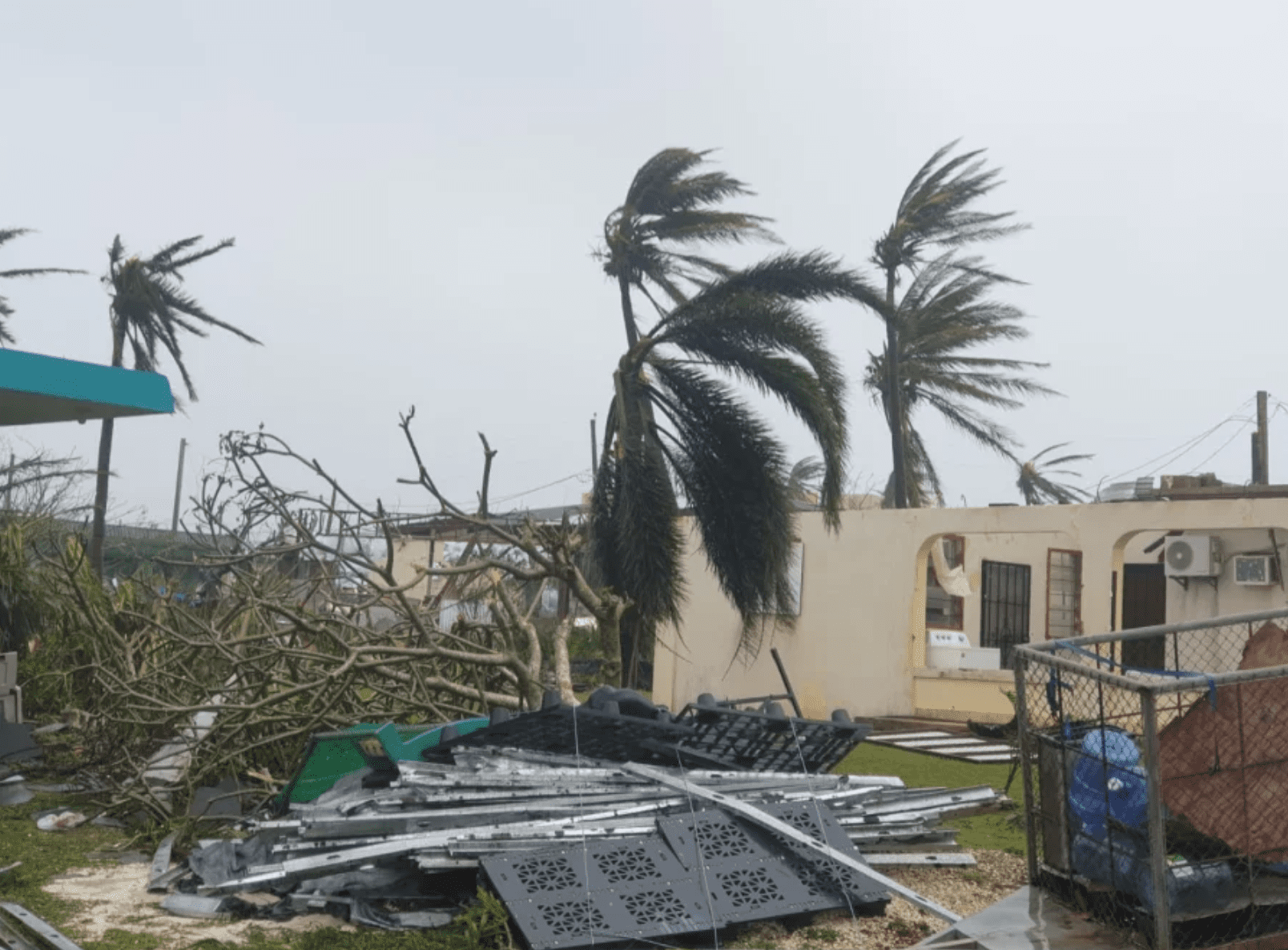
Storm damage is seen in Saipan, Commonwealth of the Northern Mariana Islands, after Super Typhoon Sinlaku struck the U.S. territory in the Pacific. (Photo courtesy NPR and Office of the Mayor, municipality of Saipan/AP)
In a video interview with the Source, Aydlett, speaking from Guam and still without power as of Sunday, said that Super Typhoon Sinlaku’s slow movement made an already dangerous storm even more destructive.
“It’s bad enough having a super typhoon, but this storm was moving three to five miles per hour,” Aydlett explained. “Most people can outrun that speed, and that’s how slowly the system was moving over the islands of the CNMI, prolonging typhoon force winds for over 24 hours. The islands of the CNMI had tropical storm force conditions for over three days, and that compounded the impacts and extended the duration of those incredible conditions, resulting in catastrophic damage,” he said.
Aydlett said Guam avoided the worst of the structural damage, though it still dealt with widespread disruptions, including outages. In the CNMI, however, Aydlett said the damage was extreme.
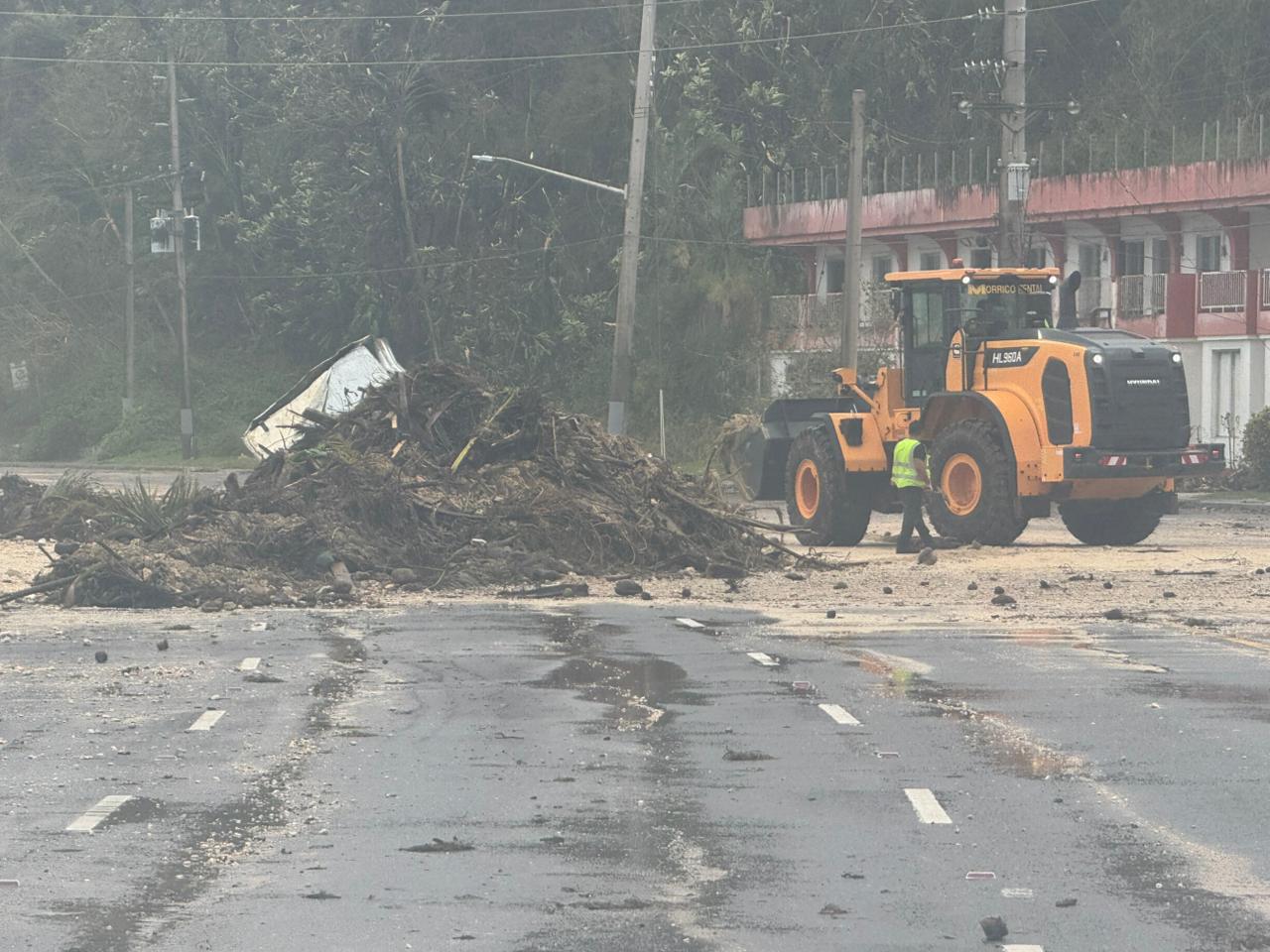
Cleanup begins in Guam after Super Typhoon Sinlaku, with heavy equipment clearing storm debris from a roadway. (Photo courtesy Marcus Landon Aydlett, NWS, Guam)
“As far as damage in Saipan in the CNMI, it’s total devastation, and this is a repeat of seven and a half years ago when Super Typhoon Yutu affected the area. There are no leaves on the trees, and many trees are down,” stated Aydlett. “Most structures that were not reinforced concrete don’t exist anymore, so a lot of things were significantly impacted. It’s going to be a long road to recovery.”
“Fortunately, I’ve been told there have been no casualties, no injuries, and no fatalities, which is, to me, a mission accomplished, because at the Weather Service, our top priority is to protect life and property,” he noted.
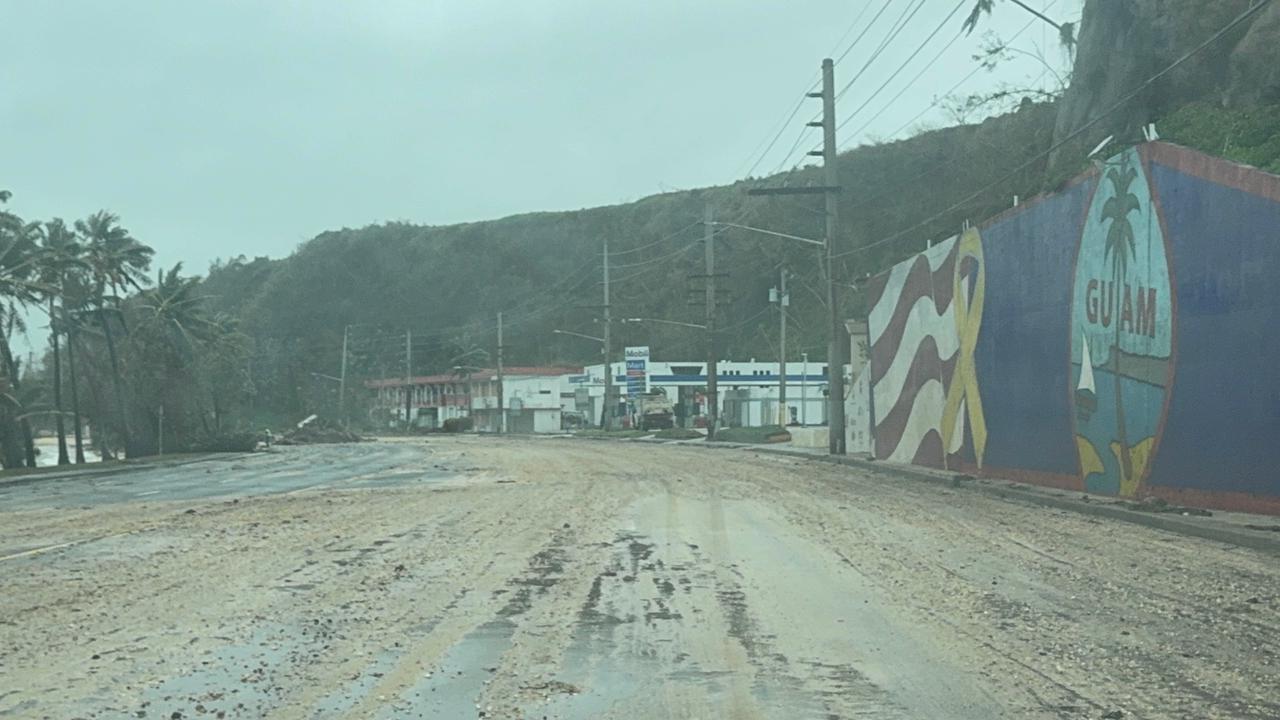
Debris and mud cover a roadway in Guam in the aftermath of Super Typhoon Sinlaku. (Photo courtesy Marcus Landon Aydlett, NWS, Guam)
Still, Aydlett confirmed that, sadly, casualties have been reported on other islands affected by the storm, including Micronesia. He said a U.S. Coast Guard flyover showed just how dramatically the landscape had changed after the storm.
“The Coast Guard brought me up onto a C-130 aircraft, and we did a flyover immediately as the thing was starting to pull away,” Aydlett stated. “It was a severely turbulent flight, but we saw a bird’s-eye view of Tinian and Saipan, and there’s no green vegetation; it’s all brown,” he said. “What used to be thick, lush greens over in the villages and the city area – it’s all gone. It’s all brown with only structures remaining. It’s going to be a tremendous loss for the island’s vitality, but also for the tourism, at least in the short term.”
A Familiar Territorial Reality
Aydlett said one of the biggest realities for Guam and the CNMI is that major recovery resources cannot simply be driven in from a neighboring state. For island territories, crews, supplies, and outside help often have to be flown in, which can slow everything down. That is a reality many Virgin Islanders know well.
“The recovery process, much like the Virgin Islands, is going to be very slow and methodical, because you are unable to immediately obtain supplies and hundreds of personnel coming into the weather-torn area. You have to fly everything into the islands, and so we lean very forward in our weather communications and our preparedness and posturing so that FEMA, Red Cross, and other entities can start deploying people and personnel over here.”
He added that emergency and relief personnel were already arriving into the region even before the storm had fully passed.
Asked what people in other territories, including the U.S. Virgin Islands, should take away from Sinlaku, Aydlett pointed first to disaster preparedness.
“Maximize your preparedness,” he advised. “I can’t stress this enough, because when it comes to disasters here in the islands and the territories, whether it’s in the Pacific or the Atlantic, it takes time to get assets and resources over here. Even though people may be pre-deployed to an island, if a disaster strikes the entire island, their response is going to be needed everywhere, and they can’t get to everybody all at once. Therefore, you have to be able to fend for yourself for at least several days. That includes having water, food, cash, batteries, candles, and anything to survive for at least three to five days before help can start trickling into the villages.”
How People Can Help
Aydlett said the Red Cross is one of the best ways people can support Guam and the CNMI. The American Red Cross Pacific Islands Region includes Guam and the Northern Mariana Islands.
“The Red Cross is an option for people to donate to, and we have Red Cross all over the islands here from the Hawaiian Islands to the Micronesia area,” Aydlett said. “They have boots on the ground, and they’re always a standard source for help and assistance to the people.”
He also recommended Be Heartfelt, which identifies itself on its website as a 501(c)(3) nonprofit charity serving kids and youth locally and globally and lists Guam among its mission locations.
“Another opportunity to look into is the Be Heartfelt organization. This is a nonprofit that’s based out of Kansas, and the president is from Guam,” Aydlett explained. “I personally have partnered with that charity for about three years, running the island’s largest food drive, and they just started spinning up disaster operations for Saipan and Tinian specifically. This is all volunteer-led, so all the money, all the donations go straight to the people who need it,” he continued.
Aydlett added that the group is working to get food items and meal packs directly to families in the hardest-hit areas.
For readers in the U.S. Virgin Islands and across the Caribbean, Sinlaku’s aftermath is also a reminder that island communities can face long recoveries even when forecasts are strong and help is already on the way. With the 2026 Atlantic hurricane season officially beginning June 1 and running through Nov. 30, the storm is a timely reminder to review emergency plans, check supplies, and be prepared before the next threat develops.
A St. Croix man has been arrested in connection with a December 2025 shooting in Peter’s Rest, according to the Virgin Islands Police Department.
Police identified the suspect as Turrel Thomas, who was taken into custody on Friday following the execution of arrest and search warrants by the Criminal Investigation Bureau, with assistance from the Special Operations Bureau and Intelligence Units, according to the police report.
The case stems from an incident reported around 4 a.m. on Dec. 13, 2025, when the 911 Emergency Call Center received ShotSpotter alerts indicating gunfire in the Peter’s Rest area near Carlos Bar. Responding officers recovered multiple spent cartridges at the scene, according to the VIPD.
An investigation by CIB detectives identified Thomas as the suspected shooter, police said. During the execution of the warrants, officers seized a firearm, the police report stated.
Thomas was booked and unable to post $100,000 bail. He faces charges of attempted murder and possession of firearm. He was transported to the John Bell Correctional Facility pending his advice of hearing, the report stated.
Federal agents raided a St. Thomas strip club Friday night that they alleged was actually a brothel, where dancers brought in from outside the territory were coerced into a commercial sex scheme to repay travel and housing expenses, according to court records released Saturday.
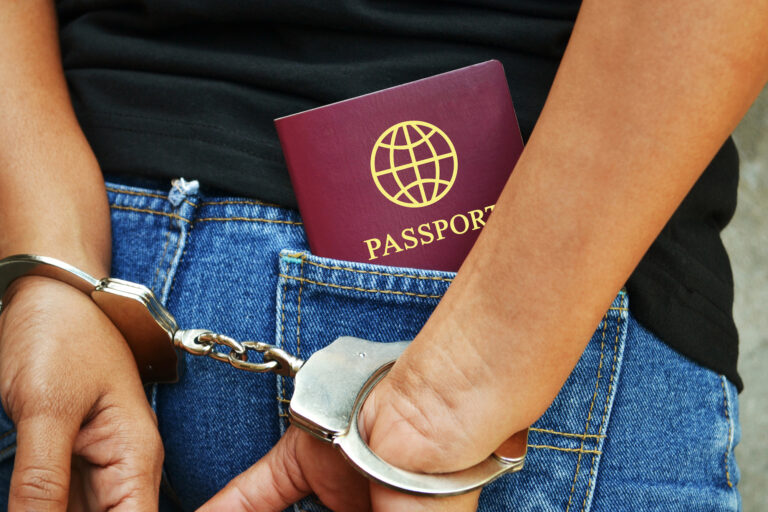
Some alleged victims, as young as 17, stripped when they started working for previous iterations of Red Hook’s Tootsys Gentlemen’s Club, according to court records. Some, smuggled into the territory illegally, had their passports seized until payment was made, according to court records.
Federal Bureau of Investigation agents arrested 56-year-old Hussein Jamil, who also goes by Hussian Jamil Suarez and Tony, 39-year-old Magda Castro Santos, also known as Tatiana, and Julio Hidaldo De Pena, 65. All three were charged with conspiracy to transport for the purpose of prostitution, conspiracy to commit interstate and foreign travel or transportation in aid of racketeering enterprises, and conspiracy to harbor aliens for financial gain — punishable by a maximum of 10 years in prison, according to the U.S. Department of Justice.
They appeared before U.S. Magistrate Judge G. Alan Teague Saturday and were held without bail ahead of their detention hearings scheduled for Monday afternoon.
The operation involved flying in exotic dancers from the mainland and smuggling in others without proper documentation, prosecutors alleged. Most of the women lived in a Bolongo house rented by Jamil. Undocumented workers smuggled in through the BVI, however, were kept away from American dancers, victims told law enforcement.
The Friday night raid on the Bolongo home caught the attention of multiple social media users who posted alerts of a strangely low-flying helicopter in the Bolongo area, as well as emergency vehicles.
Alleged sex-trafficking victims told law enforcement that Jamil contacted and lured the dancers by phone or social media, offering to pay for flights and provide low-cost lodging. The club’s website remained active Saturday, with an advertisement for dancers that offered housing, transportation to the club, and the potential for paid flights.
Hidaldo De Pena allegedly ran the security camera-laden house and transported women between the Bolongo home and Tootsys, which was managed by Castro Santos, according to court records.
Her duties included ensuring the dancers paid their fees, directing clients to the dancers, and collecting payments for private dances and commercial sex, prosecutors alleged.
Dancers were typically charged $100 to $200 per week to live at the Bolongo house and made to pay a $60 buy-in fee every night in order to work at Tootsys, according to court records. They were required to work six nights a week — Tuesday through Sunday — and were fined $500 for every night’s work they missed. They were also fined $10 for every 15 minutes they were late to work, prosecutors alleged.
“When dancers arrived on St. Thomas for the purpose of working at Tootsys, the alleged conspirators’ coercive fee scheme pushed the dancers to make more money by engaging in commercial sex, both at Tootsys and through customers ‘buying out’ dancers to take them to an offsite premises,” U.S. Attorney Adam Sleeper said in a written statement.
A criminal complaint filed with Virgin Islands District Court outlined prosecutors’ summary of the operation: “To pay these fees, the conspirators encouraged the dancers to engage in commercial sex acts at Tootsys to make more money. For instance, private dances typically cost $30 for every 15 minutes. Going into the ‘Chandelier Room,’ a room on the main floor reserved for dancers to have sexual intercourse with customers, typically costs $350 every
fifteen minutes. Additionally, customers can ‘buy out’ a dancer to take her off site, often to a hotel room for the purpose of engaging in commercial sex, which typically costs $1,500. The dancers and Tootsys each receive a portion of the payments for these services.”
The Tootsys enterprise may have been ongoing as far back as June 2019, according to court records. Some victims interviewed by authorities allegedly said that when immigration agents and other law enforcement visited the club, undocumented workers would change into street clothes and pretend to be patrons.
One former Tootsys employee told prosecutors several of the undocumented foreign employees had been forced to surrender their passports to club designates. But not all the undocumented Tootsys employees — from Venezuela, Colombia, the Dominican Republic, and elsewhere — felt trapped, according to court records.
A Venezuelan woman was smuggled from Tortola to St. Thomas with the promise of making better money, she told prosecutors. Once working for Tootsys, she was told she needed to repay an $800 smuggling fee. After two months in St. Thomas, she returned to Venezuela — only to return to the U.S. Virgin Islands 20 months later. This time, her fare was paid for by Jamil. She was again smuggled through the BVI to St. John, and then to the Bolongo house in St. Thomas. She again traveled back to Venezuela and then again to St. Thomas for a third round of working at Tootsys. She told prosecutors that she had sex with Jamil to pay off her smuggling debt.