Come join us as at CCT to celebrate our 40th anniversary as Caribbean Community Theatre presents three shows on May 23, 24 and 25 of “40 Seasons of Love” — a collection of songs and skits performed by some of your favorite performers, and directed by Michael Armendariz and Heather McRae, who will also perform, featuring choreography by Claire Goodman.
Caribbean Community Theatre
-Musical accompaniment will be provided by Joshua Harvey (Music Director) on piano, Padraic Coursey on guitar, and Mario Thomas on bass.
-The performers:
Women: Claire Goodman, Megan Grant, Leslie Highfield, Clara Killy, Heather McRae, Kiomie Pedrini, Annie Barry Pendley, Shanell Petersen, Maddy Wilson
Men: Michael Armendariz, Sean Bailey, Daniel Deane, Tyler Donohoo, Lionel Downer, Tony Emanuel, Bob Gard, Robert Reffell, Will Smith
Plus some of the cast of Anna in the Tropics: Paul Del Rio, Michelle Dizon, Ali Banuelos and Sarah & Addie cast: Karen McIntosh Bruce, Glenderlyn David (Sunday Matinee Only).
Show Dates:
Friday, May 23 at 8 p.m.;
Saturday, May 24 at 4 p.m.; and
Sunday Matinee, May 25 at 4 p.m. (final performance).
Purchase advance tickets online at Eventbrite, or for reservations or more information, email eileencct@gmail.com.
As usual we will have a cash bar, raffle, and a special silent auction!
We are reaching out to our friends within the community for donations such as gift certificates, goods or merchandise to be used for our silent auction or nightly raffle, or monetary donations to support CCT.
Students from the St. Croix Educational Complex participate in the cultural competition. (Source photo by Diana Dias)
The Virgin Islands Education Department’s Division of Virgin Islands Cultural Education held a celebratory event Friday at the One Communications office on St. Croix, highlighting the accomplishments of students who participated in a unique cultural competition. The event was held in partnership with One Communications, a key collaborator in this year’s initiative.
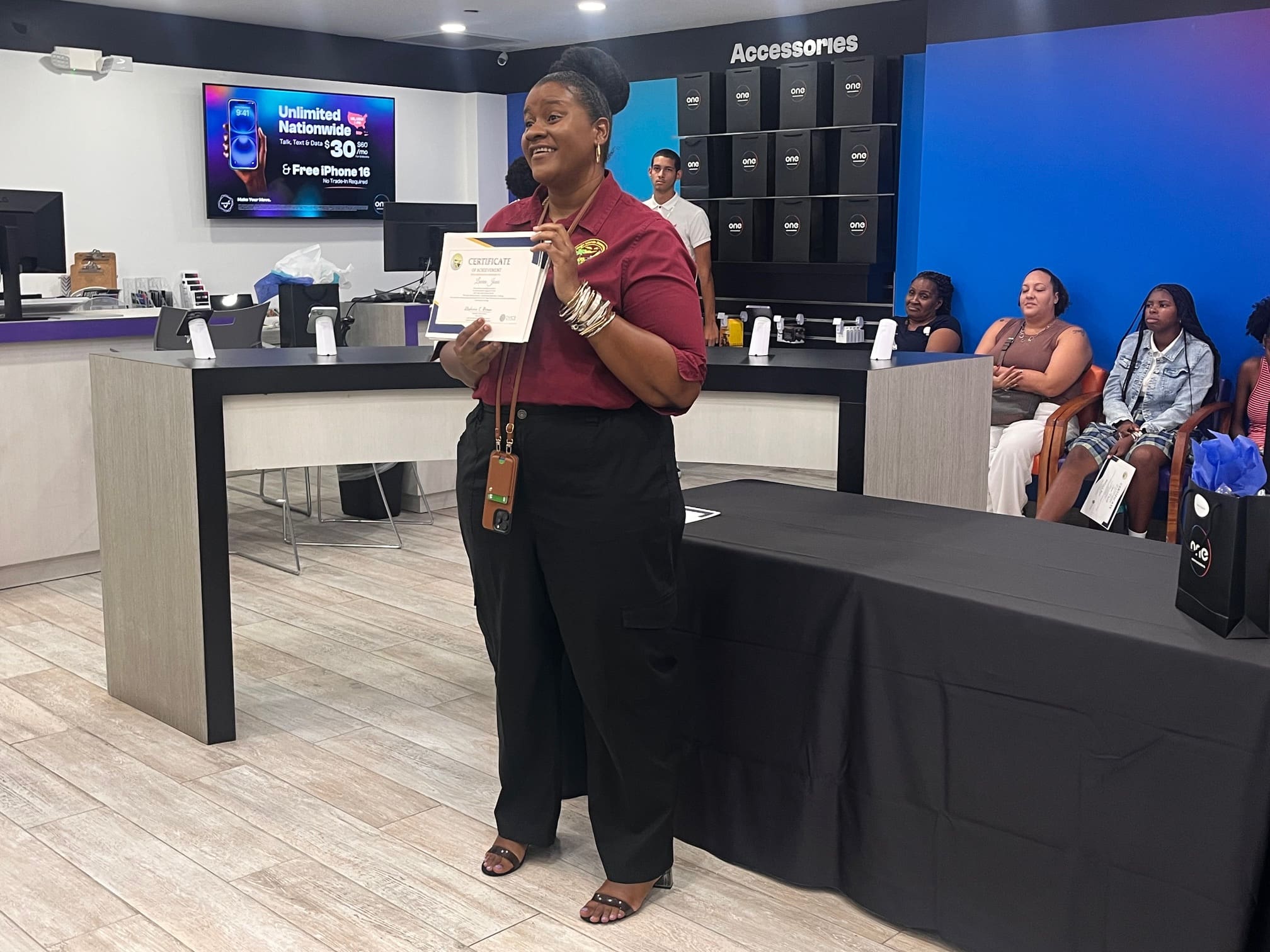
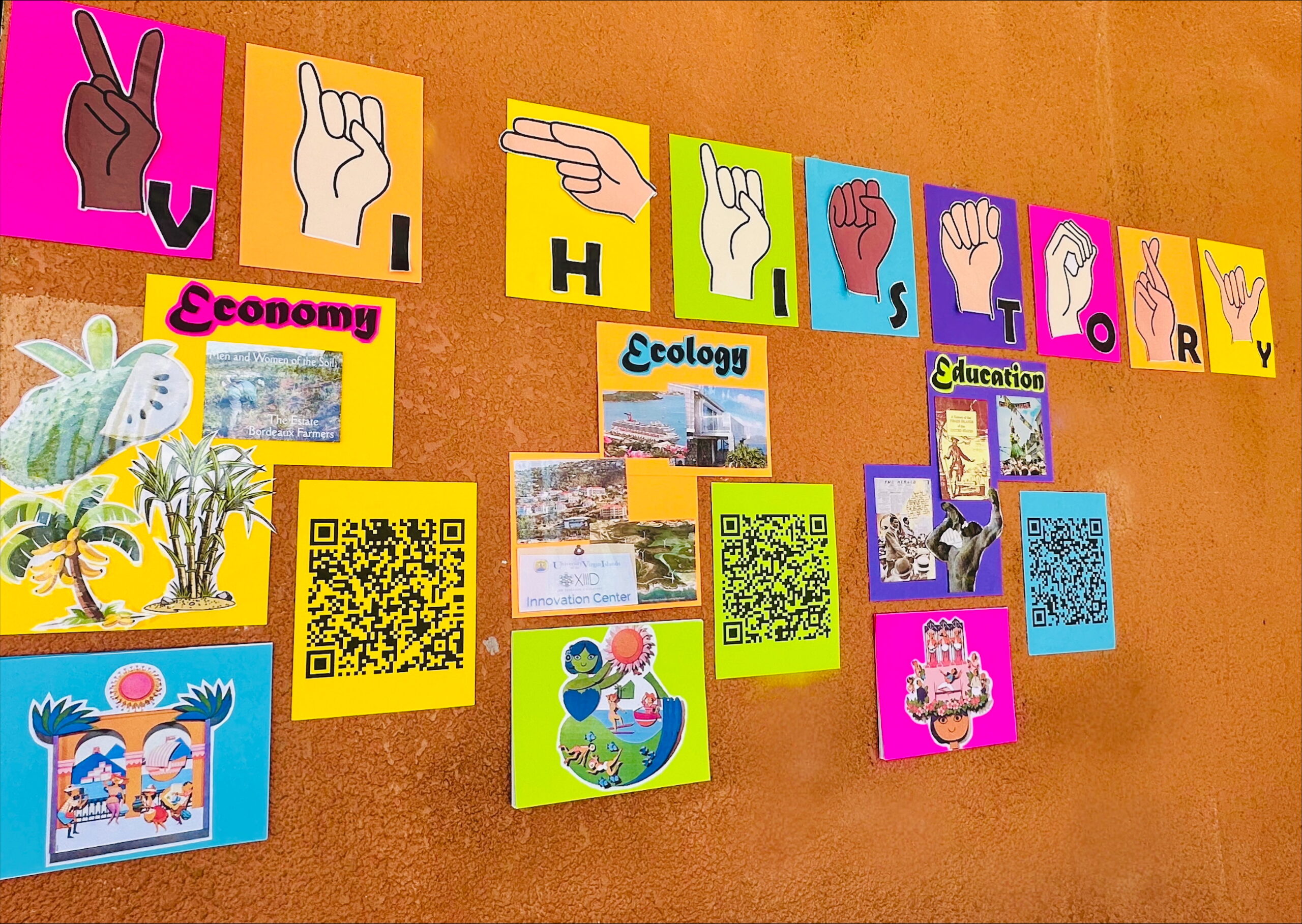
The Division, which is committed to integrating local heritage into all academic disciplines, particularly the sciences, used the opportunity to award prizes to student winners and recognize all participants with certificates of achievement from across the territory. Present were students from the St. Croix Educational Complex, Alfredo Elementary School, Pearl B. Larsen Elementary School and more. In a new feature this year, QR codes were provided to showcase students’ presentations, allowing attendees to access and appreciate their research digitally.
Alfredo Andrews Elementary School students scored big at the event, winning three awards. (Source photo by Diana Dias)
Marketing Coordinator Kafi Armstrong emphasized the importance of local corporate engagement, stating, “I think it’s very important for a company, especially a local company, to be in touch with its community. And our children, our youth, are definitely our future. So why not invest in them?”
State Director Stephanie Chalana Brown, who leads the Division of Virgin Islands Cultural Education, explained that the division operates within the broader Education Department’s Curriculum and Instruction division. “We try to make sure that we integrate national standards with our local standards,” said Brown.
State Director Stephanie Chalana Brown, who leads the Division of Virgin Islands Cultural Education. (Source photo by Diana Dias)
She further explained the importance of incorporating heritage across various subject areas. “We began to think about how the division has a standard for Virgin Islands culture and how to infuse science, math, agriculture, CTE — all with heritage studies — because they’re all intertwined,” she said.
This year’s competition offered three challenge categories: a Door Challenge, a Sustainability Challenge, and the VI Ancestry Challenge. While participation in the Door Challenge was limited, with only one student entry from the St. Thomas district, the other two challenges saw a much higher level of engagement.
SharraMae Estigo, a Special Education teacher, and her students contributed meaningfully to the project, which featured interactive elements, including QR codes on her submitted door design.
Student Door winner from the St. Thomas/St. John district is SharraMae Estigo. (Source photo by Diana Dias)
Brown highlighted the VI Ancestry Challenge as particularly impactful, thanks in part to support from the Community Foundation, which provided access to the American Ancestors platform, a genealogical research tool. “Students can access census records and explore genealogy, but only on a VIDE platform,” she noted. “This research helps them understand whose stories get told and why, encouraging them to consider careers in anthropology, archaeology, and genealogy.”
Navigating historical records, however, was not without challenges. “It was a hard challenge going through census records, and students didn’t always understand everything,” Brown said. “We offered professional development, but teachers still needed assistance, especially in classrooms with 20 or 30 students. Records were sometimes incomplete, or names misspelled, which made the process even more complex.”
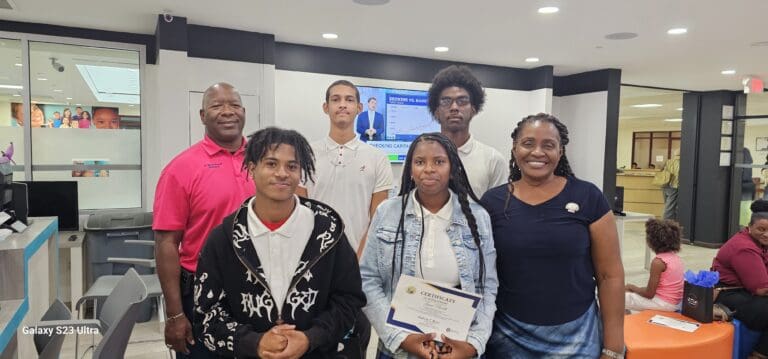
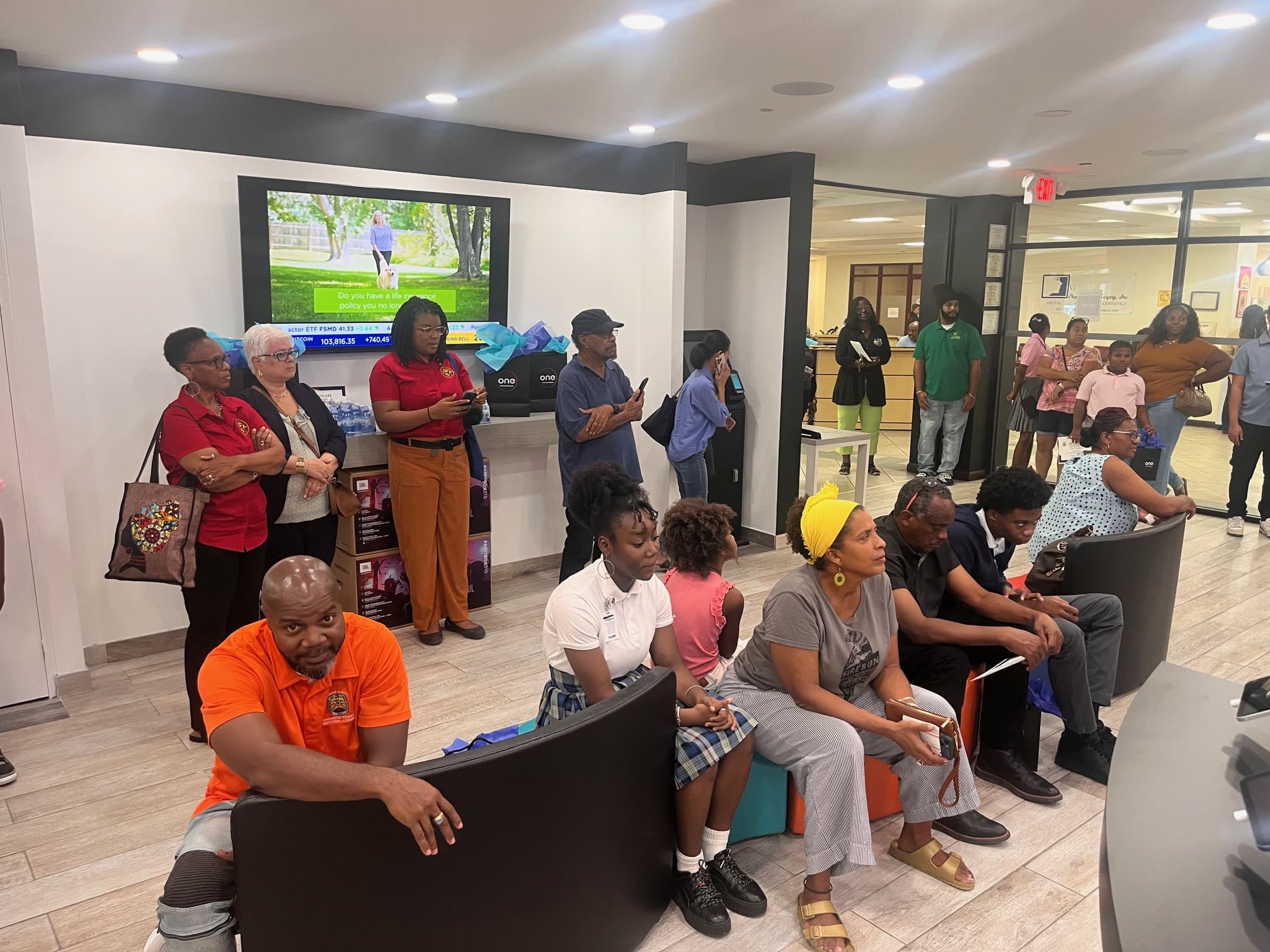
Parents, family, and the staff of One Communication and other community members show support for the culture competition winners. (Source photo by Diana Dias)
Still, the dedication of teachers and the enthusiasm of students shone through. “A lot of our teachers who participated this year did so by turning the project into a grade-weighted assignment,” Brown explained. “It was wonderful. We got to see how standards actually come down and trickle into the classroom.”
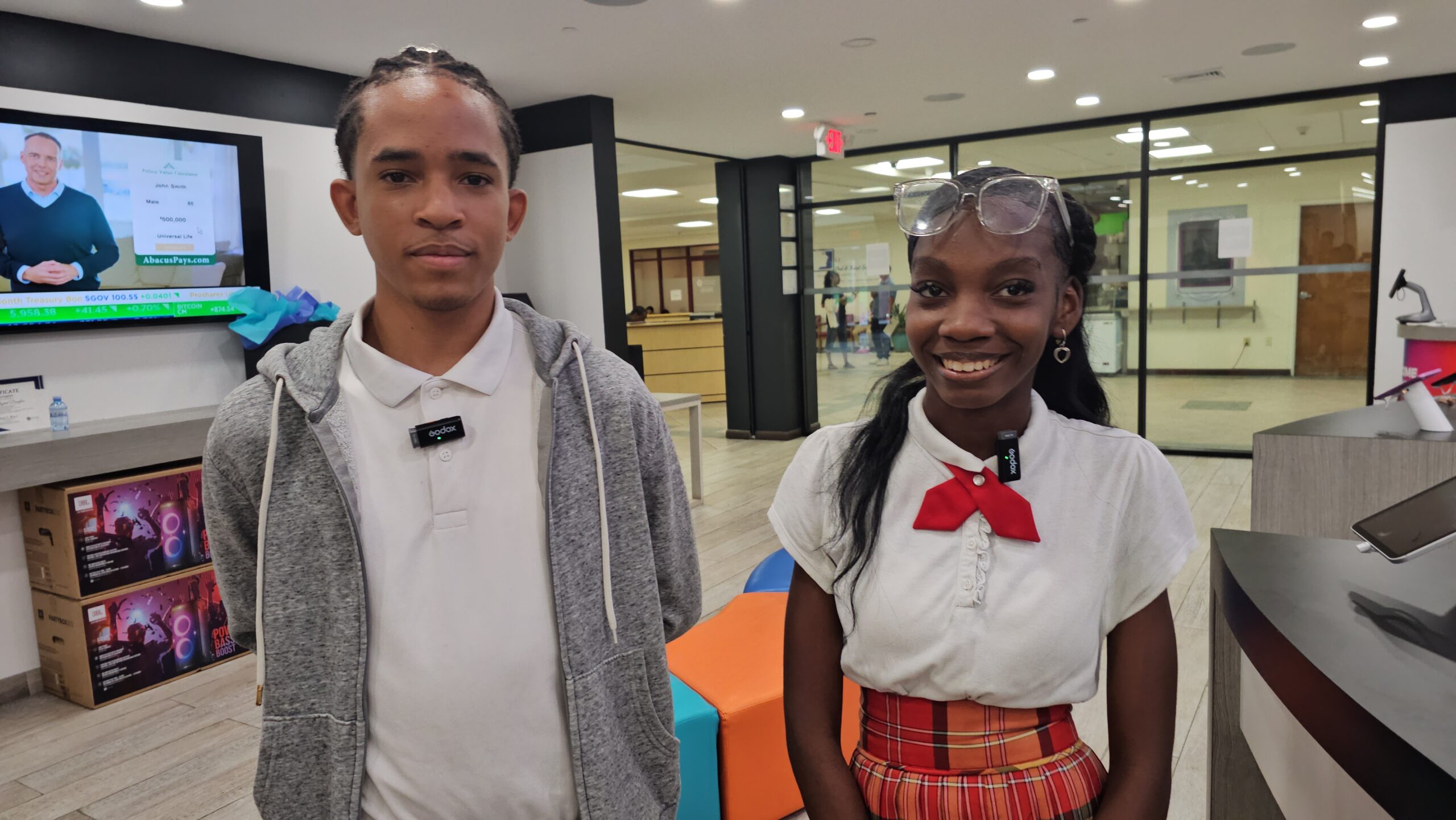
One participant, Trinity Pickering, said about a challenge, “We did the Sustainably Challenge, and in that we took things from our classroom to represent the natural resources, and we did a video where we took a project from our class, which was plants.”
“We talked about how it was important. I learned that cultural diversity is an important thing in our culture,” she continued.
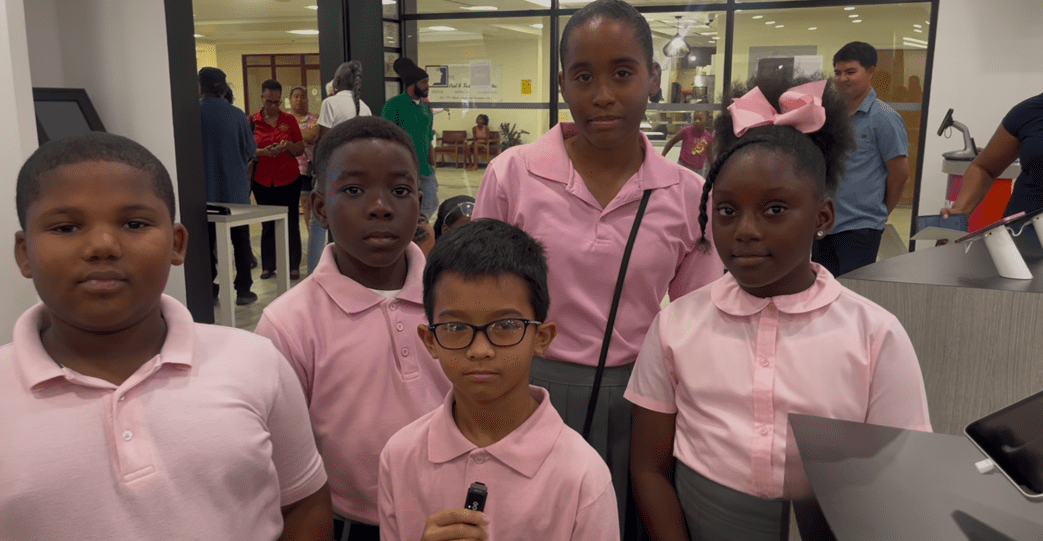
Dan Montella and Trinity Pickering from the Pearl B. Larsen Elementary School, two competitors. (Source photo by Diana Dias)
Reflecting on the event’s success, Brown shared her excitement. “This is the largest number of students we’ve had so far. In the first and second years, we didn’t have as much participation. I am so happy to see all the kids and their parents who came out today,” said Brown.
Armstrong also welcomed community engagement beyond the event, adding, “We are always excited to have people in our space at all times. So if you’re at home or anywhere and you feel like stopping by, just come in and see the new store. We welcome you.”
Here is a list of this year’s winners:
Antonio Blanco Alfredo Andrews School Horace Clarke
In his biweekly column, Langley Shazor speaks to issues important to men within the territory.
“Misery loves company” is something we have heard since time immemorial. Many of us have experienced this and have been victims of the contagion that is misery. Being in certain spaces and around certain individuals can be downright draining. I am sure all of us can recall a time where we felt exhausted, depleted, and worn out from those conversations. Quite literally, your energy can be upended and shifted by the wrong locations and persons.
However, today we are going to speak to the perpetrators. We often talk about protecting our space, our peace, enforcing boundaries, and staying firm in our resolve. What we don’t talk about as often is changing our behaviors when we are the ones contaminating spaces and the lives of others. It is always difficult to both acknowledge and adjust our perspectives and lenses when we are the problem. Today we can begin the journey to self-decontamination.
We have all been seeing a lot of things on social media lately, riddled with negativity and disagreement. We see the news and feel the effects of poor decision making at all levels of leadership and in all sectors. We wake up daily with a slight tinge of apprehension due to the uncertainty of what lies ahead, locally, regionally, and globally. So, it is quite natural to be frustrated, irritated, angry, outraged, discouraged, helpless, and sometimes, hopeless. We must allow ourselves to feel and to work through those feelings to help find solutions.
The complication with this is that many of us aren’t actually doing the work to heal or overcome what is happening internally. We are weaponizing and projecting it into every room we enter and onto every person we encounter. We stew and steam until we boil over. That is the best case if you have some semblance of emotional regulation. Many people simply explode immediately and everyone is collateral damage. This is not only unhealthy, but unfair, and frankly should be intolerable by those in close proximity.
I recently gave a presentation entitled “Taking Care of You: Redirecting Stress”, where we discussed the types of stresses and ways to address and mitigate them. One of the points that really hit home with two different audiences was the conversation around self-induced stress. Some of the stress factors we highlighted were setting unreasonable expectations, overbooking, too much screen time, among others. I mention this here because some of us refuse to accept responsibility for our role in what is happening in our lives. We are very quick to be victims and shirk the idea that we are also perpetrators of our own misery. Sometimes, we have to stop thinking that something is happening to us and realize that it is happening because of us.
This skewed belief is part of what justifies projecting our issues, pains, sufferings, troubles, trials, and struggles onto others. Even if you are truly innocent in whatever affliction you are experiencing, the people who have nothing to do with it, or are not the cause of it or being treated unfairly. If you are unable to regulate your emotions, you need to stay away from people. If you are unable to stay away from people due to having a family or a job without the availability for time off, then you need to learn how to regulate your emotions. The cycle of irregulated emotions looks like this: you have an attitude, so you infect innocent bystanders who then take on your state and return the same attitude. This reaction gives you a sense of entitlement and justification, thereby increasing the license to keep this poor behavior prominent. What exacerbates this series of events is that you never stop to look at your conduct as the catalyst, only continue to identify the reactions of those around you.
We must stop looking out the window and start looking in the mirror. One of the final thoughts of the aforementioned presentation was a quote by the Dalai Lama which said, “If a problem is fixable, if a situation is such that you can do something about it, then there is no need to worry. If it’s not fixable, then there is no help in worrying. There is no benefit in worrying whatsoever.” To reiterate the self-induced stress aspect, we need to let things go we can’t fix or change, and if we can do either, we need to stop focusing on the issue and start focusing on the solution. Furthermore, while we are on this path to stabilization, we need to eradicate infecting the spaces we inhabit. Failure to do so will have us waking up one day isolated and alone because we have destroyed every network, burned every bridge, and ostracized every person who cared for us. Unfortunately, some people have and will experience this and still fail to understand it was a product of their own doing.
You do not have to suffer the fracturing of your foundation and circle and the dissolution of your support. You do not have to live a life of misery and undue suffering. You do not have to be the reason people don’t want to be around you. Take the initiative to be your own vaccination and keep the infection from spreading.
Langley “Casual-Word” Shazor is a poet, author, publisher, entrepreneur, public speaking coach, podcast host, and pastor who is an advocate for youth and men. His goal is to enlighten, empower, and liberate those who are silenced, marginalized, and enslaved to self-destructive thoughts and behaviors. Visit thecasualword.com.
Editor’s Note: Opinion articles do not represent the views of the Virgin Islands Source newsroom and are the sole expressed opinion of the writer. Submissions can be made to visource@gmail.com.
The Virgin Islands Police Department is investigating a reported machete assault that occurred Saturday night along Julian Jackson Highway near Brewers Bay beach on St. Thomas.
According to the VIPD, officers with the Criminal Investigation Bureau responded around 10 p.m. after a man reported he had been attacked while standing outside his vehicle. The victim told police a male suspect approached him and struck him in the head with a knife, resulting in a laceration.
Detectives are seeking witnesses or anyone with information that may assist in identifying the suspect. Tips can be reported by calling 911 or contacting Detective E. Rijo of the Criminal Investigation Bureau at 340-774-2211.
Information can also be shared anonymously through Crime Stoppers USVI at 800-222-8477. VIPD said all tips will be kept confidential.
Virtue of the Week focuses on building peaceful and caring communities through understanding and fostering the practice of virtues. The Source supports the Virtues Project and will publish one virtue developed by the project each week.
Independence
Independence is confident self-reliance. We have the courage to see reality with our own eyes, not through the eyes of others. We are true to ourselves. We make decisions without undue influence from others. We responsibly care for ourselves. We do not depend on another to define our value, or lose ourselves to love. We bring ourselves fully to a relationship, yet honor the boundaries that protect each other’s dignity.
Quote: “If a man does not keep pace with his companions, perhaps it is because he hears a different drummer. Let him step to the music which he hears, however measured or far away.” —Henry David Thoreau
The Practice of Independence
I think for myself.
I create enough to sustain myself.
I trust my own decisions.
I enjoy healthy self-care.
I do not burden my relationships with unrealistic expectations.
I balance intimacy with self-reliance.
Questions for Discussion
How can independence strengthen our social justice work?
What does independence look like in your strongest relationships?
What does healthy self-care look like in our community?
What do we need to be fully ourselves in our community?
Sign up to receive the Virtue of the Week by email!
Virtue of the Week is provided by the Community Foundation of the Virgin Islands (CFVI) in partnership with the VI Source and Virtues Matter.
About the Community Foundation of the Virgin Islands
Since 1990, CFVI has been a catalyst for positive change in the territory through initiatives committed to youth, learning, family support and the environment. With a professional staff and a volunteer Board of Directors composed of community leaders, CFVI is a trusted advocate and supporter of programs that ensure opportunity and sustainability for current and future generations. CFVI is a registered non-profit organization entirely supported by individual donors, grants, trusts, corporate donations and estate planning. For more information, visit cfvi.net.
About Virtues Matter
Virtues Matter was started by a passionate wife-husband team of social entrepreneurs seeking to positively uplift as many lives as possible. We aim to inspire and empower, to build capacity, strengthen relationships, and help everyone lead lives of passion and purpose.
Virtues Matter believes in a world where people are committed to kindness and respect, strive to be their best, and live with hope, courage, and in unity. We built the Virtues Cards mobile app, an interactive personal and team development tool, to help people identify and develop key virtues skills. We also offer dynamic workshops, online training, and customized programs to help people cultivate these positive qualities of character. To learn more, visit virtuesmatter.com.
Check out our weekly weather forecast with Jesse Daley, covering Sunday, May 18, through Saturday, May 24. Our YouTube playlist is updated every week, AND check out Jesse’s daily weather updates here.
Remember this: In all your successes and failures, it was because of the Virgin Islands, not in spite of them. Remember where your dreams, your grit, your resilience, and your unshakable determination were forged.
What kind of success is it if you thrive but never at home?
Jonelle-Alexis Jackson (Submitted photo)
When you return and feel the sting of generational and systemic failures, the weight of decay, the ache of despair—know that these conditions exist in every corner of the Earth. And when you see others, native or not, thriving in the very soil where you once struggled, I hope something stirs awake inside you.
When the eyes of people who’ve never touched our shores light up when they hear where you’re from, that’s when you truly see what’s at stake. When we see and hear the dreams of many looking to escape the ills of their realities, who will quickly, liquidate, scam, and scrape whatever they can to find themselves here, I hope it makes your body ache.
Whether you’re coming home to mourn, to fete, or to reclaim yourself, tread every inch of these islands with reverence. Honor the people who have suffered and are still suffering. Understand that returning is not a performance—it is a responsibility.
(Source photo by Jonelle-Alexis Jackson)
I have been blessed to know that my roots stretch deep into this soil and far beyond it. I have been blessed to witness that while the horrors persist, so do the people! So do the communities and organizations that need your active support—not your commentary from afar, not your once-a-year post, but your presence, your partnership, your follow-through.
Stop feeding into the divide and those that benefit from it. Know your history. Ask and research for yourself. Tune in and follow the conversations with the same fervor you have after these decisions are made. We hold trivial matters to the fire with more urgency than we do the systems and individuals actively eroding our future. We shout louder at each other than we ever do at the ones who profit from our silence, confusion & disengagement.
Recognize the leverage we hold. We are not powerless—we are distracted. And that distraction serves someone. We’ve handed power to those who exploit and disrespect us. We can take it back.
Do not let them rest. Do not let them tread peacefully while our elders suffer, our youth flee, and our leaders fail to lead. Show them the price of their choices. Confront them with the consequences of their corruption and cowardice.
Let your love for these islands show not only in your celebration, but in your confrontation. In your commitment. In your refusal to be pacified by nostalgia, or lulled into thinking your success elsewhere exempts you from responsibility here.
Eagerness alone is not enough.
(Source photo by Jonelle-Alexis Jackson)
The idea that the diaspora is “eager and interested” is valid, but we need to examine how that eagerness manifests. Too often, there’s a pattern of distant engagement: showing up during crises, offering critique without context, or launching short-lived initiatives with no staying power. Meanwhile, those still living here navigate these challenges daily, without the luxury of stepping away when things get hard. That reality demands more than philosophical support. It demands real partnership.
One of the most harmful dynamics is when those who leave position themselves as more enlightened or capable simply because they’ve accessed different resources abroad. The mindset of “I left because things don’t change” may feel personally valid, but when weaponized, it becomes a quiet dismissal of those who stayed—of their strategies, their sacrifices, and the unglamorous, everyday labor of persistence.
If the diaspora truly wants to contribute, the work starts with decentering yourself.
It means listening before leading. It means taking the time to understand the current local ecosystem—not assuming that what works in New York or Atlanta can be copy-pasted into St. John, St. Croix, or St. Thomas.
It means putting money behind local initiatives, lending skills without strings, boldly saying NO to the parasites and village idiots we grew up with, and honoring the pace of real community work—which rarely aligns with quarterly benchmarks or viral content and election cycles.
It also means confronting your privilege. Leaving doesn’t make you less of a Virgin Islander—but it does change your vantage point. You may not experience the outages, the impossible bureaucracy anymore, but it doesn’t help to condemn and condescend. So while your ideas and solutions may be well-intentioned, they often don’t reflect the daily grind of survival here. That distance matters. Acknowledge it—with humility, not guilt. And definitely not with superiority.
And yes, modernization is necessary. But modernization is not just digital—it is relational. It’s about recalibrating the power dynamics between home and diaspora so efforts are rooted in mutual respect and shared leadership. Tech without trust is empty. Strategy without solidarity is performance.
So yes—let’s activate our people everywhere. But let’s do it with honesty. With equity. And with a deep, unshakeable grounding in the lived realities of those still holding the line at home.
Our future demands more than memory—it demands action. The 6th Constitutional Convention is not just a meeting of delegates—it is a defining moment. An opportunity to reflect the needs, dreams, and demands of Virgin Islanders in our own language, on our own terms. It is where we decide how power is distributed, how justice is upheld, how our identity is protected, and how our future is shaped.
This process isn’t just about politics. It’s about legacy. About the kind of Virgin Islands our children will inherit. About how we protect our land, our rights, and our people. And whether you’re on island or abroad, you have a role to play.
Don’t wait until it’s over to have an opinion. Don’t be louder after the fact than you are right now, when your voice and pressure could shape the outcome.
Share accurate updates and context within your networks
Ask hard questions. Demand transparency.
Amplify local voices doing the groundwork. Find an organization and get involved.
Submit your thoughts and concerns to your delegates
Bring others into the conversation—even if they don’t usually “do politics”
If you care about education, about land use, about housing, about autonomy—this is your moment. If you care about cultural preservation, about youth opportunity, about real economic development—this is your moment.
This is how we reclaim what has been lost, protect what remains, and define what’s next.
This is how we ensure that the Virgin Islands survives—not just as a memory or a vacation destination—but as a place where we can all live, thrive, and lead. This is our moment to get it right—let’s not waste it. Not this time. Not again.
—Jonelle-Alexis Jackson is a Virgin Islands-born photojournalist, media producer, and creative strategist committed to amplifying stories that challenge systems and uplift community. With roots in both the territory and the diaspora, her work bridges culture, accountability, and collective action.
Editor’s Note: Opinion articles do not represent the views of the Virgin Islands Source newsroom and are the sole expressed opinion of the writer. Submissions can be made to visource@gmail.com.
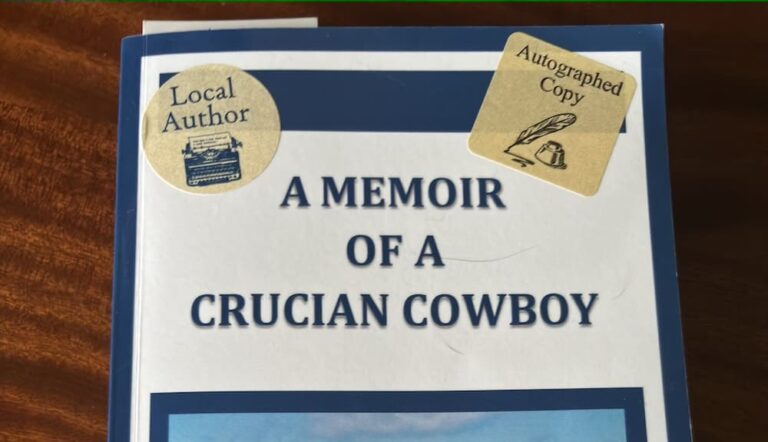
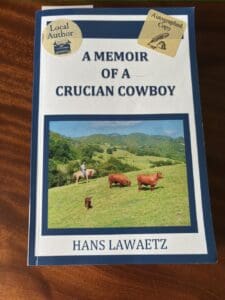
Hans Lawaetz’s story of his family and farm, “A Memoir of a Crucian Cowboy,” is available at Undercover Books and through Amazon. (Source photo by Susan Ellis)
“A Memoir of a Crucian Cowboy” by Hans Lawaetz is not an easy read. It took three years to write, and he has included many facts, events, and memories.
The 89-year-old cowboy not only rode the range but, following in his family’s footsteps, helped develop a breed of cattle, raised a family, and administered several national and community organizations.
Lawaetz has included various stories of his adventurous life. His experiences reflect basic Crucian strength. Each chapter tells of the people of the island during those days and their focus on conservation, athleticism, and agriculture.
Lawaetz is the third generation to farm the West end of the island. The first to settle on the island was Pastor Herman Lawaetz in 1889, who served as pastor of the Lord God of Sabaoth Lutheran Church in Christiansted.
Herman Lawaetz’s cousin, Carl, relocated to St. Croix in 1896 to farm 450 acres in the Western part of the island. Hans Lawaetz’s father Frits, was the third of seven children born to Carl and his wife.
“I wrote the book to get out the history of Senepol cattle,” he said.
Bromley Nethropp was the first to begin breeding Senepol cattle when he crossed a Bos Red Poll from England with a Bos Taurus N’dama, originally from Senegal, West Africa, in 1918. The two breeds are known for good milk, good beef, and being heat- and disease-resistant.
Years later, Frits Lawaetz and his partner purchased a herd of Nelthropp cattle and continued to work for years toward having the name Senepol trademarked. The breed was registered in 1949, and some said it was “the best looking breed.”
After Hans Lawaetz graduated from college, he served in the U.S. Air Force for five years and then returned to St. Croix to work at Annaly Farms. He eventually took over and managed the business, which eventually included a meat market that is still in existence.
Hans Lawaetz devoted decades to the Virgin Islands Olympic Committee. In 1966, the territory was given permission to participate, on a trial basis, in the 1966 Central American and Caribbean Games. Because participants did so well, the Virgin Islands was granted full membership in the International Olympic Committee. Hans Lawaetz served as president for 16 years and 20 years as secretary general. His fundraising for the Olympics included a fruitful day where he visited Lawrence Rockefeller and Leon Hess on the same day and received $15,000 in donations from both. A highlight of his time was watching his daughter Jodie carrying the V.I. flag and leading the Virgin Islands delegation in the 1984 Los Angeles Games.
The other organizations Hans Lawaetz was actively involved with included the V.I. Conservation District, Good Hope School, Country Day School, and the St. Croix Horse Show Association.
Some of his travels to places such as Colombia, Brazil, Paraguay, Mexico, and Guatemala, where he went to talk about cattle and the Senepol Breed Association, are recounted in his book.
Overall, Hans Lawaetz’s 329-page book is a thorough read of history and shares recollections of the Caribbean region, especially St. Croix.
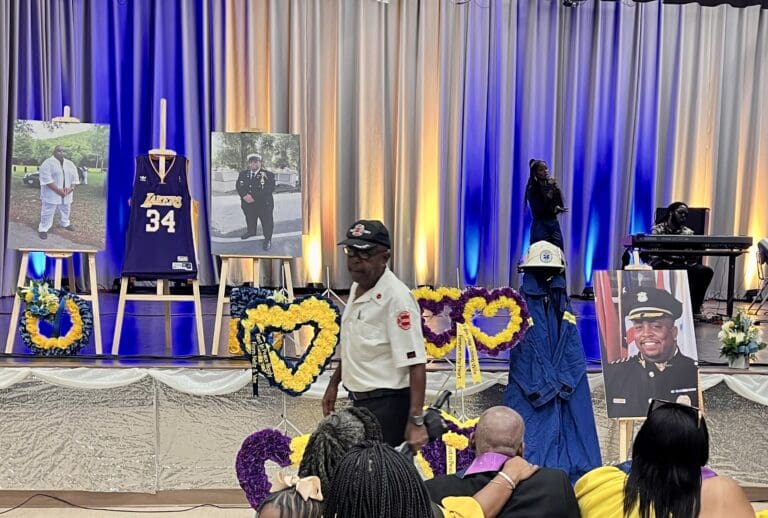
A procession of uniformed first responders filed by the casket of the late St. Thomas Rescue Chief Carl Fleming on Saturday. (Source photo by Judi Shimel)
As Police Week winds down in the Virgin Islands, first responders in the St. Thomas-St. John District paid their respects to one of their own. The funeral service for Capt. Carl Fleming, Sr., who served with St. Thomas Rescue, was underway in the auditorium at the Bertha C. Boschulte Middle School on Saturday.
Fleming died April 8 at the age of 58.
As the viewing ended and the service began, uniformed EMTs, rescue responders, and firefighters marched silently past the casket. They took their seats in the back of the hall as the services began.
Saturday was a day to remember first responders on St. Thomas and St. John. (Source photo by Judi Shimel)
Outside the auditorium doors, members of the squad Fleming called his “A Team” spoke quietly among themselves. Rescue groups in service on St. Thomas, St. Croix, and St. John are volunteer organizations sometimes called community first responders.
Across the United States, some community responders are affiliated with ambulance services; others are not. The number of active groups is unclear, according to the National Institutes of Health.
And like rescue groups in other areas, local volunteers often have full-time duties as first responders. Victor Adams is one of them.
“I came into contact with Bigley — or Carl Fleming — approximately 18 years ago when I joined the EMS system,” Adams said, “and from the time I joined, he’s been like a big brother to me — mentoring, showing me the ropes.”
Former rescue volunteer Michael Wheatley became a fire captain in West Palm Beach, Fla. Outside the venue where the funeral took place, he described Fleming as “a family man, a community man — a rescue man.”
St. Thomas Rescue founder and President Patrick Benjamin described the group’s contribution to emergency response as “very good.” A veteran volunteer of 40 years, Benjamin said he and Fleming spent years working side by side.
“St. Thomas Rescue is highly trained. We started with first aid — basic first aid. We had to learn CPR, EMS – paramedics,” the president said, adding that some former volunteers are now in the States working as fire chiefs, nurses, and in emergency rooms.
Since he first joined the St. Thomas squad in 1996, Fleming trained and gained expertise at vehicle extractions — pulling victims out of the wreckage at auto accidents. Keridon Williams, a 20-year veteran, said the chief promoted training opportunities for all volunteers.
Today, the organization has about 50 active members.
“St. Thomas Rescue — it still is — a volunteer organization where back in the day, we would have only heavy rescue operations. So, any type of motor vehicle accident, it was rescue who was being called out in the middle of the night … to rappel off the side of the mountains, or to cut people out of cars. Biggs was effective – he was an extrication expert, so he passed on all of those training and all of those tips and techniques to us and on to the younger generation,” Williams said.
Many on the squad said their work as volunteer responders gave their lives a sense of purpose. They credited Fleming for setting an example they could easily follow.
“You mentioned about which call he was on. The question is, which call he wasn’t on. He was always on call; if there was a call for service, he was there,” Adams said.
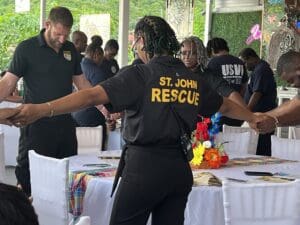
Appreciation for the community service of V.I. rescue groups was shown later in the day on Saturday as the Prayer House of Faith held an appreciation day for police, firefighters, and members of St. John Rescue. About two dozen first responders joined the Cruz Bay event held to mark the church’s 16th anniversary.
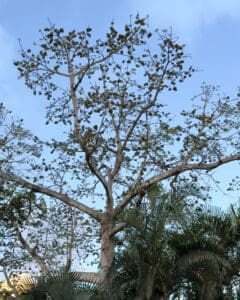
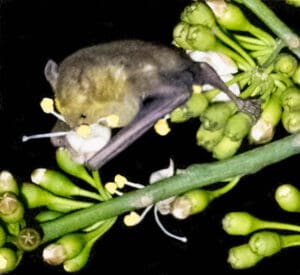
Kapok trees in the Virgin Islands attract local leaf-nosed fruit bats (Artibeus jamaicensis). (Photo Gail Karlsson)
One morning at the Unitarian Fellowship meeting my friend Kim mentioned that the big kapok tree by her place nearby was in bloom, and invited us to come over that evening to check it out. We needed to wait until dark because the flowers only open up at night, to attract the nocturnal fruit bats that are their main pollinators.
This tree is huge, and dominates the skyline.
Large kapok (ceiba) trees can produce thousands of flowers all at once. (Photo Gail Karlsson)
I had read that kapoks, also known as silk-cotton trees (Ceiba pentandra), were viewed as sacred trees by the Tainos, the early inhabitants of the Caribbean islands who came up from South America. The Tainos were probably traveling in dugout canoes made from thick kapok tree trunks, and carrying the seeds with them. Reportedly, the Tainos revered the bats attracted to the kapok tree flowers as the spirits of the dead that offered a connection between those still living and the world beyond.
I had never actually seen the bats showing up at one of the trees. The kapoks don’t flower very often, and then it’s not always okay to go around looking for bats at night, especially on other people’s property. So we were grateful for this invitation.
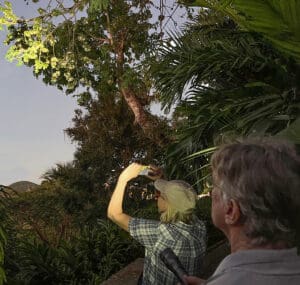
When my husband and I arrived after dinner, it was already dark, a bit late, and it was hard to figure out what was going on. Small areas of the tree were being lit up by other people holding flashlights, and bats were frantically flying around the flowers that were already open. Someone pointed and yelled out ‘there’s one’’ and then that bat quickly sped off and other ones whizzed by out of the shadows. As they flew around they were knocking off dead flower heads, which showered down on us, along with occasional bits of nectar-scented poop. Good to have a hat on.
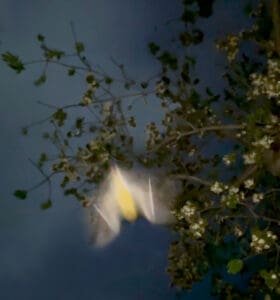
I had my telephoto lens with me, which requires two hands, and I couldn’t hold a flashlight as well. Also, I am not skilled at shooting in the dark, and had trouble focusing on the spots people were pointing at before the bat and circle of light had moved on.
It was challenging to try to focus my camera on bats flying around in the dark. (Photo Gail Karlsson)
It was all very frustrating and confusing until the tenants on the third floor invited us to come up and look at the mid-level of the tree from their deck. Up there, the bats and flowers were much closer. And one of the tenants was kind enough to hold her flashlight on a few nearby bats long enough for me to get some in-focus photos of them drinking nectar from the center of opened flowers.
Getting close, with someone holding a flashlight steady, I finally got a good look at some of the bats. (Photo Gail Karlsson)
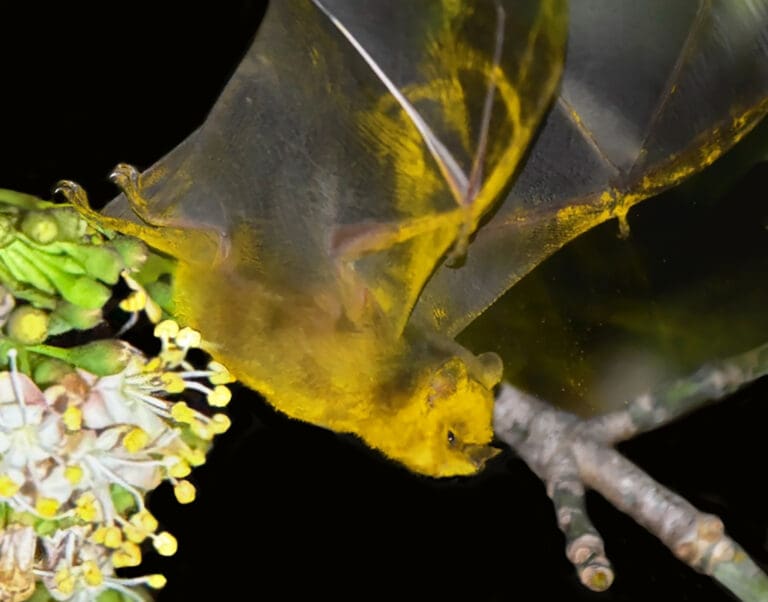
By about half an hour after we arrived, the bats seemed to slow down, maybe because they had already drunk a good bit of nectar from the flowers. Instead of zooming around like crazy, they started dropping down and lying on top of clumps of the opened flowers with anthers sticking up full of pollen.
This bat seemed to drop heavily onto some flowers. (Photo Gail Karlsson)
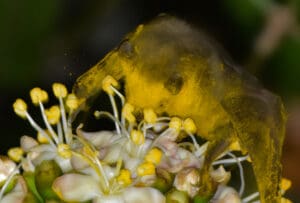
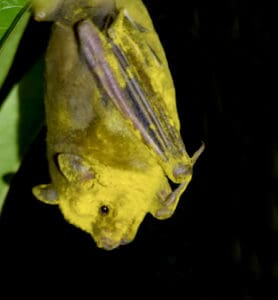
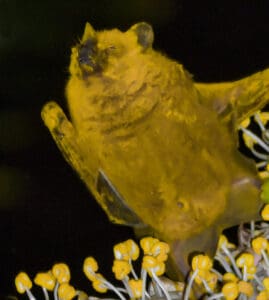
By then the bats’ faces and brown fur were covered with the yellow pollen.
The bats transport the pollen as they move around to other flowers. (Photo Gail Karlsson)
The blooming and pollination process lasts for a few weeks as different sets of flowers on the tree open sequentially. Even though it seemed like there might have been over 100 bats coming to feed, they needed to keep coming back to get around to pollinating all the flower bunches as they opened. The tree had to produce a lot of nectar to keep them coming. Once this frenzy of activity was finished, it might be years before the tree would have the strength to bloom again.
After that first night I went back a few more times to try to understand more about what was happening, arriving well before dark to be ready when the bats started coming.
I prepared by going to the hardware store to get a strong flashlight. They recommended one called ‘Big Larry’ and I enlisted my husband to hold it steady while I tried to get photos of the bats in flight. The people with the balcony were no longer there, so I tried to find a good viewing spot from the ground. There were some relatively low-hanging branches with flowers, but unfortunately, Big Larry’s beam could not really reach that far.
The next day I went back and found an even stronger flashlight – all business, no nickname.
My husband held the flashlight as I tried to video the bats with my phone. (Photo Joan Farrenkopf)
That night I invited the visiting speaker for the Unitarian Fellowship to come with me, because she had missed the first night’s visit. It was particularly thrilling this time because when the bats came several of them swooped down low and circled us. In the dark I heard her exclaim “Mon dieu, il m’a touché”. When I looked over she was rubbing her arm and said she was so surprised she lost her English and reverted to her childhood French. Another night I promised a different tree-loving friend ‘a life-changing experience’ and she was not disappointed.
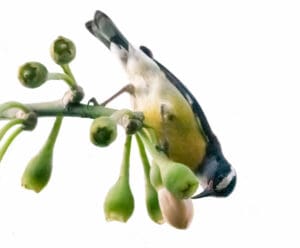
The bats were not the only creatures attracted to the tree’s flowers. When I went by one day in the late afternoon, I could see that bananaquits were investigating the buds. Some bananaquits seemed to be trying to pry open the flower’s tips. Others were more aggressive, poking their sharp beaks into the sides of the flowers as a short cut to getting at the nectar sac without providing any pollination services in exchange.
A bananaquit prepared to pierce a flower to reach the nectar. (Photo Gail Karlsson)
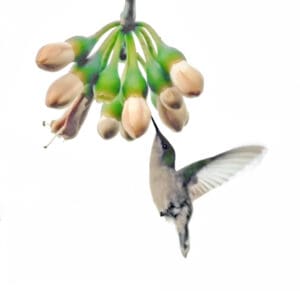
Later on, hummingbirds tried to sneak their long, skinny tongues into the flowers, just as the petals started to crack open.
An Antillean crested hummingbird explored the opening flower buds. (Photo Gail Karlsson)
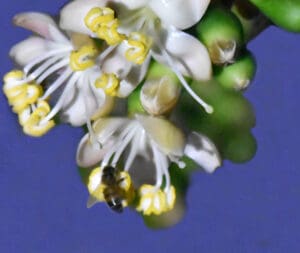
At dusk, hummingbird moths and bees gathered around as the scent of the opened flowers started spreading through the area. I though the bees would be sleeping by then, but I guess this was an opportunity worth staying up for.
Bees stayed up as night fell to get a turn at the kapok flowers. (Photo Gail Karlsson)
What an adventure to stand underneath this marvelous tree at dusk and join the wild company drawn to its exuberant blossoming.
And then, when it got dark and the bats arrived, there was a wild frenzy that made my heart race. My time there certainly felt like a spiritual experience, connecting me with so many other ways of being in the world, in the night, on this island.
A pollen-covered bat stood still for an intoxicated moment before flying off. (Photo Gail Karlsson)
Gail Karlsson is the author of a photo book Looking for Birds on St. John, as well as two other books about nature in the Virgin Islands – The Wild Life in an Island House, and a guide book Learning About Trees and Plants – A Project of the Unitarian Universalist Fellowship of St. John. Follow her on Instagram @gailkarlsson and at gvkarlsson.blogspot.com.




 In his biweekly column, Langley Shazor speaks to issues important to men within the territory.