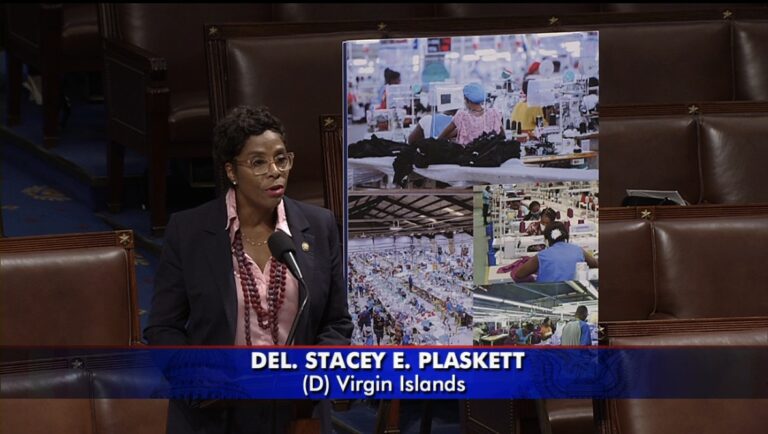
Congresswoman Stacey E. Plaskett released the following statement after the House of Representatives passed H.R. 6504, the Haiti Economic Lift Program Extension Act, reauthorizing the HOPE/HELP trade preference program for three additional years through December 31, 2028:
“Today’s passage of the Haiti Economic Lift Program Extension Act is a significant victory for Haiti and for strategic U.S. engagement in the Caribbean. The bipartisan support for reauthorizing HOPE/HELP demonstrates that when it comes to supporting our neighbors and advancing our shared interests, Democrats and Republicans can work together.
“I am proud to have championed this legislation to support our Caribbean neighbors and foster economic development in the region. I want to thank Ranking Member Neal, Chairman Smith, Dr. Murphy, and my longtime friend, Haiti’s Ambassador to the United States, Lionel Delatour, for their leadership in keeping the light of Haiti HOPE alive in the House of Representatives. The work of countless civil society groups supporting Haiti’s stabilization and any American manufacturers pushed for the renewal of this legislation.
“HOPE/HELP is a trade preference program with strong bipartisan support, that secures jobs for our allies. Haitian apparel utilizes U.S. cotton and plays an essential role in shifting supply chains out of China and into the Western Hemisphere.
“I continue to emphasize the importance of U.S. trade engagement in the Caribbean region. This legislation advances stronger bilateral economic ties, provides greater certainty for investors, and delivers the economic security Haiti needs to rebuild and emerge more prosperous and resilient.
“The legislation will now be considered by the U.S. Senate, and if passed, will move to the President’s desk for signature. We know Haiti’s workers and families are counting on us to ensure this vital program continues without interruption.”
Background: Haiti faces overlapping humanitarian, political, and economic crises requiring immediate action. More than 60% of the people of Haiti are living below the poverty line, with over 25% in extreme poverty. The 37% youth unemployment rate, combined with declining female literacy and lower school enrollment rates, as well as the crime and gang violence, makes finding skilled work increasingly difficult.
The apparel sector is of incredible importance to Haiti’s economy and is the foundation for the country’s economic development. Given the cascading job losses and extreme security crisis that have displaced over 1.4 million Haitians and left half the country’s population experiencing life-threatening hunger, Haiti cannot afford to wait any longer for reauthorization of this vital program.
The HOPE/HELP reauthorization extends the period during which imports of certain Haitian-manufactured textile and apparel, and other goods produced in Haiti are eligible for duty-free treatment, providing the long-term certainty that Haitian producers and workers need to build stronger, more resilient futures. The legislation also restores eligibility for certain textiles that became ineligible due to changes in the Harmonized Tariff Schedule.
The Department of Public Works provides the community with an update regarding the streetlight installation on the Melvin Evans Highway as a part of the Clifton Hill Connector Project.
Starting today, Tuesday, Jan. 13, DPW’s contractor – Grace Civil, LLC – will begin the installation of the 20 remaining replacement poles in various locations along the highway. Motorists should proceed with caution when traversing this area.
The Department of Public Works appreciates the community’s patience and understanding as it continues its efforts to improve road conditions throughout the territory.
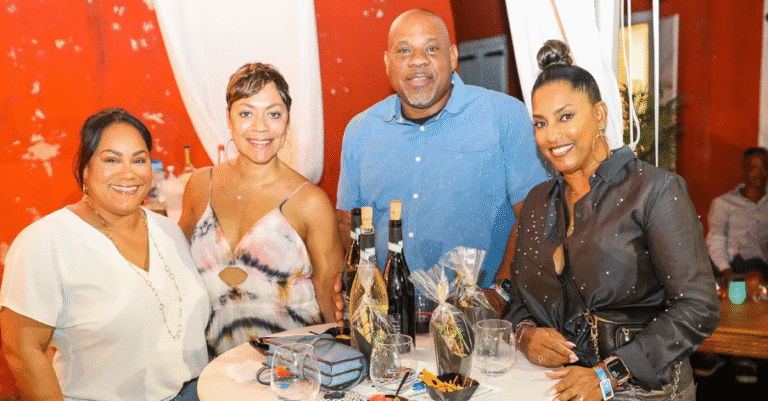
The Sunset Soca Wine Festival will return to St. Croix on Sunday, bringing wine, Caribbean cuisine, and soca music to Loops Beach in Estate La Grange during the Martin Luther King Jr. holiday weekend.
Now in its second year, the festival is scheduled to run from 2 p.m. to 8 p.m. at 72 La Grange, also known as Loops Beach. Organizers describe the event as a sunset-focused experience that blends curated tastings of local and international wines with Caribbean-inspired food offerings and a soundtrack driven by soca and regional rhythms. Music for the 2026 edition will be provided by DJs Chubby, Pops, and Kimo Dan, creating a continuous soundtrack as guests move through the event. Decor and installations are designed to reflect the island setting, with organizers describing the layout as an immersive experience that blends food, music, and wine rather than separating them into distinct segments.
Euriell “BJ” Joseph, operational manager for the festival, said the decision to bring the event back was driven largely by the response to its inaugural year. “The energy and support from St. Croix have been incredible,” Joseph said. “We’re excited to welcome everyone back this weekend and continue celebrating the island’s culture, hospitality, and love for great wine and music.” Organizers say the festival also aims to support local vendors, artists, and culinary partners, contributing to cultural tourism during one of the territory’s busiest holiday weekends.
Tickets remain available for general admission and VIP experiences, though organizers note that capacity is limited. Additional information about the Sunset Soca Wine Festival is available through the event’s official website here.
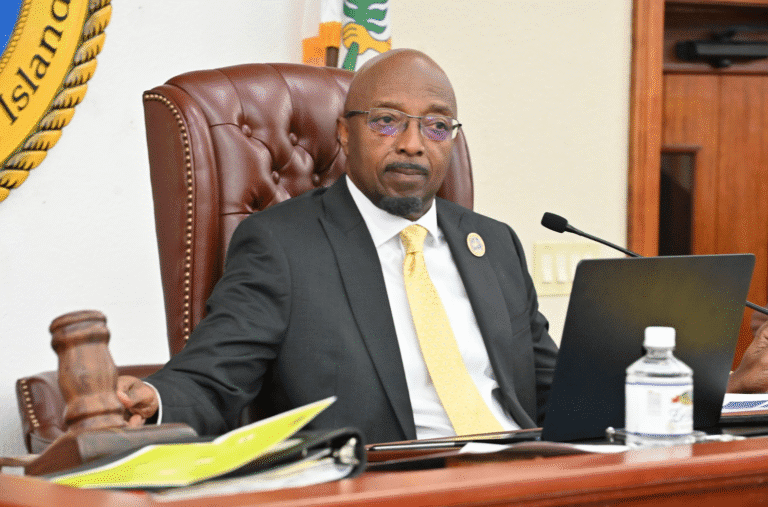
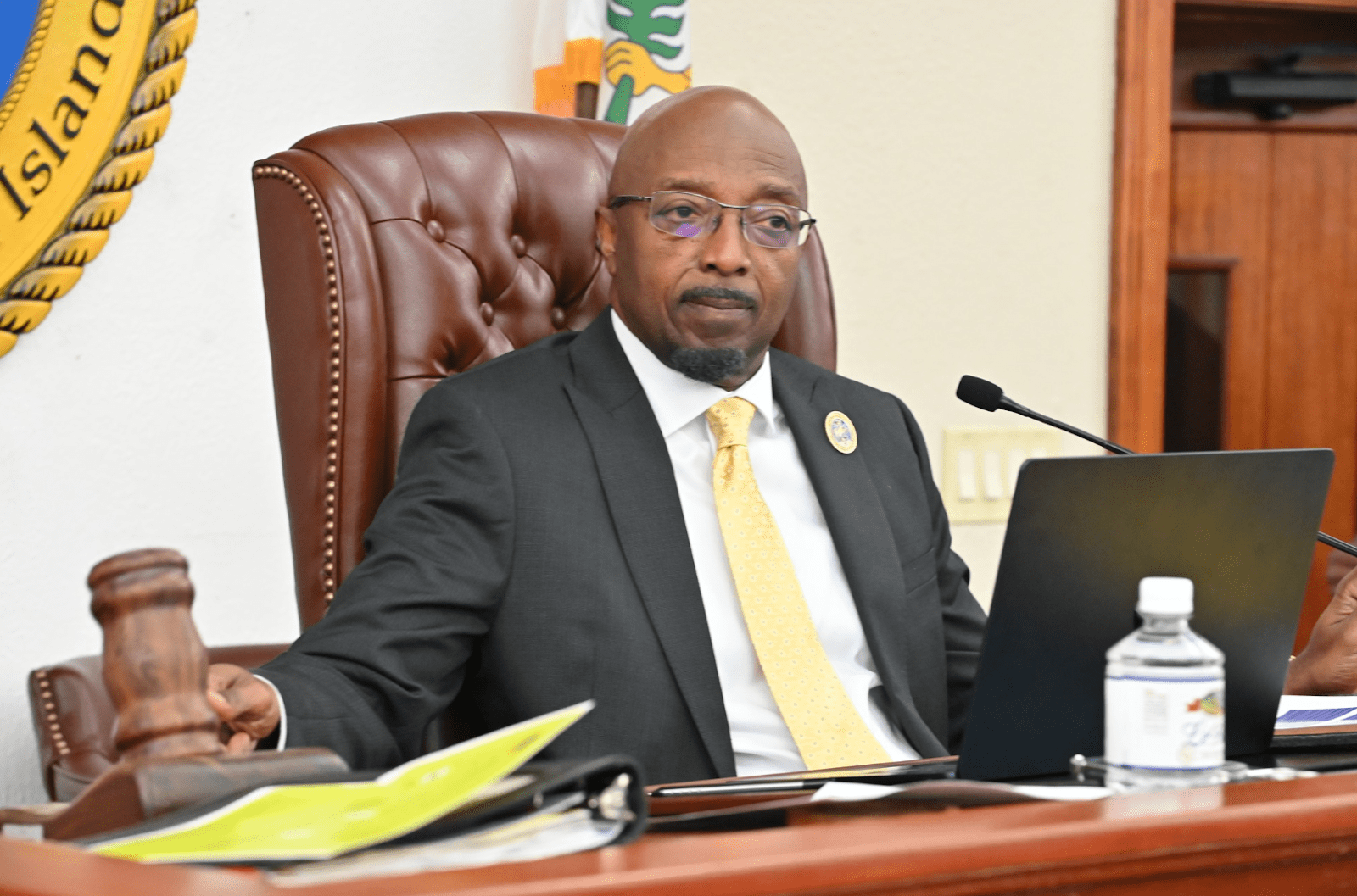
Sen. Milton E. Potter chairs the Committee of the Whole meeting Monday. (Photo courtesy V.I. Legislature)
The 36th Legislature on Monday approved a phased increase in the Virgin Islands’ minimum wage and advanced a $4 million streetlighting appropriation for the Water and Power Authority.
Lawmakers spent much of the day focused on a multiyear minimum wage increase they said was overdue for residents working multiple jobs, while also considering potential amendments to the WAPA streetlighting bill. Both measures ultimately passed unanimously and were sent to Gov. Albert Bryan Jr.
On a 15–0 roll-call vote, senators approved Bill 36-0030, which would raise the territorial minimum wage in three steps to $12 an hour in 2027, $14 in 2028 and $15 in 2029. The measure amends Title 24 of the Virgin Islands Code and represents the first territory-wide adjustment to the wage floor in years.
Sen. Novelle E Francis Jr. described the measure as a “sliding scale” intended to balance the needs of workers with the realities faced by employers by giving businesses time to adjust. At the current $10.50 minimum wage, a full-time worker earns about $21,840 a year. Under the proposal, annual earnings would be roughly $24,960 at $12 an hour, $29,120 at $14 an hour, and $31,200 at $15 an hour.
“Things are hard. There’s no doubt in this community things are hard,” Francis told colleagues, adding that the delayed start date and gradual increases are meant to “allow [small businesses] to catch their breath, be able to plan and allow for them to be able to actually implement this.”
Supporters argued the bill simply attempts to bring wages closer to the cost of living after years of rising prices for housing, food and utilities. Sen. Marvin Blyden Jr. recalled the backlash lawmakers faced after the last minimum wage increase in 2016 but said the Legislature has a responsibility to act.
“We always do the right thing on behalf of the people,” Blyden said. He pointed to residents who “work two, three jobs” just to stay afloat, leaving parents “not home to look at the children … they really can’t spend the time with them, and they’re on their own.”
Sen. Kurt A. Vialet said the initial increase from $10.50 to $12 an hour is modest compared with what families are already paying to get by. At $10.50, he noted, someone working 80 hours every two weeks earns about $21,840 annually; raising the wage to $12 increases that by just over $3,000.
“You’re not breaking the bank,” Vialet said. The goal, he added, is to give workers “an opportunity not to have to work two full-time jobs, but … reduce the time they’re working at the next job so that they could spend more time with the family.” He rejected arguments that the increase would drive inflation on its own, noting that “everything else was increasing while we were not increasing the minimum wage.”
Several senators placed the wage bill in a broader national context, noting a wave of minimum‑wage increases taking effect across the United States. Sen. Marise C. James cited a Forbes report noting that 19 states raised their minimum wages on Jan. 1, pushing the number of workers in states with wage floors above the federal minimum higher than those still covered by the old standard.
“Increases are necessary … to keep up with the rising cost of living,” James said.
Some lawmakers also acknowledged that many workers still earning the minimum wage are concentrated in sectors with thin profit margins. Sen. Avery Lewis said his research suggests these workers are often employed in child care and day care services. “They work hard too,” Lewis said, adding that those workers “do deserve an increase.”
Sen. Kenneth Gittens described the bill as a matter of “basic fairness and economic dignity,” arguing that too many Virgin Islands residents work full-time and still struggle to cover essential expenses. He said that when workers earn more, they are more likely to spend locally, strengthening small businesses rather than harming them.
Lawmakers also took up Bill 36-0210, which appropriates $4 million from the Virgin Islands Insurance Guarantee Fund to the Water and Power Authority for the repair, replacement and operation of streetlights across the territory. The bill, cosponsored by Francis, aims to address years of deferred maintenance that have left major roadways poorly lit.
Supporters noted that WAPA has said it needs more than $8 million to fully address the street-lighting problem and emphasized that the $4 million appropriation comes from excess insurance fund revenue, in addition to the $20 million already committed to the General Fund this fiscal year. Vialet characterized the funding as a long-overdue effort to meet basic public-safety obligations rather than a new subsidy for the utility.
Earlier in the day, Sen. Ray Fonseca proposed amending the bill to set aside $500,000 of the WAPA appropriation for a 3D mammography machine at Schneider Regional Medical Center, citing breast cancer as the leading cause of cancer‑related death among women in the territory and noting that the hospital’s current machine is out of service. “Breast cancer screenings are delayed, placing our women at significant risk of late‑stage breast cancer diagnosis,” Fonseca said.
Several senators said they supported expanding access to cancer screening but objected to diverting streetlighting funds or allocating more money to hospitals, arguing that hospitals had not demonstrated sufficient accountability.
Francis acknowledged that funding a mammography machine is “equally important,” but argued that Bill 36‑0210 was not the right vehicle. “There was no discussion in terms of utilizing this particular measure for that purpose,” he said, urging that such proposals be developed openly. “Let’s have the discussion, let’s communicate, let’s collaborate and come up with a compromise. But we can’t just have an ambush in the night.”
Ultimately, the mammography amendment was not adopted, leaving the full $4 million in the WAPA bill. Later, senators returned for an evening session to consider a series of riders added to Bill 36‑0210. Lawmakers adopted amendments tightening background‑check requirements for health care licensing boards, adding a definition of “serious illness” to leave policy, cleaning up outdated references in the Virgin Islands Code, and authorizing a permanent structure at the Capitol to house the cremains of Alma B. Ottley alongside those of Earl B. Ottley. With those changes in place, the bill passed unanimously, 15‑0.
Senators also advanced attorney Pedro Williams as a judge of the Superior Court’s St. Thomas–St. John Division, citing his decades of legal practice and community service. They approved a resolution honoring U.S. Sen. Mike Crapo of Idaho for his role in securing a historic increase in the federal rum cover‑over tax reimbursement to $13.25 per gallon, designated Jan. 27, as St. John’s Legendary Rhythm and Blues Cruise Day, and approved lease agreements for WSTA Radio and St. John Taxi Services Corporation
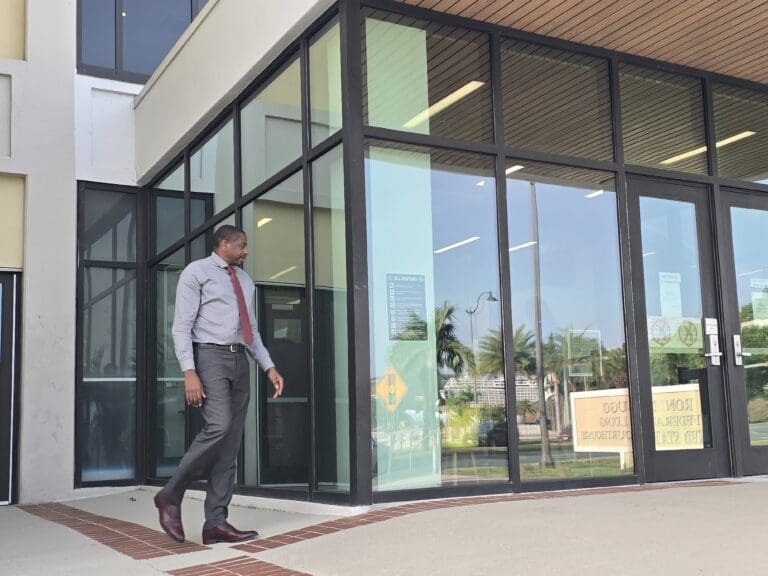
The sentencing of former Sports, Parks and Recreation Commissioner Calvert White and business owner Benjamin Hendricks is scheduled for Jan. 22 on St. Thomas. (Source photo by Kit MacAvoy)
Federal prosecutors are recommending a more than 12-year sentence of imprisonment for Calvert White, the former Sports, Parks and Recreation commissioner who was convicted of wire fraud and bribery last summer.
“The defendant’s abuse of public office and creation of a scheme to demand and accept bribe payments in exchange for facilitating the awarding of a $1.43 million government contract, coupled with his leadership role in the scheme, warrants a significant custodial sentence,” U.S. Justice Department trial attorney Alex Dempsey wrote in a sentencing memorandum last week. “The government recommends a sentence of 151 months of imprisonment, which is at the low end of the applicable guideline range, followed by three years of supervised release.”
Honest services wire fraud carries a maximum penalty of 20 years in prison. Bribery concerning federally-funded programs carries a maximum penalty of 10 years in prison if it involves at least $5,000 — the exact amount wired to White by a cooperating witness over the course of a federal investigation into White and his accomplice, business owner Benjamin Hendricks.
In a separate filing, prosecutors recommended a nine-year sentence, followed by three years of supervised release, for Hendricks.
The charges against White and Hendricks stemmed from a federal investigation into a kickback scheme by which White — with Hendricks as a go-between — tried to solicit a $16,000 bribe in exchange for steering the award of a federally-funded security contract to Mon Ethos Pro Support, a cybersecurity company formally owned by convicted felon and cooperating witness David Whitaker.
A jury found White and Hendricks guilty on all counts after a weeklong trial in July.
“As a long-standing public servant, the defendant, perhaps more than anyone, knew that public services is a public trust, and that an official in such a prominent and sensitive positions must always place loyalty to the Constitution, local and federal laws, and core principles of ethical conduct above personal interest and private gain,” Dempsey wrote. “By steering a contract to his financial benefactor, Whitaker, the defendant breached the bond of trust that the citizenry bestowed upon him.”
That scheme, Dempsey wrote, damaged and undermined the integrity of the U.S. Virgin Islands’ procurement process.
“Competitors that thought they were bidding on a level playing field — and citizens who thought that their public officials were maximizing their taxpayer dollars — both realize now that they have been deceived and cheated,” he wrote.
White’s attorney, Clive Rivers, requested a maximum 27-month sentence, while Hendricks’s attorney requested 37 months. Both are slated to be sentenced on Jan. 22.
For 109 years, the people of the U.S. Virgin Islands have lived under American sovereignty without full democratic rights – a condition originally deferred in the 1916 Treaty that transferred the islands from Denmark to the United States. Today, that continued deferment of civil and political rights is not only untenable – it is unconstitutional, immoral, and incompatible with modern human rights norms. And now, incredibly, this long-unresolved injustice is being dragged into contemporary Arctic geopolitics, as if the rights of Virgin Islanders were mere collateral in a great-power bargaining game. This cannot continue.
The Unkept Promise of 1917
When Denmark agreed to sell what are now the U.S. Virgin Islands, it did so only after securing a peculiar promise: Article VI of the 1916 treaty stipulated that “the civil rights and the political status of the inhabitants of the islands shall be determined by the Congress” at a later date. In other words, the islanders’ rights were put on hold – deferred until Congress chose to act. Over a century later, Congress still has not granted Virgin Islanders equal civil and political rights. U.S. citizenship was eventually conferred in 1927, but to this day Virgin Islanders cannot vote for President, lack any voting representation in Congress, and remain unable to fully participate in their own self-government at the federal level. As a recent U.S. Civil Rights Commission advisory concluded, citizens in the territories “share the following: None can vote for President, none are represented by a voting member of Congress… each has a lower status of citizenship compared to citizens living in the fifty states.” This reality – American citizens governed without consent – flouts the fundamental principle of equal rights under the U.S. Constitution.
The deferral of Virgin Islanders’ rights was not an accident of history; it was intentional. During the 1916 negotiations, Denmark pushed for guarantees that the islands’ inhabitants would be granted full U.S. citizenship rights and even proposed a local plebiscite on the transfer. The United States flatly rejected those proposals, insisting that questions of political status and civil rights must be left to future “subsequent congressional determination” rather than enshrined in the treaty. Denmark reluctantly acquiesced, ratifying the treaty on terms that explicitly deferred the civil and political status of Virgin Islanders to the discretion of a future U.S. Congress. In hindsight, that “future” never truly arrived. The people of the Virgin Islands were transferred in 1917 without a vote, without any enforceable rights guarantees, and without any post-transfer plan to achieve self-government. That broken promise has left generations of Virgin Islanders in a democratic limbo – governed by the United States, yet not fully part of it.
Collateral in Arctic Diplomacy
It is bad enough that this colonial-era injustice has persisted into 2026. But now it risks being compounded by geopolitics half a world away. The 1916 treaty that sealed the fate of the Virgin Islands also included another key element: as part of the deal, the U.S. formally recognized Danish sovereignty over all of Greenland, via a diplomatic assurance known as the Lansing Declaration. In other words, the United States promised it would “not object” to Denmark’s control of Greenland – a pledge given as reciprocal consideration for Denmark’s agreement to the sale. Fast-forward to today, and that century-old assurance has become a focal point of renewed U.S.–Denmark–Greenland tensions. Washington’s current administration has openly mused about acquiring Greenland, even suggesting military action is “always an option” to take the strategic Arctic island. Senior figures like White House adviser Stephen Miller have insisted that “obviously, Greenland should be part of the United States,” brazenly adding that “nobody is going to fight the United States militarily over the future of Greenland.” Such rhetoric not only alarms our Nordic allies – it directly undermines the 1916 treaty framework that the U.S. itself established. In fact, in March of this past year the U.S. government effectively repudiated the Lansing Declaration’s guarantee, casting doubt on the very treaty that underpins both Greenland’s status and the U.S. Virgin Islands’ political limbo.
Danish leaders, for their part, have responded with outrage and appeals to principle. Foreign Minister Lars Løkke Rasmussen has called for calm dialogue instead of “a shouting competition,” urging the U.S. to return to sensible diplomacy. Greenlandic officials like MP Aaja Chemnitz have been blunt in asserting that “Greenland is not for sale, never will be for sale” – emphasizing that any decision about Greenland’s future belongs to the Greenlandic people, not to Washington or anyone else. Even America’s own bipartisan voices have chimed in: U.S. senators overseeing NATO affairs reminded the White House this week that “the United States must honor its treaty obligations and respect the sovereignty and territorial integrity of the Kingdom of Denmark,” and that coercion of an ally “undermines the very principles of self-determination that our Alliance exists to defend.” These statements underscore an uncomfortable irony. How can the United States so righteously invoke treaty obligations and the right of peoples to self-determination in the Arctic, while denying those same principles to the 87,000 American citizens (2020 Census) living in the Virgin Islands?
As Washington escalates its Arctic ambitions, the people of the Virgin Islands find themselves in an absurd and unjust position – their unresolved political status seemingly used as a bargaining chip. Is the United States prepared to discard one part of the 1916 deal (the promise to Denmark) in order to pursue Greenland, while continuing to ignore the other part of that deal (the deferred promise of equal rights for Virgin Islanders)? Such cynical realpolitik treats Virgin Islanders’ rights as transactional – as if we are pawns on a chessboard of Arctic strategy. This is morally repugnant. The civil and political rights of an entire community are not currency to be traded in high-stakes diplomacy. We are not Denmark’s to bargain over any longer, and we are certainly not Washington’s to indefinitely put on hold.
An Urgent Moral and Constitutional Imperative
After 109 years, the status quo in the U.S. Virgin Islands is untenable. A condition that might have been dismissed as “temporary” in 1917 has hardened into a permanent second-class status. It is often said that this arrangement is “constitutional” under the Insular Cases. That is true only in the narrow, technical sense that those cases have not yet been formally overruled.
But the Insular Cases themselves—rooted in early-20th-century racial and colonial assumptions—stand in direct conflict with the Constitution’s core guarantees of equal protection, consent of the governed, and democratic legitimacy. Recent opinions of the United States Supreme Court have openly questioned their validity and moral authority.
In that light, the continued reliance on the Insular Cases to justify the permanent deferment of Virgin Islanders’ civil and political rights is not a defense of the Constitution, but a deviation from it—and one that grows more untenable with each passing year.
The United Nations, through its decolonization mandates, has long held that the U.S. must bring the Virgin Islands to a “full measure of self-government.” In April 2025, a coalition of Virgin Islanders even filed a petition before the Inter-American Commission on Human Rights, charging that the centuries-old disenfranchisement and inequality in the territory constitute ongoing human rights violations. (The Commission has taken the case seriously – it accepted the petition and invited the U.S. to negotiate a friendly settlement.) It should not take international tribunals to tell Americans what our own history and values already should: governing people without their consent is wrong. Colonially deferencing the Constitution is as immoral in 2026 as it was in 1776.
Crucially, one need not prescribe any particular status solution – statehood, independence, or otherwise – to recognize the urgent need for change. Indeed, this is not about partisanship or a specific political agenda; it is about fundamental fairness and the rule of law. The current arrangement, in which Virgin Islanders are U.S. citizens subject to U.S. laws yet have no vote in the government that makes those laws, is a clear example of “government without consent.” It is no coincidence that this exact phrase echoes the grievances of the American Revolution. How can the United States champion democracy on the world stage – whether in the Caribbean or the Arctic – while perpetuating disenfranchisement in its own Caribbean territory?
After 109 years, the deferment contemplated by Article VI can no longer be treated as an open-ended option. If Congress claims the authority to determine the political status and civil rights of the People of the U.S. Virgin Islands, then it also bears the responsibility to exercise that authority transparently, deliberately, and without further delay.
At minimum, this moment demands two concrete actions.
First, a formal congressional hearing—within the next legislative year—specifically examining Article VI of the 1916 Convention, its historical execution, and its continuing legal and constitutional effects on the people of the Virgin Islands.
Second, the establishment of a defined timetable for a federally recognized political-status process, including a binding referendum conducted under terms that ensure informed consent and meaningful choice.
Anything less amounts to the continued suspension of democratic rights by inertia.
Whatever the outcome of Greenland-related negotiations, the people of the U.S. Virgin Islands cannot remain structurally collateral to a revived treaty framework. In 2026, permanent deferment is no longer governance—it is avoidance. And avoidance, after more than a century, is indefensible.
About the Author
Shelley A. H. Moorhead is President of the African-Caribbean Reparations and Resettlement Alliance (ACRRA) and an Associate Member of the CARICOM Reparations Commission. He has served as Minister of State for External Affairs of the U.S. Virgin Islands and as Secretary-General and Chairman of the Standing Committee of the Inter-Virgin Islands Council. His work focuses on treaty law, decolonization, and the continuing legal consequences of slavery and colonial transfer.
Editor’s Note: Opinion articles do not represent the views of the Virgin Islands Source newsroom and are the sole expressed opinion of the writer. Submissions can be made to visource@gmail.com.
Gov. Albert Bryan Jr. granted clemency to nine individuals, commuting the sentences of four inmates and pardoning five others, according to a press release issued Monday by Government House.
The commutations and pardons took effect Monday.
Emanuel Greer, 55, had his sentence commuted to time served due to what the administration described as exemplary institutional adjustment. Lester Greenidge, 71, received a commutation to time served after maintaining a clean institutional record, completing multiple programs and serving as a mentor to other inmates, according to the press release.
Sholome Akeemo Francis, 39, who has been incarcerated for 17 years, had his sentence commuted to 30 years, with the remaining portion suspended effective Monday. Alston Lambertis Sr., 68, had his sentence commuted to time served after maintaining a clean record throughout 43 years of incarceration, the press release stated.
The governor also pardoned five individuals for prior offenses: Joseph A. Eastman, 58; Keith Benjamin, 68; Ras Desho Emanuel Afamefuna Joshua, also known as Larry Emanuel Joshua, 65; Ranold Lionel Jackson, 33; and Steven R. Jackson, 40, the release stated.
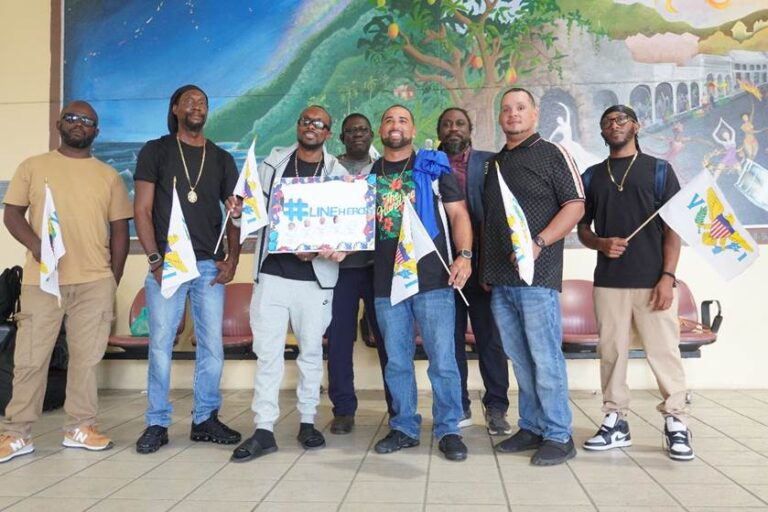
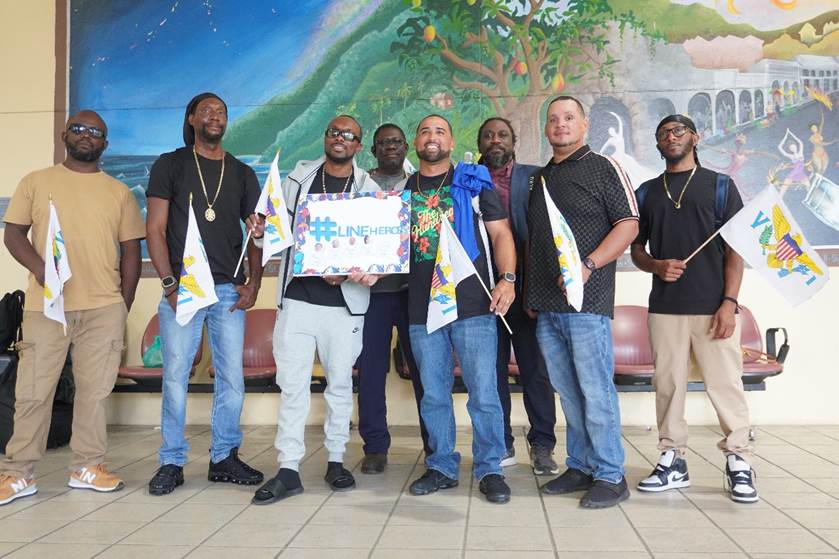
WAPA linemen headed to Jamaica as part of the restoration team from St. Croix, (front row) Bevron Goodwin, Charles Isles, Luiscito Frederick, Rey Belardo, Jr., Misael Mendoza, Jr. and Evanson Matthew, Jr. Back row: Paul Gumbs, WAPA Line Superintendent, and Collin Brown, WAPA Transmission and Distribution Director, came out to support their team departing at the Henry E. Rohlsen airport this afternoon. (Photo courtesy WAPA)
A crew of Virgin Islands Water and Power Authority linemen departed Monday for Jamaica to assist with post-hurricane power restoration following the impact of Category 5 Hurricane Melissa, according to a press release issued by the authority Monday.
The team is expected to spend about one month in Jamaica, providing hands-on support to local utility crews working to repair damaged electrical infrastructure, including powerlines, poles, and transformers, according to the press release.
The delegation includes lineworkers and safety personnel from WAPA’s St. Croix and St. Thomas St. John districts. Crew members departed from Henry E. Rohlsen Airport on St. Croix and Cyril E. King Airport on St. Thomas before joining in Miami for their onward flight to Jamaica, the press release said.
“While we faced our own challenges last year, we are reminded that it could have been far worse,” said Karl Knight, WAPA chief executive officer and executive director, in the release. “We watched as our Caribbean brothers and sisters in Jamaica were devastated when Hurricane Melissa made landfall.”
Knight said the effort reflects the support the U.S. Virgin Islands received after hurricanes Irma and Maria.
“We have not forgotten that we were spared this hurricane season, and we will do our part to demonstrate the same goodwill we received,” he said.
Paul Gumbs, WAPA line superintendent on St. Croix, said the crew understands the demands of long-term recovery.
“We understand the long road to recovery because we’ve walked it ourselves,” Gumbs said. “Volunteering in Jamaica is about helping our Caribbean family move forward.”
WAPA will continue to maintain operational readiness in the U.S. Virgin Islands while the crew is deployed, according to the release.
A St. Croix man was arrested Sunday in connection with a property damage complaint, the Virgin Islands Police Department reported.
Police said patrol officers arrested Francisco Cruz-Santiago on Sunday without incident and charged him with destruction of others’ property (DV) and disturbance of the peace. He was advised of his Miranda warnings and taken to the Wilbur H. Francis Police Station, according to the police report.
The arrest stems from a complaint filed Jan. 4 at about 3:25 p.m. at the Wilbur H. Francis Police Station. According to police, the complainant reported that Cruz-Santiago destroyed a storage room, pump room and tool shed. Police said Cruz-Santiago admitted to the damage.
Cruz-Santiago was transported to Juan F. Luis Hospital for treatment and later discharged, the police report stated.
He was remanded to the John A. Bell Adult Correctional Facility pending an advice of rights hearing, according to the report.
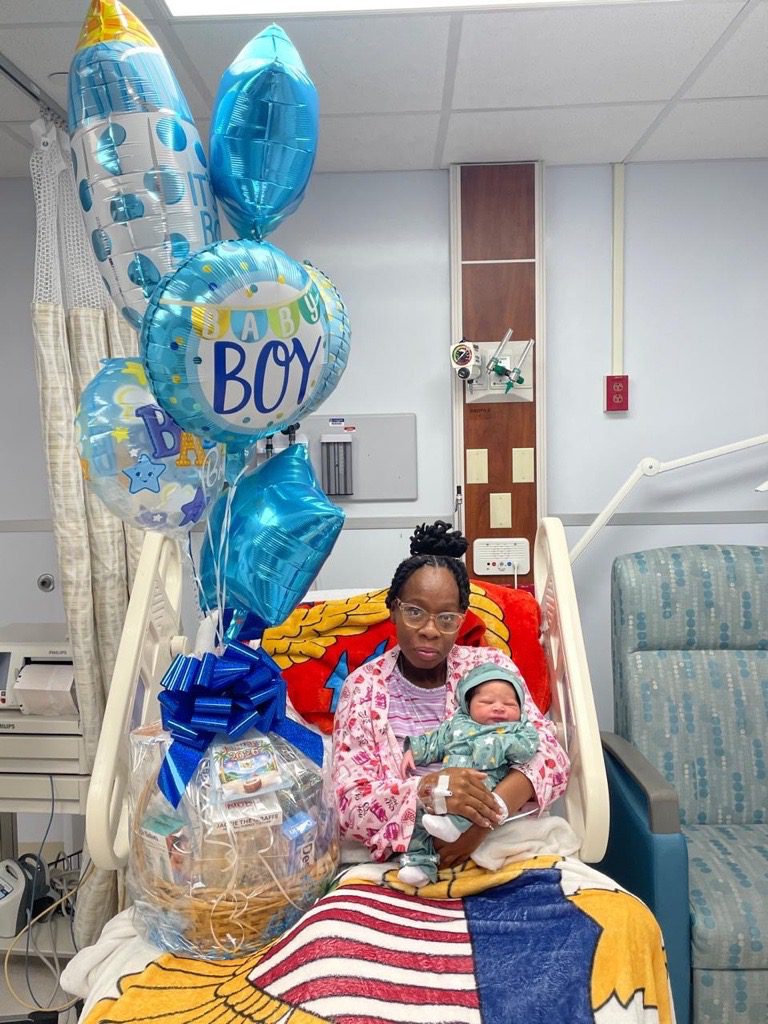
Juan F. Luis Hospital and Medical Center welcomed its New Year’s Baby early Thursday morning with the birth of Chosen Petersen, born at 3:35 a.m. Jan. 2, according to a hospital press release.
Chosen Petersen rests in his mother Chantik Griffith’s arms at Juan F. Luis Hospital and Medical Center after being named the hospital’s New Year’s Baby, born Jan. 2. (Photo courtesy JFL)
Chosen weighed 8 pounds, 2 ounces at birth. His mother, Chantik Griffith, said the experience of welcoming her first child in the new year was challenging but positive.
“It was rough, but I had a great experience,” Griffith said.
Griffith credited her mother, Diana Lewis, a JFL employee, along with Midwife Bruno and Nurse Hanley, for their support during the delivery, the release stated. While still recovering physically, Griffith said the experience has been emotional, noting this is her first child following a previous loss, the press release stated.
When asked to describe her newborn in one word, Griffith said lovingly, “Greedy.”
As part of the hospital’s New Year’s Baby tradition, Griffith and her son received a gift basket donated by Premier Baby Shop. They were also presented with matching Crucian hook bracelets from Sonya’s, with the bracelet given to Chosen designed to be adjustable as he grows, the release stated.
Griffith also thanked the hospital’s mother-baby staff for their care and support, the release stated.
Juan F. Luis Hospital congratulated Griffith and her family on the birth of Chosen Petersen and extended well wishes to them in the new year, the release stated.