

In rezoning 15.9 acres of St. Croix green space for medium-density residential use, the Senate added a “guardrail” amendment meant to only allow housing on the property. Although the measure prohibited most commercial uses commonly allowed by R-3 zoning, it explicitly allowed for building hotels — something residents of the sleepy Beeston Hill neighborhood called “stupefying,” Saturday.
The Virgin Islands Code allows many structures and activities in R-3 zoned areas not typically associated with housing, including amphitheaters, churches, convention centers, country clubs, garages, museums, schools, stadiums, sewage treatment plants, and much more.
In hopes of quelling outraged neighbors of the property — who fretted the landowner’s original plan to zone the area for businesses would bring noise, traffic congestion, and fundamental change — the Senate unanimously passed an amendment to the rezoning bill that limited use to a short list of housing-related activities: single and multi-family dwellings, apartment hotels, rooming and boarding houses, children’s homes, nursing and retirement homes, sanitariums, religious quarters, mobiles homes, as well as hotels and guesthouses.
Senators at Wednesday night’s Committee of the Whole meeting said the rezoning was to alleviate the territory’s housing crisis and never mentioned hotels would be allowed.
Atta Misbeh and brother Jihad Misbeh purchased the property zoned R-1, low-density residential, in late September 2022 and almost immediately attempted to change the zoning to B-3. Less than two months later, his plan for 24 condos in a mixed-use strip mall on the property was before the Senate.
Despite hundreds of signatures in an online petition and the Department of Planning and Natural Resources’ recommendation against rezoning, the Senate passed the rezoning measure in December, just over three months after the Misbehs purchased the land. Gov. Albert Bryan Jr. said the effort was the clear result of “special interests” and vetoed the bill.
Atta Misbeh altered the plan in 2025, asking for a B-2 zoning to help raise money for development. Former Senator and one-time DPNR Commissioner Alicia Barnes represented Misbeh before DPNR land-use experts, promising the landowner planned to only build housing-related structures. Neighbors were suspicious.
DPNR again advised the Senate against the rezoning, as did people living in the area and others. Crucian culture keeper Olasee Davis said the recently enacted Comprehensive Land and Water Use Plan specifically warned against spot zoning. He urged the Senate to adhere to the plan and DPNR’s recommendations.
“We know housing is needed. The question is whether commercial zoning is needed to accomplish it,” Davis told the Senate Monday.
That same day, Barnes told the Senate Misbeh would be willing to accept R-3 zoning if B-2 was unavailable.
On Wednesday, shortly before votes were taken, Senators Avery Lewis and Kenneth Gittens proposed the amendment to change the official wording of the bill from B-2 to R-3 with a provision that only allowed for residential use under narrow subsections of the VI Code. They said it would address many of the concerns other residents had about traffic and noise. It may not.
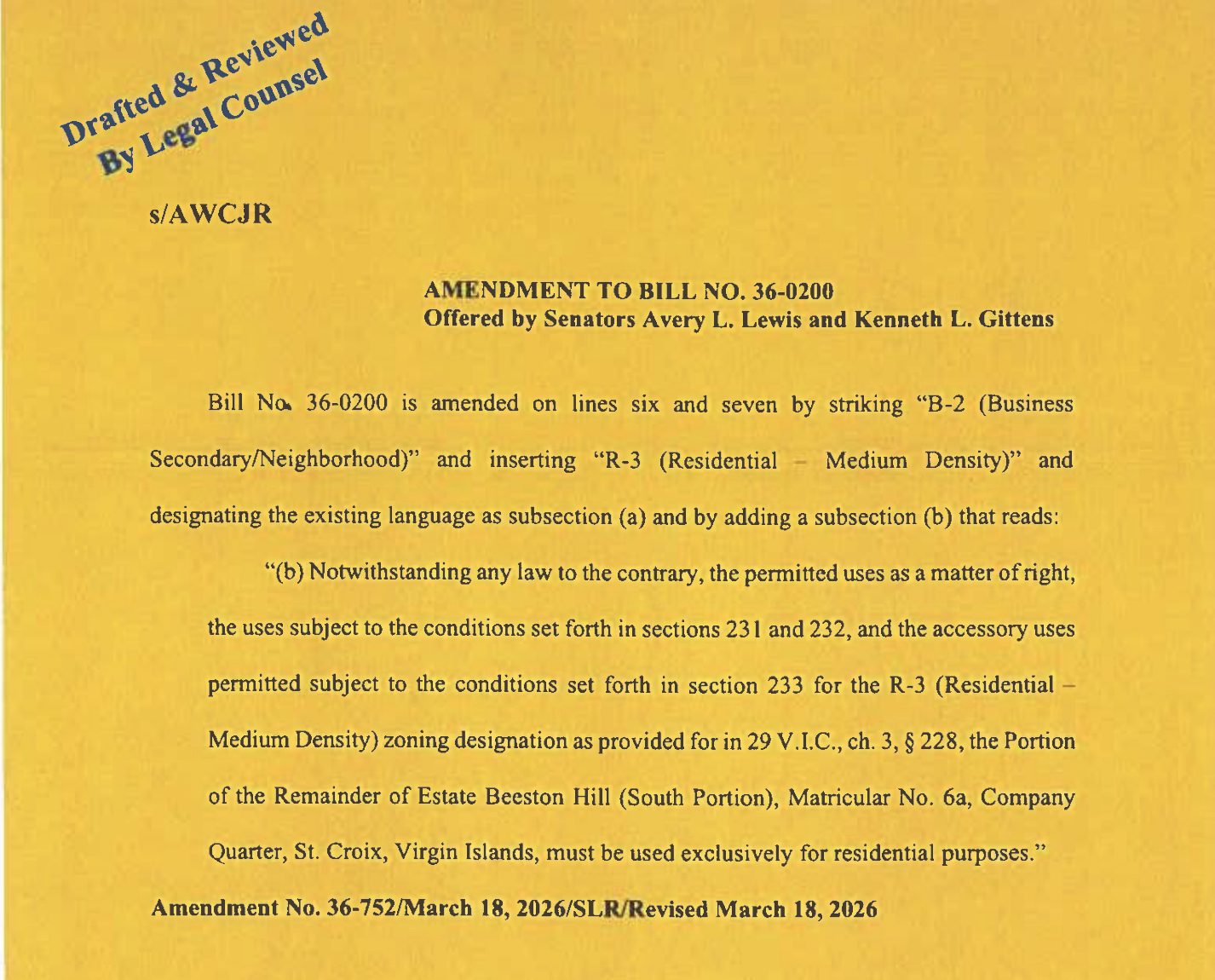
Even the narrow residential-only subsections of R-3 zoning rules allow broad options for massive development.
The law requires 35 acres of green space in R-3 zoning, which leaves Misbeh or future owners with roughly 10 acres to develop. With a maximum of 80 people living on any one acre in structures no taller than six stories, Misbeh could potentially develop accommodations for 800 or more people in the sparsely populated neighborhood.
Judith Lordi lives on an adjacent property and told the Source Saturday the idea of 800 people in six-story buildings or a hotel complex in the area was “stupefying.”
Attah Misbeh did not respond to emailed questions about his knowledge of what was allowed in an R-3 zone, nor his future plans for the property.
It was unclear when or if Bryan would sign the rezoning bill into law.