

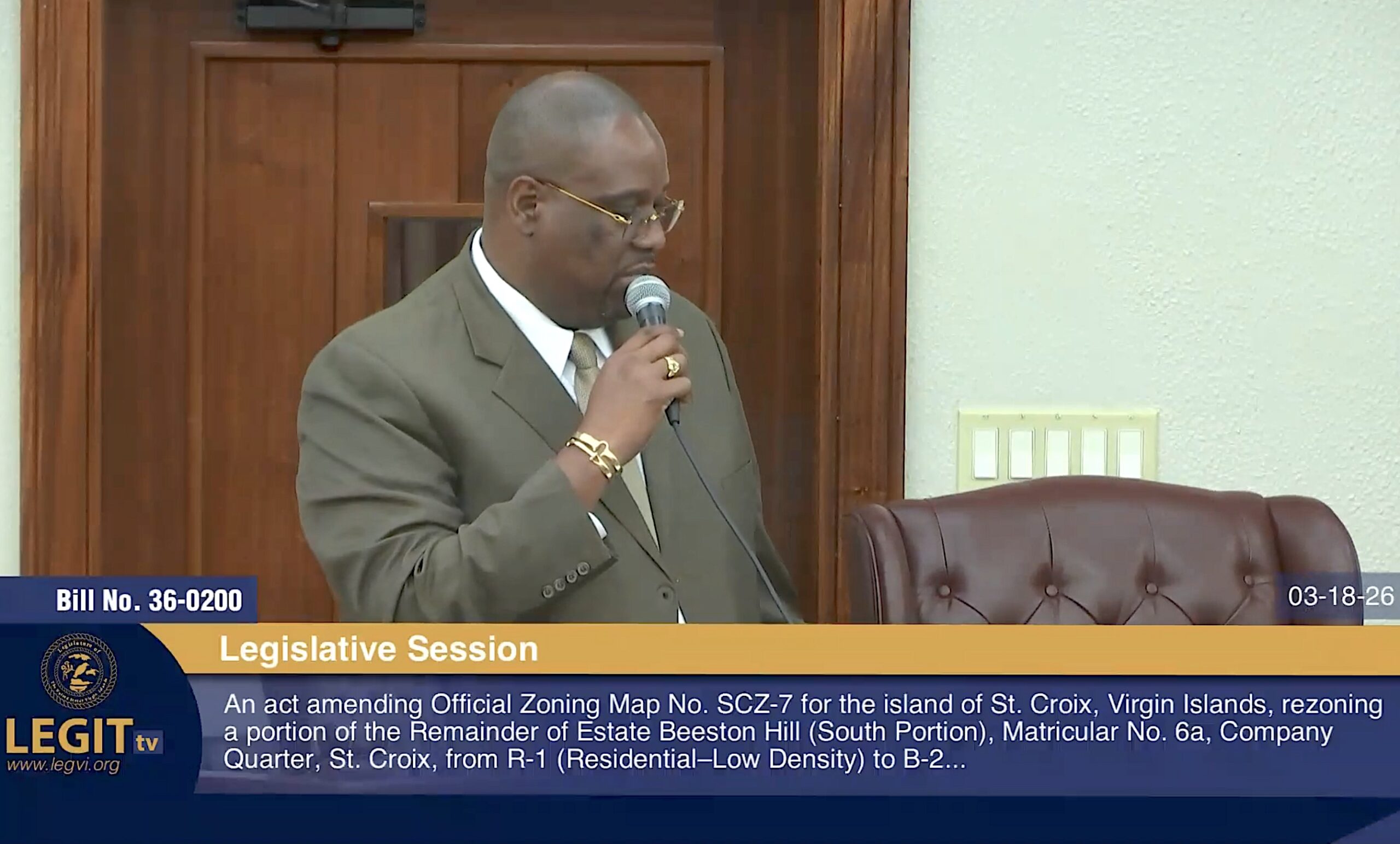
Lawmakers touted a compromise late Wednesday that allowed developers to rezone nearly 16 acres of St. Croix green space but still keep the area residential. The eleventh-hour amendment blocked developers from erecting commercial interests — but does allow for six-story buildings able to house 800 people in the sleepy neighborhood.
Senators said doubters of the plan were being antidevelopment and overly protective of the quiet, sparsely populated community. They said responsible development could ease the territory’s housing crisis.
Beeston Hill residents and neighbors writing to the Source Thursday insisted they were all for responsible development that complied with the comprehensive land use plan adopted just 15 months ago.
The Senate approving a plan not vetted by the Department of Planning and Natural Resources left them feeling betrayed, heartbroken, and distrustful of their government. If their neighborhood investments could be upended, whose are safe, people in Beeston Hill and other residential areas asked.
DPNR Land-use experts had repeatedly advised against rezoning the area from R-1, low-density residential, to allow for business use. Among the many reasons given were concerns about traffic flow, noise, and dramatic changes to the character of the area. The department had never investigated an R-3 rezoning.
The Virgin Islands Code specifically lists many uses not associated with housing as residential under R-3, including: amphitheaters, churches, convention centers and country clubs, garages, hotels, mobile homes, museums, schools, stadiums, sewage treatment plants, and much more.
The property owner, Atta Misbeh, had sought to change the zoning to B-3, allowing for a strip mall in 2022. Despite DPNR’s recommendation against rezoning, the Legislature approved the request, inaccurately painting dissenters as snowbirds and not actual Crucians. Gov. Albert Bryan Jr. vetoed the measure in 2023, telling the Source it smacked of “special interest.”
Misbeh tried again in 2025, this time asking the property to be rezoned B-2, neighborhood business. He said the designation was to help raise financing for condominiums and that he would not allow businesses on the property. Neighbors called it a ruse. DPNR advised against the plan in October 2025. But in February, despite DPNR’s report, Bryan himself suggested rezoning the property B-2 for housing.
In a hearing Monday, DPNR again advised against the rezoning. Territorial Planner Director Leia LaPlace-Matthew told senators the Comprehensive Land and Water Use Plan had strong emphasis on limiting spot zoning.
Representatives for Misbeh suggested R-3 zoning as an alternative.
The Senate moved debate on the measure to the end of Wednesday’s long agenda — when Sens. Avery Lewis and Kenneth Gittens proposed the amendment to change the official wording of the bill from B-2 to R-3 with a provision that only allowed for residential use.
Lewis seemed to take the rezoning personally and called Misbeh his “brother.”
“I have a brother that come here year in, year out with a piece of property right here. That boy try everything and neighbors don’t want him in the area. And I know that feeling. I see my mother cry, my family cry. And my brother try everything. And all they want, him to pay property tax and water the grass,” Lewis said. “I am for progress the correct way and that’s what we are doing here today.”
Gittens said he understood wanting to keep the neighborhood’s current charm, but urged embracing change for the greater good. He said the amendment addressed most of the neighbors’ objections.
“The concerns about capability within the surrounding residential area for character are valid and deserve some careful considerations, therefore the amendment that we put in is to address all — most — of those concerns there,” Gittens said. “I believe this adjustment strikes a more appropriate balance and it allows for reasonable development of the property while maintaining the use that is more consistent with the surrounding residential area there at Beeston Hill and responsive to the concerns raised.”
Some senators applauded Misbeh’s tenacity and willingness to adjust his plans — and had a harsher assessment for people who opposed it.
Sen. Novelle Francis acknowledged bulldozing the 15.9 acres of virgin green space would be a big change but a necessary one.
“We came up with a compromise for Beeston Hill. We know of the issue of NIMBY — not in my backyard. No one wants these major developments within their backyard but we do have a housing crisis here in this community,” he said.
Sen. Marvin Blyden felt likewise.
“I heard many suggestions and recommendations and no matter what came it was like, ‘not in my backyard. I don’t want that.’ That’s a problem also because here it is we’re talking about a housing crisis in the territory, homeownership opportunities, places for folks to rent and live with their families but those who have already are saying, ‘no, we don’t want you guys here.’ And that’s unfortunate and, in my opinion, unacceptable. We must learn to coexist. We must learn to live with each other and compromise,” Blyden said.
Sen. Kurt Vialet said the real controversy would be not building on the site. He lumped the rezoning in with a controversial bill to reinstate bush burning using new incinerator technology.
“Is it controversial to just sit and do nothing year in and year out and expect growth in the Virgin Islands? How controversial is it that we just sit here and we go spin wheels over and over and over for all those who are antidevelopment, for all those who don’t want to move forward in technology and then we rave about other island jurisdiction that are moving forward while we sit here and just spin wheel,” Vialet said.
Senators had long called DPNR’s recommendations a gold standard for zoning and other construction advisement, even suggesting the Legislature had no business weighing in. Beeston Hill resident David Doward, who testified at the hearing Monday, said he’d trusted the process and now felt betrayed.
“As a Virgin Islander and adjacent property owner, I feel the rug has been pulled out from under us. I had to reach out just to be allowed to testify, there was last-minute notice, and a new zoning amendment was introduced during the hearing without any advance warning. The process felt one-sided, and the safeguards that were promised as part of a compromise appear to be absent from what was ultimately approved,” Doward said.
He and other property owners had invested in the area, in part, because it was zoned low-density. Changing that, and the climate of the neighborhood, undercut their immediate and future interests, he said.
“I am also deeply concerned by the mischaracterization of residents, especially when the case for rezoning could not be supported on its own merits. For those of us who invested our savings based on existing zoning, this represents a major and unexpected shift in the character of our community,” Doward said. “If this can happen here, it can happen to any Virgin Islander, and that raises a serious question: Why would the next generation choose to come back and invest? I am left deflated, with a complete loss of trust in our government.”
Neighbor Judith Lordi said much the same.
“Do they wish everyone who wants a bit of privacy and quiet to live on a mountaintop? Beeston Hill has never excluded anyone who wanted an R-1 community. With spot zoning, no investment in housing is safe. DPNR sets the criteria for land use. If the government won’t listen to its own department, it’s like keeping a dog, but barking yourself,” Lordi said. “I feel betrayed by our lawmakers and our leaders.”
Beeston Hill resident Joan Kupfer said the legislation’s so-called guardrails against inappropriate development of the land were a mirage.
“By overriding DPNR’s expert recommendations, the Legislature is sidelining the very planning framework meant to protect communities, and rushing last-minute amendments without proper review raises serious concerns about transparency. Increasingly, it feels less and less driven by sound policy and more by who has influence — where connected interests are advanced ahead of the community that will live with the consequences,” Kupfer said.
She urged the governor not to sign the bill and return it to DPNR for proper vetting. But Kupfer thought the problem was far larger than the Beeston Hill residential area. New commercial districts rob established commercial districts of customers and innovative businesses, creating abandoned stores and blight.
“We are also seeing a troubling shift where mid-island commercial creep is pulling activity away from established west-side commercial areas, accelerating their decline and forcing residents to travel farther for everyday needs. Smart growth should strengthen existing commercial corridors — not abandon them while opening new ones,” she said.
“As Beeston Hill residents, we have been protective of this hillside for a reason. We have seen what happened at Barron Spot and Golden Rock, where legislative overrides of DPNR led to outcomes that forever changed those hills. Those are real examples where mistakes were made — and once protections are removed, they cannot be undone,” Kupfer said.
Hermon Hill resident Carey Guilbeau agreed the problem was larger than one chunk of land. If legislative spot zoning continued, what was the point of the long-awaited Comprehensive Land Use Plan, she wondered.
“Significant taxpayer dollars, time, and extensive public input from residents across the territory went into developing that plan,” Guilbeau said. “It’s disheartening.”
Like Doward, board members of the Maison de Poincy Condominium Association said they were caught off guard at the Senate meeting Monday, having not been notified of the suggested R-3 compromise beforehand.
“It was obvious, based on Monday’s Committee of the Whole meeting, that Mr. Misbeh and the senators had already agreed to a strategy of rezoning to R-3,” board members told the Source. “If this was to be a compromise, why weren’t the neighboring communities allowed to effectively have a voice on the R-3 issue?”
The condominium board had reached out to senators multiple times, they said, but never received replies.
“There has also been a misleading narrative that opposition came from only a handful of Beeston Hill property owners. A broader review of public comments, social media, and past input during the development of the Comprehensive Plan clearly shows this concern is much more widespread across the territory,” board members said.
The board wrote to Senate President Milton Potter Wednesday morning, beseeching him to vote against rezoning to B-2 or R-3. If rezoning to R-3 was the only option, they urged the amendment to specifically ensure language barring nonresidential use of the land stay with the acreage in perpetuity, meaning any future owners would have to abide by the same rules. The amendment contains no such language.