

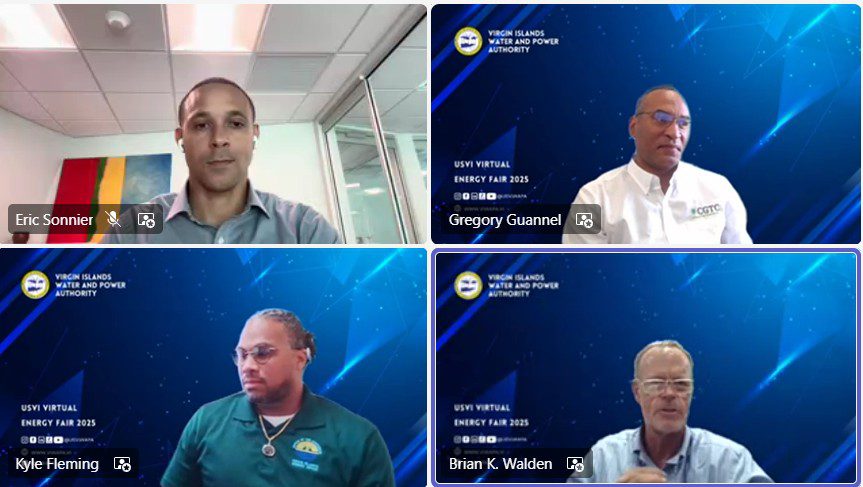
Movers and shakers from across the territory’s energy and construction sectors gathered Friday over the video conferencing platform Zoom to discuss renewable energy in the U.S. Virgin Islands during the V.I. Water and Power Authority’s “Virtual Energy Fair.”
WAPA Chief Executive Karl Knight said during opening remarks that the utility was about more than just maintaining the territory’s aging, troubled energy grid.
“We are about modernizing it, future-proofing it, and making sure that it meets the needs of the next generation of Virgin Islanders,” he said. “Reliability begins with maintaining the assets that we have while we transition to new generation — more efficient generation — while we transition to utilizing renewable energy resources.”
Knight said those efforts include building resiliency by moving some parts of the energy grid underground, conducting more vegetation management, and further developing the territory’s solar capacity to reduce fossil fuel dependency, lower emissions, and improve grid stability, “all while creating opportunities in clean energy careers and technology.”
The utility’s move to solar and battery projects includes the Petronella and Hogensborg solar farms unveiled on St. Croix this year. WAPA’s governing board approved energy storage service agreements for two more solar farms, in estates Bovoni and Fortuna on St. Thomas, in September.
“It still makes good sense to us,” Knight said of solar power at the time, “because we do not have a lot of indigenous resources, and we’re still very much dependent on the importation of fuel oil — and now propane. Having indigenous sources of energy are actually in our best interest for a variety of reasons. Foremost, we’re still a part of the country where we can produce solar power for less expense than our fossil fuel generation.”
The push toward more renewable energy also contrasts with the goals of the Trump administration, which has rolled back or eliminated programs like the $7 billion “Solar For All” initiative meant to make solar power more accessible and affordable for lower-income Americans. Multiple states, nonprofits and other groups have sued the U.S. Environmental Protection Agency over the program’s cancellation. More recently, the administration put what would have been among the largest solar projects in the world — the Esmerelda 7 solar farms in Nevada — in their crosshairs.
Panelists who participated in Friday’s energy fair discussed how residents and businesses can still implement solar options amid that backdrop. During one panel, Brian Walden, director of WAPA’s VIEnergize net energy billing program, asked Caribbean Green Technology Center director Greg Guannel to describe the challenges involved.
“The biggest hurdle is the cost. It costs a lot of money to do that, and I think that the second hurdle is clear communication — understanding the technology that you are getting,” he said, calling solar and battery solutions “something that requires a lot of attention and understanding.”
“Is it being done for just reducing a bill? Is it being done for having some form of energy security — resilience — when there’s some uncertainty with WAPA? Is it being done because … you really want to have energy at night?” he asked. “Really sort of communicating those, and then matching those various needs that the population has with what the utility can do, I think, is something that requires a lot of attention.”
A later panel focused on workforce development and retention. Sabrina King-Leonce, WAPA’s director of human resources, said that “anything that really touches our energy sector is in high demand.”
“We need everybody, from line workers to electricians, substation techs, individuals that are skilled in safety, protection, control, PV installers when you’re thinking about how we can support the territory’s clean energy push,” she said. “We’re looking for engineers, people that are skilled in power systems — I mean the list goes on.”
Rosalie Drago, vice president of external affairs and strategic engagement at frequent WAPA contractor Haugland VI, said more training opportunities are needed.
“And what we’ve been doing is trying to partner with local schools, and — we’re going to do this more — to take folks with no experience and get that hands on experience,” she said, adding that Haugland has also sent employees off-island to receive training. “But really what we need, if we want resilience and sustainability, is to bring training to the island so that there’s a consistent pipeline.”