

Gov. Albert Bryan Jr. was gathering leaders from the other U.S. territories to petition the Department of the Interior and the White House for an exemption to new U.S. Customs rules that ended duty-free treatment for shipments valued at $800, Government House said Tuesday.
The rule changes, laid out in President Donald Trump’s Executive Order 14324 in July and implemented Aug. 29, disproportionately affect people in the territories outside the U.S. Customs zone because so much commerce and daily life depend on overseas shipping, Bryan said.
“Families, students, seniors and small businesses in the Virgin Islands rely on small packages the way most communities rely on a corner store,” the governor said in a written statement. “They carry essentials, tools, and hope in a box. A targeted exemption recognizes that the same rule can weigh differently on an island. We can meet national enforcement goals without making everyday life harder for people who already pay more for distance.”
As the Virgin Islands prepared for the upcoming tourist season, small businesses said they’d struggled with the rule changes and their associated impact — slowing shipping, raising prices, and, above all, sowing confusion.
Kristin Wall, owner of Fish Face in Charlotte Amalie, invested heavily in a state-of-the-art website a few years ago that allowed her customers easy online browsing and shipping. The rule change upended that.
“We made a really big investment and it’s been paying off until now,” Wall said. “That investment will not pay off if we cannot ship internet sales.”
Like many Virgin Islands businesses, the bulk of Wall’s in-store customers are tourists boating or flying by for a day or two. Four or five times a week, she’s asked to ship fragile or oversized purchases to visitors’ homes, she said.
“We were finally recovering from Irmaria and then COVID, and now trying to deal with this. I support a lot of local artists, this is hurting many families,” Wall said. “One reason St. Thomas is such a great destination is due to our duty-free status. If we no longer have that, many more businesses will go under.”
Antiques dealers, art galleries, jewelry stores, and more said the new rules had been an off-season burden they hoped not to carry into the 2025-26 tourist season, just a few weeks away.
Confusion about the tariffs drove at least one St. John jewelry store to briefly take their website offline, removing a vital slow-season sales channel.
Another Cruz Bay perplexed jeweler soldiered through the changes, which included the recent implementation of the Zonos Prepay mobile phone app. The free fee-estimating application requires users to photograph items valued at less than $800 before Customs imposes the needed tariff.
As cumbersome as the app may be, said Ruby Taylor, an inventory administrator for Vibe Jewelry, it’s easy compared to the paperwork — and trip to the post office — needed for shipments of $800 or more.
“It’s definitely a lot of extra steps, especially if it is something over $800,” said Taylor, who started with the jewelry store about a week before the Customs change.
She also witnessed the added cost of even modest jewelry purchases.
“Let’s say you buy a product for $340, the tariff would be about $50,” she said, “not including shipping.”
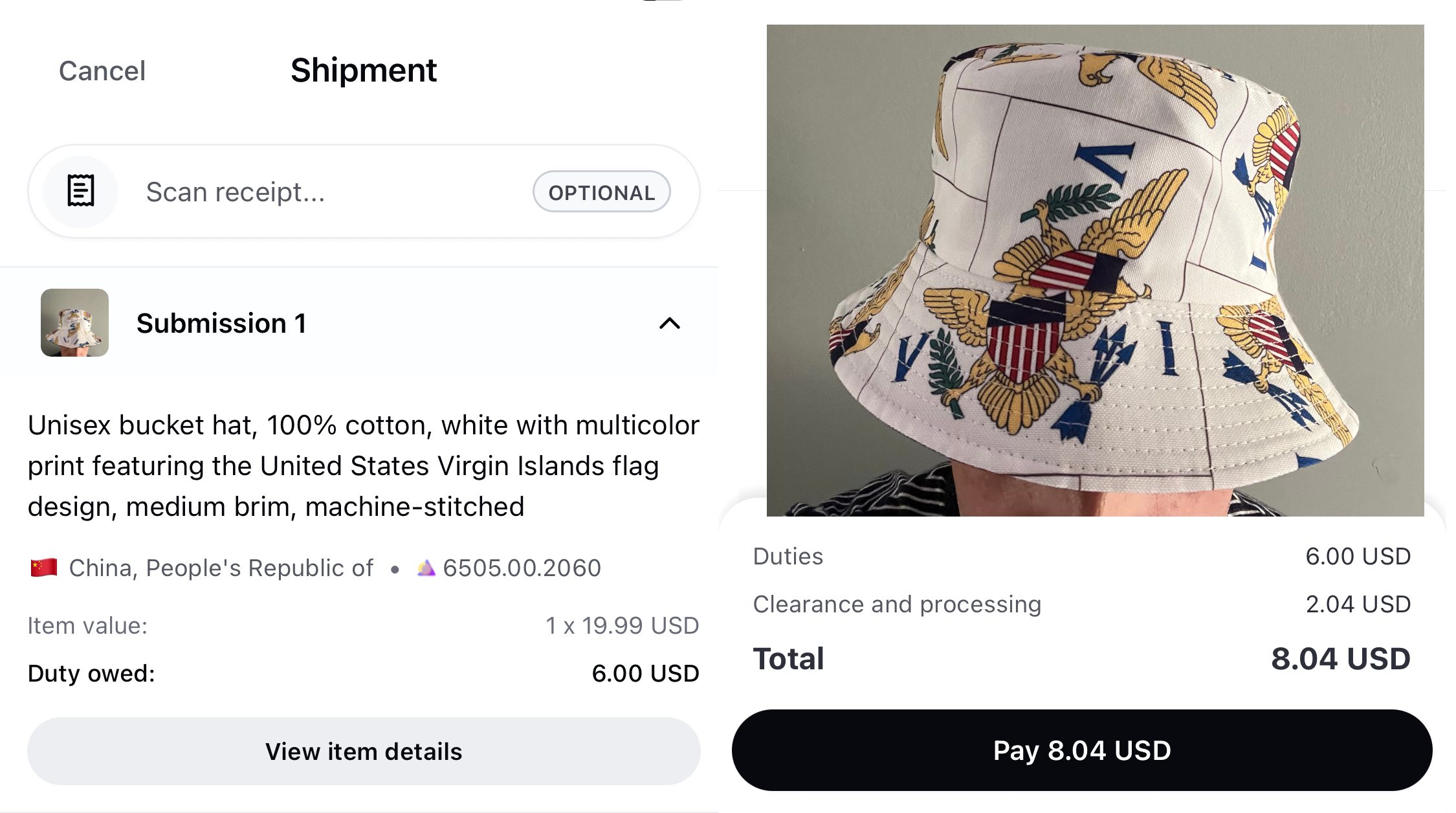
For items under $800, the Zonos Prepay application often defaults to tariffs levied against China. This puts a $6 duty on a $20 USVI flag novelty hat — and then adds more than $2 in clearing and processing fees. The $20 hat now costs $28.04.
In St. Croix, Crucian Gold owner Therese Trudeau said she and other small business owners were left guessing about what to do.
“There is no real clear instructions on how to navigate these new tariffs. We mail out packages on a daily basis from our store and have been given contradictory information regarding what to do when we speak to the US post offices,” Trudeau said. “Also, as territories of the United States, certain customs and duty exemptions have always applied to products manufactured, produced or grown in the USVI and Puerto Rico, so why did this change now?”
She said nearly all the local businesses, as well as individual people, rely heavily on shipping.
“I am also concerned about the increase in cost, which will unavoidably land on the greater community,” Trudeau said.
Kristin Wall agreed, saying online retailers were taking on “location surcharges” for anything ordered from the mainland.
“So instead of free shipping on Walmart Plus for $99 a year, I got hit with a $300 location charge on cat food and personal items I ordered. It’s a mess,” Wall said.
Other businesses, from jewelers to fishermen, worried the parts and raw materials needed were becoming more expensive or not available at all.
Hamblet and Shelley Williams, owners of Great Exploration Tours, said they’d been waiting on replacement parts for their tour vehicles for weeks. It’s added anxiety to preparation for the upcoming busy season.
“Normally parts would come in three days; now it’s been two weeks,” Shelley Williams said. “I think it’s really relevant to the operations of transportation because that’s a big part of tourism, right?”
Bryan said a “distinct customs framework” lets the territory calibrate costs for residents and businesses, coordinating enforcement closely with federal partners.
“This is a practical fix with human stakes,” he said. “It keeps the shelves stocked, the classrooms supplied and the wheels of our local economy turning.”
Congressional Delegate Stacey Plaskett suggested in September that if being outside the U.S. Customs zone was no longer a benefit to the territory, the governor could request the federal government initiate a change in status.
Bryan pushed back on the point, saying any change in Customs status was up to Congress.
“The customs status of the Virgin Islands is determined by Congress through federal law and administered by federal agencies, including the U.S. Department of the Treasury, the Department of Homeland Security, and U.S. Customs and Border Protection. The governing framework was established in the Tariff Act of 1930 and related statutes, and only Congress has the power to change it,” Bryan said
The governor said he would send a formal request this week to federal partners about an exemption to the shipping tariffs, and lead a territorial coalition to ensure the proposal reflects the realities of island life “without undercutting national policy.”