

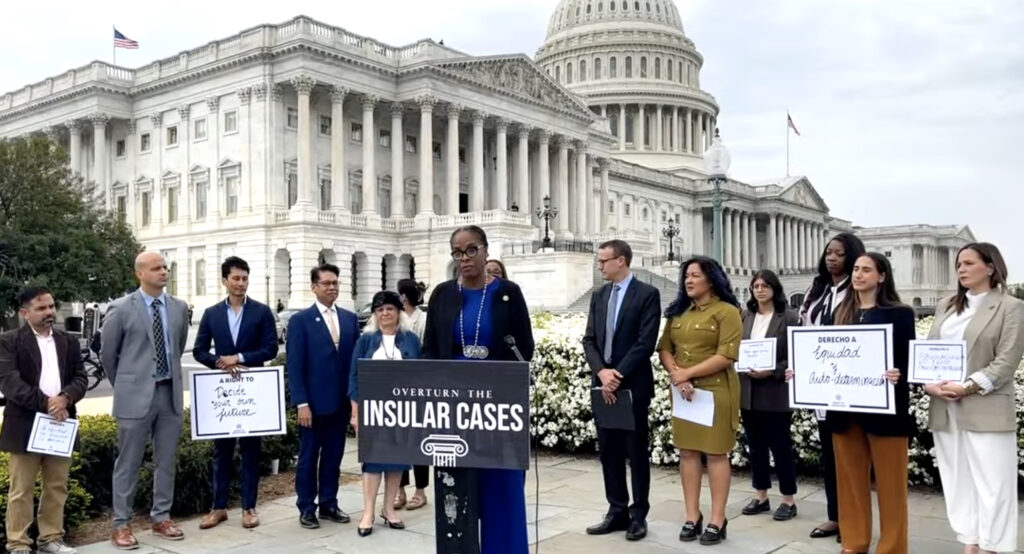
Delegate to Congress Stacey Plaskett and Gov. Albert Bryan Jr. sent letters to U.S. Attorney General Merrick Garland Wednesday asking that he disavow and stop defending a series of overtly racist early 20th Century Supreme Court rulings known as the Insular Cases.
Plaskett and others speaking on Capitol Hill Wednesday afternoon said a denunciation by the Department of Justice would be an important step to a Supreme Court reversal of the cases, which bar residents of the five U.S. territories from full citizenship. Describing the people of the territories as “half-civilized,” “alien races,” and “savage tribes,” the Insular Cases rulings block federal voting rights and birth-right citizenship, leaving Congress to decide if people born in the territories are Americans.
“In 2024, no one should use the racist language from the Insular Cases to deny citizenship rights to people born in U.S. territories,” Plaskett said.
Civil Rights activists and territorial representatives have been pushing for recognition and reversal of the rulings for more than 40 years, she said. A similar letter was sent in 2023 after the Supreme Court passed on hearing the Insular Cases in 2022.
“This is not a one-time issue. This is a problem of all of our modern-day administrations,” Plaskett said.
She called on President Joe Biden to apply his statement that there were no second-class citizens in the United States to the people of the Virgin Islands and other territories.
“It’s a central principle of American democracy that Americans, through their votes, can have a say in their government,” Plaskett said. “And yet, there are 3.6 million people who reside in one of the five U.S. territories — American Samoa, Guam, the Northern Marianas, Puerto Rico, and the Virgin Islands of the United States — who are denied their full constitutional rights and have been structurally disenfranchised for over 125 years.”
Neil Weare, co-founder and co-director of civil rights advocates Right to Democracy, said 42 House and Senate leaders joined Plaskett in calling on the U.S. Department of Justice to condemn and cease its reliance on the Insular Cases.
The congressional letter follows a filing by the Justice Department last month that stated “aspects of the Insular Cases’ reasoning and rhetoric, which invoke racist stereotypes, are indefensible and repugnant.”
Weare, also on Capitol Hill, said he wanted to know which aspects of the Insular Cases the Justice Department continues to embrace. Rejecting the disavowing other, similar racist rulings has led to corrective Supreme Court rulings, he said.
“DOJ action and recognition of a problem has then encouraged the Supreme Court to take action. And that’s what we’re hopeful of today,” Weare said. “Overruling the insular cases will not magically solve the colonial problems that the US has.”
In his letter to the Department of Justice, Gov. Bryan said he vehemently denounced the continued reliance on and defense of the Insular Cases.
“Virgin Islanders deserve to enjoy the full range of civil and political rights afforded by the U.S. Constitution,” he wrote.
It was the second recent letter from Bryan on the subject, having written Garland in March to mark Transfer Day.
“Unfortunately, upon our entrance to the United States, Virgin Islanders were not granted the full spectrum of constitutional rights afforded to other Americans. Instead, we were relegated to second-class status and treated as ‘possessions’ by the Supreme Court’s decisions in the Insular Cases,” Bryan wrote. “Following the 1898 Spanish-American War, the Insular Cases devised out of whole cloth the ‘doctrine of territorial incorporation,’ which allowed territories largely populated by people of color to be acquired and governed as colonies. These cases, decided by many of the same Justices who just a few years earlier blessed ‘separate but equal’ racial segregation in Plessy v. Ferguson, held that the Constitution did not apply in full to so-called ‘unincorporated’ U.S. territories, whose inhabitants could permanently be denied democratic rights and self-determination.”