

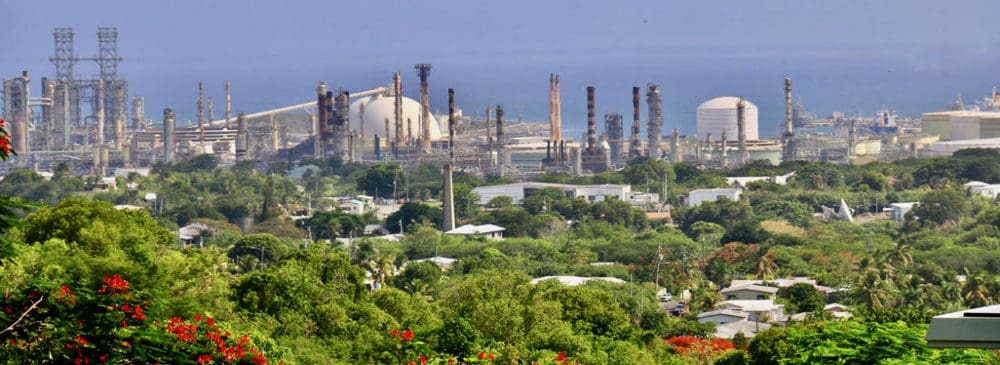
Former operators of the St. Croix oil refinery tried to back out of supplying water to people whose cisterns were poisoned with toxic emissions from the petroleum plant two years ago. It took District Court Judge Wilma Lewis less than a week to deny the appeal.
In May, Lewis ordered Limetree Bay Terminals to supply water to those who relied solely on cistern water in the vicinity of the oil sprays in 2021. In June, she added detail to the order, designating 34 neighborhoods west of the refinery as potential water recipients.
Attorneys for Limetree Bay, now known as Ocean Point Terminals, argued on Aug. 8 that giving water to people whose homes were coated with oil four times from February to May 2021 was too much of a financial burden for the company and would further public fear of contamination. They also said definitive proof was lacking that the oil spray caused harm. They also said now that the company no longer owns the refinery and has changed its name, distributing water would harm Ocean Point’s reputation.
“Plaintiffs have not provided any evidence that the properties of the thousands of unnamed residents have been contaminated with petroleum hydrocarbons released by the refinery or that any alleged contamination has caused cistern water to be unusable,” Limetree attorneys wrote in court filings. “Despite a sheer lack of any evidence of contamination and despite not having control over the refinery, or the flare from which the releases emitted, Terminals is now being required to establish a Water Distribution Program through which eligible residents are entitled to up to 12 gallons of water per day per household, with a maximum amount per household of 84 gallons of water per week.”
Limetree estimated thousands of St. Croix residents could sign up for the program, which could last several years.
“Terminals should not be required to pay millions of dollars in establishing, running, and maintaining a water distribution program to potentially thousands of households when there has been no evidence of a water or health crisis warranting such a program,” the attorneys told the judge.
Six days later, Lewis denied their call to stop water distribution to those for whom buying bottled water would be a hardship.
“First, the Court already discussed at length and rejected the premise of this argument — that there is no evidence of contamination,” she wrote in her Aug. 14 rejection of Limetree’s claim. “Second, Terminals’ suggestion that a water distribution program would ‘further add to’ the fear of a human health crisis is an implicit acknowledgment that such fear already exists on St. Croix. As with Terminals’ irreparable injury argument, the water distribution program would not be the first instance in which the community will be confronted with the alleged contamination. To the contrary, fear of the alleged contamination already exists …”
Lewis also rejected Limetree’s claim of repetitional harm: “Indeed, a connection between Terminals and the alleged water contamination is already a matter of public record in that Terminals, themselves, as well as government agencies and media networks have already published notices that connect Terminals to the alleged contamination.”
The judge’s previous orders, totaling 97 pages, already addressed Limetree’s other objections regarding the scope and cost of water distribution.
Limetree is represented locally by the law firm Beckstedt & Kuczynski in Christiansted. Its New York-based lawyers are Blank Rome LLP, a top 100 law firm according to The American Lawyer magazine. Top-ranked firms can command thousands of dollars an hour for their work and large retainers. The case against Limetree started June 9, 2021, and includes thousands of documents in 424 separate court filings.