


April is the month where the monstrous leatherback sea turtles (Dermochelys coriacea) come onto our shores to lay their eggs, particularly on the island of St. Croix. Some leatherback sea turtles do come in March, but when April arrives, we can say the season begins. Like the leatherback sea turtles, one of our rarest, beautiful wildflowers in the Virgin Islands, known as Watapama or Wattapania (Sabinea florida), which loves our dry weather, comes into bloom.
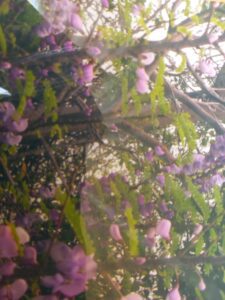
This small native deciduous tree reaches 12 to 20 feet tall with a trunk 2-4 inches in diameter. Sometimes the tree can reach 40 feet high with a trunk up to 8 inches, and long slender spreading branches. The flowers have a slender stalk about one-quarter to half an inch long and sometimes could be single.
Watapama has a bell-shaped purple calyx about 3/16 of an inch long and minutely five-toothed. It has five pale purple, lavender or blue petals nearly 7/8 of an inch long which are stalked at the base. The Watapama tree flowers mostly from January to March, with mature fruits in spring (April) and summer. In 1793, the plant was described botanically when it was discovered on the island of St. Thomas.
In the dry season also, the Tibet (Albizia lebbek) has not a leaf on her, except for the bright, crisp yellow seed pods rattling in the wind on a dry thirsty land. The dry pods appear in March and into April where trees begin to flower waiting for the spring rain to come. The Tibet tree is also known locally as Women’s Tongues.
The late native naturalist George A. Seaman mentioned this about the Women’s Tongues tree in a poetic expression.
Women’s Tongues
Women’s tongues!
I presume that you will wonder,
Vainly ruminate and ponder,
(If you have a chance between the clouds of dust and heat)
How these carefree, happy people,
With their toy fort and their ‘steeple’,
(Now you stop to query if there are jiggers in your feet)
Could have named so well a tree,
With a failing wide and free:
Women’s tongues!
Women’s tongues!
From the first dawn-peep they rattle,
Purr of love and song of battle,
(Oh, how like those ladies that you left behind at home!)
Multiplying note on note,
Till the whole bright world’s afloat,
(White or black or yellow they will dog you where you roan)
With calumnius exhibit
From the branches of the thibet —
Women’s tongues!
As I explained the other day to a group of hikers as we were hiking to the highest peak on St. Croix — Mount Eagle on the Great Northeast Central mountains range of Maroon Sanctuary Park — they felt much cooler as we climbed to the summit. St. Croix is the largest of the U.S. Virgin Islands with about 54,400 acres, or 85 square miles. St. Thomas and St. John could fit into St. Croix comfortably, and still have land to roam.
Unlike the other two Virgin Islands, St. Croix contains three dominant kinds of landscapes. The northwest is mountainous, with the highest peak being Mount Eagle. The eastern part of the island is hilly, but the elevation is lower than the northwest and northeast central part of St. Croix. The middle part of St. Croix is generally covered with a large plain and slopes from the north, west, and central mountains range, dropping to the south shorelines.
Nonetheless, the absence of higher mountain peaks on the island, for example let us say 2,000, 3,000, or 4,000 feet above sea level, makes a difference in the climatic conditions of the weather system. The northwest and northeast central mountain ranges are not high enough to catch and lift the cool air and humid trade winds from the Atlantic Ocean, thus the climate of St. Croix is considered a semi-dry tropical island.
Whereas the island of Saba, for example, is only five square miles, with a peak of over 2,000 feet above sea level. The vegetation and climate are much different in the higher elevations of Saba than on any high peaks in the Virgin Islands. Therefore, the temperature and precipitation distribution across St. Croix makes a big different in the climatic conditions of plants and animals. The northwest and northeast central mountainous range is the wettest on St. Croix due to the topography elevation.
This has a lot to do with our dry season and what time in the year it occurs. However, there are great variations in the quantity of precipitation from year to year, particularly in the mountain range on the north side of the island. With that being said, the lowest precipitation is in March and the highest from September to November. Our rainy season is from May to November, typically, and the dry season is from December to April. However, the coolest time of the year is in the dry season (winter months).
Because of the island being relatively low and with variable amounts of precipitation, drought occurs sometimes, which is a natural phenomenon of the wet and dry season on St. Croix. Oftentimes, the rain is short and torrential with powerful showers that, combined with constant trade winds and high temperature, results in high levels of evaporation and transpiration that causes dry spill to occur on the island from time to time.
As a result, from June to November the warm humid trade winds from the Atlantic Ocean blow constantly, while on the other hand, the period from December to May features cool north-westerly winds from the North American continent. Hurricanes usually occur from August to October, occasionally. However, these storms can occur earlier, but this is not common due to our geography, topography, meteorology, and ecological location in the northeastern Caribbean archipelago of the Lesser Antilles.
These climate conditions also apply to the other Virgin Islands but are different due to their topography and location in the Caribbean region. With this brief introduction of climate and geography, I hope you understand the dry and wet season of the Virgin Islands. The bottom line is, we all are impacted by the climate — culturally, agriculturally, and the season of the island’s meteorology.
— Olasee Davis is a bush professor who lectures and writes about the culture, history, ecology and environment of the Virgin Islands when he is not leading hiking tours of the wild places and spaces of St. Croix and beyond.
Editor’s Note: Opinion articles do not represent the views of the Virgin Islands Source newsroom and are the sole expressed opinion of the writer. Submissions can be made to visource@gmail.com.