

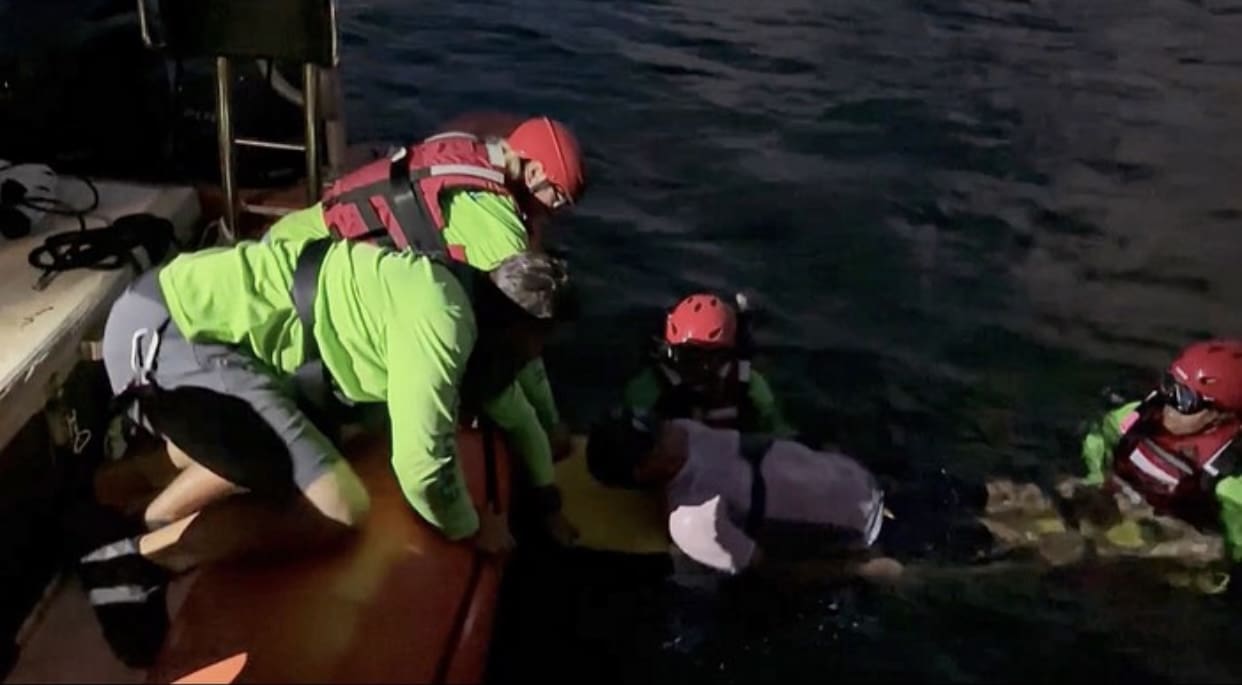
St. John Rescue — neighbors helping neighbors
Our dedicated responders take time out of their daily routine to answer the call for help because we love providing the best emergency medical services to the people of St. John.
Our Mission
St. John Rescue is a volunteer organization dedicated to saving lives, providing community education, and building a better way of life for the people of St. John.
Our Story
St. John Rescue, a nonprofit organization, was incorporated on Nov. 30, 1996 after several volunteers met monthly under a black olive tree for a year following Hurricane Marilyn in 1995. We are an all-volunteer organization on the small island of St. John, dedicated to providing emergency rescue and medical support services to local emergency medical services, police, fire, National Park, and health clinic personnel. After hurricanes Irma and Maria in 2017, St. John took the lead in coordinating the many emergency response agencies that arrived on island and conducted an island-wide search to find residents who needed help
Frequently Asked Questions:
Q: Who is the chief of St John Rescue?
A: Sonia Innocent is the chief of St. John Rescue. Sonia is a nationally registered Advanced EMT who is employed by V.I. Fire and Emergency Medical Services. She volunteers as chief when she is not working with VIFEMS.
Q: What are the qualifications for being chief?
A: To qualify for the position of chief of St. John Rescue a person must be a member of St. John Rescue, be nationally registered and locally licensed as an EMT or higher, must be a resident of St. John, and hold a valid V.I. Driver’s License.
Q: What are the chief’s duties?
- Supervises and coordinates rescue activities in order to save lives and decrease morbidity;
- Works to maintain a seamless operation within the squad and among other agencies;
- Responsible for oversight of all personnel, equipment, apparatus, and facilities;
- Oversees training of rescue squad personnel;
- Maintains discipline and control to ensure effective use of department human resources in order to ensure optimal utilization of all personnel;
- Ensures that St John Rescue is in compliance with organizational and territorial policies and procedures;
- Exercises leadership and motivate rescue personnel to incorporate St. John Rescue’s mission and goals for quality service;
- Oversees the maintenance and operation of the organization’s equipment, apparatus, and facilities to ensure operational readiness;
- Safely operates all apparatus and vessels;
- Follows all EMS regulations and protocols and ensures compliance with all EMS regulations;
- Performs patient care effectively;
- Directs all St. John Rescue emergency or non-emergency operations;
- Interacts with citizens, community/civic groups, and other local agencies;
- Demonstrates extensive knowledge of rescue/EMS practices and procedures;
- Efficiently plans and directs the use of personnel and equipment;
- Clearly and respectfully communicates performance expectations and maintains discipline and control in a respectful manner;
- Enacts disciplinary procedures as outlined in the bylaws and SOP’s of ST. John Rescue;
- Prepares an annual budget for medical supplies and motorized equipment;
- Ensures that vehicle Trip Reports, Patient Car Reports, Incident Reports, and any pertinent documentation are properly completed and entered into St John Rescue database;
- Coordinates development of personnel recruitment and retention;
- Oversees radio communication practices and equipment;
- Develops quality improvement strategies in order to provide seamless responses to all requests for assistance;
Q: When I dial 911 from a land line or 340-776-9110 from my cell phone who answers the call?
A: Your call is answered by an operator at the 911 call center located in the VITEMA building adjacent to the airport on St. Thomas. The call taker will ask you a few questions about your emergency and if it is a police, fire, EMS, marine, or National Park issue.
Once your information is taken the appropriate agency will be dispatched to the location you provided.
Please make it clear to the operator that your emergency is on St. John and provide detailed directions to your location. In addition, assign someone to be waiting outside to direct the responders to you.
Q: What type of call does St. John Rescue respond to?
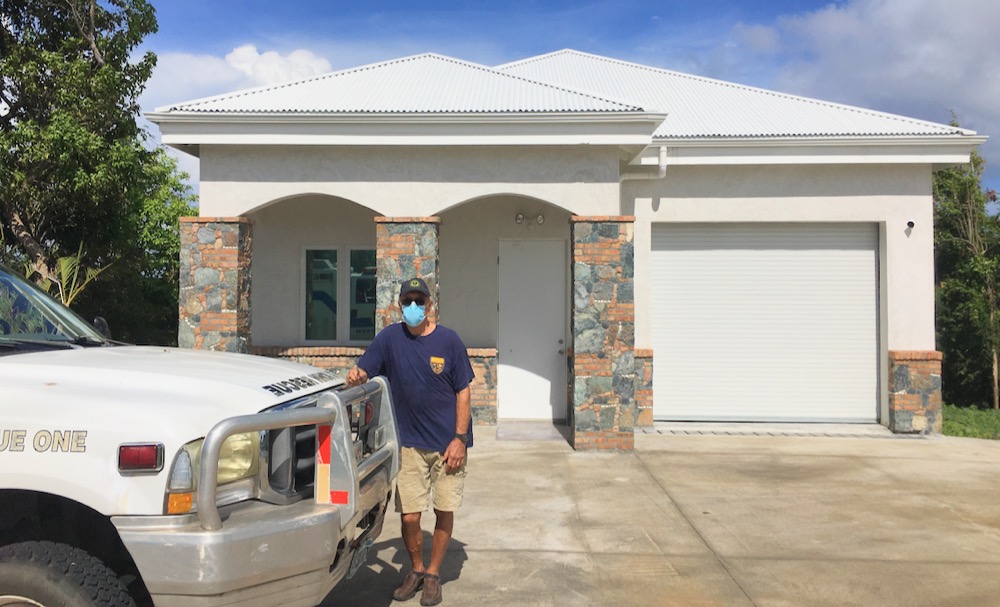
A: St. John Rescue responds to calls for assistance on land and on the sea. We operate four vehicles and two rescue boats. When we receive a call from 911 our units are deployed to the scene.
St. John Rescue works with FEMS, NPS, VIPD, VITEMA to compliment their response capabilities.
Q. Are St. John Rescue responders trained?
A. St. John Rescue responding members are nationally certified as either Emergency Medical Responder, Emergency Medical Technician, Advanced Emergency Medical Technician, or Paramedic. We follow a strict local and national training regimen.
Q: Are St. John Rescue responders paid?
A: All our responders are volunteers. However, our executive director, Valerie Boysen, is paid and is available at our headquarters Monday through Saturday from 9 a.m.-5 p.m. She is also a volunteer responder.
Our director of training, Brett Huntley, is a paid contractor. His duties include establishing and operating the St. John Rescue Training Center, scheduling regular training sessions, providing classes that members can attend to renew their certifications. Huntley is also a volunteer responding paramedic.
Q: What happens when I call 911?
A: Once you make a call to 911 you should make sure that the responders will have access to your location. If you are disabled and cannot get to the door to let the responders in tell the dispatcher at 911. Then give the dispatcher instructions as to how you want the responders to get in.
If you have pets, please secure them a room for their safety and the safety of the responders.
Can the responders see your house numbers from the road? Are the outside lights on? Did you give 911 information that will make it easier for responders to find you?
Hurricane Personal Preparedness
Before the storm hits …
It’s human nature to puts things off. We all tend to do it. But when it comes to preparing for a hurricane, you can’t wait. When the forecasters start talking about an impending storm, water, batteries, food and other essential items start flying off the store shelves. Make plans now. Gather the items for your disaster supply kit today! Don’t wait until it’s too late.
Have a plan!
Evacuate or stay put? Every situation may be different, but have a plan set. If you are going to evacuate, know where you are heading. If you are going to stay, do you have a safe room or shelter prepared in your home? Find out where the shelters will be located and if you need to register before arriving. If you have pets, how will you take care of them?
Personal Preparedness Checklist:
Develop disaster and first aid supply kits
Store loose outdoor items such as furniture
Prune trees of weak or dead branches
Place vital documents in waterproof containers
Remove and secure valuables
Develop a plan for handling your pets
Register physically challenged persons with disaster management authorities
Become familiar with the evacuation and disaster plans for St. John
Prepare a safe room in your house
Set a family meeting place
Make an inventory of your home’s contents with photos
Check your insurance coverage
Develop a communication plan with friends and relatives, both on island and stateside
Have plenty of cash on hand, preferably in small bills.
If you have a generator, make sure you have plenty of fuel and it is operable
Make sure your window screens are in good shape
Locate your storm shutters and make sure they are ready to be installed
Disaster Supply Kit
Prescription medications
Basic first aid kit
Cell phone with charged battery
Solar powered battery charger
Non-perishable food
Toiletries, hygiene supplies, toilet paper
Drinking water/containers
Flashlight and batteries
Portable radio and batteries
Plastic dinnerware, plates, cups, etc.
Manual can opener
Tarps
Basic tool kit
Duct tape
A variety of plastic containers and lids
Clothing and rain gear
Bug spray
Food and medicine for your pets
Anything you “Can’t Live Without”
Staying in Touch
Following a hurricane or earthquake, staying apprised of information via local radio and television stations is essential in helping you and your family recover. Websites are also an important link. Check them out before an emergency: www.vitema.gov and radio station WSTA are good places to start.
If you are aware of someone with special needs, please contact Human Services for assistance before an emergency is at hand.
Q. If I choose to go to a shelter; what supplies should I bring?
A. Blankets, pillows and sleeping bags. Basic toiletries, extra clothing, battery operated radio and flashlight. Personal items, including books and magazines. Important papers, such as a valid identification.

STROKE: A little knowledge can help!
Q. What is a stroke?
A. Damage or death to part the brain caused by a lack of blood and oxygen to that portion of the brain. This can be caused by a clogged vessel or a burst vessel.
Q. What are stroke risk factors?
A. Increasing age, gender, race, family history, previous stroke, high blood pressure, diabetes, smoking, high cholesterol, obesity, and heart disease.
Q. Why should I be concerned?
A. Stroke is the third leading cause of death in the U.S. behind heart disease and cancer. There are 700,000 strokes annually, and 165,000 stroke deaths annually. Stroke is the leading cause of long-term disability in the U.S. Will your insurance cover stroke care?
Recognizing a Stroke
If you think someone is having a stroke, perform a simple three-step test:
Ask the person to smile. Is there any facial droop? Is the smile even?
Ask the person to close their eyes and raise both arms and hold them out. Does either arm drift downward?
Ask the person to say: ”You can’t teach an old dog new tricks.” If the words are slurred that is a potential sign of a stroke.
What should I do?
If you think someone is having a stroke call 911 or 340-776-9110 immediately. “Time is brain.”
Reduce your risk of stroke
Have an annual physical
Eat a healthy diet
Be aware of family history
Maintain a healthy weight
Quit smoking
Check your blood pressure frequently
Check your cholesterol levels
Exercise often as possible
Manage blood sugar levels
Preventing Falls Among Seniors
Falls are not just the result of getting older. Many falls can be prevented. Falls are usually caused by a number of things. By changing some of these things, you can lower your chances of falling:
- Begin a regular exercise program. Exercise is one of the most important ways to reduce your chances of falling. It makes you stronger and helps you feel better. Exercises that help improve your balance are the most helpful.
- Make your home safer. Remove things that you can trip over. Keep areas where you have to walk clear
- Remove small throw rugs.
- Have grab bars installed near your toilet and in the bath or shower.
- Use non-slip mats in areas where the floor may be wet
- Improve lighting in your home
- Install handrails on stairs
- Wear shoes that offer good support and have non slip soles
- Have your vision checked by an eye doctor
- Don’t be afraid to ask for help — particularly if you are walking in an unfamiliar area. An ounce of prevention is worth a pound of cure.
Do You Have an Advanced Directive?
(Living wills, health care surrogates and Do Not Resuscitate Orders)
Q. How do I make a Living Will or designate a Health Care Surrogate?
A. There are several sites on the internet that will allow you to download the appropriate forms to make a Living Will or designate a Health Care Surrogate. While you don’t need an attorney to prepare either document, you should consider contacting an attorney to ensure that your rights are properly covered.
Q. How do I get a Do Not Resuscitate Order?
A. Because a DNRO is a physician’s order, you must see your primary physician. He/she should be able to provide you with the proper forms. You can also download the forms from the internet. It must be signed by a physician.
Q. What is an Advanced Directive?
A. An Advanced Directive tells your physician (or EMS) what kind of care you would like to have if you become unable to make medical decisions for yourself. Advanced Directives describe the kind of treatment you would want depending upon how sick you are. In short, you get to make decisions about your health- care before the health care crisis happens.
Q. What is a Living Will?
A. A Living Will lets you state your wishes about medical care in the event that you have an end-stage condition, become persistently vegetative, or develop a terminal condition and can no longer make your own medical decisions. You get to decide, in advance, what medical care you receive — or not receive — even if you cannot speak for yourself.
In a Living Will you may give specific instructions such as refusing specific treatments by listing these treatments. For example: “If at any time I am incapacitated and have a terminal condition, or have an end-stage condition, or am in a persistent vegetative state and if my attending physician and another consulting physician have determined that there is no reasonable probability of my recovery, I direct that life-prolonging procedures be withheld or withdrawn. I will be allowed to die naturally with only the administration of medication or the performance of any medical procedure deemed necessary. To provide me with comfort care or to alleviate pain.”
You can revoke a Living Will at any time you feel the document no longer reflects your wishes.
Designation of a Health Care Surrogate
This allows you to name someone to make decisions about your medical care — including decisions about life support — if you can no longer speak for yourself. Think carefully about whom you choose. Your surrogate needs to be an individual whom you trust and are certain will act in your best interest. You can revoke your designation at any time.
Do Not Resuscitate Orders
The DNR allows the end of life patient to direct all health care professionals to withhold cardiopulmonary resuscitation (CPR) including artificial ventilation, cardiac compressions, endotracheal intubation, and/or other defibrillation if your heart stops or if you stop breathing. A DNR order is a medical order written by a physician and signed by you.
A paramedic must follow a properly executed DNR order if it is presented to them. This document must be signed by a physician and by you. You may download a DNR from the internet.
To learn more, visit St. John Rescue’s website.