

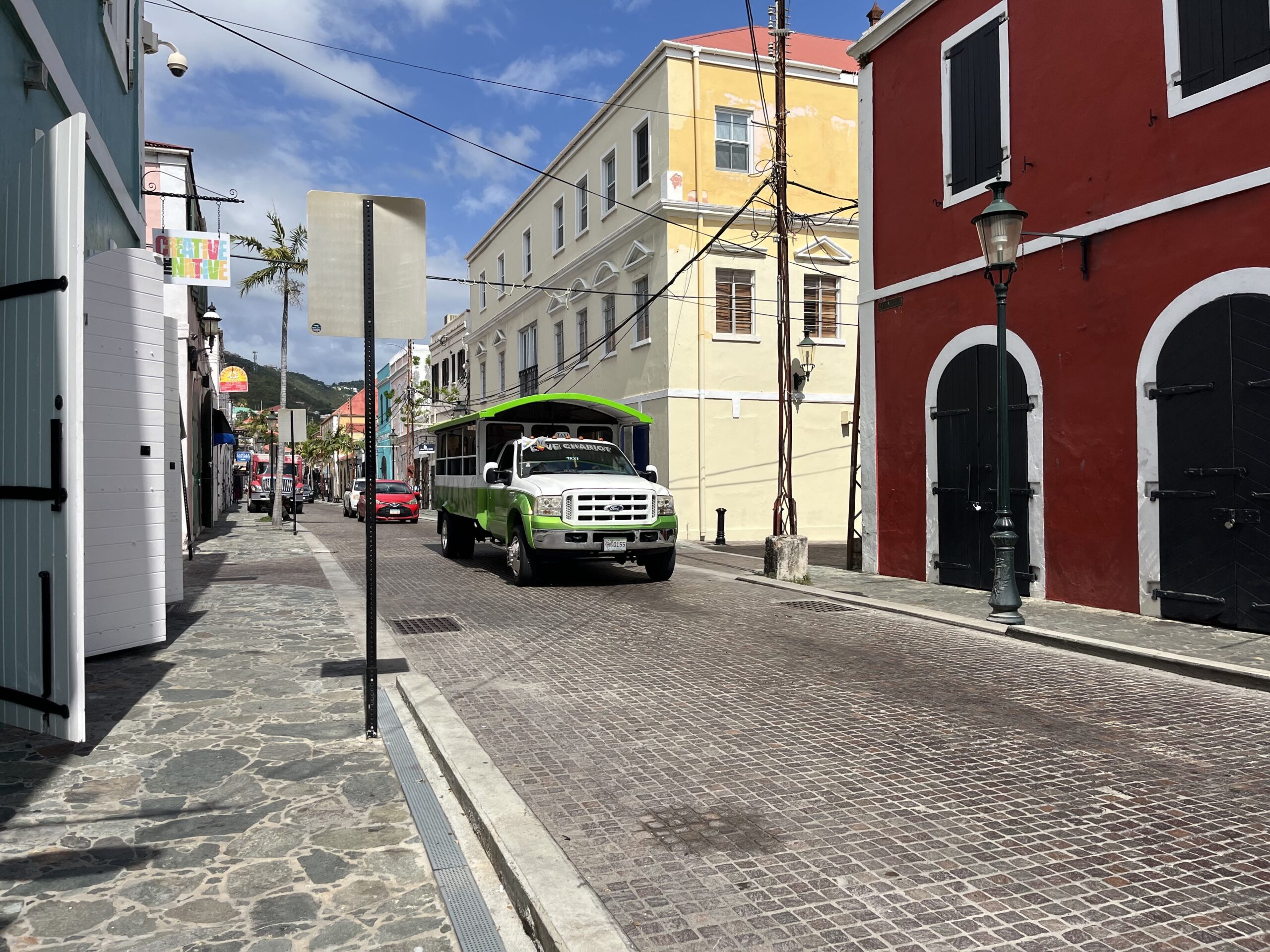
It took more than five years and $15.3 million to beautify Charlotte Amalie’s busiest tourism corridor, creating a stunning visual improvement that is also in violation of federal accessibility laws, government House officials confirmed Monday.
The Main Street Enhancement project, which swapped out cracked concrete and blistering asphalt for irregular stone sidewalks and cobblestone roadways, began in November 2015 and wrapped up in May 2021. Complaints soon followed, said Sen. Ray Fonseca at a meeting of the Senate’s Committee of Budget, Finance, and Appropriations.
“The sidewalks are made of stone and they’re not level stone,” Fonseca said. “I just went out there now and about 25 percent of them have puddles in them. I’ve gotten many complaints from the workers on Main Street that you can’t wear high heels. You’re breaking your heels and it’s tripping.”
More than beating-up shoes, the sidewalks are not Americans with Disabilities Act compliant, said Julien Henley Sr., the territory’s ADA Coordinator.
“They were supposed to have, in a project like that, 36 inches in the middle of it that was smooth surface. And they didn’t,” Henley said. “There’s no correction for it.”
Efforts to upgrade downtown Charlotte Amalie’s appeal have gone on as long as this newspaper has been publishing. The large, recent push came with federal money to revitalize nearly the entire area. Previous efforts had sought to update the area popular with tourist piecemeal.
The project was delayed by two hurricanes and the COVID-19 pandemic. Henley wasn’t named ADA Coordinator until 2019, too late to steer it toward compliance, said Karl Knight, Gov. Albert Bryan Jr.’s chief of staff.
In 2013, tourism officials were looking to attract more tourists with disabilities by increasing accessibility and training tourist-facing workers, like taxi drivers, about their responsibilities to disabled guests. Tourists with disabilities come to the U.S. Caribbean territories because of the 1990 Americans with Disabilities Act, a sight-impaired visitor downtown with her guide dog told the Source in 2011. Other islands may not have laws ensuring wheelchair ramps and wide, smooth sidewalks.
Calling the situation vexing, Sen. Donna Frett-Gregory said something had to be done.
“The American Disabilities Act was in place long before that project started,” Frett-Gregory said. “You can’t change the whole street but there should be an assessment and a determination as to what we can potentially or possibly do to right correct that area.”
More than tourists’ dollars, being ADA compliant was a fairness issue, she said.
“It gives an appearance of a level of discrimination,” Frett-Gregory said. “You don’t want folks coming to visit the Virgin Islands who are challenged with disabilities and feel like they can’t come back here because we didn’t make just that — it’s minor — adjustment so they are able to traverse the town of Charlotte Amalie.”
Knight said the Public Works Department and other stakeholders were much more cognizant of ADA compliance in public projects now. For example, plans for the renovated Vendor’s Plaza were altered after Henley’s objections.
“There’s now a sensitivity within the Department of Public Works,” Knight said. “Moving forward, I think we are addressing the problem. As for Main Street, I do think there is an ability to fix it. It will require some funds, but there is a point in time when we need to go back and revisit that project and make it ADA compliant.”
Knight and other members of Bryan’s team were at the Senate to present their budget proposal.
Government House requested $14,015,824 to fund its operations in 2025. Bryan asked for $1.225 million for “miscellaneous and special activities.” The Governor’s Office, the Bureau of Economic Research, the Office of Health Information Technology, and the Office of Gun Violence Prevention employ 86 people with another 10 positions open, Knight said.
One key position open within the Office of Gun Violence Prevention on St. Croix was someone to interact with at-risk youth. Knight said they were looking for just the right person — someone young people would trust and listen to.