

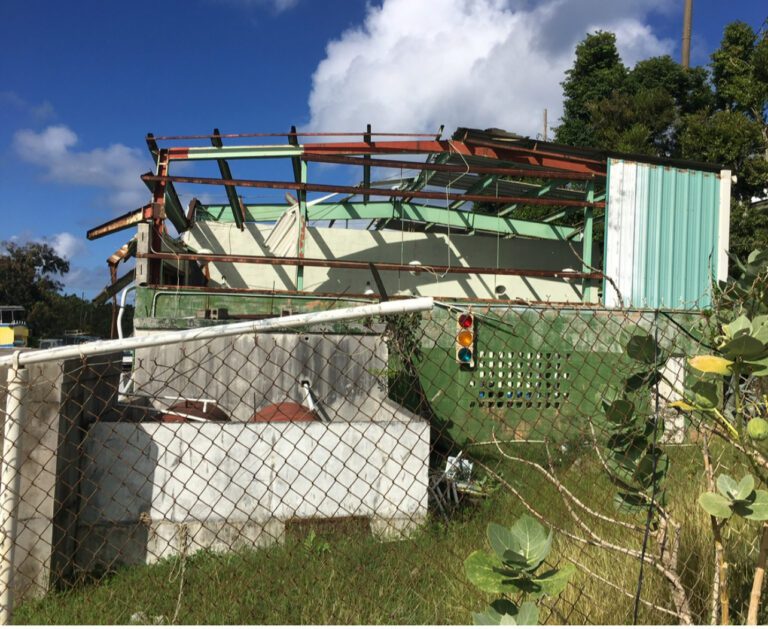
For decades, St. John’s only traffic light was the one mounted on the wall of the old Public Works Department’s maintenance building on Gifft Hill Road (Rt. 104). It didn’t work, of course. It was put there in the late 1990s as a wry joke by Ira Wade, then DPW deputy commissioner for St. John.
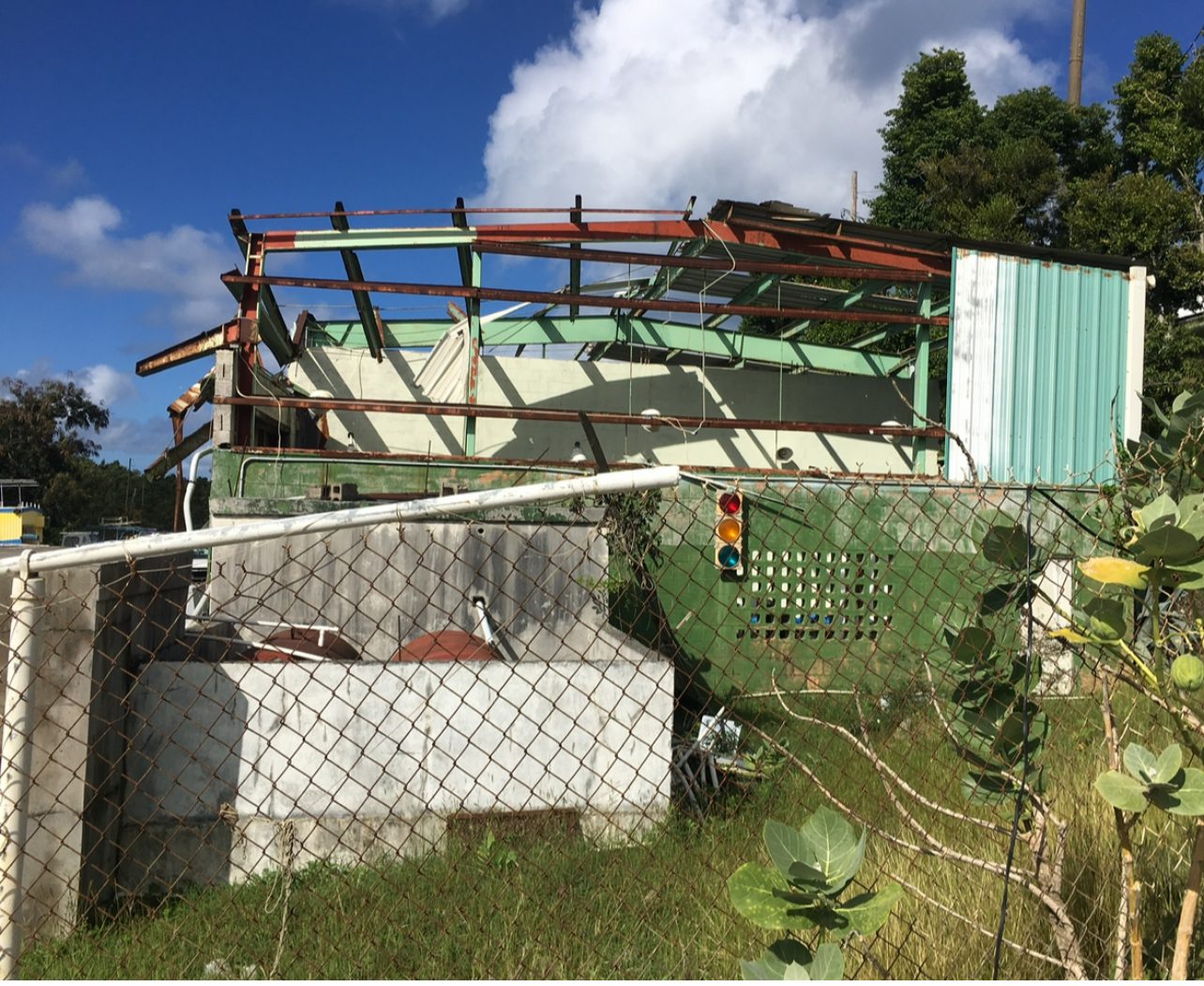
In recent weeks, some sharp-eyed residents passing the now-derelict building have noticed that the traffic light is missing. One of them, Cid Hamling, decided to investigate.
Hamling remembers well the spontaneous uprising in October 1996 that led to the traffic light’s functional demise. “Tyrone Martin, Department of Public Works special assistant, came to St. John and announced we were going to have traffic lights,” she said. “He had federal money, and he was hyped up about it.”
The idea of a traffic light in (what was then) sleepy Cruz Bay seemed absurd. During the fall of 1996, St. John was still recovering from the ravages of Hurricane Marilyn. Community and business leaders had formed the St. John Action Committee to brainstorm ways to improve the island’s infrastructure and stimulate tourism. There were many items on their wish list, but a traffic light was not among them.
“The St. John community got wind of it and said, ‘We don’t want traffic lights,’” said Hamling, then owner of Connections, a mail service center. She offered the use of phones and fax machines to anyone who wanted to contact senators and other officials. Dozens of people used them to register their opposition.
Local officials held a town-hall meeting to discuss the matter on Monday, Sept. 30, 1996, and an overflow crowd attended. Hamling recalls that when one resident called out, “Who doesn’t want it? Stand up!” all but a few stood up.
But Martin had already identified a place for the light: near the Creek in Cruz Bay, where Boulon Center Road made a T at the Northshore Road. (According to Google Maps, Boulon Center Rd. has been officially renamed Edward Moorhead Boulevard.) Martin was determined to move forward in spite of the public’s protest.
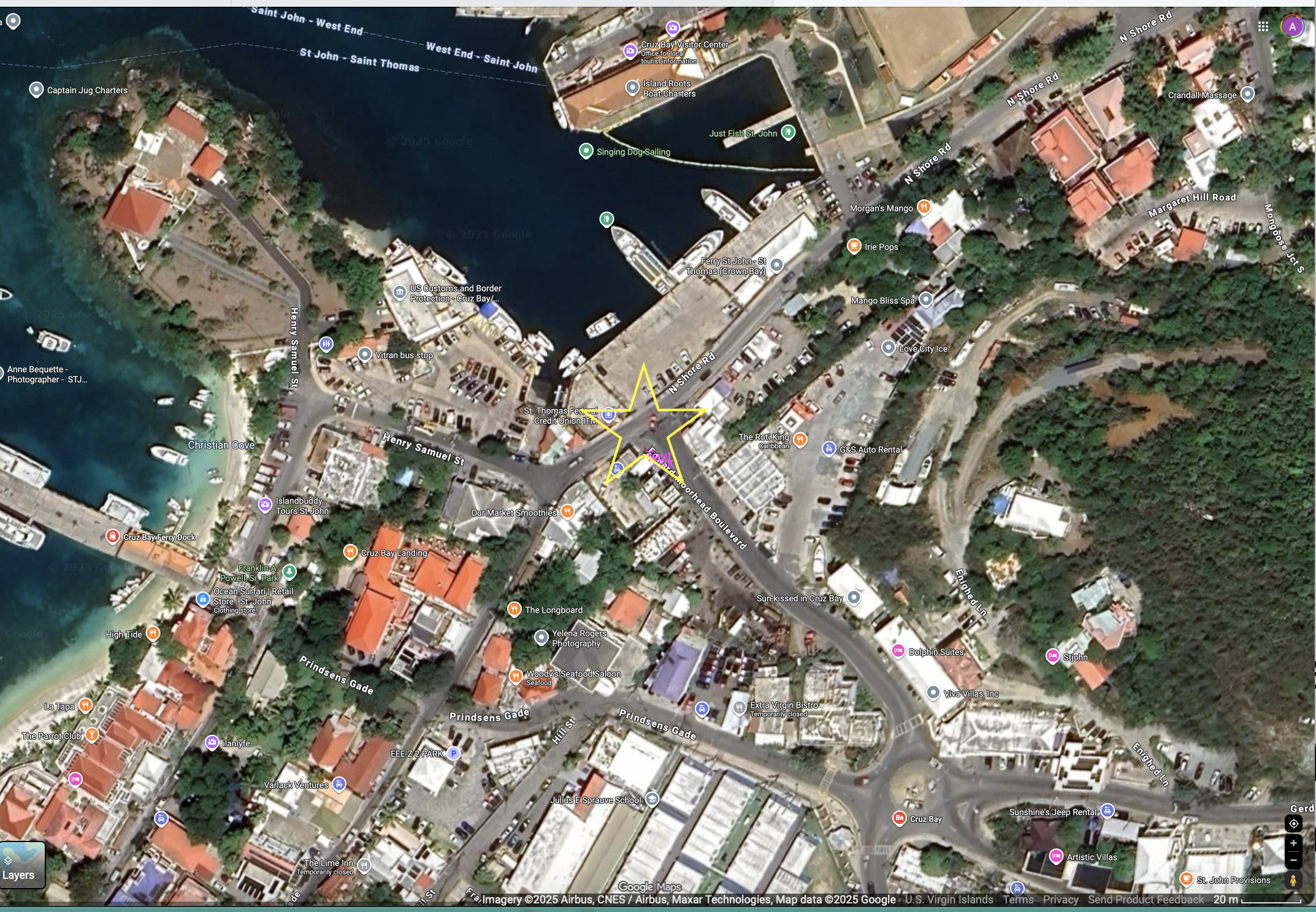
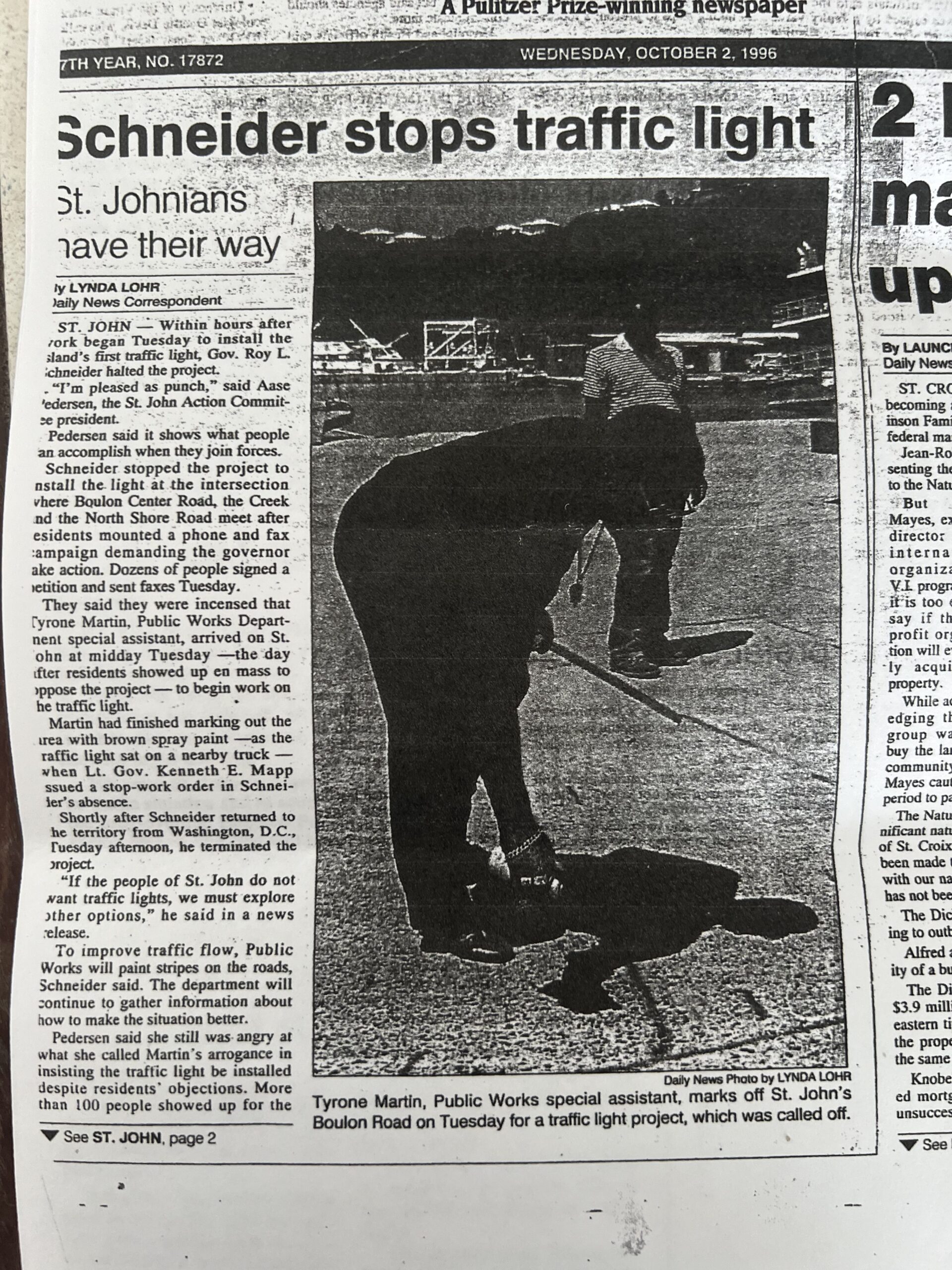
The day after the town meeting, Martin arrived with a crew in Cruz Bay and began marking the intersection with a can of spray paint; the coconut telegraph immediately went into high alert. “A large group of people went out to physically block them from proceeding,” said activist Pam Gaffin, who was on the scene.
“My understanding was the V.I. government had already indicated the traffic lights had been installed as part of a grant with an expiration date of the fiscal year end — September 30,” said Gaffin.
“They realized just days ahead of the deadline that they had one set of lights unused and decided to dump them on St. John. The lights were for a 4-way intersection — but St John does not have any 4-way intersections — not one. The First Bank corner is the closest, but since there is a one-way street that could not use the light, it counts as a 3-way intersection,” she continued.
Gaffin also said the lights were doomed to fail if they ever were installed. “These were the new, fancy computerized lights – with multiple lights on each direction. When WAPA goes out, they would not have been able to start back up again by themselves. Someone from St. Thomas would have had to come over to reset them.”
Gov. Roy L. Schneider was out of the territory at the time, according to a front-page story in the Daily News on Wed. Oct. 2, so Lt. Gov. Kenneth Mapp intervened by issuing a stop-work order. Schneider terminated the project upon his return.
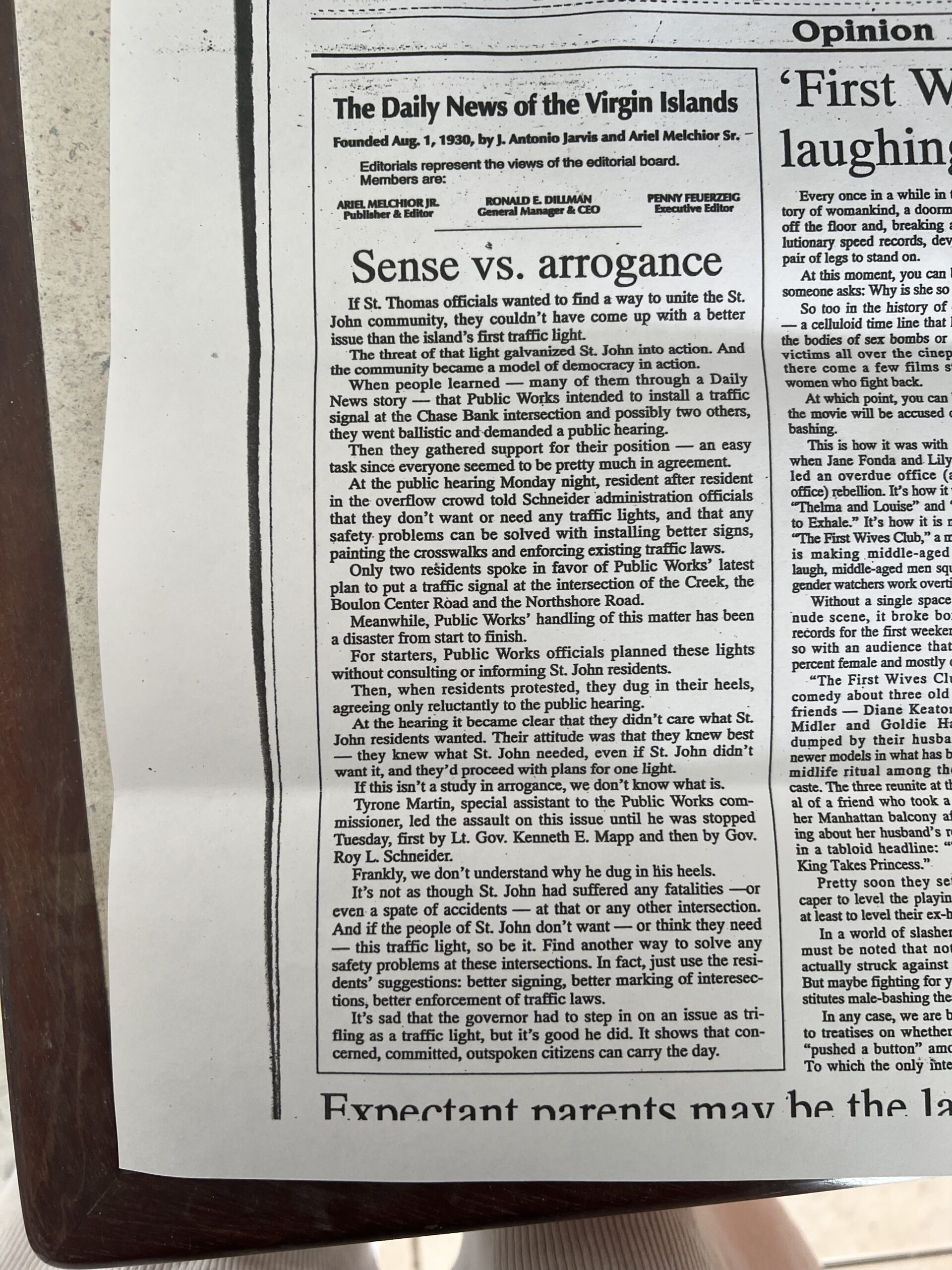
Following that incident, Gaffin said that Ira Wade, who served as deputy commissioner of Public Works for St. John, ”Swore he would never, ever install a traffic light on St. John, no matter what, and hung one of the lights up on the Public Works building.”
Ironically, the island’s recovery was faster than most people anticipated. Growth boomed over the next few years, and traffic congestion at the intersection near the Creek became a big problem. Barge companies began offering multiple trips throughout the day, and when vehicles lined up to get on or off, traffic often came to a standstill.
Wade went into high gear to deal with traffic woes and planned a roundabout to allow traffic to flow around the five-way intersection near O’Connor’s Texaco gas station. Five years later, construction on the roundabout still hadn’t begun.
It was an enormous undertaking that involved moving countless truckloads of earth to change the elevation of the site, forcing the Texaco Station to close down. The Theovald E. Moorehead Marine Terminal in Enighed Pond was completed in 2006, and barge services relocated from the Creek in Cruz Bay. When work on the roundabout was completed several years later, it was deemed a success. Gaffin said, “Boy, I miss Ira Wade; he really knew how to get things done.”
And what happened to the traffic light that Ira Wade put up on the wall of the Public Works maintenance building?
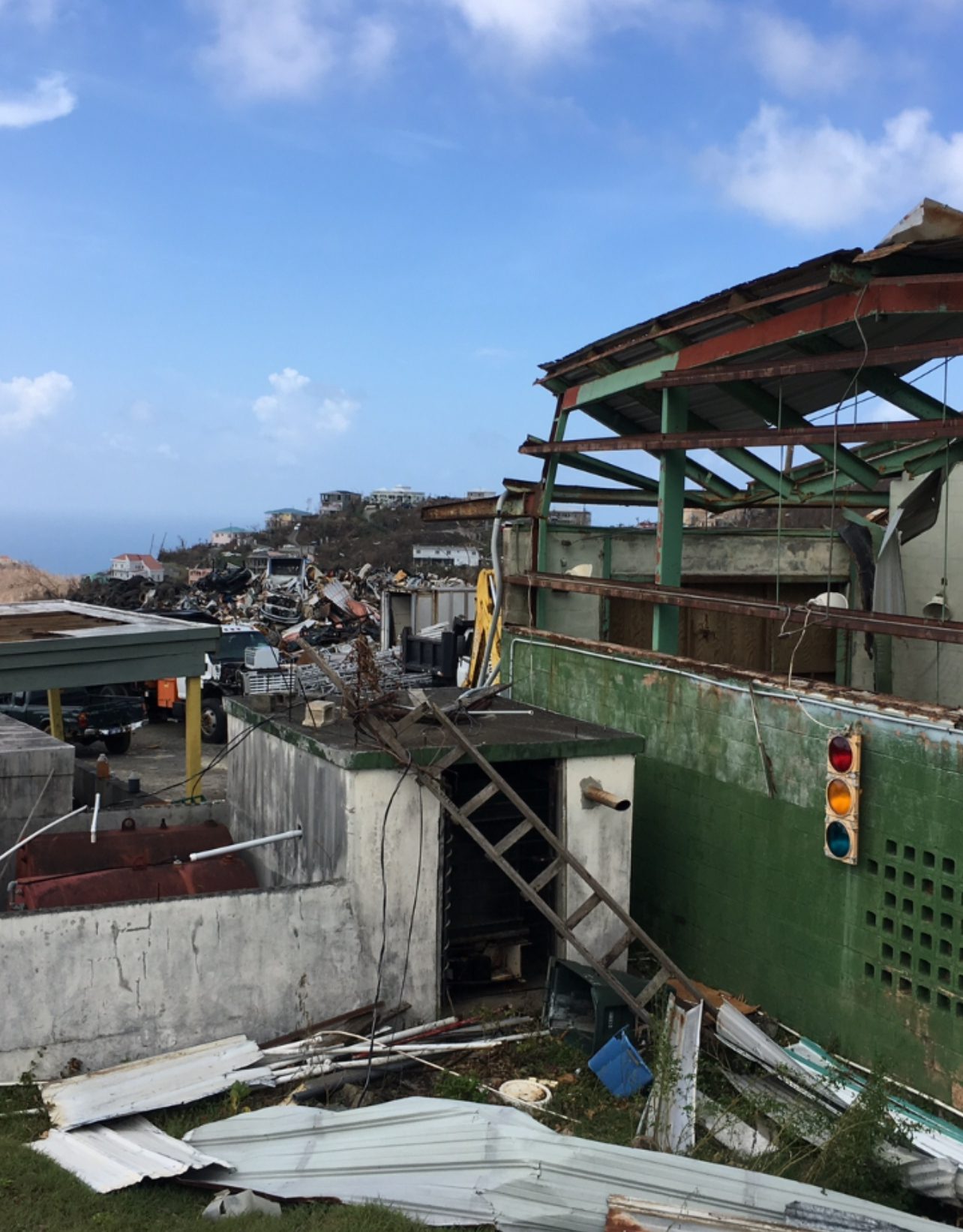
Two weeks ago, Hamling found it lying on the ground on Public Works property. The traffic light was removed in preparation for pending demolition of the building and remains in DPW’s custody.
Hamling wants to see the traffic light preserved as a reminder of a unique moment in St. John’s history. Members of the St. John Historical Society hope to display it as part of their collection so that this almost-forgotten pistarckle will live on in history.












Op-Ed: The Lounge | A Column for Men: Living the Lessons Part 3 Leading Without Losing Yourself: Accountability in Ministry
Ministry is one of the few callings where people expect you to be both superhuman and constantly available. The same people who admire your strength often assume you have none of your own battles. The same ones who pull on your gifts sometimes forget you are still managing your own healing. That is the tension of ministry. If you are not emotionally aware, you will lose yourself trying to meet needs you were never meant to carry alone.
I have watched it. I have felt it. The quiet weight of pouring and praying and showing up. The moments when you do not have it, but you show up anyway. The nights when your body is present but your soul is exhausted. The times when you are processing disappointment, but you still have to lead the meeting, deliver the message, or be the example. And somewhere in the shuffle between calling and capacity, your identity starts to blur.
That is why emotional intelligence is so critical in ministry. Because you can become excellent at helping others and still be dysfunctional inside. You can preach healing and be bleeding internally. You can lead people to deliverance while quietly drowning. That is not drama. That is reality. And if you do not slow down and check in with yourself, ministry will become performance instead of overflow.
One of the biggest dangers in ministry is mistaking service for self-awareness. You can be active in every assignment but disconnected from your actual condition. You can be the go-to person for advice while avoiding your own mirror. You can be known and admired but completely numb. That is how burnout begins. That is how spiritual fatigue shows up. And that is how you wake up one day and realize you no longer recognize the person behind the collar or the pulpit.
Emotional intelligence is not just a leadership tool. It is a survival strategy for anyone who serves. It teaches you to sit with your feelings before they sabotage your flow. It teaches you how to rest before resentment sets in. It teaches you how to regulate your response when the weight of people’s expectations gets heavy. And it reminds you that you are not your role. You are not your results. You are not defined by how much you can carry. You are loved by God even when you say no. Even when you pause. Even when you are not performing.
I had to learn that ministry is not a replacement for therapy. It is not a substitute for processing. It is not a pass for neglecting emotional accountability. There were seasons where I kept going because I thought that was faithfulness. But the truth was, I was afraid to be still. I thought rest would make me look weak. I thought boundaries would make me look selfish. I thought silence would make people forget me. And the more I ignored myself, the louder my emotions started talking in ways I could no longer control.
That is where emotional intelligence changed everything. It gave me the language to say, “I am called, but I am still growing.” It gave me the courage to admit that I needed rest, not just for my body, but for my spirit. It gave me the tools to understand that every urgent request is not my responsibility. It reminded me that the Holy Spirit does not just work through what I say to others—it works through what I allow God to say to me.
Ministry accountability is not just about what you teach or how you lead. It is also about what you model. Are you showing people how to serve from a place of health, or are you normalizing burnout? Are you pointing people to the God of peace while living in constant chaos yourself? Are you teaching grace but refusing to give any to yourself? These questions are not meant to condemn. They are meant to confront.
Ministry is sacred. But it is not supposed to break you. It is supposed to refine you. And refinement takes honesty. It takes stillness. It takes structure. It takes asking for help before you collapse. And it takes recognizing that just because people expect you to have it all together does not mean you have to pretend you do.
If you are reading this and you are tired, I see you. If you are wrestling with the weight of showing up, I understand. If you are carrying pain that you do not feel free to name, let me remind you of something simple but powerful—you are allowed to be human. You are allowed to cry, to rest, to reflect, to reset. That does not make you weak. That makes you wise.
Do not let the assignment make you forget who you are. Do not let the platform become the only place you feel seen. Do not let ministry rob you of your mental and emotional health. You cannot pour if you never pause.
So take care of the vessel. Not just for them. For you. Because the best ministry flows from wholeness, not hustle.
Editor’s Note: Opinion articles do not represent the views of the Virgin Islands Source newsroom and are the sole expressed opinion of the writer. Submissions can be made to visource@gmail.com.
Related Link:
Op-Ed: The Lounge | A Column for Men: Living the Lessons, Part 1: The Weight of the Collar: Accountability in Leadership
Op-Ed: The Lounge | A Column for Men: Living the Lessons, Part 2: The Mirror in the Home – Accountability in Fatherhood