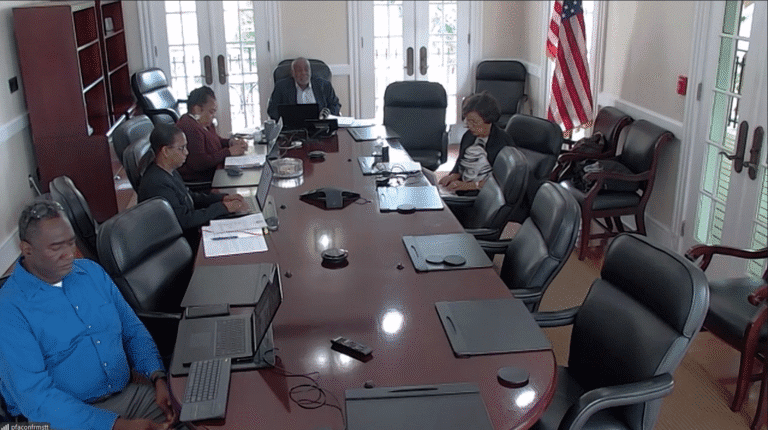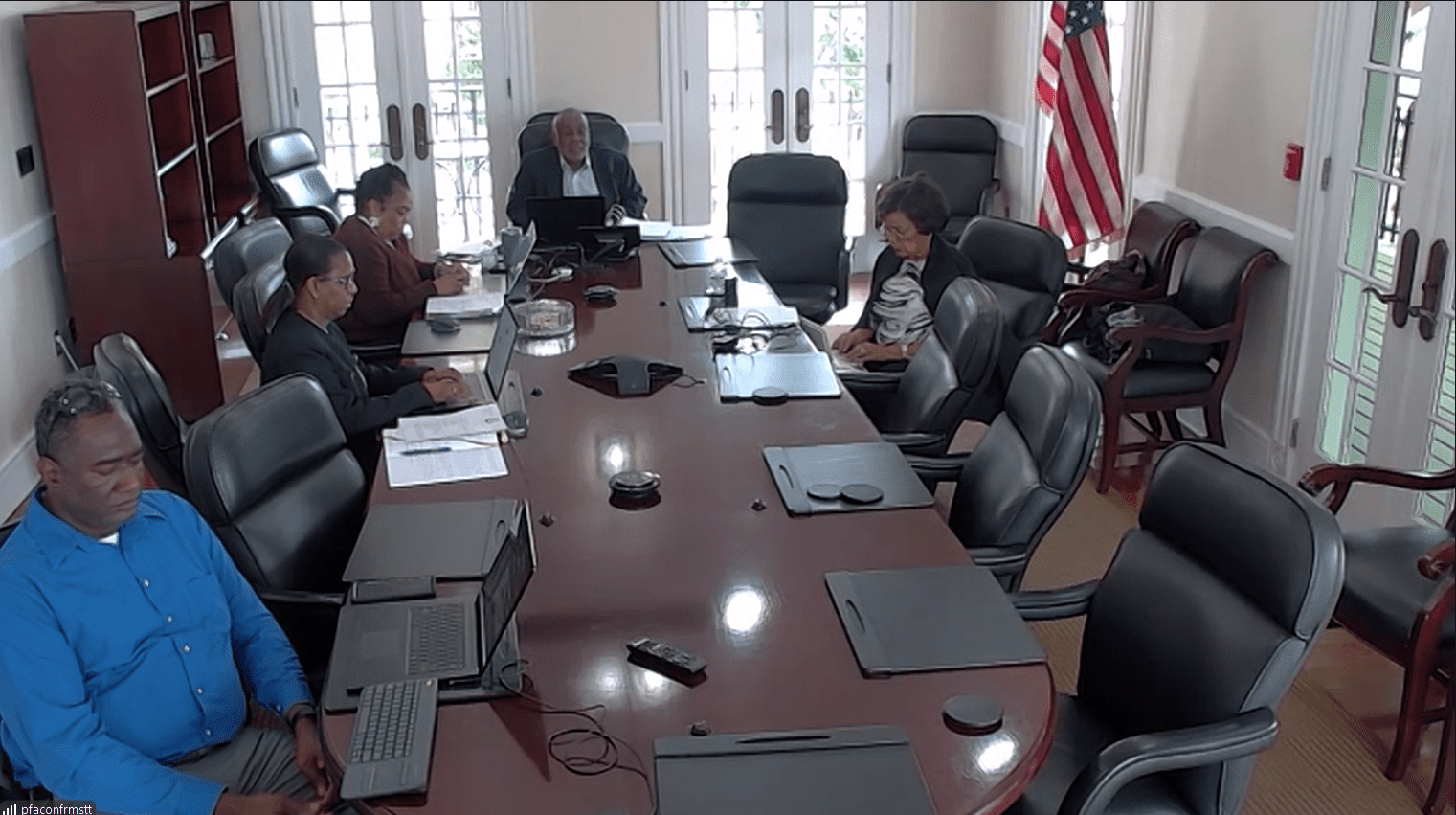

In their first public reports since securing a quasi-victory in the form of a permanent extension to the rum cover-over rate, four lobbying firms offered updates on their overlapping efforts to advance the Virgin Islands government’s federal agenda amid a mercurial White House administration, upcoming midterm elections and the shadow cast by officials’ dealings with Jeffrey Epstein.
Kevin Callwood, whose lobbying work for the territory spans decades, told the V.I. Public Finance Authority board that the conditions in Washington are “considerably different” than in recent years.
“We are dealing with a completely different set of facts, and we have a turbulent political environment,” he said. “We have coming elections at home, and also here at the national, federal level. We’re now receiving unsavory media attention related to Jeffrey Epstein that continuously sullies our reputation. Our objective sees us moving past all this, maintaining our steady ship in Washington and growing where we can.”
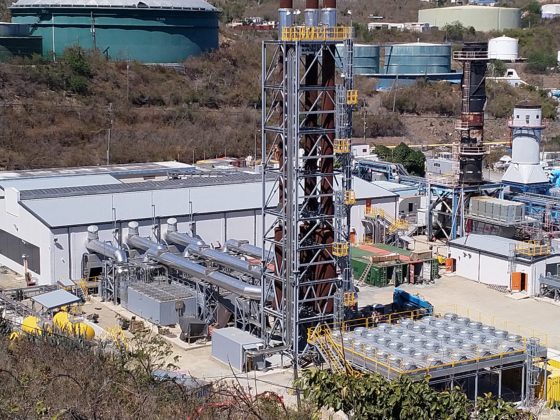
The reports covered everything from tariffs and the territory’s inclusion on the European Union’s so-called “blacklist” — a controversial list of 11 jurisdictions which fall short of the EU’s anti-money laundering and financial crime deterrence standards — to lawsuits and efforts to revive the St. Croix refinery. Adrian Lukis from Ballard Partners, a firm with close ties to President Donald Trump’s administration and which used to employ current U.S. Attorney General Pam Bondi and Trump’s chief of staff, Susie Wiles, said the firm hadn’t “engaged on” the refinery issue for several months following an unsuccessful attempt to secure financial support from the U.S. Energy Department.
“That was not, I think, a viable opportunity,” he said. “But I do think that the EPA and White House have expressed a desire to try to fast-track approvals.”
Dave Schnittger of Squire Patton Boggs elaborated later and noted that his team facilitated a meeting last year between Gov. Albert Bryan Jr. and Aaron Szabo, the EPA’s assistant administrator for its Office of Air and Radiation.
“We began laying the groundwork for that meeting at the very beginning of the second Trump administration,” he said. “And you know now, with some of the changes and dynamics taking place with respect to Venezuela, our hope is that there is an opportunity now to do what we wanted to do for a long time, to position the refinery for the role that it’s uniquely suited to play — not just empowering growth in the territory, but also strengthening the energy supply for the entire nation.”
Schnittger said Squire Patton Boggs is working with the White House, the newly minted National Energy Dominance Council, and the U.S. Energy Department to make that happen. Bryant Gardner, a partner at Winston and Strawn, offered a more cautious assessment.
“It’s not open,” he said of the refinery. “Hopefully the political environment will help it, but, you know, according to experts, the longer it sits, the harder it is to restart it. And so … the clock is ticking. We’ve looked at issues with their potential deconstruction activity, or scrapping — to make sure that the government’s interests are protected there underneath the refinery operating agreement — and there are environmental issues as well. There’s ongoing, open litigation with the EPA.”
While Bryan has long touted a safe refinery restart as one of the goals of his administration, the facility was only mentioned briefly during his most recent and final State of the Territory Address. Days later, a delegation of Ghanaian officials and representatives from international energy companies toured the refinery and the adjacent terminal after meeting with leadership from both operations. On a call with the Source Friday, Bryan said an upcoming visit to D.C. will be “particularly interesting” because conversations about U.S. territories usually focus on those in the South Pacific.
“Now, with what’s going on in Venezuela, they’re going to want to talk to us more about the military activity in the Caribbean again,” he said. “It is real key that we’re going to get that attention — because I was jealous that Guam got all that military attention — but they’re most definitely going to be curious about what kind of resources we need to support them in their defense of the Caribbean. So the refinery’s gonna be a topic, I know. I’m really excited to have those conversations.”
Regarding the blacklist, Gardner said its inclusion of U.S. territories seems “politically motivated.” The U.S. Virgin Islands’ owes its inclusion to the fact that it: doesn’t apply any automatic exchange of financial information; has not signed an international cooperation agreement to counter tax evasion; has “harmful preferential tax regimes” through the V.I. Economic Development Authority and exemptions under the International Banking Center Regulatory Act; and “has not committed to addressing these issues,” according to the Council of the European Union.
“So what the EU has said is that there’s a number of different sort-of planks that they have in resistance to getting us off the blacklist. One of those is transparency,” Gardner explained. “We don’t provide them information about our taxes and tax programs and taxpayers, and we’ve said to them: we simply can’t do that. We cannot enter into an agreement with the EU, and so we’ve worked through [the U.S. Treasury Department] to amend the existing tax implementation agreement so that we can exchange that information through Treasury, just like any other state.”
Gardner said the next challenge will be around the Economic Development Authority and Economic Development Commission.
“They want to understand them better,” he said.