

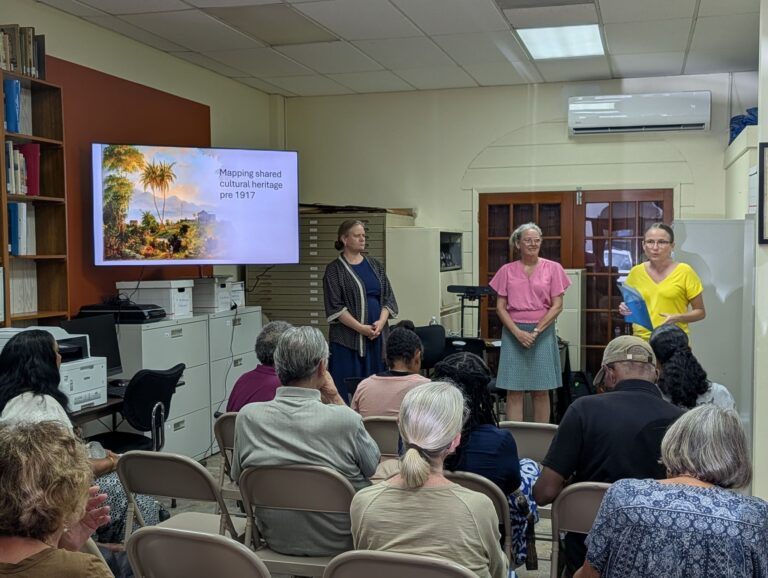

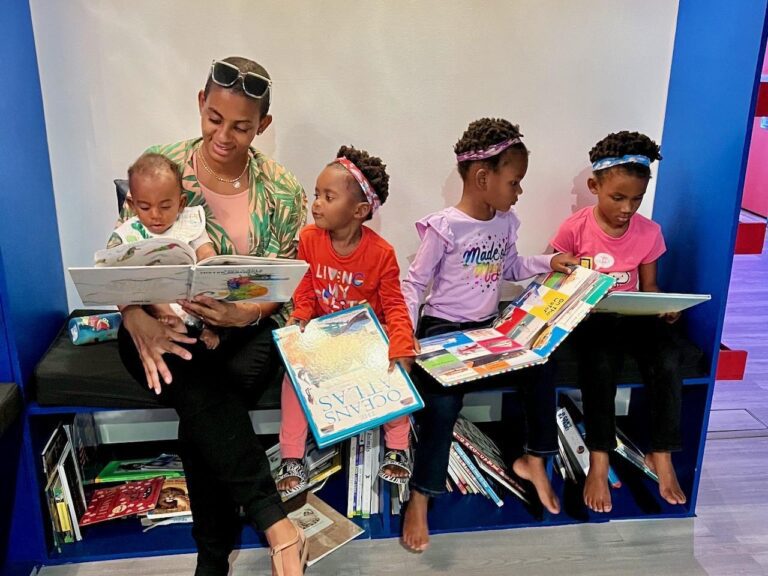
A Danish team of heritage researchers joined local historians and community members at the Caribbean Genealogy Library Saturday, Feb. 7, on St. Thomas to discuss efforts to document and preserve Virgin Islands culture and heritage.
“We’re here today because my colleague Louise Sebro and I are appointed to do a mapping of cultural heritage, which is rooted in the period pre-transfer, to see what is left, what is endangered, who are the stewards?” said Karen Sivebaek Munk, chief curator at Museum West Zealand. “But most importantly, we want to do some workshops with people and hear what is most important to them.”
Munk said the project was launched by the Danish Parliament amid growing interest in Denmark’s historical ties to the Virgin Islands and the legacy of the former Danish West Indies. “More and more people in Denmark are interested in our cultural engagement and otherwise here in the Virgin Islands,” she said, explaining that the team was asked “to do a mapping of existing cultural heritage” rooted in the period before 1917.
She said the researchers quickly decided the work could not be limited to colonial-era monuments. “We did not want to do a project that was just documenting old Danish buildings. We wanted to not focus entirely on European Danish culture, because that’s such a small, small part of what this place is,” Munk said. “We share cultural heritage, but in many, many facets.”
Louise Sebro, a museum inspector with Museum Lolland-Falster in Denmark, said the mapping is designed to capture both physical and living traditions that reflect the islands’ history. “We want to describe both African, Caribbean, Creole and European,” Sebro said. “It’s also very important for us that what we describe is both the tangible and intangible cultural heritage.”
Sebro outlined how broad that definition is for the team. “Tangible cultural heritage could be artifacts from visual arts and tools, clothing. It could be architecture, landscapes, natural landscapes of man-made cultural significance and collections, items held in museums, libraries and archives,” she said.
Munk said the nonmaterial side is just as crucial. “Then there are intangible cultural heritage, like old traditions, legends, arts, customs and rituals, knowledge and skills and maybe even more things that we haven’t thought of,” she said.
The researchers stressed that they do not want to impose an outside definition of what matters. “We can’t do this alone because we need your voices to help us understand what is endangered, who are the stewards of the cultural heritage,” Sebro said. “What should be promoted? What should be revived?”
The core of the program was an exercise asking audience members to identify one element of Virgin Islands cultural heritage they would preserve above all others and explain why. Participants highlighted everything from bamboula to murals, including music, dance, language and community values, often linking them to intergenerational education and preservation.
Several speakers said younger Virgin Islanders are not being systematically exposed to traditional culture in schools. “I think we’re losing certain things,” one participant said, adding that families now rely heavily on digital photos and files that are never printed or archived.
Others said retired educators and individual culture bearers are carrying much of the responsibility, but that broader access and formal history instruction are needed so students do not have to “go out of their way to find this information.”
Beyond specific art pieces and forms, residents described behavior, values and community ties as core elements of local heritage. One longtime St. Thomas resident said he would preserve “the tradition of civility and respect among people, especially toward elders,” while another described the “village-oriented, authentic care and compassion for one another.”
The responses and follow-up discussion underscored concerns that traditions are fading due to insufficient government and institutional support. At the same time, participants pointed to a continued sense of shared history, resilience and cultural pride.
Caribbean Genealogy Library Board President Sophia Aubin said hosting events like Saturday’s is central to the library’s mission. “We hold events at the library to bring people in to connect with the collection,” Aubin said. “Knowing your individual history and knowing the community history is important. It’s important to preserve it in order to share it with those that are here today, but also to pass it along to the future generations.”
Insights from the St. Thomas event, along with similar previous workshops on St. Croix and St. John, will be incorporated into a report the Danish team plans to publish. The document is expected to outline tangible and intangible heritage, identify areas that are endangered and highlight local stewards working to preserve Virgin Islands culture.






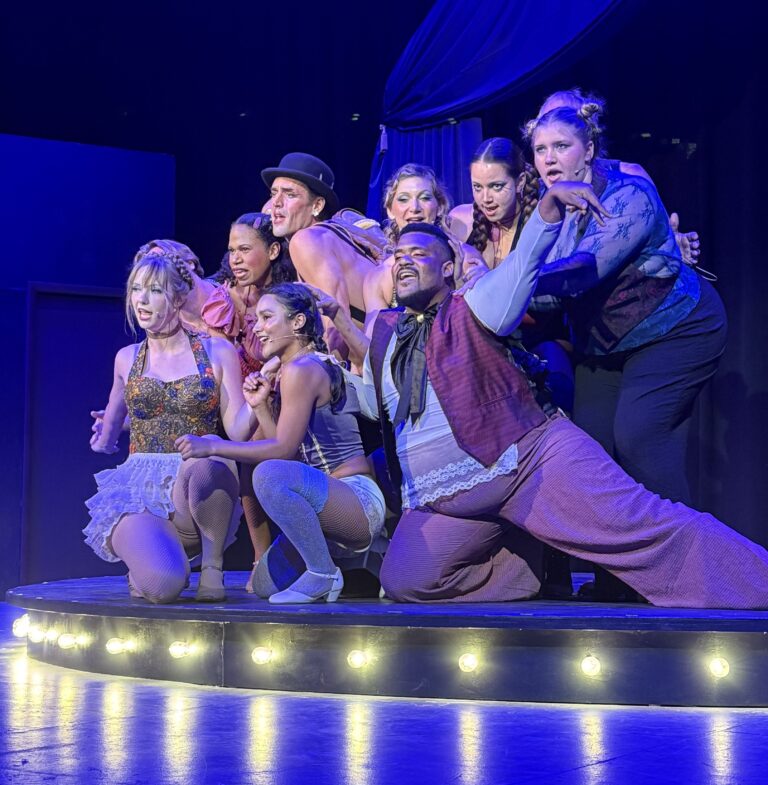
 There are six more performances over the next two weekends of CABARET at CCT: Fridays and Saturdays at 8 p.m., Feb. 13-14 and 20-21, and two Sunday matinees at 4 p.m. on February 15 and 22.