

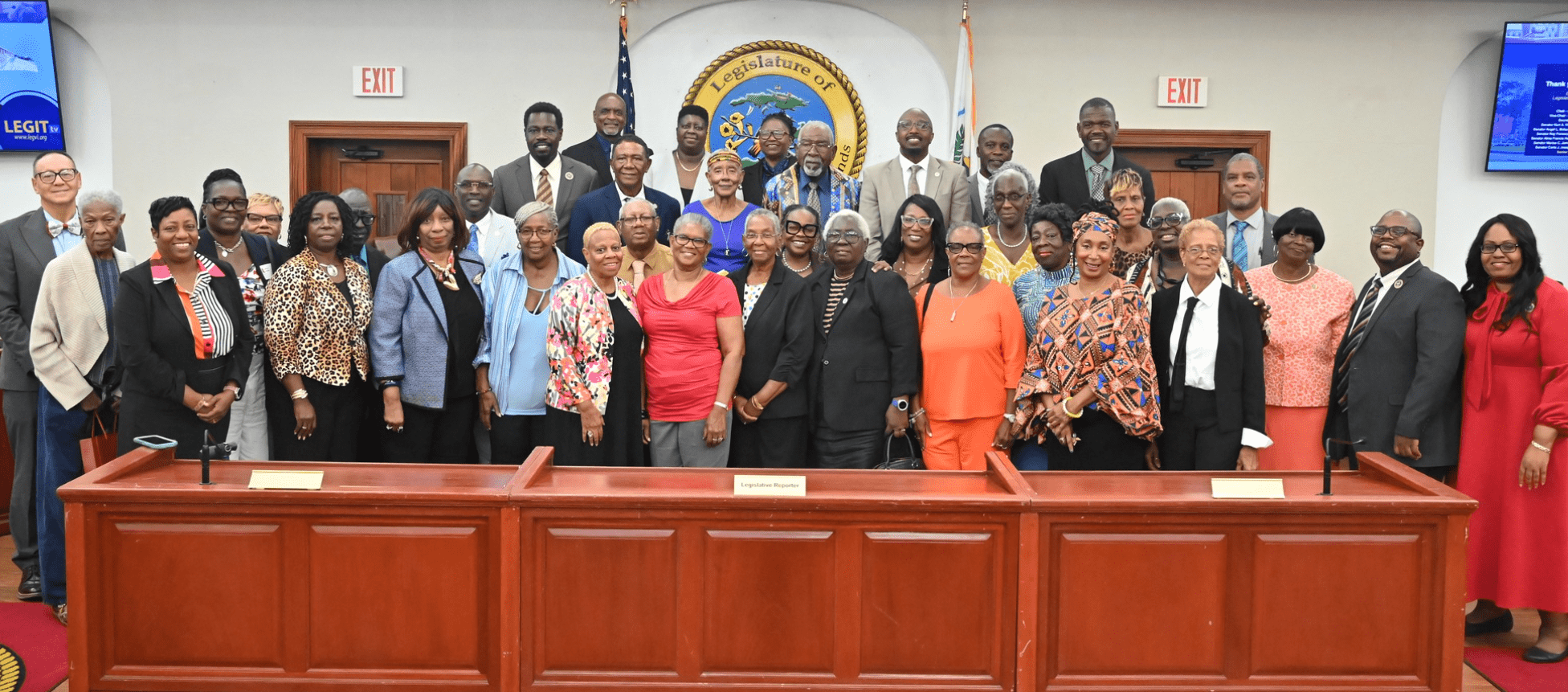
On Wednesday, lawmakers and older residents gathered for a Citizenship Day Mock Senate session, using a simulated legislative hearing to debate a proposal to expand ancillary health coverage benefits for older adults and disabled residents under the Virgin Islands Medical Assistance Program.
Older residents role‑played as senators, legal counsel, clerk and sergeant‑at‑arms. They opened with an invocation, held roll call, voted to waive a rule so participants could remain seated during debate, and then took up Bill No. 36‑0000, a proposal to establish ancillary health coverage benefits for older adults and disabled beneficiaries under the territory’s Medical Assistance Program.
After debating the measure and questioning how it would be funded, the mock Senate voted 14–1 to forward the bill to the real Senate Health, Hospitals, and Human Services Committee for a full hearing within 30 days.
Though presented as a mock exercise, senators repeatedly emphasized that the concerns raised about health care access, rising costs and public services reflected real challenges facing the territory’s aging population.
“I am honored to have all of these seniors representing us, because you have paved the way for us,” Sen. Franklin D. Johnson said. “People may call this a mock session, but the issues being discussed are very real … The Virgin Islands I grew up in was built by a village raising its people, and that village is still here. We’re going to continue to stand by and support our seniors.”
Seniors used the mock hearing to describe how difficult it is to age in the territory, pointing to a gap between program rules and real‑life costs. They said many retirees now rely on limited pensions and Medicare, yet still fall just above the Medical Assistance Program cutoff.
They also highlighted uneven access to health care across the islands, noting that gaps in hospital and clinic services can force residents to travel off‑island even for minor problems. Underlying their remarks was a shared demand that the safety net better reflect the real cost of aging in the Virgin Islands, and that any new benefits be matched with a realistic plan to pay for and deliver them.
Sen. Kurt A. Vialet said testimony from participating seniors underscored the scale of unresolved issues facing the territory’s elderly population, particularly in health care and public services.
“If you listen to the testimony of every senior that testified, there were salient points that came out, and you could clearly see that the senior population has a tremendous amount of issues that need to be solved,” Vialet said. “The issues are immense.”
He said lawmakers have continued working to address gaps in services through funding and policy efforts.
“As a Legislature, we have been really trying hard to see what else we could do to supplement what is taking place in the Virgin Islands,” Vialet said. “We know the lack of facilities, the lack of health care …”
Vialet emphasized that legislators continue to appropriate funding, while implementation rests with the executive branch.
“The senators appropriate money for the executive branch to implement, not this body,” he said. “But it is so common to blame the senators who don’t have the power, and then don’t blame those individuals who have the power to get it done, and are not doing the job.”
Sen. Carla J. Joseph said sessions like this invigorate lawmakers by putting seniors directly in front of them.
“I really love having these types of activities with our seniors, because it helps us to remember who we are working for when we are senators,” she said. “It helps invigorate us to continue to do the fight and to continue to do the work.”
With the measure now headed to the Senate Health, Hospitals and Human Services Committee, senators have agreed to take it up for a hearing within 30 days. Seniors used the mock session to put eligibility, funding and uneven access to care on the record, and those questions will be waiting when the proposal returns to the Legislature.