

Members of the Department of Planning and Natural Resources’ Coastal Zone Management Committee expressed optimism Tuesday during a virtual public hearing on plans to modernize the Yvonne E. Milliner Bowsky School and rebuild the Emanuel Benjamin Oliver Elementary School on St. Thomas, as the public begins a seven-day period to submit responses to the applicants’ testimony.
“We’re excited about all of our projects coming online. It’s no mystery to anyone on this call that our buildings are deteriorating every day that we speak. So the quicker we are able to retrofit our campuses where they become more conducive to the learning environment for our students is where our passion and our drive remains,” said Education Commissioner Dionne Wells-Hedrington.
Regarding the Bowsky School, student capacity will increase from 420 to 624 students after renovations. The 10 acre property’s project includes demolishing existing temporary modules to modernize classrooms, constructing a new gymnasium that will serve as a safe shelter, a sports field with a soccer pitch, parking expansion and reconfiguration with a perimeter vehicle loop for fire truck access, a waste water treatment plant, a potable water system, a HVAC chiller yard, and upgrading the electrical and plumbing systems. New roofs on campus will be constructed with metal and have solar panels attached for battery storage. Additionally, renovations will also manage stormwater runoff.
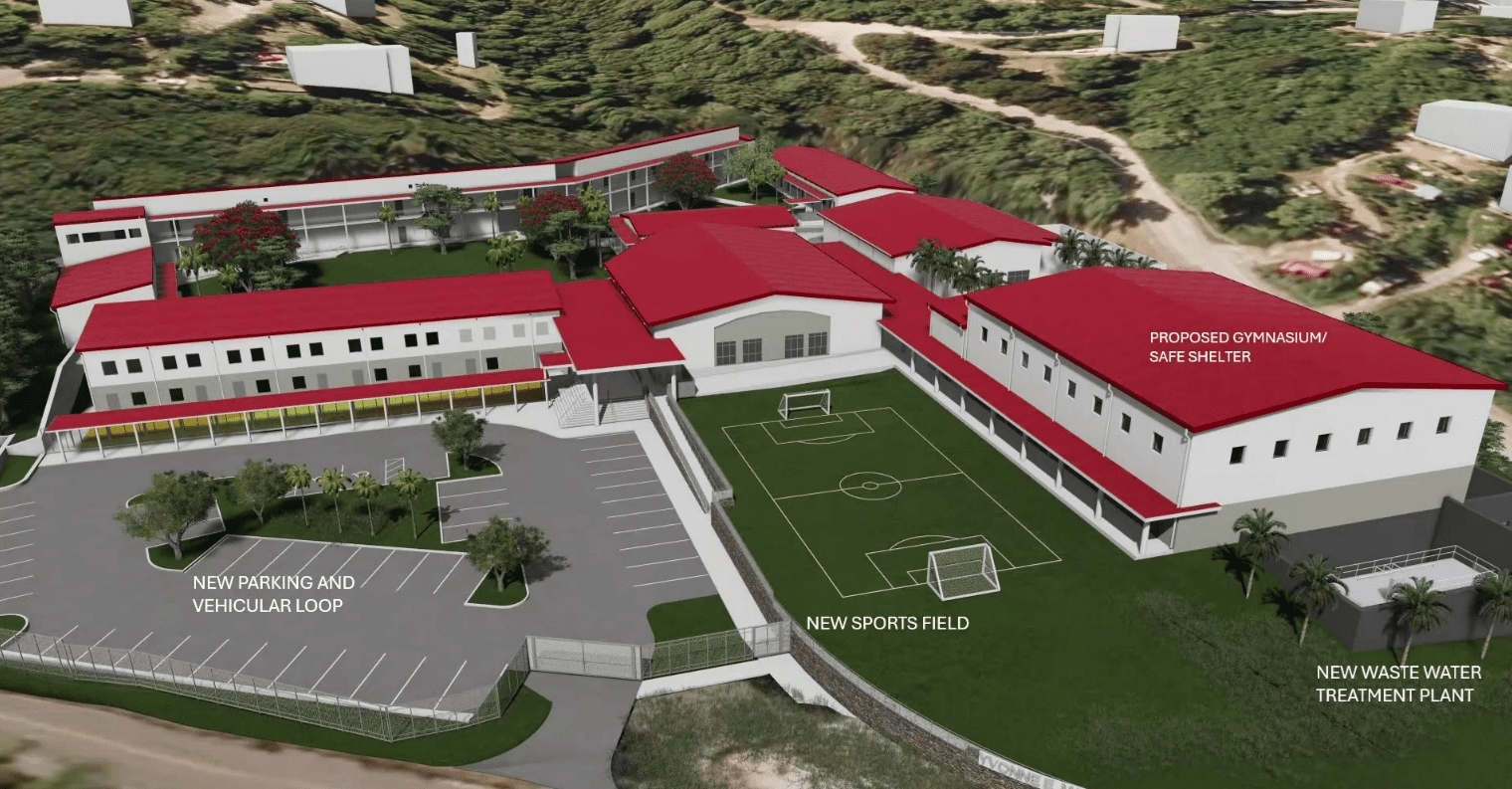
Amy Dempsey, the environmental consultant for Bioimpact, said: “One of the problems they have consistently at the school is that the road that runs at the back of the school floods.” She added that the plan addresses this problem.
Additionally, according to Dempsey, “two heritage trees” and “a few specimen trees” will be impacted by the expansion of the parking lot.
“In order to build an adequate amount of parking and everything, there was no way to work around them,” said Dempsey. She added that native vegetation, however, will be replanted, and that a 90-foot well near the property can possibly be used for groundwater mitigation.
The project is expected to be completed in four phases and take 38 months.
Jawanza Hilaire questioned applicants about the parking lot construction, alluding that the upgrade might not mitigate traffic for pickup and drop-off challenges.
Chris Boyette, architect representative from Zycovich, responded, “If we can try and utilize that back road where we can do pickup and drop off for older kids, and then try to minimize the entry drop off, we’re studying that.”
Vance Pinney, CZM committee member, questioned the applicants about the use of the nearby well. He commented that he had no facts on the matter, but that “tests should be done on that well because I understand something in the past where that well was poisoned because two brothers who were trying to kill each other.”
Dempsey shared that though she heard about the family feud regarding the well, there are no intentions to use the well for the school, but rather for groundwater studies.
Regarding the Emanuel Benjamin Oliver Elementary School, the campus will get a complete revamp.
“It will be a pre-K to 8 school when it is completed,” said Chaneel Callwood-Daniels, Education Department architect. “So we are taking the first step to demolish all the buildings that are there, and then the designs are in progress.”
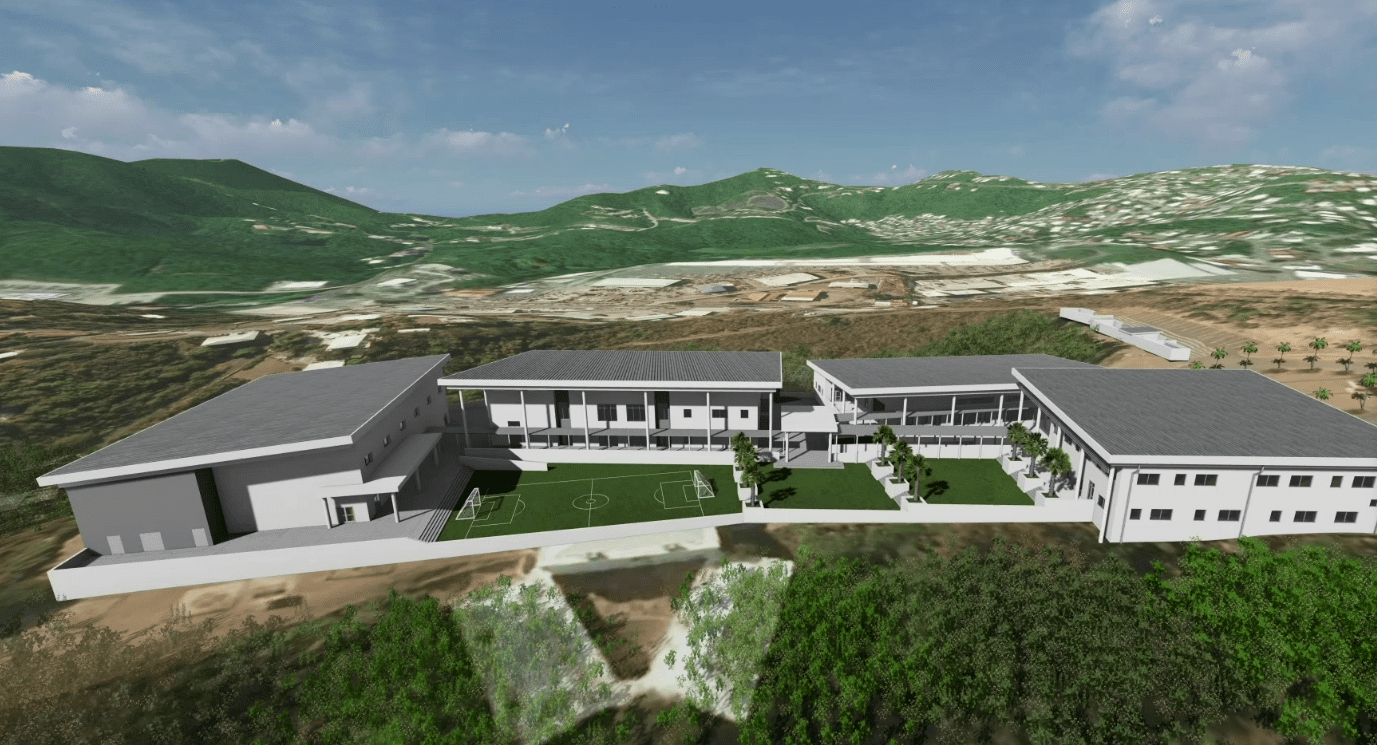
The project will demolish all buildings, parking lots, and sidewalks. A new entrance drive, a north-side parking lot, and a west-side utility building will be constructed. Additionally, one two-story administration building, one two-story classroom building, a dining room building, and a gymnasium will be constructed and arranged around a central courtyard. An outdoor sports court between the gym and classroom building will be added and a playground will be added between the classroom and administration building. All buildings will be constructed with pitched roofs.
This 10-acre property project is expected to take 25 months to complete and is anticipated to start at the end of this summer. Originally designed to house up to 700 students in 1975, it will be reduced to accommodate 486 students. Education officials said that though the student footprint is decreasing, other campuses are expanding to accommodate increasing student bodies on island.
“Presently there’s a [community] lot, and if my memory serves me correct, those lots have to gain access through the school’s property,” mentioned Pinney, who inquired about alternative access routes for property owners near the school.
Wells-Hedrington responded and said that the access through the school is a “shortcut” for the residents, but the main access is adjacent to the school.
“The community utilized a walkway in between the campus as a shortcut to their area. However when we build this school, that access to this shortcut won’t be available any more,” she said. “It’s just a matter of defining the property, but their access will not be limited because they have the access now.”
“Where are all these materials that are being demoed going? Because we already have a landfill that is beyond measurable right now. And if this was built in the 70s, it’s concrete, it’s steel,” questioned Jawanza Hilaire, CZM board member.
Maria Luisa Villegas, representative of the contractor Suffolk-Americaribe, said they are currently in communication with the Waste Management Authority for the disposal of material.
Additionally, the Coastal Zone Management Committee held a decision meeting Tuesday night and unanimously voted to approve CZT-04-03(L), a Yacht Haven Grande modification project to renovate the property’s existing pool deck, resurface the tennis court, construct two padel courts, three pergola seating areas, and expand the fenced area. Per approval, the committee required the applicant to allow neighboring children and adults an opportunity to learn tennis and pickleball.
CZM members Calford S. Martin, Vance E. Pinney, and Jawanza Hilaire were present.