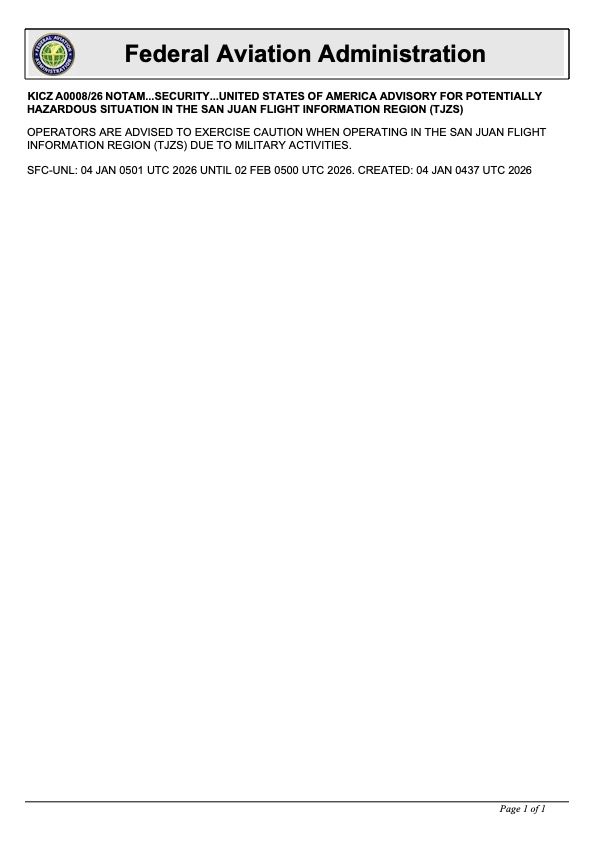

On Jan. 4, the Federal Aviation Administration issued a NOTAM (Notice to Airmen) of potentially hazardous conditions in the San Juan flight information region due to military activities.
Territorial airport manager Jerome Sheridan said Wednesday the ongoing NOTAM, which is in place until Feb. 2, did not portend “any threat” to the territory’s airports.
“First and foremost,” Sheridan said, “no one should be afraid to fly. This is no threat to the USVI.”
The notice is for “aviators and airport personnel.”
This particular notice came from the FAA, but “could be issued by several entities,” he said.
The NOTAM advises abnormalities in a specific region that might suddenly arise, “for people in the sky, like when the president flies,” Sheridan offered as one example.
“It is not intended to ward people off; we don’t want the public to be alarmed.”
As for the” military activities” mentioned in the NOTAM, Sheridan said, “We are aware the Department of Defense is in the area.”
The Sunday, Jan. 4 NOTAM followed the abduction of Venezuelan President Nicolas Maduro and his wife in a raid on the Caribbean nation, which reportedly took place on Saturday, Jan. 3.
The Virgin Islands and Puerto Rico airspace was closed to all commercial traffic on Jan. 3. The FAA lifted the prohibition on Jan. 4
A report of the action on the Library of Congress website explains that along with commercial flight operations of U.S. aircraft in Venezuelan and southern Caribbean airspace, “the FAA also took action to close the airspace it directly controls in the Eastern Caribbean, known as the San Juan flight information region (FIR), which overlies Puerto Rico, the U.S. Virgin Islands, and surrounding waters.”
Sheridan was clear, however, that as of Wednesday, Jan. 28, the Henry Rolsen Airport on St. Croix and the Cyril E. King Airport on St. Thomas are currently “very much open for business.”