

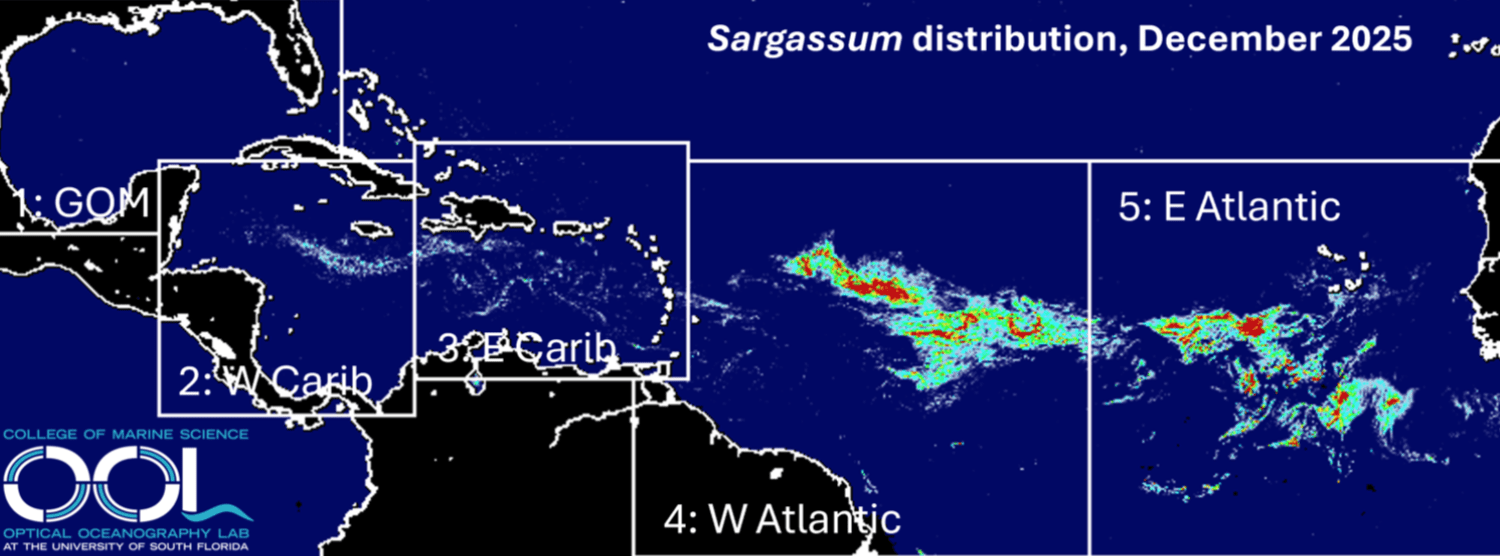
Sargassum levels across the Atlantic and Caribbean jumped sharply in December 2025, a wintertime surge that could set the stage for another major sargassum year in 2026. Unusually early beaching events are already possible in parts of the region, according to a recent report from the University of South Florida’s Optical Oceanography Lab.
The OOL at USF monitors the presence of sargassum across the Atlantic, Caribbean, and Gulf regions using satellite imagery. The group’s December 2025 report was released on Jan. 5 and noted that total amounts increased significantly during December.
“Compared to November 2025, a substantially increased sargassum amount was found in every region except the Gulf,” USF said. “In particular, the sharp increases in the eastern Caribbean Sea and western Atlantic led to record-high sargassum in December. The western Caribbean Sea also saw rapid increases, although the absolute amount was still low,” USF continued.
Why the December Increase Matters
For the U.S. Virgin Islands, the update is a notable early warning. USF researchers said that the seaweed will likely continue to increase, potentially leading to beaching events in parts of the Lesser Antilles in the coming months.
In the December bulletin, USF researchers noted that the Atlantic currently contains two separated large masses of algae — one in the western Atlantic and one in the eastern Atlantic — both attributed to local growth.
“The most striking result is that there are two separated large masses in the western and eastern Atlantic, both due to local growth and thus contributing to the record-high sargassum amount in December for the entire Atlantic,” USF explained.
USF also cautioned that some beaching may already have occurred, calling that timing “unusual” for this time of year and adding that early beaching could continue in the months ahead.
“Although the amount of sargassum in the Gulf will remain negligible, sargassum in the Caribbean will likely continue to grow, leading to beaching events along the Mexican Caribbean coast and some of the Lesser Antilles islands,” USF warned.
“Some beaching events may already have occurred. Such early beaching events are unusual but will likely continue in the coming months. Because of the rapid growth from November to December 2025 and because of the high sargassum amount in most regions, 2026 is likely to be another major sargassum year, with sargassum amounts possibly exceeding 75% of the historical values,” stated USF.
USF Researcher’s Perspective
The Source connected with Brian Barnes, an assistant research professor at USF, who provided additional information about the increase in sargassum and what it might mean for the USVI.
Barnes explained that, while the amount of seaweed reached record highs in December, the risk of beaching events across the USVI is still limited.
“The risk of near-term beaching events is still pretty low for the USVI,” Barnes confirmed. “Sargassum is the highest we’ve ever seen for this time of year in the eastern Caribbean at 0.3 million metric tons, but it’s still much lower than what we typically see during midsummer, which is about one million tons on average and can reach up to eight million, which occurred in 2025,” he said.
Speaking to the cause of early beaching events, Barnes offered the following details:
“The more sargassum in an area, particularly nearshore, the more likely that a portion of that will be transported inshore,” Barnes stated. “There’s more sargassum than normal in the eastern Caribbean for this time of year, and therefore, inundations have happened that are unusual for this time of year. Currently, there is not much sargassum near the USVI or in directly upstream regions that would imminently impact the islands.”
As the USF bulletin noted, there are currently two large sargassum masses in the western and eastern Atlantic. Barnes said that “The western Atlantic mat is more likely to impact the USVI,” and this could potentially occur in the coming months.
Sharpening the “Why” Behind Sargassum’s Big Years
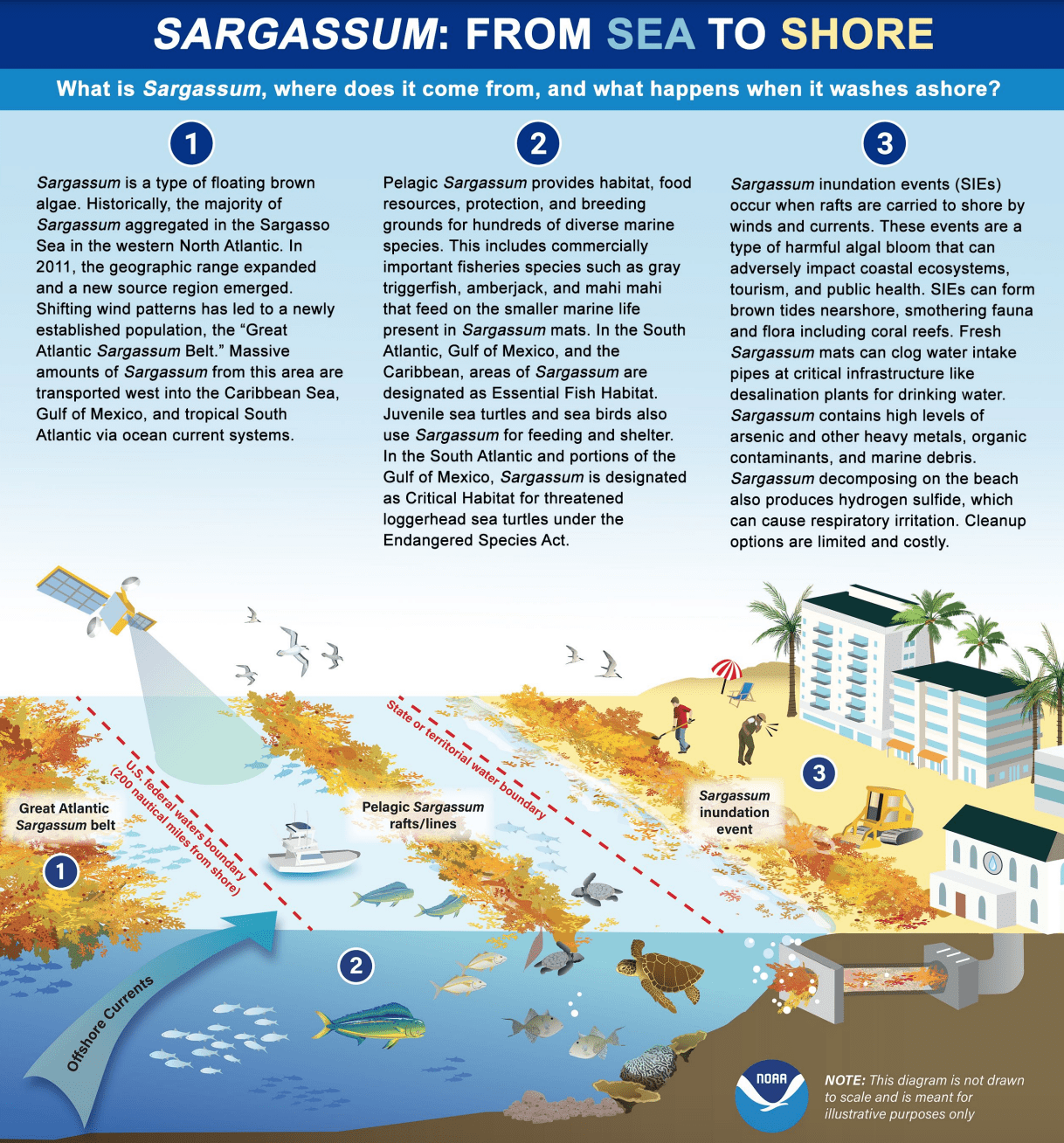
In addition to its December outlook, the USF team pointed to two recent Nature Geoscience studies that help explain what may be driving recent extremes in the amount of seaweed.
One research paper, titled “Equatorial Upwelling of Phosphorus Drives Atlantic N2 Fixation and Sargassum Blooms,” published in November 2025, noted that equatorial Atlantic upwelling can deliver “excess” phosphorus. The report explains that this can fuel nitrogen fixation, effectively boosting the nutrient supply in a way that helps support major sargassum blooms in the tropical Atlantic and Caribbean.
That same study also connects sargassum variability to climate patterns, including signals that could help improve year-to-year predictability of bloom intensity.
A second Nature Geoscience paper shared by USF, “Dramatic Decline of Sargassum in the North Sargasso Sea Since 2015,” published in December 2025, highlights a different Atlantic shift. In the report, the researchers found a dramatic decline of sargassum in the north Sargasso Sea since 2015, alongside changes in seasonal growth patterns. They suggest these basin-scale changes in abundance and transport may indicate a broader “regime shift” in how sargassum is distributed across the Atlantic.
“We posit that the north Sargasso Sea decline is due to reduced sargassum supply from a historical Gulf source region, possibly attributable to increasing sea surface temperatures and more frequent marine heat waves in the Gulf,” according to the paper. “Together, proliferation in the Great Atlantic Sargassum Belt and decline in the north Sargasso Sea may represent the beginnings of a regime shift in sargassum distribution.”
Follow Sargassum Updates and the Weather Forecast
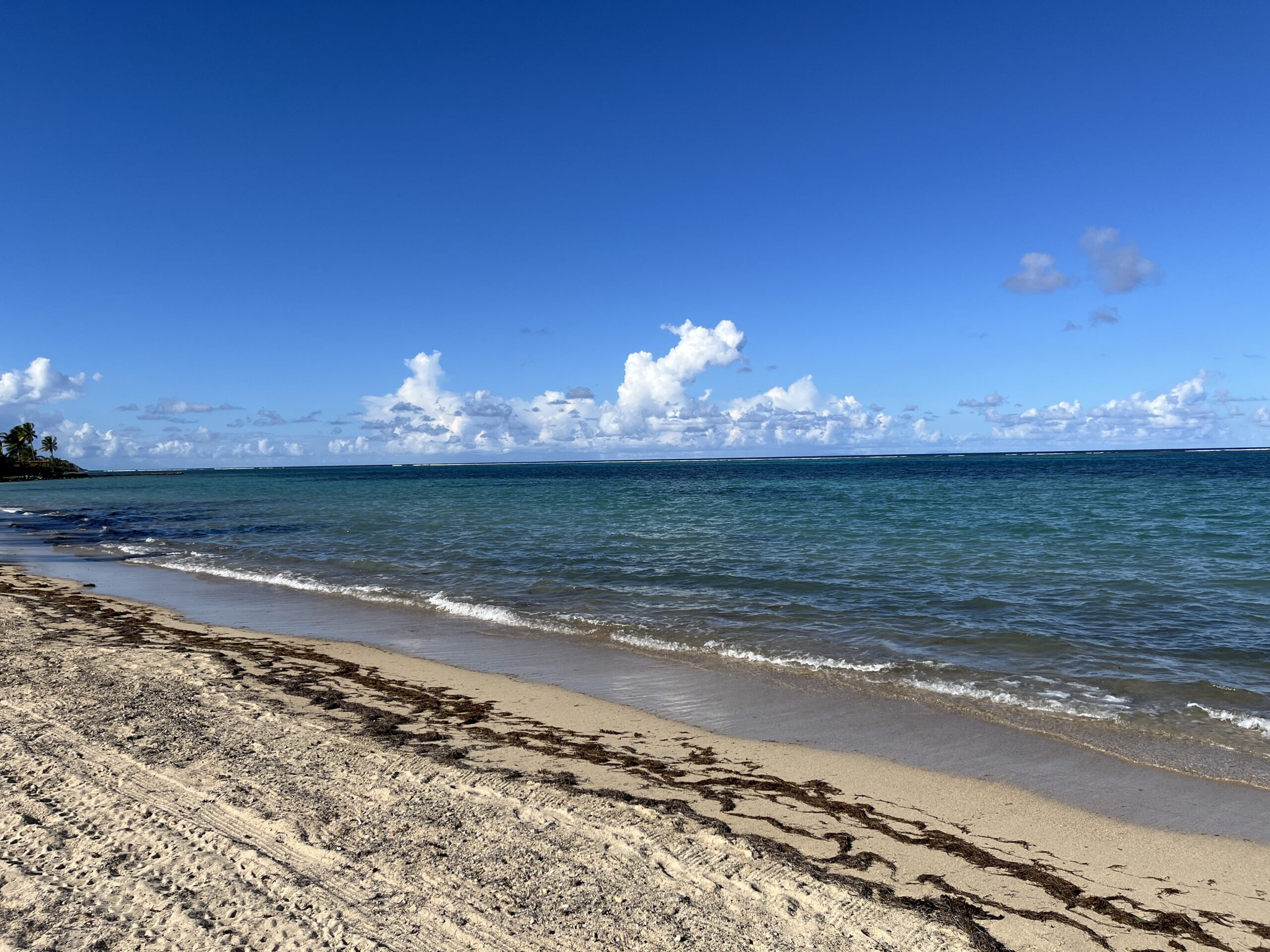
USF emphasized that the amount of the algae in the Gulf should remain small, but growth in the Caribbean is expected to continue, meaning beaching remains possible, particularly along the Mexican Caribbean coast and parts of the Lesser Antilles in the months ahead.
Individuals can follow the progression of the current mat of seaweed and stay up to date each month on where sargassum may be headed.
Finally, in addition to tracking the occurrence of sargassum, residents and visitors across the U.S. Virgin Islands are encouraged to continue monitoring the local weather forecast.
Weather information is available from the NWS, the NHC, and NOAA. The local weather forecast for the U.S. Virgin Islands is regularly updated on the Source Weather Page and VI Source YouTube Channel, and individuals can also find helpful weather information and alerts from the Virgin Islands Territorial Emergency Management Agency.