

In a cross-territorial discussion hosted Wednesday by the advocacy group Right to Democracy, scholars and organizers from U.S. territories convened to examine both the history and contemporary impacts of militarization.
“Our focus as an organization, and the focus of this conversation, is on ensuring that people in the U.S. territories have power and agency over decisions that impact them,” said Adi Martínez Román, co-director of Right to Democracy and co-moderator of the event. “U.S. military activities are having profound impacts on the communities across the territories, and our belief is that these communities should have a say in these activities, whether as part of the U.S. political body or on their own.”
Panelists from Puerto Rico, Guam, and the Northern Mariana Islands, along with moderators from the U.S. Virgin Islands and Puerto Rico, discussed the wide-ranging impacts of militarization, from rising costs of goods to environmental and public health concerns. They also examined the historical roots of U.S. military presence in the territories.
“In our contemporary history, the change in colonial administration that occurred in 1898 created a new model of occupation and militarization,” said Melody Fonseca Santos, associate professor of political science at the University of Puerto Rico. “Puerto Ricans have a long history of engagement with the U.S. military, marked by moments of struggle, resistance, and even victories.”
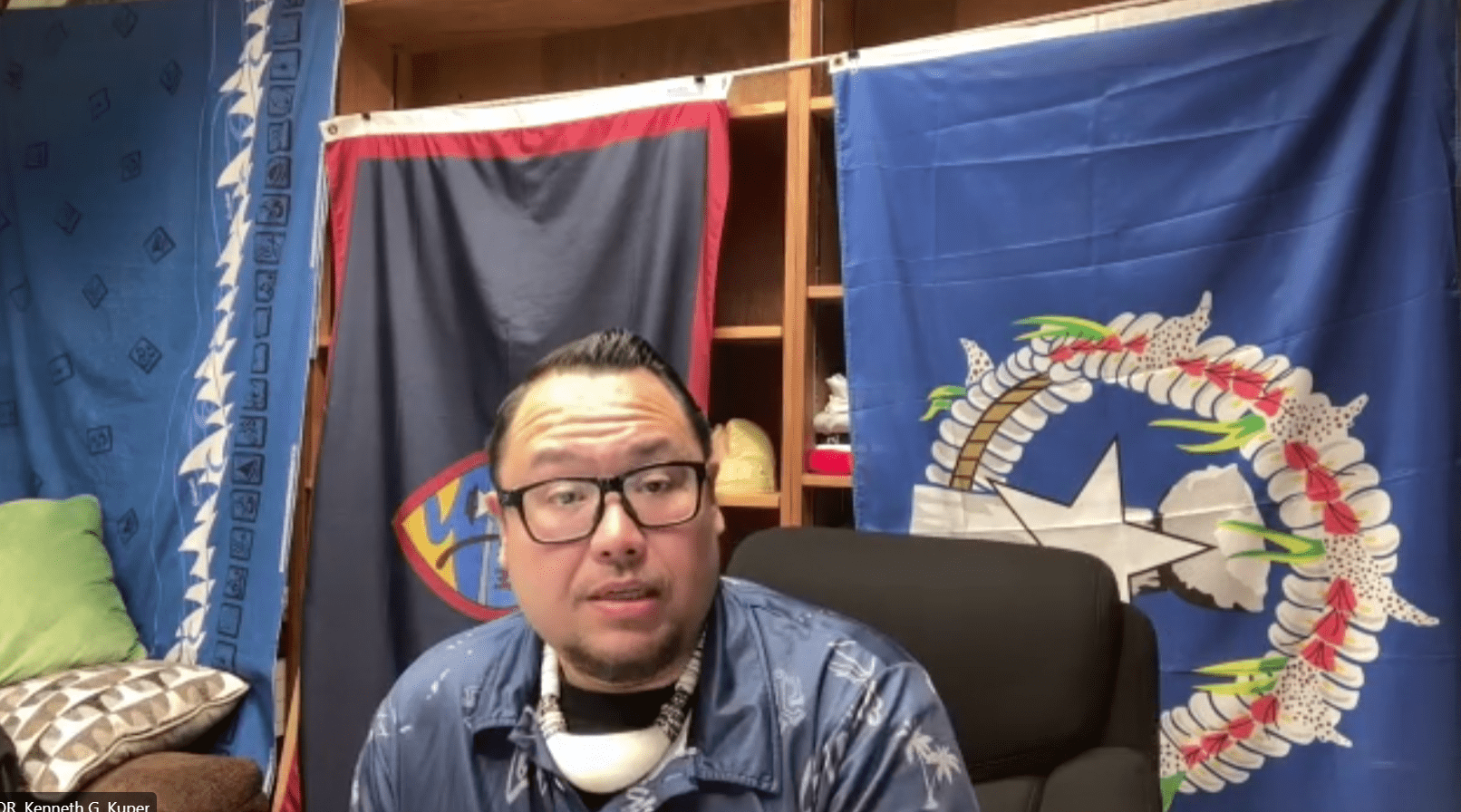
That same year, Guam was ceded from Spain to the United States. “After the Spanish-American War, just as Puerto Rico and the Philippines were transferred to the United States, so was Guam, though Guam was much smaller,” said Kenneth Gofigan Kuper, associate professor of political science at the University of Guam’s Micronesian Area Research Center and director of the Pacific Center for Island Security, a think tank offering independent foreign policy analysis for the Asia-Pacific region.
“At that time, we were put under a naval government. So the highest ranking naval official pretty much ran Guam and these officers were not made for civilian government.” Kuper said.
The consequences, he explained, remain visible today. “Twenty-seven percent of our land is currently occupied by the U.S. military,” Kuper said. “A lot of times, what is good for Guam security and U.S. security will line up. But what do we do in the instances in which they don’t? … We need to exercise our agency.”
For the Northern Mariana Islands, the transition to U.S. association came through negotiation rather than conquest. “At that time, [we] negotiated our political status with the United States, which resulted in our current status as a U.S. Commonwealth,” said Theresa “Isa” Arriola, an assistant professor in the Department of Sociology and Anthropology at Concordia University.
Arriola also chairs Our Commonwealth 670 (OCW 670) on Saipan, a community advocacy group dedicated to research, education, and awareness about military planning in the Mariana Islands. “The arrangement gave us a level of political autonomy that we had not had before, yet the United States maintained complete authority, essentially over foreign affairs and defense,” she said.
Hadiya Sewer, a U.S. Virgin Islands native and co-moderator of the panel, discussed how the U.S. Virgin Islands, purchased from Denmark in 1917 for $25 million in gold, became a strategic outpost, a status whose effects can still be felt in many ways. “St. John is over two-thirds National Park, St. Croix had one of the largest oil refineries in the Western Hemisphere, and St. Thomas was a polling station during the naval administration,” Sewer said.
Panelists agreed that the effects of militarization are still felt across the territories, reshaping economies, housing markets, and local environments. “If the military is a 12-foot giant in your house, he’s bound to step on you sometimes,” said Kuper. “Our two pillars of our economy are military spending and tourism.” He noted that raising concerns can carry a social cost: “Sometimes to criticize even remotely the military, you get labeled as, like, anti-American … which is quite odd,”
Santos told the panel that U.S. military activities have left deep and lasting scars on Puerto Rico’s environment and public health, particularly in Vieques. She noted that in Vieques, “the prevalence of cancer …[is] 30% higher than in the rest of Puerto Rico,” with especially elevated rates among children and youth. She described these areas being treated as “sacrifice zones,” where residents have faced displacement, toxic exposure, and ongoing threats to water and land.
“To this day, they have not finished cleaning these territories, and there is no idea of when these territories will be transferred from the military to the communities,” she said, warning that the consequences of contamination remain unresolved, with no clear timeline for environmental restoration or the return of local control.
Santos also emphasized Puerto Rico’s ongoing strategic importance to U.S. military plans in the Caribbean. “After decades of active militarization, the strategic position of Puerto Rico has again become of high interest to the United States,” she said, citing recent troop deployments and increased use of local bases. She cautioned that these military activities carry tangible social and environmental costs.
The island’s central role in U.S. military strategy has also sparked long-standing local resistance. “In Puerto Rico, there are community groups and political organizations that have sustained a culture of anti-militarization and anti-imperial struggle,” said Santos.
She said she feels that the costs of militarization outweigh the economic benefits. “There’s no discourse of economic development that is worth it if we put into perspective that other cost. The health, the contamination, the loss of land.”
Panelists made clear that dissent is not about opposing individuals in uniform, but about standing for community agency. “To critique systems of power that are directly benefiting from violence, and war, and war preparation does not mean we’re in opposition to military personnel …” said Arriola. “It means privileging and centering self-determination, centering indigenous agency, and actually exercising the right to your political future.”
As the discussion closed, Román said, “It is very important that we have these conversations,” she continued. “It is important to recognize that the territories need to have agency, actual agency, in these decision making processes, because the decision making that is being done … is affecting our communities, it is affecting our economy, and it is subjugating our leaders and our local governments into acquiescence with models that might not be the best for the development of our people and our communities.”