

When three chiefs of indigenous Caribbean tribes met with tribal members on St. John this week, their primary purpose was to sign a declaration of unity “to cooperate and assist each other, whenever possible, in matters of mutual interest and concern.”

But their visit included so much more. It offered them an opportunity to commune with each other at sites frequented by Indigenous people centuries ago, including the petroglyphs (rock carvings) at the pools of Reef Bay and the shaded areas along the beach at Cinnamon Bay.
It also gave them the chance to tell the public that indigenous Caribbean tribes are not extinct, as some may have thought, but are “surviving and even thriving,” in the words of one chief.
The three chiefs — “kasikes” in the Taino language — represent tribes from Puerto Rico, the Virgin Islands, and Dominica. Though they have much in common, each of them has a unique role and tribal community. They shared their experiences on Wednesday evening at an event held at Bajo El Sol Gallery in Cruz Bay.
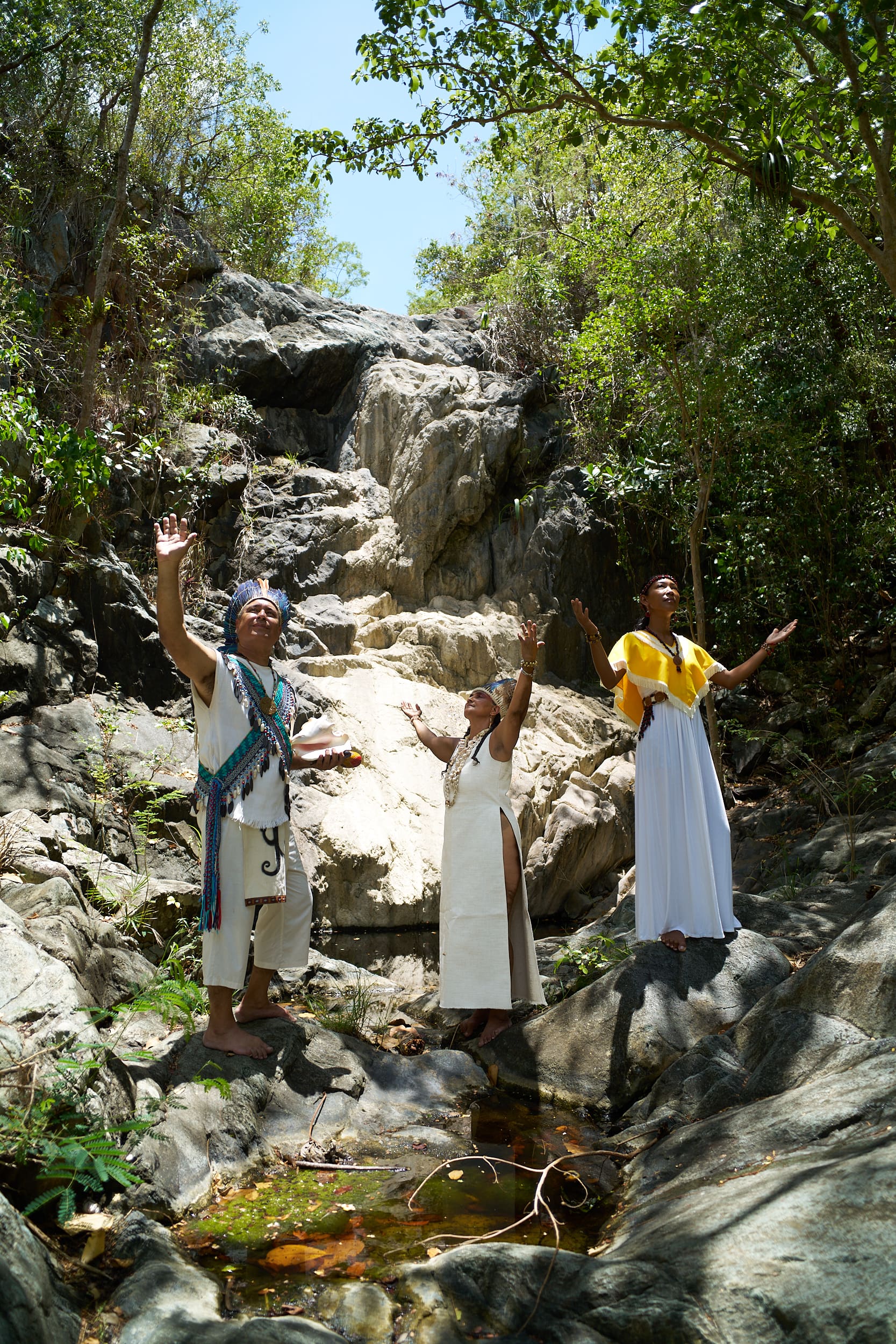
Kasike Roberto “Mukaro Agueibana” Borrero heads up the Boriken Guiania Taino Tribe of Puerto Rico, where he said the community “raised our own funds to purchase land to give it back” (to our people).
Barrero said seeking federal recognition for his tribe — “really, affirming rights that we already have” — is a long-term goal. But given the current political climate in the United States, “It’s better to focus on things locally,” he said. Among his current initiatives is the mastery of the Taino language and publication of a Taino dictionary.

Barrero has guided Kasike Maekiaphan “Anacoana” Phillips of St. Thomas as she has sought recognition for the Guiania Taino Tribe of the Virgin Islands. In 2021, after a 10-year campaign led by Phillips, Gov. Albert Bryan Jr. signed a proclamation that officially established the tribe and affirmed its rights to promote its culture, language and traditions.

Since 2011, Phillips has been trying to raise awareness that many Virgin Islanders have Taino ancestry. She grew up hearing tales about her great-grandmother Francisca, who, as a young woman of Spanish and Taino descent, was kidnapped from Puerto Rico by the “pirate James Abbott” and brought to Salt Island in the British Virgin Islands.
Francisca had six daughters, including Phillips’ grandmother, Bellencita Almestica, who married into the Benjamin family from John’s Folly, St. John. Those six daughters had 43 children by Phillips’ reckoning. Phillips, herself, is one of 20 children. She has 12 children of her own, 17 grandchildren, and three great-grandchildren so far, so their Taino heritage continues to spread.
Phillips’s son Emmanuel is a St. Thomas-based photographer and filmmaker, and his latest film, “We Are Taino,” was screened on St. John at Bajo El Sol Wednesday evening. The film, which depicts his mother’s discovery of her Taino heritage, is part of a series produced by PBS and is now available on YouTube.

The third chief to attend the meetings on St. John is Ouboutu Anette Sanford of the Kalinago Nation in Dominica. Unlike the Taino tribes, which have been struggling for recognition, the Kalinago Nation was established in 1763 and has functioned somewhat autonomously since 1903.
The Kalinago people, originally called “Caribs” by Europeans, led to the term “Caribbean” for the region. Now, nearly 3,000 Kalinago people live in a communally owned tribal area consisting of 3,700 acres on the eastern side of Dominica.
Their chiefs are elected by the people and serve five-year terms. Sanford, who is the first female chief in 400 years, told the audience at Bajo El Sol that the tribe makes their own laws, settles their own land disputes, and monitors researchers who come in to study the community.
She acknowledged the importance of having a homeland and encouraged Phillips to pursue her efforts to establish a site for the Taino in the Virgin Islands.
Phillips has been searching for a site to set up a demonstration Taino Village in the Virgin Islands. In June, she made a proposal to the Magens Bay Authority to acquire a site within the arboretum in Magens Bay.
Sean Krigger, director of the V.I. State Historic Preservation Office, says in the film “We Are Taino” that archaeological evidence shows that Magens Bay was once a Taino site, so the proposal falls within the office’s “mandate to protect and promote our Native American history.”
The events this week on St. John were sponsored by the Friends of the Virgin Islands National Park, according to Tonia Lovejoy, the organization’s executive director. “It was a landmark meeting for the Friends,” she said. “We are honored to bear witness to the ‘Meeting of the Chiefs’ and the signing of the ‘Declaration of Unity’ among them. It stands as a testament to the power of peace among people.”

For further information on the presence of Taino in the Virgin Islands, follow the links below to the series “Taino Today.”
Taino Today Part One: Descendants Challenge Outdated Extinction Theory
Taino Today, Part 2: Phillips Seeks to Raise Awareness of Taino Ancestry
Taino Today, Part 3: The Phillips Family Has Gained Recognition
Taino Today, Part 4: Recent Discoveries at Cinnamon Bay Show Presence of Early Indigenous Culture
Editor’s Note: For those who are unfamiliar with the term “Taino,” it refers to “the Arawakan-speaking peoples of the Caribbean who arrived from South America over the
course of 4,000 years,” according to an article in National Geographic.




We are offering corporate and Personal Loan at 3% to 7% Interest Rate for a duration of 1 to 20Years. We also pay 1% commission to brokers, who introduce project owners for finance or other opportunities. interested for more details davephilip12@gmail.com