

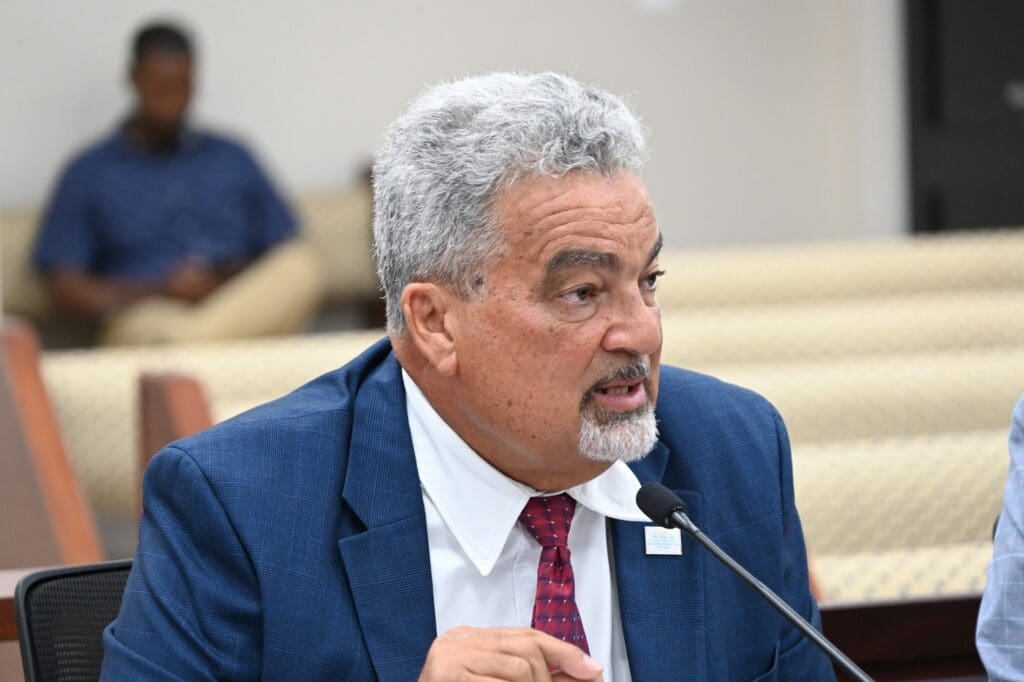
Despite modest progress in some sectors, the economic health of the U.S. Virgin Islands remains in flux, with real-time challenges demanding strategic intervention, officials told lawmakers during a pivotal Senate hearing Monday.
In testimonies before the 36th Legislature’s Committee on Economic Development and Agriculture—chaired by Sen. Hubert L. Frederick—leaders from the Virgin Islands Economic Development Authority (VIEDA) and the Bureau of Economic Research (BER) painted a nuanced picture of the territory’s economy: one of cautious optimism, underscored by structural gaps and the urgency to modernize systems, boost self-sufficiency, and increase transparency.
VIEDA CEO Wayne Biggs Jr. outlined ongoing efforts to support job creation, housing access, and investment attraction. He pointed to internal stability—backed by 13 consecutive clean audits and over $85 million in federal grants—as a sign of progress, and highlighted the $8.998 million in loan guarantees issued under the federal State Small Business Credit Initiative (SSBCI 2.0), which have helped generate 99 new jobs and retain 94 others across construction, tourism, and healthcare. Through its VI Slice gap financing program, the Authority has also helped 47 first-time homeowners close on properties, with $5.2 million approved as of March, he said.
Meanwhile, initiatives like the Enterprise Zone Commission’s neighborhood revitalization projects and agro-processing center development—funded with $2 million from the Legislature—are intended to uplift distressed areas on both St. Thomas and St. Croix. Two new industrial buildings are planned for St. Croix to meet demand, with both of the territory’s economic development parks currently at full occupancy.
But challenges remain. Several senators raised concerns about VIEDA’s continued reliance on government appropriations despite its semi-autonomous status. While Biggs explained that the Authority’s clients pay taxes to the government, not directly to the agency, lawmakers such as Sen. Marise James questioned why the EDA isn’t financially independent yet. Sen. Novelle Francis pressed further, asking for a clearer accounting of return on investment, including how much tax incentive recipients contribute to public education. Biggs estimated beneficiaries contribute up to $350 million annually to the government’s coffers but acknowledged the agency lacks mechanisms to track specific impacts, such as educational donations, which are reported—often belatedly—by the Department of Education.
Senators also raised alarm over staffing and capacity. With compliance officers handling double the ideal caseload and eight unfilled positions due to salary constraints, Biggs said the agency’s ability to keep up with demand is under strain. CFO Kelly Thompson-Webb added that while larger grants help cover operations, smaller awards offer little to no administrative support, forcing VIEDA to dip into its core budget. Lawmakers agreed the situation places an undue burden on the Authority, which charges sister agencies just 5% for indirect costs—far less than the government’s 15%.
In a broader warning about long-term viability, Biggs said marketing remains underfunded, noting the agency’s $500,000 budget pales in comparison to Puerto Rico’s $20 million spend. An additional $3.5 million, he argued, could significantly raise the territory’s visibility. Infrastructure delays—especially FEMA-related repairs and permitting slowdowns—continue to limit investor interest. Senators acknowledged these bottlenecks and voted to hold in committee Bill No. 36-0065, which would shift the V.I. Port Authority’s focus from constructing a new warehouse to assisting with the renovation of an existing facility on St. Thomas—a measure seen as a more viable solution amid resource constraints.
At the same time, BER Director Dr. Haldane Davies focused on the data needed to support policy decisions. While outlining projects like a Household Income and Expenditure Survey and a health insurance viability study, Davies flagged the lack of recent GDP data and broader gaps in federal reporting for U.S. territories. He stressed that the territory must build a more resilient, data-informed economy—and that doing so requires skilled personnel, modern technology, and sustained federal engagement.
Several senators expressed concern about how long the Vision 2040 plan has remained in the strategy stage. While Biggs said progress is being made in sectors such as the blue economy and clean energy, others argued that execution still lags. Sen. Frederick, in particular, underscored the importance of economic resilience and local empowerment through targeted legislation and inter-agency collaboration. “Our focus is on fostering sustainable growth and promoting a more diversified economy that benefits the entire territory,” he said.
Still, inflation remains a pressing concern—especially on St. John, where consumer prices have increased by 2.2%, with gas prices hovering near $4 per gallon. Lawmakers questioned what protections were in place to shield residents from the effects of rising costs. Additionally, the closure of large retailers like Kmart has prompted calls to attract major distributors. While Biggs said statutes currently exclude most retail from EDC benefits, discussions are underway with companies like Amazon about the possibility of a local distribution hub.
Both Biggs and Davies acknowledged the strength of long-term frameworks such as the Comprehensive Economic Development Strategy and Vision 2040, but said real impact depends on addressing outdated infrastructure, workforce limitations, and tighter coordination between government agencies.