

Scientists with the National Oceanic and Atmospheric Administration (NOAA) have developed an algorithm system to measure in-flight turbulence. By studying nearly two decades of data, the research could help improve flight safety for NOAA reconnaissance missions into tropical cyclones and establish new turbulence standards for passenger flights.
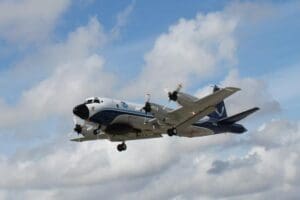
According to an article released from NOAA on March 31, a team of NOAA scientists wanted to learn more about the intense turbulence experienced while flying aboard a NOAA Lockheed WP-3D Orion aircraft to obtain weather information about Hurricane Ian, a major hurricane in 2022.
“NOAA flies hurricane hunter aircraft to gather and transmit critical data essential to protecting lives, property and strengthening our economy,” the NOAA article said. “Crew members include officers in the NOAA Commissioned Corps, and scientists and engineers from NOAA’s Office of Marine and Aviation Operations, NOAA Research, and the NOAA Satellite and Information Service,” the report continued.
“The question spurred scientists, two who were aboard [the flight into Hurricane Ian, which experienced severe turbulence], to develop a new system to measure flight bumpiness. The new rating system, described in research published online in the Bulletin of the American Meteorological Society, can be used broadly to measure bumpiness on other flights. It can also be used to advance safety improvements,” the NOAA article said.
“We wanted to know how our flight into Hurricane Ian stacked up against other bumpy missions,” said Joe Cione, a hurricane researcher at NOAA’s Atlantic Oceanographic and Meteorological Laboratory, who was aboard the flight to gather data to improve the forecast. “With turbulence as the leading cause of injuries aboard aircraft, we hope our research can help improve the safety of many who fly.”
Measuring Turbulence
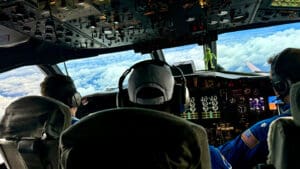
Researchers created an algorithm to rate turbulence to improve safety for pilots, crew, and passengers. Their findings could help establish new turbulence standards, making air travel safer, including for the traveling public aboard commercial flights.
The research report explained the following details about how the new system to measure bumpiness was established.
“To create the system, the team of scientists from NOAA Research, NOAA’s National Weather Service, and partner scientists gathered flight data routinely recorded every second on its P-3 aircraft [an airplane used to investigate tropical cyclones] flying into Atlantic hurricanes from 2004 to 2023. The data tracks three dimensions of motion, front to back, left to right as well as up and down.
“[Researchers] also included the data from Hurricane Hugo in 1989 and [Hurricane] Allen in 1980, two particularly bumpy flights. From all this data, they created an algorithm to define and rate bumpiness.”
The report indicated, “While there are other systems that measure atmospheric turbulence, what is new and different about the bumpiness measuring system is that it quantifies the bumpiness felt by people inside the aircraft, accounting for three dimensions of motion: front to back, left to right as well as up and down.
“The current gold standard for measuring turbulence, called ‘Eddy Dissipation Rate,’ measures the rate at which energy in the atmosphere dissipates, focusing on what’s occurring in the atmosphere and not inside the plane,” according to the report.
NOAA’s Turbulence System Explained
The Source contacted one of the authors of the airplane bumpiness research paper for additional details about the project. Joshua B. Wadler, lead author of the new research and an assistant professor of meteorology at Embry-Riddle Aeronautical University, explained how the algorithm system may be helpful for safety.
“We created [the] algorithm based on physics first principles that use the data that is already collected and recorded on the NOAA P-3 [aircraft],” Wadler explained. “The [new] algorithm [analyzes] the previously available data [from instruments aboard a NOAA aircraft] and computes the bumpiness [included for three dimensions of motion: front to back, left to right as well as up and down],” he said.
Wadler noted that the algorithm could be used to evaluate passenger plane bumpiness levels, helping to keep individuals safe.
“For the general public, I view the bumpiness metric as providing an additional safety standard,” Wadler stated. “For example, if future research shows that high amounts of bumpiness impede decision making, bumpiness that exceeds a certain threshold might require additional sign-off on some decision-making from air traffic controllers.”
“Since the algorithm to compute bumpiness uses information every aircraft records in real-time, it would be relatively straightforward to apply it to any aircraft,” Wadler said. “We plan to [eventually] work with the Federal Aviation Administration and potentially [commercial] airlines to standardize this process,” he added.
The Source also connected with Sim Aberson , a meteorologist at the Atlantic Oceanographic and Meteorological Laboratory’s Hurricane Research Division, which is part of NOAA. Aberson is a “Hurricane Hunter,” and he was on board two reconnaissance flights into Hurricane Felix in 2007 and Hurricane Cristobal in 2014. The data from these flights were included in the research leading up to the development of the new bumpiness algorithm.
“[The extreme turbulence during the flight into Hurricane Felix] all happened really so quickly that it was over before [the scientist on board the flight] registered that anything [serious] had happened,” Aberson described. “[However,] the radars went out, which meant that we could not see the structures around us, [and] it was dusk on a moonless night, so it was difficult to see the clouds,” he continued.
“The [bumpiness experienced during a research flight into Hurricane Hugo in 1989] was the most dangerous, and we know that there can be even more dangerous events,” Aberson warned. “[Therefore,] it’s important to know how the aircraft responds,” he said.
Aberson said that while it is rare for hurricane research aircraft to crash, accidents can and do happen. The most recent U.S. hurricane reconnaissance flight that went down over the Atlantic Ocean occurred in 1955.
Safety and Protection for the Public
In addition to developing the new system to measure bumpiness, environmental scientists are committed to studying the environment and helping keep the public safe. A recent Source article highlighted some of the significant research conducted by the individuals at NOAA and the National Weather Service.
According to information from NOAA’s Research division, “NOAA Research enables better forecasts, earlier warnings for natural disasters, and a greater understanding of the Earth.” The site also explains the division’s “role is to provide unbiased science to better manage the environment, nationally and globally.”
Individuals can read about the latest NOAA research on the agency’s website.
Staying Informed About Weather Events
Hurricane season begins on June 1 and runs through Nov. 30, and USVI residents and visitors are encouraged to be prepared. In addition to obtaining weather information from the NWS and NOAA, the local weather forecast for the U.S. Virgin Islands is regularly updated on the Source Weather Page and VI Source YouTube Channel. Individuals can also find helpful weather information and alerts from the Virgin Islands Territorial Emergency Management Agency.