

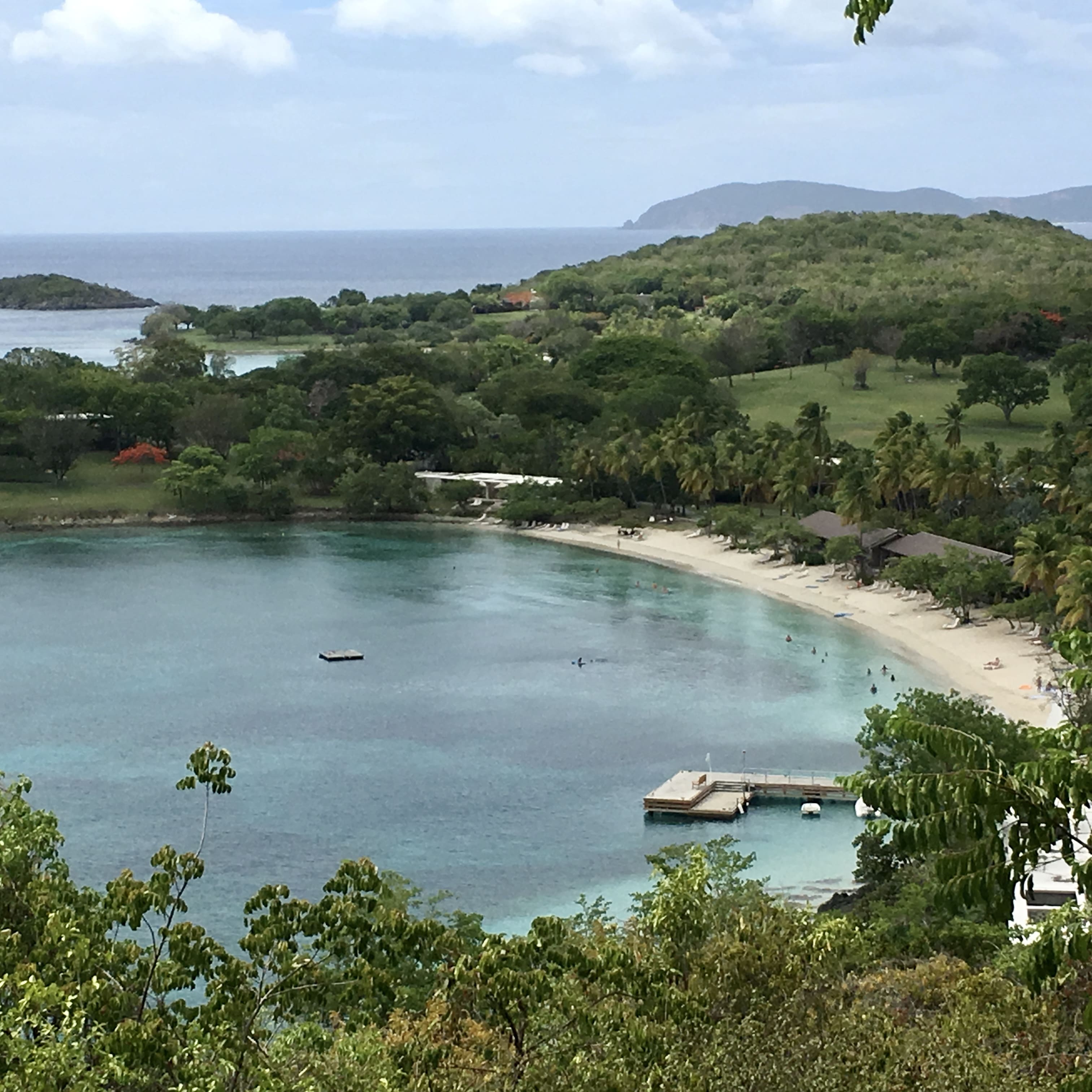
Caneel Bay Resort on St. John belongs to the U.S. government, the V.I. District Court has ruled, ending a long-running lawsuit by EHI Acquisitions, the company that had operated the luxury hotel property since 2004 and sought to take title to the land and its improvements.
At issue in the lawsuit that was brought in June 2022 was whether the resort on 150 acres of prime St. John beachfront real estate belongs to EHI Acquisitions, which managed the property under an agreement known as a Retained Use Estate, or to the federal government after the RUE expired at the end of September.
The RUE was created in 1983 by Laurance Rockefeller, who donated some 5,000 acres of land to the National Park Service but reserved the Caneel Bay property for the Jackson Hole Preserve, the family’s land trust. Under the agreement, the preserved land was transferred to the NPS with the understanding the RUE — also known as the 1983 Indenture — would remain in place for 40 years. The resort has been managed by different entities since then, the latest being EHI Acquisitions, an affiliate of CBI Acquisitions.
The court was left to determine whether language in the RUE obligated the federal government to pay EHI for its improvements to the property over the years; whether it reverted to EHI because the Interior Department rejected its 2019 offer to relinquish the RUE for $70 million after the resort was destroyed by hurricanes Irma and Maria in 2017; or whether it belonged to the NPS free and clear.
Third Circuit Judge Cheryl Ann Krause was unequivocal in her 20-page Memorandum Opinion and Order granting the United States’ motion for a summary judgment, filed Monday, that the language of the 1983 Indenture makes clear that the property and its improvements were to be given back to the government at the expiration of the RUE for a nominal consideration of $1.
Krause was assigned to the case in December after V.I. District Court Chief Judge Robert Molloy was removed without explanation. Her ruling comes after she ordered both sides in January to file supplemental briefs answering questions of contract and property law specific to the case, which they did by the Feb. 8 deadline.
“Examining the plain language of Paragraph 8 in the context of the whole Indenture, we are convinced that this meaning was entirely philanthropic. The dispute between EHIA and the United States hinges on the meaning of the word ‘offer’ as it is used in the Indenture,” she wrote.
“It does not say that the Grantor shall make ‘an offer to convey for value’ or ‘an offer to sell.’ Indeed, commercial language like ‘bargain’ or ‘fair market value’ is conspicuously omitted from the Indenture. When parties use clear and unambiguous terms, we will not insert additional terms that are contrary to the parties’ plain meaning,” Krause stated. “Thus, here, the plain language of Paragraph 8 indicates that the parties did not intend to make the improvements’ transfer contingent on payment.”
EHI had argued that “properly framing the issue” came down to the meaning of the phrase “an offer … to convey and transfer.”
“Defendant cannot prevail merely by demonstrating that the phrase encompasses a gift. Defendant can prevail only by demonstrating that it means only a gift and precludes a bargain,” it said in its February brief.
Furthermore, if “the Indenture were interpreted as requiring a gift of the Improvements, it would necessarily be a future gift, and would therefore be ineffective and unenforceable” under Virgin Islands law, EHI argued.
The government contended that EHI “signed documents agreeing to convey and transfer the improvements to the United States at the end of the RUE and operated under those documents for over 15 years. It was only after EHI failed to get the RUE extended and the time was approaching for EHI to transfer the improvements to the United States that, all of a sudden, EHI claimed it owned the entire 150 acres of land and all the improvements on it.”
It was forthright on the matter of ownership and whether the RUE holder had any right to compensation and asked that “EHI should be ordered to convey the Improvements to the United States and estopped from claiming title to the Premises.”
Furthermore, it argued that EHI was unjustly enriched because it has retained possession of the improvements located on prime real estate on St. John after the RUE expired in September and the court ordered the United States to refrain from taking possession of the property until the lawsuit was resolved.
“EHI also has retained possession of the insurance proceeds that it received to rebuild the Caneel Bay Resort after the 2017 hurricanes,” the government noted. “The resort has not been rebuilt.”
In ruling for the government, Krause expressed incredulity at EHI’s arguments.
“EHIA’s interpretation of ‘offer’ is not only unsupported by the Indenture’s text and structure, but also raises significant obstacles to the contract’s implementation. First, it would allow the Grantor to demand payment for early termination at any point between September 30, 1986 and September 30, 2022. In effect, then, EHIA asks us to accept the far-fetched conclusion that in signing the Indenture, the Government agreed to give [Jackson Hole Preserve] a 36-year option to suddenly demand that it pay an unknown number of millions of dollars or else forfeit several hundred acres of prime beachfront property,” Krause wrote.
“Second, EHIA’s reading of ‘offer’ would have an absurd consequence: EHIA concedes that if the RUE were allowed to expire, the improvements would go to the United States at no cost, yet it maintains that the Government must pay for the improvements if the RUE is terminated early,” the order states.
“Under EHIA’s interpretation of the Indenture, it is difficult to imagine why any rational actor would allow the RUE to expire, when doing so would mean giving the Government for free what it could have offered the government at a price — with the sweetener that if the Government declined, the RUE’s owner would keep its money and acquire premium property at no cost,” it said.
Contrary to what EHI claims, “the Indenture does not treat the transfer of the improvements differently depending on whether the RUE is terminated early or terminated upon expiration. The Indenture is instead structured so that however the RUE ends, the land and improvements wind up in a single set of hands: either the Government’s (if it accepts the improvements and incorporates the resort into the National Park) or the Grantor’s (if the Government declines the improvements or excludes some part of the resort from the Park),” Krause wrote.
“This reversion mechanism is consistent with the parties’ stated intent that the Park ‘ultimately be an integral part’ of the National Park ‘for the public benefit,’” she said, citing the 1983 Indenture.
“The gift of the resort to the United States is contingent — not on payment, which is nowhere mentioned in the Indenture — but on the Government’s willingness to abide by JHPI’s expressly philanthropic vision for Caneel Bay,” Krause wrote.