

Editor’s Note: This article, which originally ran in Western Tanager magazine, is reprinted with the permission of the Los Angeles Audubon Society. It is part one of a continuing series on birds and birdwatching in the Virgin Islands by Robbie Lisa Freeman.
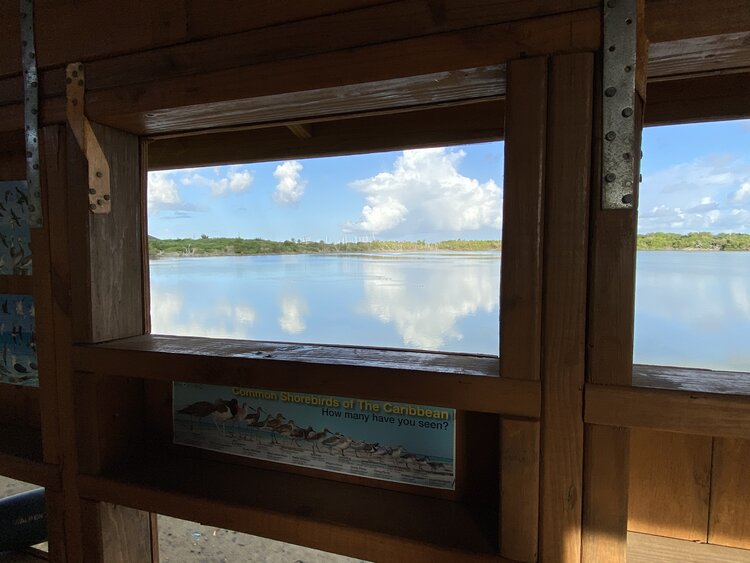
I’m standing in an 8’ x 10’ x 16’ stout wooden box overlooking the semi-dry salt pond at the Southgate Coastal Reserve. From this newly constructed bird blind, I see hundreds of shore birds foraging through the mud flats and shallow waters. Countless more circle overhead, rising and falling in a perfectly synched aerial ballet.
“What draws them here?” I ask, crinkling my eyes in my binoculars as if that will help me see better. “Let me show you,” says guide Jennifer Valiulis. “Follow me.” Outside the bird blind she sets up her scope, futzes with it, then beckons me over. “Take a look.” Her powerful scope reveals a world of surprises: the mud flats are moving! They’re crawling with millions of tiny red fiddler crabs — the perfect hors d’oeuvres for the 100+ species of resident and migrant birds recorded around the area. We see sandpipers, soras, snipes, plovers, egrets, herons, terns, and yellowlegs, to name a few. And this is the end of migration season! “Many of these shore birds will head north soon,” says Valiulis, “but others, like the Least Terns, are just arriving. During rainy season, when the pond fills, we get totally different birds — lots of ducks. We’ve had flamingos. Last year we had the first record of a Scarlet Ibis — two adults plus a hybrid.” The ibises, typically found farther south where they’re lauded as the national bird of Trinidad and Tobago, had likely wandered off course. Fortunately for both wandering and migrating birds, a preserve like Southgate can be a life-saving oasis in a long journey.
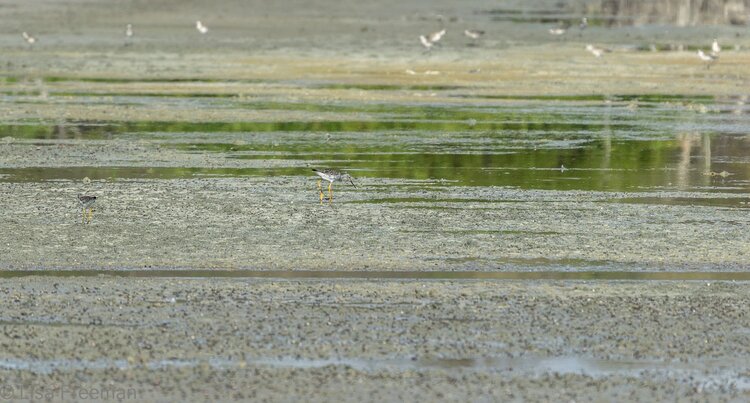
The 100-acre Southgate Coastal Reserve is a critical wetlands ecosystem for sheltering and nourishing birds. It includes a coastal salt pond, upland grasses, and mangrove and beach forests. According to Valiulis, who is executive director at St. Croix Environmental Association (SEA), the preserve not only supports threatened and endangered bird species, but it provides a beach berm for three species of imperiled sea turtles, and habitat for the endangered St. Croix Agave. She shows us a recently planted specimen. “This agave is only found on St. Croix, but became rare in the wild due to habitat destruction and collection by specimen seekers,” she says. Today, SEA works with the U.S. Fish and Wildlife Service, National Park Service, and other associations to designate critical habitat for it.
Valiulis shows us other native plants and trees SEA has planted, such as the caper tree, and orange manjack. Replanting native habitat has been critical to forest and wetland birds. “After Hurricane Maria struck in 2017, this whole area was carved out; complete destruction of plants and trees,” she says. The Category 5 hurricane was the region’s worst in recorded history. But after four years of recovery there are bright spots. “This bush, Sweet Scent, popped up after the hurricane,” she says. “We like it because it’s native, and these small clusters form flowers that attract both birds and bees.” As if on cue, we hear a melodious song and look up: A Yellow Warbler sits high in a shrub. He delights us with few more notes before disappearing in a golden flash.
As we trek on, Valiulis describes the goals of SEA: education, conservation, and advocacy. SEA conducts school field trips, classroom lectures, community events, and even kids’ camps to help families learn about island wildlife and conservation. “One of my favorite activities is free snorkel clinics for families,” she says. “Many islanders have never snorkeled. Once they see fish, sea turtles, and coral under water, it can be life-changing.” Having experienced first-hand a sea turtle encounter here, I whole-heartedly agree.
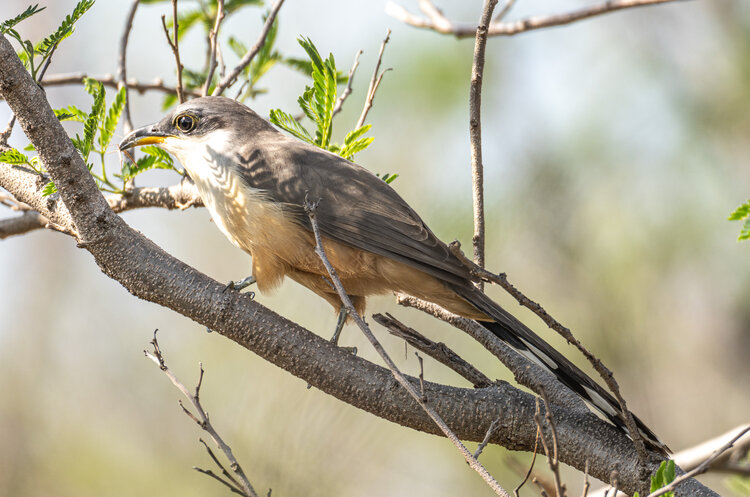
But for now, with our feet on dry land, I’m hoping for an encounter of a different sort: “Ever get Mangrove Cuckoos here?” I ask. “We don’t see a lot of those,” Jen admits. I’m crestfallen, but not for long. Minutes later I see motion in the corner of my eye — a bird tucked into a scrubby bush. When he pops out, I whisper loudly, “Mangrove Cuckoo!” He’s just feet from us, so we stand frozen, holding our breaths, hoping he might thread his way into the open. And … ever… sooo… slowly… he does, popping his head out clasping nesting materials in his beak. When he’s suddenly joined by a second cuckoo, Jen gasps. “They’re usually solitary, so to see two together is rare,” she says. “This might be a first record of them nesting here!” That’s an impressive morning discovery and an encouraging sign that SEA’s conservation efforts may be paying off — providing new safe havens for birds of all types.
A day later I drive to another avian sweet spot, St. George Village Botanical Gardens. These gardens were once part of a 150-acre sugar plantation. But when sugar profits soured, cattle replaced the cane. In 1972, a 16-acre parcel of land was donated to the St. Croix Garden Club to establish a village garden. Today, the remarkably transformed site is known for its vast botanical collection of over 1,000 rare and native plants. Arriving at 7 a.m., I’m excited to see what birds inhabit this little oasis. From the parking lot, I immediately spy not one but two American Kestrels in the tall trees. Through my binoculars I can see that they’re bent over breakfast — likely a mouse or lizard, judging by the long limp tail. Below the birds, in the tall grass I see movement, then the head of giant green iguana, one of the world’s largest land lizards. He pauses, then bolts like lightening through the scrub. Thoughts of Jurassic Park come to mind.
In the garden’s reception area, I’m met by a tall crucian man — made taller by his turban headwrap. The esteemed Olasee Davis is a man who wears many hats, both literally and figuratively. By trade, the native Virgin Islander is a Professor in the Natural Resources Program at the Cooperative Extension for the University of the Virgin Islands. He’s also an activist, ecologist, botanist, historian, teacher, writer, and bushman who has spent a lifetime educating locals, visitors, students and politicians about St. Croix’s cultural history and environmental preservation.
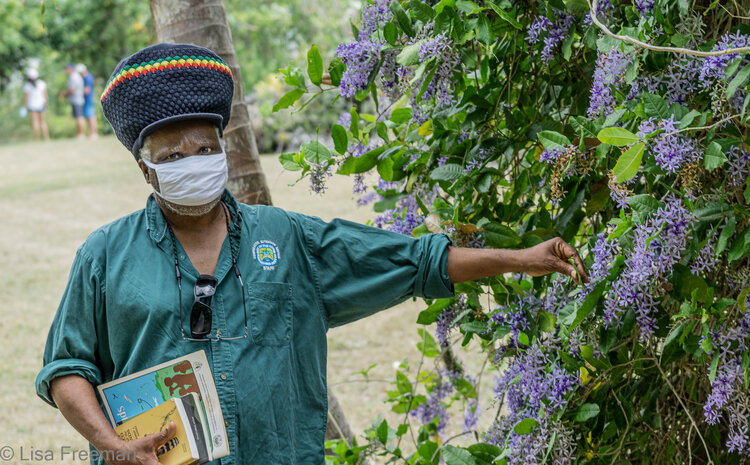
“Preservation does not happen on its own,” says Davis, who helped pave the way to protect what is now St. Croix’s East End Nature Preserve. “Our beautiful places require vigilance. Those of us who fought for the preserve worked many years to make that happen.” Davis conducted hundreds of tours to educate residents and testified at dozens of public hearings to fend off development. After winning that conservation battle, he helped establish the St. Croix East End Marine Park, and was a central force in making Point Udall accessible, “so that every person, even those with disabilities, could enjoy the site,” Davis says.
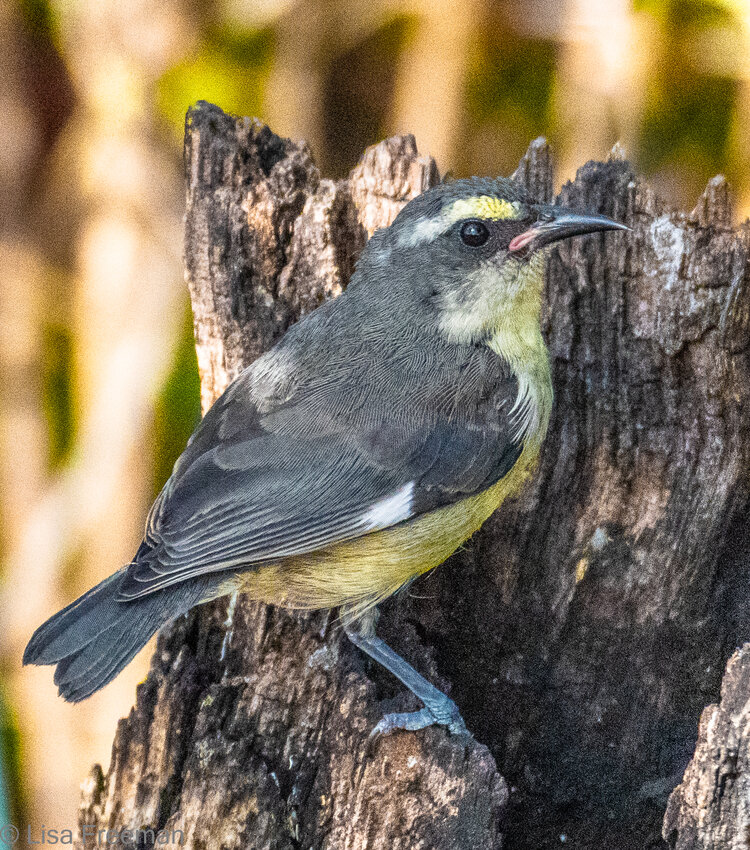
As we stroll the gardens, Davis points out the native and rare plant species that help to sustain bird life. He’s seen over a hundred bird species here through the years. At the pond area, herons and ducks find shelter. Near the cactus garden, Green-throated and Antillean Crested Hummingbirds joust for territory. In the trees, Pearly-eyed Thrashers and Bananaquits banter. The raspy sound of the Bananaquit, the official bird of the U.S. Virgin Islands, was once one of the most prolific calls on the island, but as sugar cane disappeared so did many of the “sugar birds.” Bird protections are a concern for Davis, who’s seen two of his favorites, the Scaly-naped and White-crowned Pigeons, seriously diminish in number.
“More than 100 years ago, thousands of White-crowned Pigeons nested on nearby Green Cay, but hunters and egg poachers destroyed the colonies,” says Davis. Today, researchers rally to protect the remaining breeding sites, such as Ruth Island, and advocate for restoration of nesting and foraging areas in wetlands and woodlands on St. Croix. “Are you hopeful?” I ask. “We must have hope,” says Davis. “Without nature and a healthy environment, human life is not sustainable. We must better manage the resources we have.”
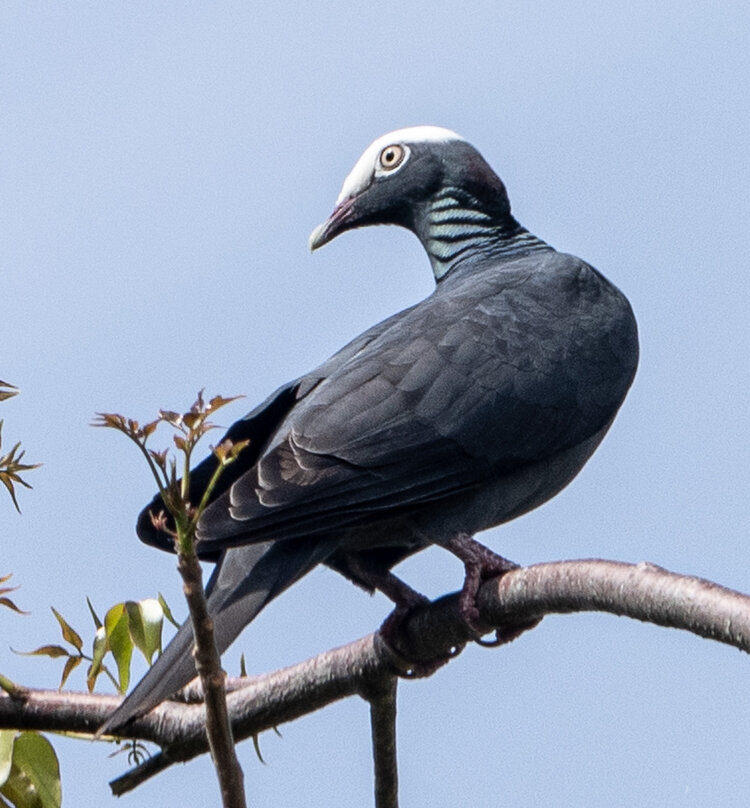
Fortunately, St. Croix is doing many things right. In addition to the Southgate reserve, St. George gardens, and the East End Nature Preserve and Marine Park, the 84-square mile island is home to Sandy Point Wildlife Refuge, Green Cay National Wildlife Refuge, Salt River Bay National Historical Park and Ecological Preserve, Buck Island Reef National Monument, The Nature Conservancy’s Estate Little Princess preserve, and 33 territorially owned offshore cays that have been designated as wildlife sanctuaries to protect nesting habitat for generations to come. And while these preserves provide plenty of birding hot spots, I find lifers in the most unexpected places. Walking onto my beachfront deck the first morning in Frederiksted, I spied a White-crowned Pigeon. Snorkeling for turtles in Frederiksted Bay, I saw Laughing Gulls perched on a piling. Strolling the harbor boardwalk in Christiansted, I stumbled upon a Little Blue Heron, fishing just feet in front of me. And stopping by a golf course pond, I glimpsed Common Gallinules and White-Cheeked Pintails. No matter where you bird, boat, hike, stroll or swim on St. Croix, you’re likely to run into a lifer. It’s just one of the many sweet treats of visiting this former sugar cane island.
Robbie Lisa Freeman is a public relations professional in Los Angeles and a contributing writer for the Western Tanager. Follow her on Instagram @freebird2020LF.