


If Tropical Storm Elsa had decided to track north instead of south through the island chain and into the Caribbean Sea last weekend, would the Virgin Islands have been ready to meet it head-on?
A check with various agencies last week suggests the answer is: pretty much.
Long gone are the days when hurricane preparations began once bad weather threatened and consisted of stashing a few extra gallons of potable water and some canned goods and flashlight batteries, tacking up a little plywood and hoping for the best.
Today’s hurricane preparedness starts well before the official opening of the Atlantic hurricane season in June and stretches across a wide array of concerns, from basic infrastructure to arrangements for special protections for the most vulnerable residents.
Work is not yet complete on all fronts, and some officials may be counting on a bit of wiggle-room since, with a few notable exceptions, the season typically doesn’t gear up for the Virgin Islands until late August. But in many areas, the territory appears well prepared.
“We are on it,” Steve De Blasio said, speaking on his cell phone Thursday while he rode the ferry from St. Thomas to St. John to deliver a generator for a storm shelter. As deputy director for logistics at the V.I. Emergency Management Agency, De Blasio is a key player in coordinating efforts among local government agencies, some nonprofit organizations and the Federal Emergency Management Agency.
“We learned a lot of lessons” from previous storms, he said.
De Blasio, and others interviewed for this report, stressed the collaborative nature of preparedness efforts, but, he said, “Ultimately, it falls under Human Services” to manage much of the work.
Human Services Commissioner Kimberly Causey-Gomez told the Source her department has approved six locations to serve as primary evacuation shelters in the 2021 storm season:
St. Croix – St. Croix Educational Complex and the D.C. Canegata Recreation Center
St. Thomas – Bertha C. Boschulte Middle School and Addelita Cancryn School
St. John – Adrian Sr. Center
Water Island – Fire Station Community Field House
VITEMA, backed by FEMA funding, equips the shelters, De Blasio said.
That includes repairing or replacing existing generators, as needed, fueling them, and, when a storm is imminent, stocking the shelters with food and water. In these days of Covid-19, it also means supplying shelters with personal protective equipment such as masks and hand sanitizer, he said.
“We’re going to make sure the people are safe,” he said.
The agency also will provide food, water, and other disaster supplies to be handed out to residents after a major storm. Items are already stored on-island, and there is a well-stocked FEMA warehouse of items on Puerto Rico meant to serve both Puerto Rico and the Virgin Islands, he said.
The plan is to open two points of distribution, or “PODs” on each of the larger islands, St. Croix and St. Thomas, and one or two on St. John as well as one on Water Island. VITEMA has already identified more than a dozen potential PODs on the two larger islands in case one or more of them is badly damaged in a storm and is unusable.
De Blasio said the agency will announce the location of operating PODs once a storm has passed and once there is a federal disaster declaration. It also anticipates setting up “special purpose PODs” at some housing communities, bringing goods directly to residents.
VITEMA also has six “light towers” – two each on St. Thomas, St. John and St. Croix – that it will deploy after a storm, he said. Each tower is equipped with its own generator and rests on wheels so it can be transported anyplace where a light source is lacking.
“They were so valuable after Irma-Maria,” De Blasio said, referencing the back-to-back Category 5 hurricanes of September 2017. “We’ve put fuel in them all already” and have contracted with local suppliers to keep them fueled. If a contractor suffers damage in the storm and is unable to provide fuel, “we have the federal government for back-up.”
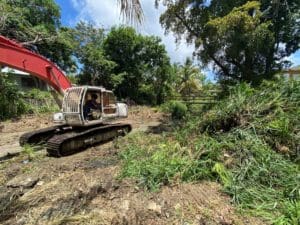
While the emphasis of hurricane preparedness is on planning for anticipated and unanticipated situations, at the Public Works Department there also has been a lot of mitigation work happening in recent weeks.
Beginning in April, the department has been methodically clearing out the territory’s guts to help prevent them from getting clogged and overflowing in heavy rains, then undermining roadways and damaging nearby private properties.
“It’s an all-in effort,” Public Works Commissioner Derek Gabriel said, adding that the project is about 95 percent complete. He appealed to the public to stop using guts for trash removal, saying crews have found everything from old tires and yard furniture to kitchen appliances in some guts.
In case of a storm, “our primary emergency service function is route clearance,” Gabriel said.
To that end, the department has divided each island into sectors and assigned personnel in each sector with responsibility for clearing primary and secondary roads of storm debris, he said. Necessary equipment will also be housed at various sites throughout the islands or be sent home with personnel when a storm is approaching, to be at the ready once the storm passes. Private contractors will augment staff after a disaster declaration.
Public Works is also a lead agency for distributing sandbags to the public, for use in shoring up homes against potential flooding.
Gabriel said the department has 3,000 pre-filled sandbags on St. Croix, 5,000 on St. Thomas, and 1,000 for St. John for distribution to residents in the event of an emergency. It also plans to make sandbags available sometime in July under its “Blue Skies” program of pre-disaster preparedness.
One of the “lessons learned” from the chaos that ensued after the 2017 hurricanes was that many elderly and disabled residents were left to cope on their own.
In 2018, the Legislature passed a law creating the Elder, Dependent, Adult and Disabled Person Disaster Emergency Assistance Registry (DHS Disaster Registry Flyer), and making Human Services responsible for maintaining it. The law does not specify exactly what assistance will be provided, but in an email response to the Source last week, Causey-Gomez expanded on its purpose.
“The intent of the Registry is to ensure we are able to locate individuals registered after a catastrophic event for their health and safety,” she said. “If there is an event natural or manmade, a wellness check will be made. If there was a serious disaster, rescue missions can be made from address coordinates. Also, care packs can be delivered.”
She said information in the registry can also be used to update registrants on disaster information via text and email and phone messages.
About 660 people have registered so far, according to Causey-Gomez. Forms are available at the V.I. Elections System, the Bureau of Motor Vehicles, and at DHS facilities (the Knud Hansen complex on St. Thomas; the Richmond Senior Center on St. Croix; the Multipurpose Center in Cruz Bay, St. John) as well as on the department website, www.dhs.gov.vi.
Besides maintaining the registry and identifying emergency shelters, Causey-Gomez listed a myriad of disaster responsibilities for Human Services “to include sheltering, feeding operations, emergency first aid, bulk distribution of emergency items, and collecting and providing information on victims to family members.”
It also includes connecting the community with disaster assistance and recovery programs like access to food stamps, crisis counseling, disaster unemployment, disaster legal services, support and services for special needs populations and other federal and territorial benefits.
Hurricane preparedness also involves special training in some departments and agencies as well as regular intra-agency meetings. DHS conducted a mandatory, day-long, department-wide preparedness session on June 29, for instance, and from July 12-19, VITEMA will hold two-day training sessions on POD management on each island.
FEMA holds monthly meetings with local officials and the Emergency Management Council to plan and coordinate disaster response, and last week, VITEMA Director Daryl Jaschen and FEMA Region II Acting Administrator Thomas Fargione met separately after the council meeting, according to a FEMA press release.
But the government can’t do it all.
Several officials emphasized that individuals have to prepare for disasters themselves.
De Blasio said emergency food and water supplies are based on what was needed in previous disasters. There should be sufficient food and water for hundreds of residents on Water Island, up to 3,000 on St. John, and for 15,000 to 20,000 each on St. Thomas and St. Croix, for five days.
But what happens after that? And what happens if more people are in need after the next storm? And what happens in the (unlikely) event that all the stored supplies are lost in the storm?
The first – and last – line of defense against disaster is individual preparation.
“I would encourage everyone to make their own checklist,” Gabriel said. It’s something he and his wife did a few weeks ago, surveying their shutters, checking that the generator was fueled and working, stocking up on food and water and any medications, planning what their children might need.
“(People) need to be ready and need to be self-sufficient” for a rule-of-thumb five days after a storm, De Blasio said.
Erik Ackerson, VITEMA public information officer, urged residents and visitors to keep informed on impending situations by signing up for the Alert VI warning system, by visiting the agency’s website at www.vitema.vi.gov.
(Editor’s Note: Several departments/agencies contacted for information about their preparedness activities did not respond in time. If the Source receives additional information, it will include it in a future article.)