

Carmen Amaro crouches down on the parapet of the Fort Frederik Museum clutching her camera in her hand. She’s hoping she’ll be able to snap a better picture of her son, Miguel Parrilla, from up here.
“He’s the second one in line,” she says with pride, pointing to a row of children waiting nervously in the fort’s central hallway.
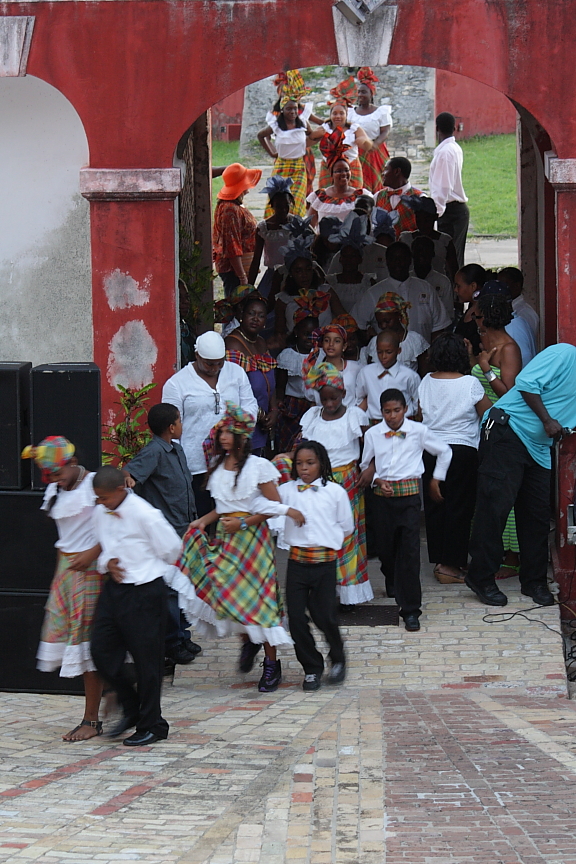
Miguel is only in elementary school, but he’s dressed with the formality of a man about to get married. He’s wearing a white dress shirt with a madras bowtie and cummerbund that match the skirt and head wrap of the young lady on his arm.
With a word from the announcer, Miguel and the line of children behind him promenade into the fort’s courtyard, applauded by the hundred or so adults who have gathered this evening to see the territory’s next generation of quadrille dancers.
The Revival of Quadrille in our Schools event was the idea of music teacher Valrica Bryson. She started the Revival in 2006, the same year that she founded a quelbe band and quadrille dance troupe at the St. Croix Educational Complex.
“People have this fallacy that kids would not want to learn how to dance quadrille or learn the quelbe music,” she says. “That’s the farthest from the truth.”
Quelbe and quadrille are taught in many schools around the territory, though there is no school-system-wide program to do so. The programs that exist were all started by individual teachers who took it upon themselves to expose their students to the official dance and music of the Virgin Islands.
Bryson explains that the Revival is a celebration of the hard work these educators and their students have done to keep this art form alive. All schools with an active program are invited to a grand quadrille ball on St. Croix where they can share their mutual passion for this timeless dance.
At the fort, Miguel and his classmates glide and spin across the stone courtyard. The boys keep their backs straight and chins up while the girls whip the hems of their skirts around them, moving fluidly with the beat of the music. The bright hues of their madras outfits almost match the fort’s earthy red walls.
“Salute!” cries the announcer and the dancers lock eyes and bow solemnly to each other.
It’s like a scene from a storybook. Outside these walls, life in Frederiksted goes on as normal, but in here, the evening feels like a moment out of time.
While Bryson believes that passing on quadrille is an important part of preserving the Virgin Island’s history, she says that the dance can have a real impact on life today. She believes that it teaches lessons and values that her students need to learn.
“Dancing quadrille teaches our kids how to respect each other,” she says. “Young men respecting young ladies and young ladies respecting young men.”
She says that there is a natural camaraderie that arises between quadrille dancers. You can’t do the dance alone; you have to learn to work with your partner and that means meeting them as an equal.
This, she hopes, is the lesson her dancers will take away from her classes. Bryson says that she is tired of the violence in the territory—tired of kids killing kids over nothing.
“It’s very, very important that we find a way to provide our kids with a positive outlet,” she says. “So that they can learn how to get along with each other and form a stronger camaraderie, so they will think twice about taking the life of another.”
One of the aspects of the Revival that Bryson is most proud of is that children from across the territory have a chance to mingle and form bonds.
“We have kids that come from Christiansted, Frederiksted, from the north side of the island and the southern parts of the island,” she continues, adding that on the dance floor “you won’t know where any of these kids are from.”
“There’s no territorial lines, no ‘I’m from here and you’re from there,’” she continues. “There’s no colors.”
She believes that if these children first meet each other as dance partners, maybe in the future they will not see each other as enemies, no matter what neighborhood they come from.
Bryson doesn’t believe that quadrille will single-handedly stop crime on the islands, but she says it’s a step in the right direction.
“All of those kids that were there, they’re friends,” she says. “It doesn’t matter where they’re from; they’re friends.”
 After the children are finished dancing, Miguel meets up with his mother, her camera now filled with pictures. Whether or not he has learned all of the deeper lessons Bryson hopes the dance will teach him is unclear; he just knows he had a good time.
“He loves it,” Amaro says, smiling at her son.
She says she’s proud of him and that she was happy to see him carry on the legacy of a dance that is so important to the territory’s identity.
“It’s a tradition. It goes on and on and on,” she says. “I hope when he gets big, his children will dance quadrille too.”