

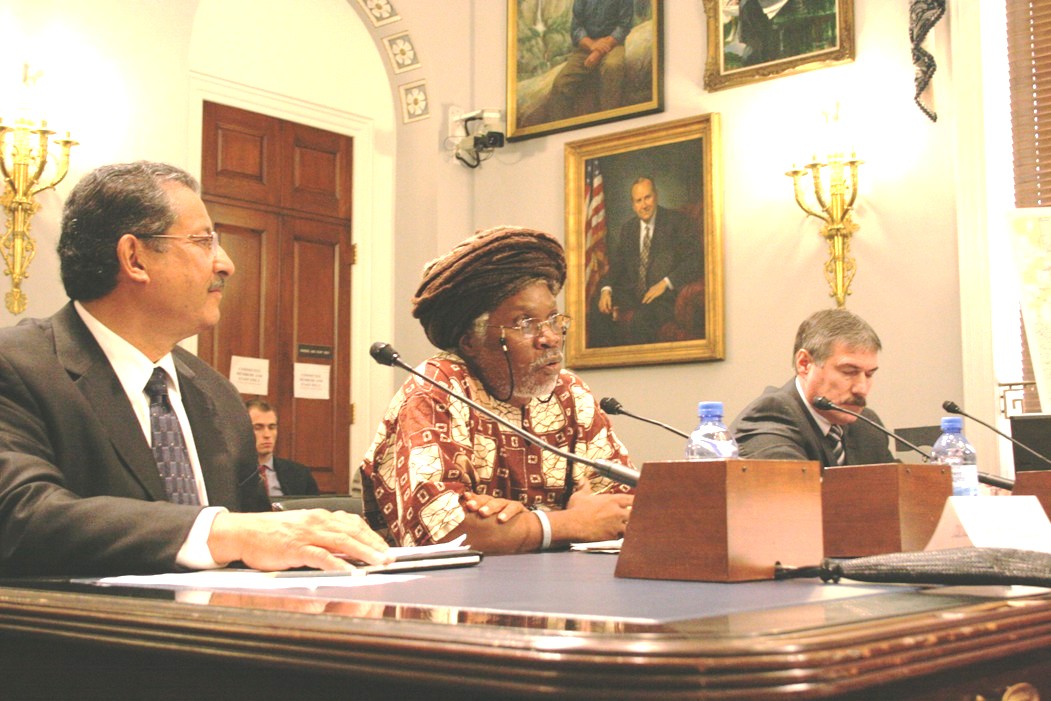
 St. Croix historian, ethno-botanist and environmental educator Olasee Davis testified to Congress in support of legislation to establish 2,900 acres of Estate Castle Nugent on St. Croix as a National Historic Site Tuesday. The bill, sponsored by Delegate Donna Christensen, was being heard by the House Natural Resources Subcommittee on Parks, Forest and Public Lands.
“I have taken thousands of school children on the property hiking, especially the pristine coastal environment,” said Davis. “They have learned about the natural, cultural, historical, archaeological and marine resources of the areas, such as the endangered [leatherback, green and hawksbill] turtles.” Davis added that the land has also given schoolchildren a deeper understanding of the territory’s colonial and American history.
As a member of Congress and the bill’s sponsor, Christensen introduced Davis and also spoke in support.
“This bill enjoys broad-based community support, to include the St. Croix Environmental Association, ART Farm and countless other people,” Christensen said. “In addition to guaranteeing the protection of one of the most ecologically sensitive areas on the island, it will also preserve a rich part of our cultural past, by preserving the archaeological remains of indigenous Native American inhabitants.” she said.
Christensen first submitted legislation for a feasibility study—a prerequisite for becoming a park—back in 2006. However, the project goes back to at least 2003, when one of the main landowners in the area, the Gasperi family, first broached the idea. Right now the Park Service is conducting a feasibility study and has already held several public meetings to get input from residents.
The proposed park site abuts the parcel by Great Pond slated for the Golden Gaming casino development and is roughly bordered by the Howard M. Wall Boy Scout Camp, Estate Fareham and Manchenil Bay, just west of Ha’Penny Beach. Inland, it runs as far as Lowrys Hill and Laprey Valley. The bill says it will include associated submerged lands out to the three-mile territorial limit, including the largest coastal fringe reef in the territory.
The Castle Nugent property has a long agricultural history dating back to the 1730s, when the Danish estate house, now listed on the National Register of Historic Places, was constructed. For the past several decades, the property has been used to raise Senepol cattle, according to Christensen’s office.
Senepol are a breed developed on St. Croix and prized for their resilience in tropical climes. The bill, submitted Oct. 6 and referred to the Committee on Natural Resources, would help ensure continued rearing of Senepol cattle with a provision that guarantees a continued relationship with the University of the Virgin Islands supporting ongoing scientific research of the cattle.
The feasibility study for the proposed park is one of two going on right now.
The other, is for a memorial to Alexander Hamilton in Estate Grange. There is presently no national monument to the first secretary of the Treasury.
Should there be a park, it will be a unit of the National Park System and managed by the Park System’s existing St. Croix offices, according to the bill.