

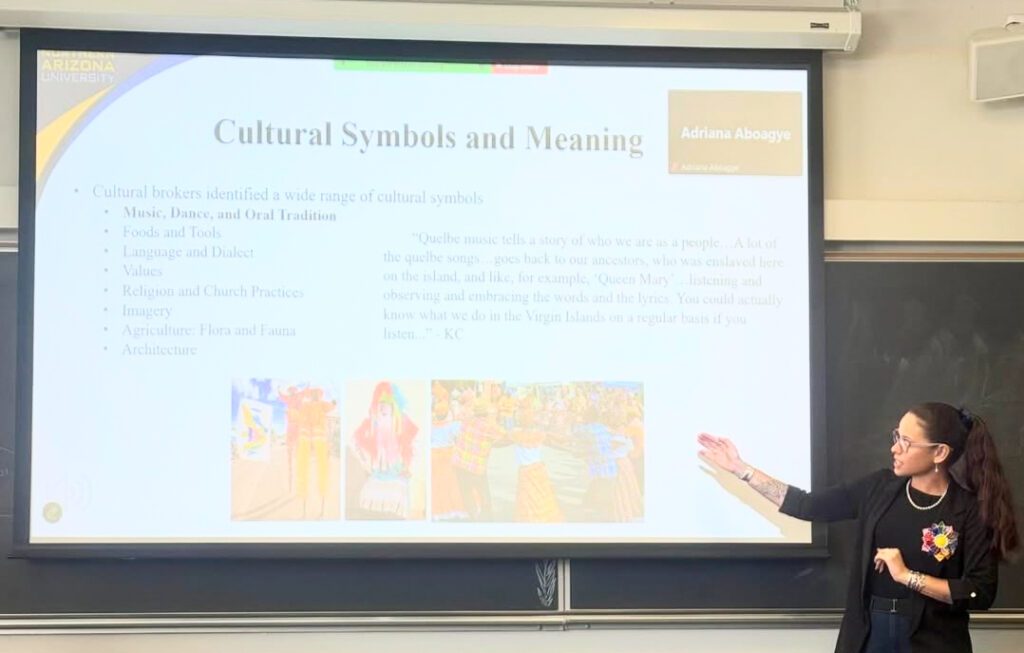
St. Croix native and doctoral candidate Izhani Rosa is exploring how Crucian cultural symbols — from quelbe music and masquerade traditions to language, food, religion, and oral storytelling — are understood, preserved, and reflected within local education systems.
Rosa, a graduate of Good Hope Country Day School and current doctoral student in a dual PhD program in School & Counseling at Northern Arizona University, recently presented research entitled “Its Dynamic and Persistent: Cultural Broker Perception of Crucian Culture.” The project examines how local “Culture Brokers” — respected community figures deeply connected to Crucian traditions — interpret cultural symbols and their place in schools and learning environments.
“At present, our local educational system is bound by the expectations and standards of mainland schooling, and so the role that local culture plays is limited and peripheral,” Rosa explained. Through her research, she said, local cultural experts are “calling for a reform that would include a more consistent and intentional integration of cultural symbols within our education system.”
At the outset of the project, Rosa discovered there was little existing research focused specifically on interpreting Crucian cultural symbols within educational settings. “But how,” she asked, “do I get to education and culture, if there are no formal research studies to draw from?” That gap ultimately shaped the direction of the study.
Describing her positionality as an “Afro-Latina Crucian woman” and “fourth generation Crucian native,” Rosa said her upbringing on St. Croix — combined with years spent studying and living on the mainland — positioned her as what she calls a “Partial Insider” in the research process. Her familiarity with Crucian dialect, traditions, and community relationships afforded her both trust and access during extensive interviews with five local culture brokers.
“St. Croix is culturally unique in a variety of ways,” Rosa explained during a Zoom call from Northern Arizona University. “We are kind of an amalgamation of various cultures put together.”
A graduate of Good Hope Country Day School’s Class of 2017, Rosa is also well known in the community for serving as “Miss St. Croix Festival Queen” from 2019 to 2022. She lived on St. Croix for the first 17 years of her life, but said her experience living “within mainland systems” positioned her “slightly further away” from the community she was studying. At the same time, her Crucian roots and shared understanding of local culture helped shape the research process. “They knew who I was and I knew how to interact in a respectful and culturally appropriate way,” she said.
Rosa organized the study around local “Culture Brokers,” which she describes as “individuals who help bridge gaps for historically marginalized communities by serving as voluntary, respected and trusted cultural experts.” The five participants selected for the project represented a wide cross-section of Crucian cultural knowledge and public life — including educators, musicians, historians, legal professionals, and tradition bearers connected to masquerade, quelbe, storytelling, and culinary arts.
Among those who participated were a local storyteller and teacher of masquerade and culinary arts traditions, a University of the Virgin Islands history professor and member of Stanley and the Ten Sleepless Knights, an administrator for Virgin Islands Cultural Education, a quelbe musician and fellow member of the Sleepless Knights, and an Associate Justice.
Serving as a foundation for the study were two guiding questions: How do cultural brokers describe Crucian culture and its symbols? And how do they describe the relationship between education and Crucian culture? Rosa said the work was rooted in the understanding that “culture shapes so many aspects of life, including how kids learn,” adding that research has shown culturally responsive curriculum and pedagogy can help build belonging, identity, and engagement among students.
In describing her methodology, Rosa said she approached the project as “a qualitative pilot study using a focused ethnographic approach” through a “post-positivist theoretical background,” while also utilizing an “Insider/Indigenous psychology perspective.” The interviews focused on defining Crucian culture, interpreting a “constellation” of cultural symbols grouped by likeness, and discussing the role of culture within schools and learning spaces.
Those symbols included language and dialect, music, dance and oral traditions, religion and church practices, architecture, and agriculture. Rosa found that many of the symbols identified by participants were rooted in honoring and remembering African ancestry. “Many of our symbols stem from African practices that were brought in by our enslaved ancestors and persisted despite attempts at erasure during slavery,” she explained. Several traditions, she added, evolved through what participants described as the “Africanization of European practices.”
The culture brokers interviewed agreed that Crucian cultural symbols should be preserved and more intentionally integrated both at home and within schools. Four of the five participants strongly supported the development of curriculum that incorporates cultural practices across core subject areas, while the fifth advocated specifically for a comprehensive K-12 local history and social studies curriculum. Participants said such efforts could help strengthen students’ sense of pride, belonging, and connection to Crucian heritage.
Speaking about the study, the territory’s State Director of Virgin Islands Cultural Education Stephanie Chalana Brown described the work as a “structured and locally grounded examination of how culture is understood by those who actively carry, teach, and shape it.”
“The research centers five Culture Bearers working across education, law, arts, and community practice,” Brown said. “That sample may be small, but it is intentionally selected for depth, and it produces consistent patterns that deserve attention within both academic and policy spaces.” She added that the study identifies “where culture currently lives in schools, how it is experienced by students, and what direction cultural experts are calling for.”
Rosa also expressed appreciation for her own educational experience at Good Hope Country Day School, crediting the school with helping prepare her for doctoral-level research and academic work.
“GHCDS gave me the skills needed to thrive in academia,” she said. “I was exposed to, dare I say, advanced content. I believe that GHCDS instilled values for critical thinking and productive questioning. I was taught to analyze and think deeply about what information is being presented. I also believe that we were taught skills for effective communication and an appreciation for science and research.”