

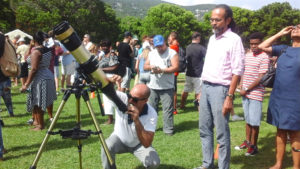
Eclipse watchers on St. Thomas turned the University of the Virgin Islands soccer field into a place of wonder on Monday afternoon, as they gathered with students, and UVI scientists to share information about an event making its way across the sky over the United States.
As the official Caribbean observing point for the National Aeronautics and Space Administration, scientists with the Etelman Observatory set up a live broadcast of eclipse coverage from Oregon, through the Midwest to South Carolina. The trip didn’t take too long.
Chief Researcher David Morris came up with a plan. First, give visitors an overview of features to look for in a total eclipse. Next, some ground rules for outdoor observing. The follow with instructions for safely viewing the eclipse.
Resident astrologer Dr. Bruce Gendre gave the marching orders, assuring the crowd there was no reason to rush outdoors once they were armed with viewing devices.
“Don’t jam through the door, trying to be there. The sun is going to be there, it’s not going anywhere,” he said.
The seats set up in front of the images were filled, as was much of the floor space in the lobby of the sports and fitness center. In one seat, checking her mobile phone for live images of totality in Oregon, was Eddie James Simon, a regular for the Friday night observing sessions on the observatory roof.
“For me, this is the first one I’ve ever seen. The next one won’t be until 2024. I just want to take this experience now and embrace it and enjoy it,” she said.
Morris said he was delighted to see such a turnout. It had been a busy year for the observatory, he said later on. Hosting the eclipse event, was a highlight.
“We had two conferences, three new hires, a brand new math and science – physics – program going on; 25 students supported through NASA grants working at NASA-Goddard Space Flight Center, EPA, USDA, University of Wisconsin, University of Texas. Then we have 10 students working with us at the Etelman Observatory, at our new physics vacuum chamber. So yeah, it’s been a busy year,” Morris said.
Is it any wonder that a man who could unpack all that information from his head in a single sentence could master an enthusiastic flash mob of science nerds for a day?
As the clock rolled on towards 3 p.m., the number of visitors appeared to explode. Students, seniors and whole families milled through the lobby as Morris handed out pinhole viewing devices.
MJ Acuna brought along two children, a niece and two sisters. They moved as a unit, each with a set of glasses in hand.
“We planned in advance, to all have to day off so we could see this together,” she said.
Leading the way was MJ’s son Ezekiel, 8, who programmed his watch with an eclipse countdown to keep the family informed.
There was also information about the next eclipse, when Ezekiel said he’d be 10 years old.
“It’s going to be more like in Africa and Asia. It’s going to be December 2, 2019,” he said.
Out the side door and over to the left, crowds donned darkened lenses mounted on cardboard strips and held them up to the sky. The moon’s shadow turned the sun into a strawberry colored crescent.
Lines formed up at the four high-powered telescopes, mounted on tripods. Attorney Aquanette Chinnery proudly showed off the image she captured through the eyepiece, using special glasses and a mobile phone.
Back inside the lobby, a less energetic group sat to watch the moon’s shadow as it blocked out the sun over South Carolina. That was the last place where the current eclipse would be seen in totality, Morris said. After that the shadow headed out over the Atlantic. The last place the eclipse would be seen, he said, was the Virgin Islands.