
Led by enormous increases in housing costs, internet service, and, of all things, chicken, the U.S. Virgin Islands’ inflation rate outpaced the mainland’s rate by nearly threefold, according to a new report from the Bureau of Economic Research.
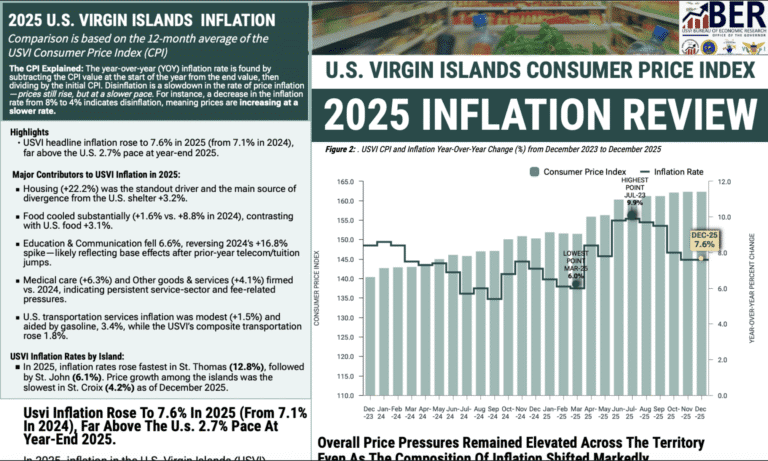
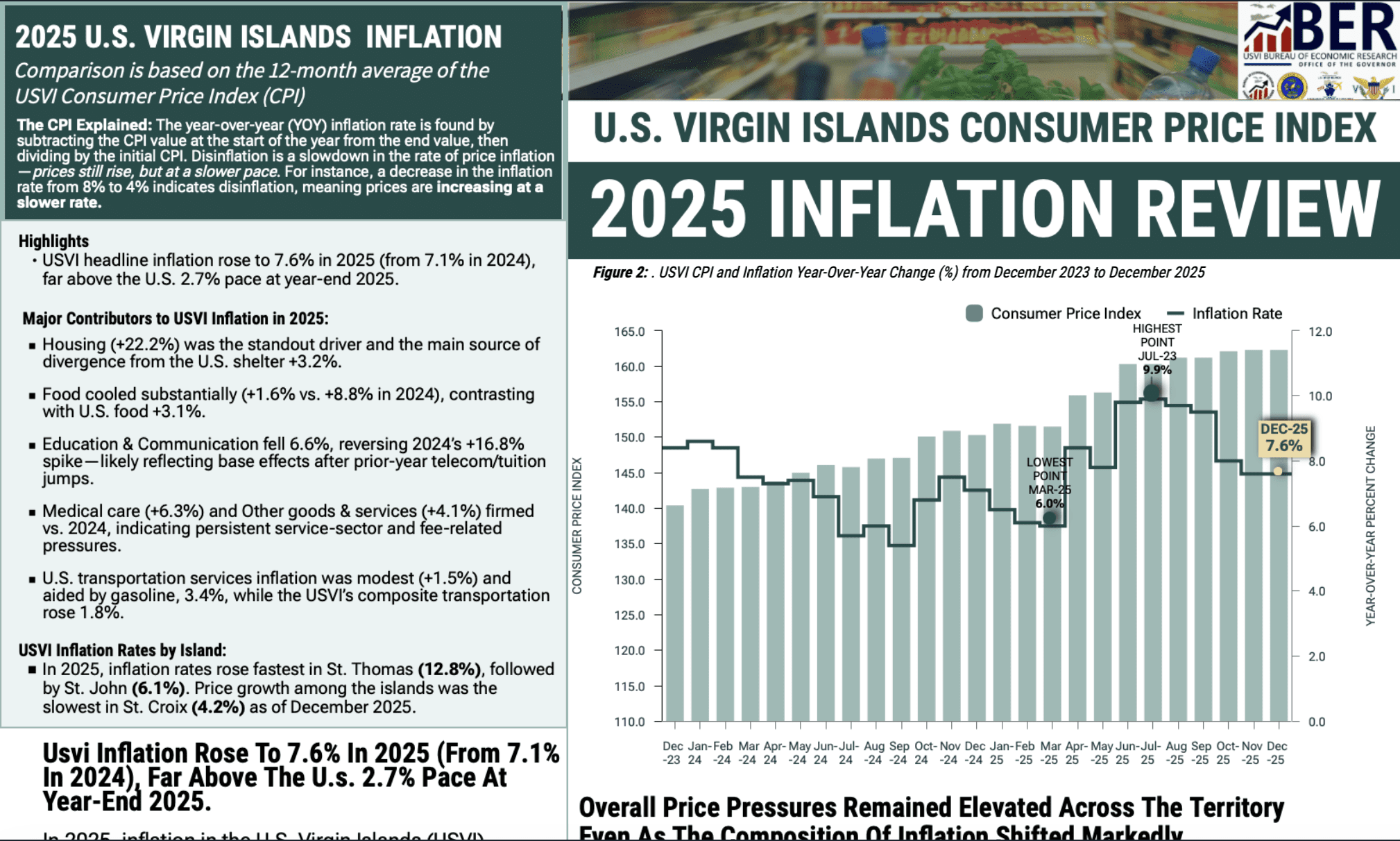
From December 2024 to December 2025, the U.S. mainland’s inflation rate was 2.7%, down from 2.9% in 2023. The territory’s rate was 7.6% — up from 2024’s 7.1%, according to the Consumer Price Index 2025 Inflation Review released Saturday.
Inflation reduces money’s buying power. A high inflation rate means $1 buys less faster. There’s no one cause of inflation but the report pinned it in part on the Virgin Islands’ heavy reliance on imports and high cost of logistics. The report cited federal grants as a sort of double-edged sword for inflationary pressure in the territory. It bolstered public funds but caused inflation through public spending.
“ … when public spending rises (or when large federal transfers are deployed locally), demand for labor, materials, and services can increase faster than supply — pushing prices higher,” the report’s authors wrote.
There were other factors as well. While the price of water dropped 38.5%, electricity rose 31.1%, according to the report.
The index lumped utility service in with housing costs. Inconsistent billing and service from the Water and Power Authority helped push the territory’s housing inflation rate to a staggering 22% — up from a 6% rate in 2024, according to the report. In the mainland, housing inflation grew at a 3.2% rate.
“The magnitude of the USVI housing increase suggests intense pressure from rents, utilities, and other shelter‑related costs, which often exert outsized influence in island economies with constrained housing supply and high import-related costs,” according to the report.
The cost of a one-bedroom rental rose 11.5% from 2024 to 2025 and a two-bedroom rental cost nearly 21% more. Those lucky enough to find an available unit may be paying $2,461.11 a month, up from an average of $2,392.69 in 2024.
Demand and price for internet services contributed to a leap in prices. The cost of basic internet service rose more than 48% from 2024 to 2025.
While the price of gasoline fell slightly, from an average $4.89 a gallon in 20204 to $4.69 in 2025, it remained well above the 2025 mainland average price of $3.10.
In 2020, the mainland’s pandemic inflation rate jumped from 2.3% to 7.1% in 2021. The territory’s rate more than doubled that increase in 2020, rising 5.8% and then 8.6% in 2021. While the mainland’s rate decreased to 6.5% in 2022 and 3.4% in 2023, the territory’s inflation rate leaped to 9.8% in 2022 and 8.4% in 2023.
Some pandemic-era rarities dropped in price. Eggs went down 2.3%. Pork and beef rose in price only slightly, just 7 cents. But chicken and milk became significantly more expensive. Milk went up 12% and chicken up a whopping 28.6%, according to the report.
St. Thomas had the highest inflation of the individual islands. The overall 12.8% inflation rate was driven by a 42% housing inflation rate. St. John’s overall inflation rate was 6.1%, driven by 14.4% rate for medical care, and St. Croix’s 4.2%, driven by 7.7% inflation rate for housing.