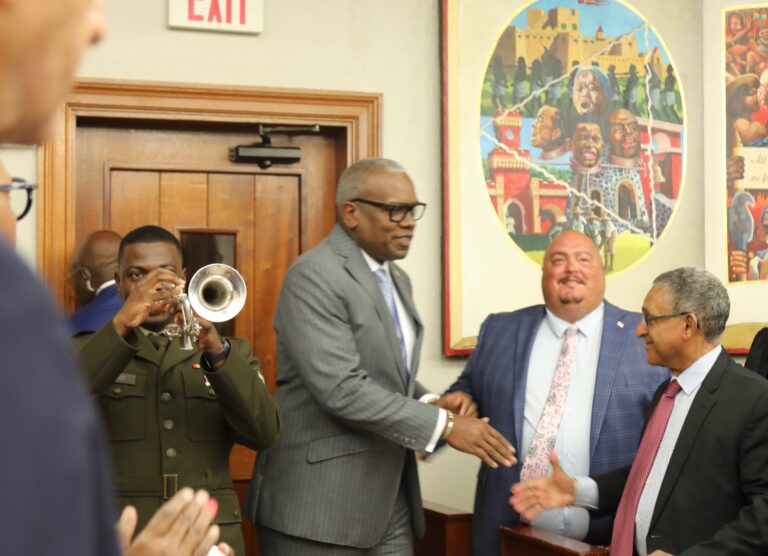
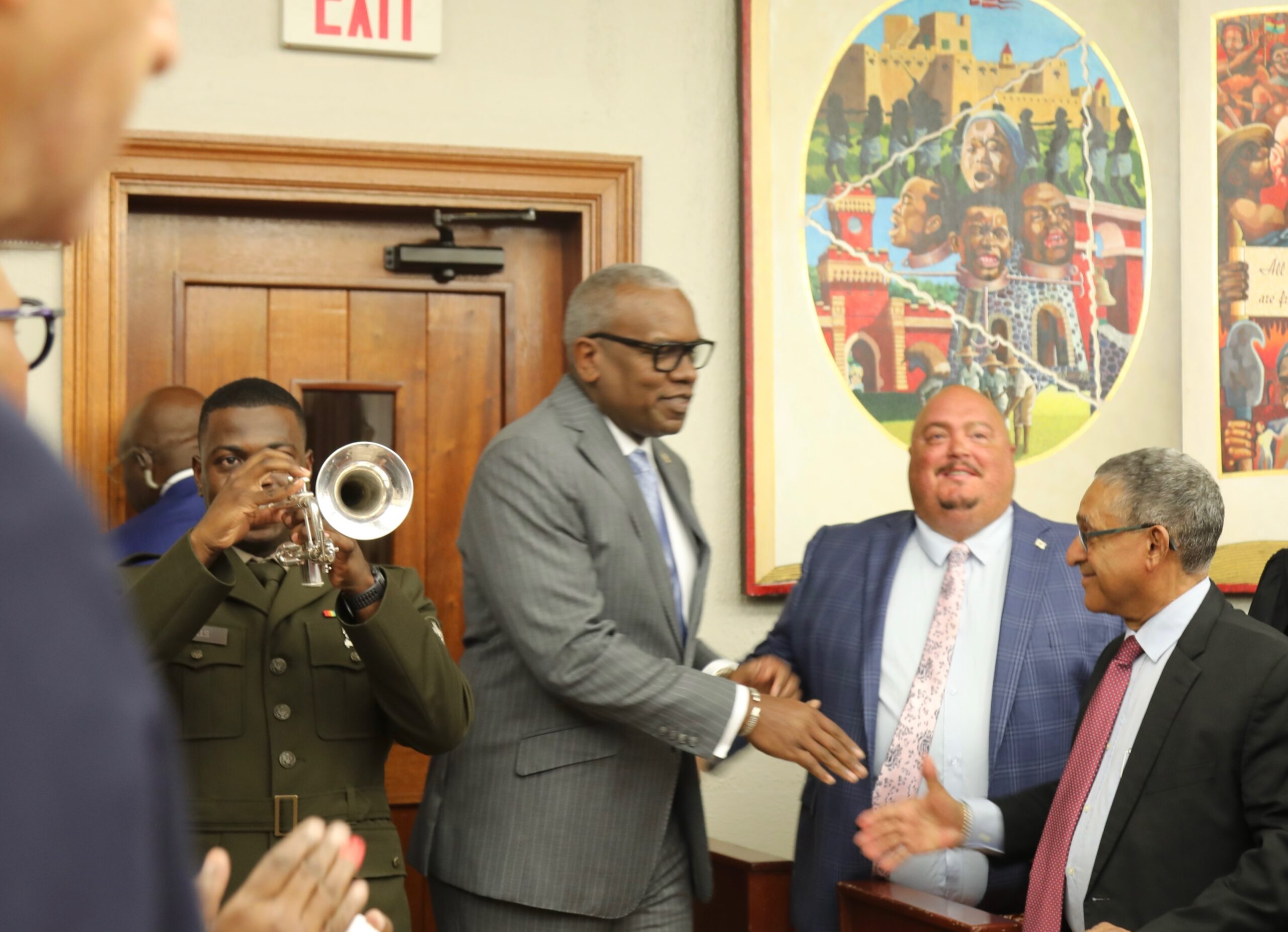
Virgin Islands education leaders should keep a close eye on federal budget negotiations and remain focused on student academic outcomes as education policy shifts continue to unfold in Washington, according to a federal policy briefing delivered to the Virgin Islands Board of Education on Monday.
Phelton Moss, managing director of Government Relations for the National School Boards Association, provided board members and local educators with an overview of the current federal landscape, including the status of the Individuals with Disabilities Education Act, the Every Student Succeeds Act, and recent federal budget proposals affecting the U.S. Department of Education.
The briefing followed a recent national conference attended by board members in Washington, where federal education developments were discussed. Board Chair Kyza Callwood said the goal was to bring that same information back to the territory in a public forum.
“We wanted to make sure the information shared at the conference was shared here — with principals, educators, and the public,” Callwood said, explaining that the board invited Moss to present the federal update locally so stakeholders would hear directly what is happening at the national level.
One of the central questions raised during the session was the status of IDEA reauthorization. Moss told members that movement on that front appears unlikely in the near term.
“We’re nowhere near reauthorization,” Moss said, adding that the current political alignment in Congress makes major legislative changes difficult during this administration. IDEA, which governs special education services nationwide, continues to be funded annually through appropriations, but formal reauthorization would require congressional action.
Much of the discussion centered on federal budget proposals and what they could mean for states and territories. Moss outlined prior proposals that included a 15% reduction to the U.S. Department of Education’s budget and significant cuts to research funding through the National Science Foundation and the Institute of Education Sciences. He emphasized, however, that Congress did not adopt those proposed reductions in the most recent appropriations cycle.
“Federally, you’re okay for now,” Moss said. “A lot of the cuts that were proposed did not make it through.”
At the same time, he cautioned that budget debates are ongoing and could resurface in future negotiations, advising board members to remain attentive to fiscal discipline and funding structures.
Beyond direct budget proposals, Moss described efforts to shift administration of certain education-related programs through interagency agreements. During the call, he noted that some school safety and community school grant programs were being transferred to the U.S. Department of Health and Human Services. Core K-12 funding streams and IDEA, he clarified, remain administered through the U.S. Department of Education.
Board Vice Chair Emmanuella Perez-Cassius asked whether territories should begin restructuring systems in anticipation of possible funding shifts. Moss responded that, at present, the existing federal funding infrastructure remains intact.
“The funding infrastructure that has been placed prior to this year remains in place,” he said.
Board members also raised questions about ESSA waivers and assessment flexibility. Member Nandi Sekou pointed to concerns about English language learners, including students who arrive shortly before testing windows open, and whether flexibility exists to accommodate them.
Moss explained that waiver authority rests with the state or territorial education agency, not individual schools or districts. “Your state department would have to create the policy conditions,” he said.
He noted that ESSA provides options for alternative assessment approaches — including adaptive testing, performance-based models, and use of national assessments such as the SAT or ACT — though many states have not fully utilized those flexibilities.
Questions also surfaced about potential impacts on meal programs. Member Abigail Hendricks-Cagan asked about reports regarding federal funding for food programs. Moss clarified that the federal school lunch program, administered through the U.S. Department of Agriculture, is not currently facing elimination, though it had been part of earlier budget negotiations. He distinguished that from Meals on Wheels, which is administered separately and has faced scrutiny in federal budget discussions.
Callwood later asked what boards should be most concerned about in the current climate. Moss advised narrowing focus rather than attempting to respond to every federal development.
“Trying to focus on every issue in public education will drain you,” he said, encouraging alignment around improving student academic outcomes and maintaining fiscal stability. He noted that federal priorities are increasingly emphasizing flexibility at the state and territorial level.
During the discussion, members acknowledged ongoing concerns about standardized test performance in the territory and asked about strategies to improve proficiency rates in English Language Arts and math. Moss did not prescribe specific policy changes but emphasized coordinated alignment between boards and education agencies.
“If you’re going to be talking to the U.S. Department of Education, you need to be able to show how everything you’re doing gets back to student academic outcomes,” he said.
Callwood said the board’s role is to remain informed, share information transparently with the public, and continue coordinating with the Virgin Islands Education Department as federal policy develops. The Virgin Islands Board of Education does not directly receive federal funding; those funds are administered through the Education Department.
For now, no immediate funding cuts affecting the territory’s K-12 operations were announced. Still, board members signaled they will continue monitoring federal budget proposals and legislative activity in the months ahead, particularly as the next federal budget cycle begins.