

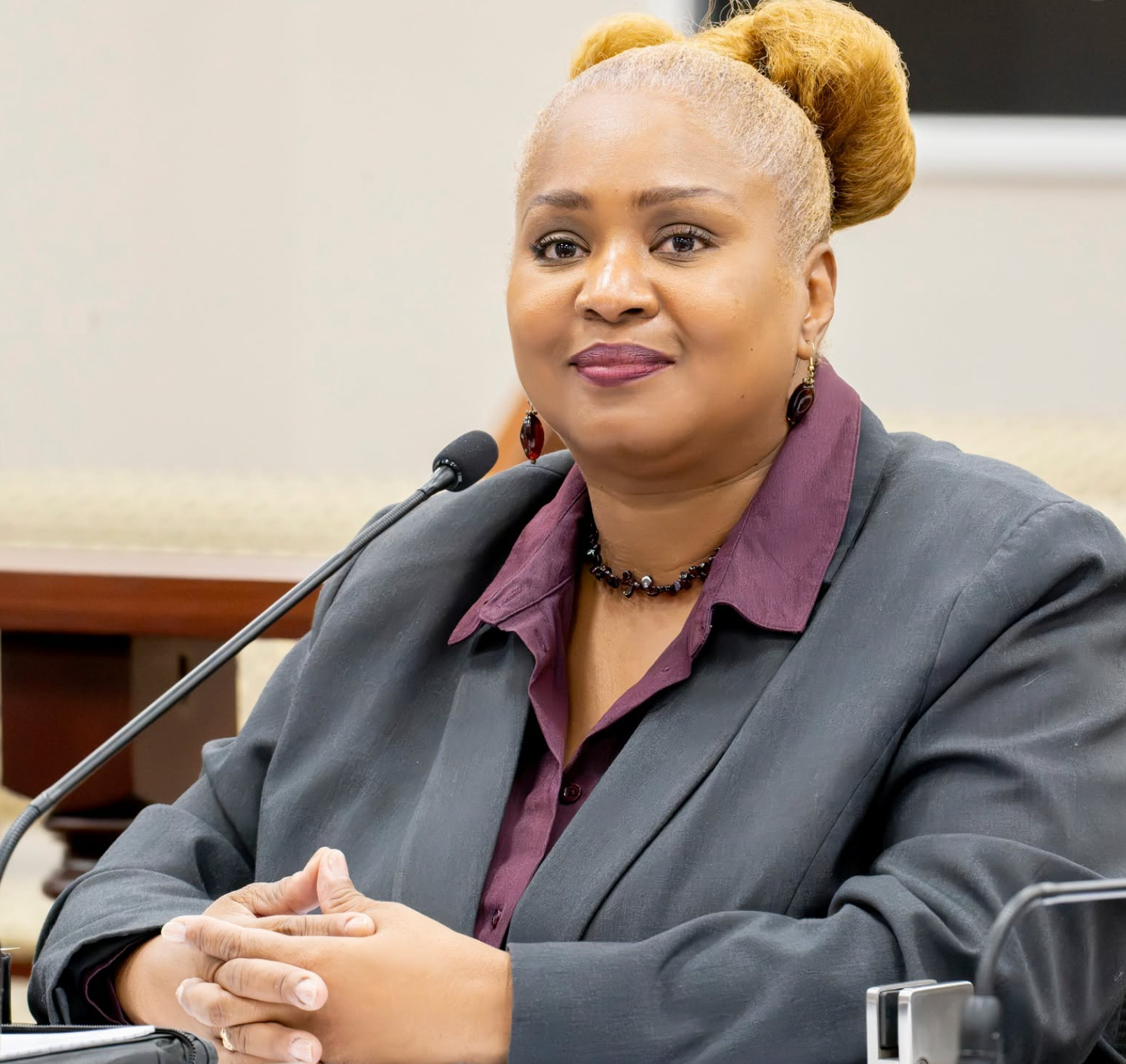
On Thursday, senators questioned the Office of the Lieutenant Governor about staffing shortages, low salaries, and delays in opening a government-owned building in Christiansted, St. Croix, during a budget hearing.
The Office of the Lieutenant Governor is seeking an operating budget of $22.7 million for fiscal year 2027, including $7.66 million from the General Fund, Acting Chief of Staff and Legal Counsel Nadja D. Harrigan told the Senate Budget, Appropriations and Finance Committee.
Harrigan said the office collected $121.1 million in revenue in fiscal 2025 and is projected to collect $125.5 million in fiscal 2026 and $127.8 million in fiscal year 2027.
She told lawmakers that “LGO divisions generate significant revenue for the government of the Virgin Islands, making LGO the second largest revenue generating government agency in the territory in fiscal year 2025.” The office oversees divisions responsible for services including “the licensing, registration, and regulation of businesses” and “the assessment of real property in the Virgin Islands and collections of taxes.”
The office currently has 32 vacancies, including 14 General Fund positions, according to Director of Business and Financial Management Claudette Farrington. Harrigan said the office had nine separations in fiscal year 2026, including three resignations and six retirements.
Senators repeatedly questioned whether low salaries are making positions difficult to fill.
Sen. Kurt Vialet said salaries in the Lieutenant Governor’s Office were “woefully low” and argued that adequately funding positions could generate additional revenue for the government.
Farrington said some positions are difficult to fill because of salary levels and educational requirements. She cited vacant franchise tax auditor positions and entry-level positions requiring accounting credits.
Because many employees are covered by union agreements, Farrington said the office would need to work with the Office of Collective Bargaining and the Division of Personnel to examine whether employees could be moved to more competitive pay scales.
Real property taxes comprise the bulk of the office’s revenue. The Tax Collector’s Office collected $56.1 million in fiscal year 2025 and $26.8 million as of June 30, a 10.3% increase over the same period the previous year. Collections are projected to reach $57.5 million in fiscal year 2026 and $58.9 million in fiscal year 2027.
Tax Assessor Ludence A. Romney said staffing shortages affect the division’s ability to process property data, conduct analysis and respond to taxpayers. “Because we are short staff, we have the same people doing about two or three different tasks, and so it takes a while sometimes to respond, and that can be very frustrating for folks,” he told senators.
Harrigan asked lawmakers to consider raising or removing the $500,000 cap on the Tax Assessor Revolving Fund, which receives 1% of real property taxes collected each year. She said the division could otherwise have realized more than $560,000 based on its collections.
Senators also questioned the government’s former FirstBank building in Christiansted, which the Lieutenant Governor’s office plans to use for several divisions. The property was purchased in 2024 and has not yet been occupied.
Harrigan said the building was advertised for solicitation Tuesday, with a prebid conference on Wednesday, and told senators it will require a build-out and other work before it can house the Tax Assessor, Recorder of Deeds, Geospatial Information Systems and teller operations. She said “there is a perception that the building is just ready to move into, and that’s not the case,” adding that the building had deteriorated while unoccupied.
Farrington said the office also expects to need an elevator “to be in compliance.” Sen. Hubert L. Frederick criticized the delay and suggested the building could instead be rented to generate revenue.
The Geospatial Information Systems Division reported progress on the territory’s Street Addressing Initiative, which received $5.3 million in federal funding during fiscal year 2026. Harrigan said more than 85% of road naming and addressing work had been completed on St. Thomas and St. Croix.
Administrator L. Chris George said the division expects to complete the underlying addressing data for St. Thomas and St. Croix by the end of the year, although installing signs could continue into 2027.
Senators also questioned the office on services available to St. John residents. Harrigan said the island has a Tax Assessor Office, while residents must travel to St. Thomas for some other services, although many are available online. Kishma Dorsett, district supervisor of Passport Services, said the goal is to return to St. John once two new employees are onboarded.
The Division of Banking, Insurance and Financial Regulation reported $35.9 million in collections in fiscal year 2025. Harrigan said the territory’s property insurance market has improved, with expanded reinsurance capacity and no additional requests for homeowners insurance rate increases since January 2025.
She told senators that insurance companies “indicated that the property insurance market has softened, reinsurance capacity has expanded, and absent a significant catastrophic event affecting the region, homeowners’ insurance rates in the territory are expected to remain stable.”
She also said an insurer has reinstated a discretionary discount program for eligible property insurance risks, allowing potential premium discounts of 5% to 15% subject to underwriting approval. Harrigan said the office returned $1.06 million in unclaimed property to 238 customers in fiscal year 2025.
Harrigan said the office’s fiscal year 2027 priorities include increasing revenue collections, completing capital and geospatial projects, filling critical vacancies and improving services and operational efficiency across its divisions.