

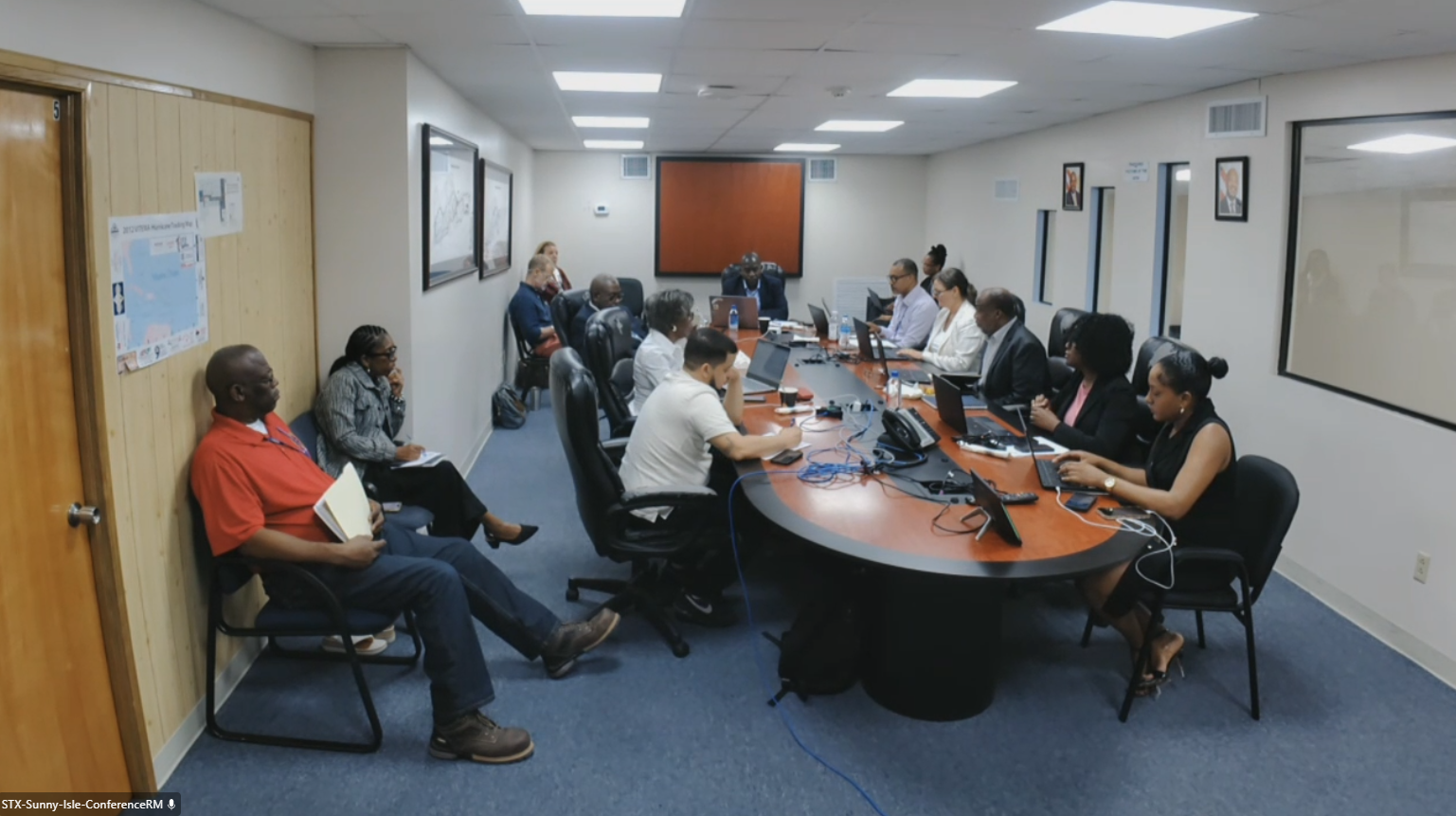
V.I. Water and Power Authority Chief Executive Officer Karl Knight told the utility’s governing board Thursday that WAPA “has not yet been made privy” to any impacts related to the U.S. Department of Housing and Urban Development’s recently announced suspension of disaster recovery funds to the territory.
On Monday, HUD cited “blatant mismanagement,” “empty promises and abject failures” in its decision to suspend Community Development Block Grant funds to the V.I. Housing Finance Authority. Those funds account for approximately $1.9 billion of the $24.5 billion in federal dollars allocated to recover from the 2017 hurricanes. The VIHFA issued a statement Tuesday arguing that it has already addressed many of the issues referenced by the federal agency in its suspension letter.
“I am still letting the powers that be sort through and work with the staff at HUD to really understand the implications,” Knight told WAPA board members during Thursday’s regular meeting. Knight said the utility has funded two major projects through Housing and Urban Development: the utility’s acquisition of Vitol’s propane terminal and its purchase of four Wartsila generators for the St. Thomas power plant.
The HUD suspension letter characterized work to restore the territory’s electrical grid as “practically nonexistent” and noted that VIHFA “has spent a mere 2% of its electrical grid recovery funding.” Of the $67.6 million allocated, just over $1.1 million had been spent by May 2026. Knight reminded board members that he raised the issue of CDBG grant funding bottlenecks months ago. He reported during a board meeting in March that the VIHFA-administered funds “have not been forthcoming,” leaving $38 million “caught up for projects that could make a meaningful difference in reliability for our system.”
“It all comes down to bureaucracy, and that is having real world implications on our ability to provide services to our customers,” he said at the time.
On Thursday, Knight said the challenges “are now being widely discussed.”
“But we’ve gotten recent authorization to proceed with those, and as a subrecipient, I’m not aware of any challenges in being able to access those funds that are already obligated and ultimately being able to draw down those funds,” he said. “I’m not aware of any impediments to that as yet — if any are to come — and so we’re going to proceed with the authorizations that we have to do what we need to do.”
Knight’s report to the board also included an update on efforts to complete the utility’s Feeder 13 bypass project. WAPA implemented two eight-hour outages on July 13 and 14 to allow contractors to work on the project, but Knight said there’s “about four more hours” of work left to be done, which will require another planned outage.
“We think we have a plan of action, and now we’re just trying to identify the right day — the right time of day, the right day of the week — when this makes sense for us to proceed,” he said, stressing that the work needed to be finished before schools start in August. Acknowledging the impact frequent outages have had on WAPA customers, Knight said candidly that the utility is at a stage in its disaster recovery work that may see disruptions become more frequent.
“It’s inevitable. To get some of this real good mitigation work done, it’s going to cause some inconvenience,” he said. “Once we’re done, and everything is nicely paved over, the benefits are going to last us for another generation to come.”
Later during Thursday’s meeting, board vice chair Hubert Turnbull noted that board members only learned of developments related to WAPA’s decade-old federal consent decree after reading about them in the local news. That case was reassigned to visiting U.S. District Judge Mark Kearney several months ago. During a status conference this month, Kearney pressed representatives from WAPA for clarity regarding the utility’s operations and its fraught relationship with Wartsila.
“If you say the word ‘Wartsila,’ everybody wants to run a story the next day, and that’s all that happened. The judge said the word ‘Wartsila,’ and everybody wanted to run a story the next day. It wasn’t newsworthy up until that point,” Knight said Thursday.
As board members continued raising concerns, Knight said it was “no secret” that WAPA has an ongoing dispute with Wartsila over maintenance of generators at the Randolph Harley power plant, four of which have failed to run on liquefied petroleum gas.
“The consent decree — they have their focus,” Knight said. “They want me to save the environment. We have an ongoing dispute, and we have issues we have to resolve. And you know … while there’s a nexus and a correlation of the two things … we’ve been having these conversations with the EPA and Department of Justice, and they actually fully well understand where we are, and they’re actually very supportive of our filings before the court because they have an understanding of the challenges under which we’re operating the Harley plant.”
“But yeah,” he added, “it doesn’t change the dispute that we have, and certainly the judge isn’t going to be able to mitigate that dispute for us.”