

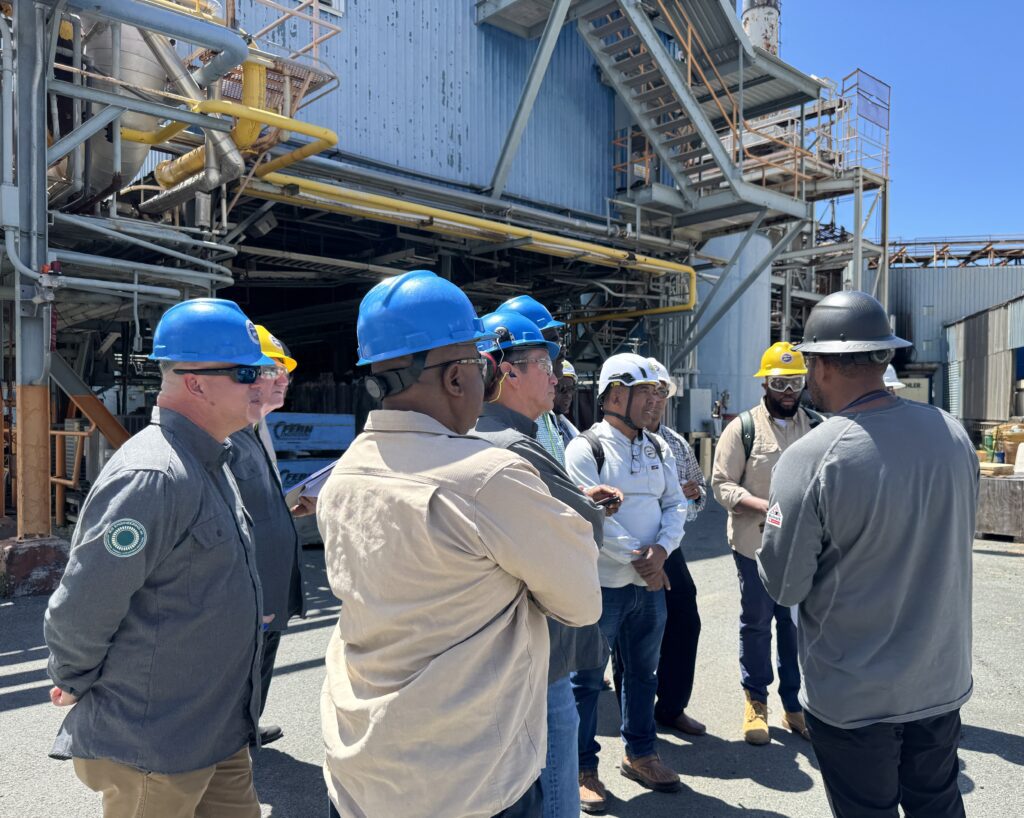
Kevin Harrigan, WAPA RHPP Superintendent (far right, black hard hat), leads a site visit of the Randolph Harley Power Plant with the contractor and ODR and WAPA teams. (Photo submitted by WAPA)
After months of procurement, negotiations, and mounting pressure over the condition of the territory’s aging power plants, the Virgin Islands Water and Power Authority and the Office of Disaster Recovery have signed a contract to move forward with a major FEMA-funded power plant replacement effort on St. Thomas and St. Croix.
The agreement with R-G Engineering/Javelin Gramercy Ventures Joint Venture will replace portions of the Randolph Harley Power Plant on St. Thomas and fully modernize the Richmond Power Plant on St. Croix, marking one of the territory’s largest utility infrastructure undertakings since hurricanes Irma and Maria, according to an ODR statement released Tuesday.
For residents who have endured rotating outages, repeated unit failures, and service disruptions in recent years, the announcement represents far more than another infrastructure project.
“This is a transformative opportunity. It completes the positioning of St. Thomas for the future and gives St. Croix the chance to rebuild and transform its plant,” WAPA CEO and Executive Director Karl Knight said in a call with the Source Tuesday night.
The project stems from FEMA’s Public Assistance Program, which pledged support after the 2017 storms to help stabilize and replace damaged and aging generation infrastructure throughout the territory. According to Knight, ODR later bundled the projects together and led efforts to secure a contractor capable of handling the scale of the work.
The selected contractor, based in Puerto Rico, is already familiar with WAPA’s system. Knight said the company previously assisted with repairs tied to Unit 27 and issues involving Unit 15 at the Harley plant, among other things, giving it experience with the authority’s facilities and the operational realities of isolated island grids.
“We’ve worked with them before,” Knight said. “They understand isolated grids and our situation in the Western Caribbean.”
Knight said contractor teams have already toured the facilities and begun coordinating with WAPA’s production staff as the authority transitions into the next phase of the project.
The work will unfold in stages, beginning with preconstruction assessments to evaluate existing facilities and finalize scope details before moving into larger construction operations. The overall project includes temporary generation, battery energy storage systems, demolition of obsolete equipment, and installation of permanent generation systems in both districts.
The temporary generation component has become increasingly important as WAPA continues managing aging units that have struggled to meet demand, particularly in the St. Thomas-St. John district. Repeated problems involving Unit 15 earlier this year contributed to rotational outages and renewed concerns about the territory’s limited reserve capacity.
“This has been discussed for quite some time,” Knight said. “When we talked about adding generation capacity into St. Thomas and replacing Units 14 and 15, the Wärtsilä units were never the end of it. This is the materialization of that.”
Under the contract, four new standby units with a combined capacity of 10 megawatts have already been purchased for St. Thomas and St. John and are expected to arrive this year after testing and packaging.
Knight said WAPA is also pursuing additional temporary generation in the 15- to 25-megawatt range for both St. Thomas and St. Croix, with the goal of bringing those portable leased units online before the end of the year to provide immediate relief while permanent systems are built out.
On St. John, approximately 10 megawatts of emergency generation is expected to come online between August and November, according to Knight.
“We’re trying to get temporary generation in before the end of this year,” he said. “We have some pretty good offers.”
The phased approach is intended to allow WAPA to retire older generators while avoiding major service gaps during construction. Knight said FEMA funding also covers demolition of equipment that is no longer necessary, while the new systems are expected to include more efficient generators and battery storage technology designed to improve long-term reliability.
For St. Croix, the project opens the door to a broader transformation of the Richmond Power Plant, including discussions about what portions of the existing facility will ultimately be demolished, rebuilt, or replaced.
Construction is expected to take several years. Tuesday’s release states that the construction phase should last approximately 48 months, with substantial completion anticipated in 2030.
Knight said another major milestone came in October 2024, when WAPA received confirmation regarding FEMA’s obligated funding amounts for the projects, allowing the authority to begin the process of drawing down federal funds tied to the work.
Still, significant permitting and environmental review remain ahead before all new generation can be placed into service, which is included in the 48-month timeline and takes up a large portion of it. Knight said major generation projects must go through extensive air permitting and emissions review with the Environmental Protection Agency, a process that can involve months of testing and back-and-forth review before final approval is granted.
“They test the units to see what they’ll emit, test them on different fuels, and there’s an extensive process before they give their stamp of approval,” Knight said.
ODR Director Adrienne Williams-Octalien described the agreement as a critical step toward finally deploying federal disaster recovery funding to modernize the territory’s power infrastructure.
“This contract marks a significant step towards utilizing federal disaster recovery funding to provide reliable power to the people of the Virgin Islands,” Williams-Octalien said in Tuesday’s release. “Thank you to FEMA for authorizing the prudent replacement of these facilities and for its continued support to execute this critical project.”
Editor’s Note: A previous version of this story misstated the generation capacity of four new standby units purchased for St. Thomas and St. John. It is 10 megawatts, not 40.