

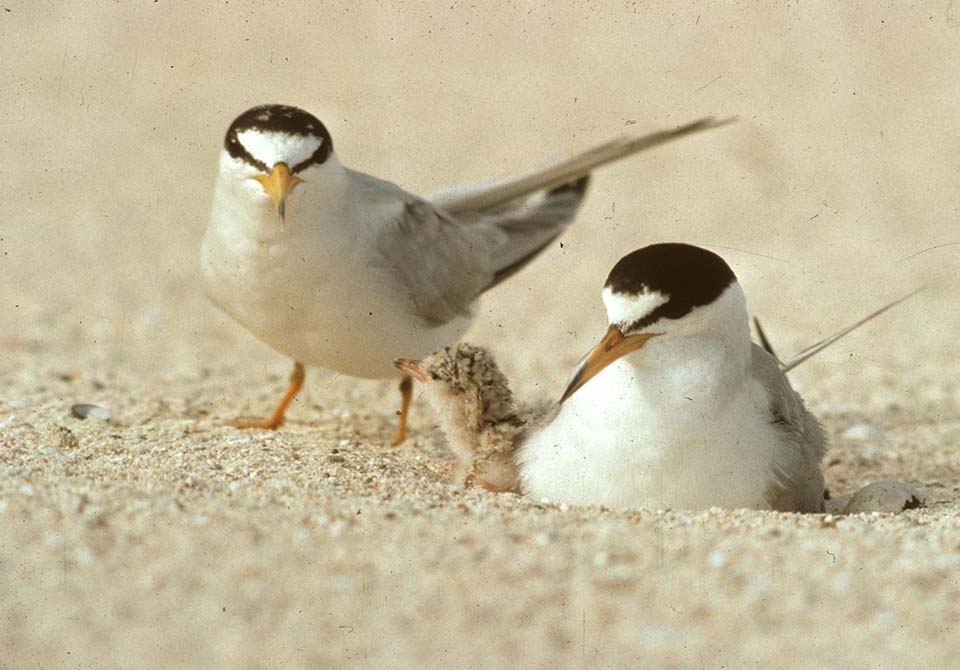
Most years, staff at the Buck Island Reef National Monument issue a warning in late April or early May to stay off the island while Least terns nest. The National Park Service on St. Croix has not said whether the birds are back, however, because all media requests, including relatively benign ones, have been routed to Washington, D.C., where a skeleton staff reportedly struggles to keep up, according to people not authorized to speak on the record.
The Source tried for three weeks to get information on the little, seasonal Buck Island birds, calling and writing the St. Croix offices and mainland headquarters but received no response — until Monday morning when a St. Croix park staffer called to say, in seemingly very-carefully chosen words, that they weren’t allowed to say.
Officials in Washington did not reply to repeated requests for information on staffing in the territory’s national parks — nor the terns. They also did not respond to questions about restricting access to information previously offered freely.
A public information officer at the Virgin Islands National Park on St. John could not comment on reports of staffing reductions but offered to pass the request to officials in Washington. Some media questions had always been routed to Washington, he said, but did not comment on whether that scope had changed in recent years.
Rafe Boulon, the former chief of resource management at the V.I. National Park and Coral Reef National Monument, said he was deeply concerned about staffing reductions and hoped it would be reversed soon.
“The current situation in our National Parks is very disturbing. Loss of employees has severely impacted both visitor services and resource protection,” Boulon said. “Reduced staff is hampering their efforts to protect and preserve our fragile natural and cultural resources. The inability of remaining NPS staff to communicate for fear of reprisal is great.”
President Donald Trump has reportedly asked park employees to report signs that “disparage” Americans.
Boulon said National Park staff — usually in the business of welcoming and educating visitors — were in a tough position.
“They are doing the best they can under the circumstances. We need to support them with understanding and hope that this current situation too shall pass soon. And hopefully not too much damage will have been done to our precious National Parks. The V.I. is not alone in this mess. People who care about our Parks need to help take care of our Parks,” he said.
Civil rights advocates spoke out a week ago on further restrictions on public access to information, claiming efforts to erase non-English language in park signage and booklets was unfair and dangerous.
Olivia Juarez, from the advocacy group GreenLatinos, said efforts to scrub facts from Salt River Bay National Historical Park and Ecological Preserve, the site of Europeans’ first recorded violent clash with Caribbean inhabitants, was to whitewash history.
“We’re here to draw attention to Interior Secretary Doug Burgum’s policies undermining truthful histories at our national parks and making public land access more dangerous for kids and for everybody,” Juarez said in a May 4 press conference. “Telling our full history truthfully is worth fighting for, no matter the odds.”
The group fears the Trump Administration’s push to purge signage critical of uglier aspects of American history — from slavery to the massacre of Indigenous people — could soon include removal of non-English language content in federal videos, and National Parks signage and books. Some non-English language scrubbing has already started, according to the parks advocacy group National Parks Traveler.
Angelo Villagomez, of the Center for American Progress, said the Trump administration was specifically targeting colonial history in the mainland south and the Caribbean — including pre-United States Spanish colonialism.
Targeting Salt River was similar to efforts to retell the history of the San Juan National Historic Site in Puerto Rico, where information on pre-European indigenous life and European contact were slated for change, Juarez said.
Boulon, whose family once owned property now part of the Virgin Islands National Park, said changing signage was akin to lying about the territory and its people.
“Attempts to rewrite our history is resulting in removal of signage and other information that relates to our cultural identity in the islands and nationally,” he said.
The push to change how National Parks present information, and what parts of history are told, came from a March 2025 executive order from Trump, ordering the Department of the Interior to “take action, as appropriate and consistent with applicable law, to ensure that all public monuments, memorials, statues, markers, or similar properties within the Department of the Interior’s jurisdiction do not contain descriptions, depictions, or other content that inappropriately disparage Americans past or living (including persons living in colonial times), and instead focus on the greatness of the achievements and progress of the American people or, with respect to natural features, the beauty, abundance, and grandeur of the American landscape.”
The goal, according to the order, was “to restore Federal sites dedicated to history, including parks and museums, to solemn and uplifting public monuments that remind Americans of our extraordinary heritage, consistent progress toward becoming a more perfect Union, and unmatched record of advancing liberty, prosperity, and human flourishing.”
In January, the administration reportedly pulled signs referencing displaced Native Americans at the Grand Canyon and glacial loss at Glacier National Park in Montana. The Sierra Club sued, saying the Trump administration was attempting to “whitewash history.”
In February, National Park conservation groups decried planned removal of Spanish language signs and those outlining the American institution of slavery and colonialism.
As for the terns, a Christiansted-based park representative referred the Source to the 2026 Superintendent’s Compendium, which states:
“Buck Island Reef National Monument has been designated as a critical habitat for seven species of threatened species of coral, including Elkhorn and Staghorn corals. The waters and bottom north of Buck Island are designated as non-recreational, and as a hazardous zone for these threatened and endangered coral species. The lands of Buck Island are designated critical habitat for the globally endangered St. Croix Ground Lizard (Ameiva polops) and is critical nesting habitat for four endangered sea turtle species, including hawksbill (Eretmochelys imbricata), for Least terns (Sternula antillarum), and other bird species. The new draft General Management Plan has designated the north side of Buck Island Reef National Monument as a non-recreational area and is listed as hazardous zone for these threatened coral species.”